Best Cloud Financial Management Software in 2026: Top 7 Tools Reviewed and Compared
14 min read
Tools
FinOps
Table of Contents
This guide compares the top cloud financial management software in 2026 to help you cut through that. Here's what we cover 1. Amnic, 2. ProsperOps, 3. CloudZero, 4. Apptio Cloudability, 5. nOps, 6. Vantage.sh, 7. Finout
Your cloud bill arrived. Engineering says it was a Kubernetes autoscaling event. Finance needs chargeback by the business unit. The FinOps lead is already on their third dashboard trying to reconcile both. Same costs, three different tools and nobody agrees on the number.
Best Cloud Financial Management Software in 2026
Amnic - One platform for CFO, CTO and SRE to see the same cloud bill across AWS, Azure, GCP and Kubernetes, without write access. Context-aware AI agents (X-Ray, Insights, Governance, Reporting) automate anomaly detection, root-cause analysis, tag enforcement and persona-specific reporting in plain language, in under 30 seconds.
ProsperOps - For AWS heavy teams that want Reserved Instances and Savings Plans managed autonomously, without a FinOps analyst owning the spreadsheet. It runs commitment purchasing on your behalf and charges only on savings delivered.
CloudZero - For SaaS engineering teams that need cloud spend mapped to product features and cost per customer metrics, not just service level totals. Best in class unit economics attribution for product-led organizations.
Apptio Cloudability - For enterprise finance teams that need audit-ready chargeback reporting, IT financial management, and multi-cloud cost close in a single platform aligned to existing finance workflows.
nOps - For AWS first teams that want automated commitment management combined with Kubernetes cost allocation, without standing up a dedicated FinOps team to manage it.
Vantage.sh - The fastest path to a working multi-cloud cost dashboard with a free tier and no sales process. Self-service onboarding in minutes, useful for engineering teams that need visibility today.
Finout - For engineering teams that want to unify cloud costs with SaaS tool spend (Datadog, Snowflake, MongoDB Atlas, and others) in one FinOps view without running separate audits.
What Is Cloud Financial Management Software?
Cloud financial management software connects your cloud bill to the teams, products and decisions that drive it. Instead of a single monthly invoice from AWS, Azure, or GCP, you get a breakdown that tells you which team, product, or customer is responsible for each dollar spent, where the waste sits and what to do about it.
At the infrastructure level, CFM platforms pull raw billing data from cloud provider APIs, normalize it across accounts, regions and services and apply cost allocation logic through tags, account hierarchies and custom mapping rules. The output is a cost model that maps infrastructure spend to organizational constructs: teams, products, environments and customers.
Core capabilities include anomaly detection on cost time series, Reserved Instance and Savings Plans portfolio management, Kubernetes cost management at the pod and namespace level, budget enforcement through policy rules and reporting pipelines for different stakeholders.
For FinOps practitioners, engineering leaders and finance teams managing material cloud spend, the real problem is alignment. Finance, engineering and leadership all look at different dashboards, arrive at different conclusions and argue about whose numbers are right. CFM software solves this by giving every stakeholder a single, reconciled view of cloud costs in terms they can act on. When it works well, FinOps stops being a monthly firefighting exercise and starts running in the background.
Quick Comparison: Best Cloud Financial Management Software (2026)
Tool | Best For | Cloud Coverage | AI and Automation | Pricing Model | Free Trial |
|---|---|---|---|---|---|
Amnic | Multi-cloud teams needing AI-native FinOps with no write access | AWS, Azure, GCP, K8s, Alibaba, Oracle | AI agents: X-Ray, Insights, Governance, Reporting | 0.25% to 1% of cloud spend | 1 month free trial |
ProsperOps | AWS teams automating RI and Savings Plans | AWS only | Autonomous commitment management | % of savings delivered | No |
CloudZero | SaaS companies needing unit economics and cost per customer | AWS, Azure, GCP | Anomaly alerts, cost allocation engine | Custom/enterprise pricing | Demo only |
Apptio Cloudability | Enterprise finance teams and IT financial management | AWS, Azure, GCP, on-prem | Automated chargeback, forecasting | Custom/enterprise pricing | Demo only |
nOps | AWS-heavy teams wanting commitment automation and K8s visibility | AWS-first, limited Azure/GCP | Commitment advisor, K8s cost allocation | % of savings delivered + platform fee | Free tier (limited) |
Vantage.sh | Engineering teams wanting fast self-service visibility | AWS, Azure, GCP, K8s, 15+ providers | Cost reports, anomaly detection | Per-seat or % of spend | Free tier available |
Finout | Teams unifying cloud and SaaS tool costs | AWS, Azure, GCP + SaaS integrations | Anomaly alerts, MegaBill view | Custom pricing | Demo only |
Top 7 Best Cloud Financial Management Software Tools of 2026
1. Amnic
Best for: Mid-market and enterprise teams that need the CFO, CTO, SRE and FinOps lead all looking at the same cloud bill from the same platform, without granting write access to any vendor. If you're running across two or more cloud providers, managing Kubernetes at any real scale and your team spends hours each week on manual reporting or anomaly investigation, Amnic is built precisely for this.
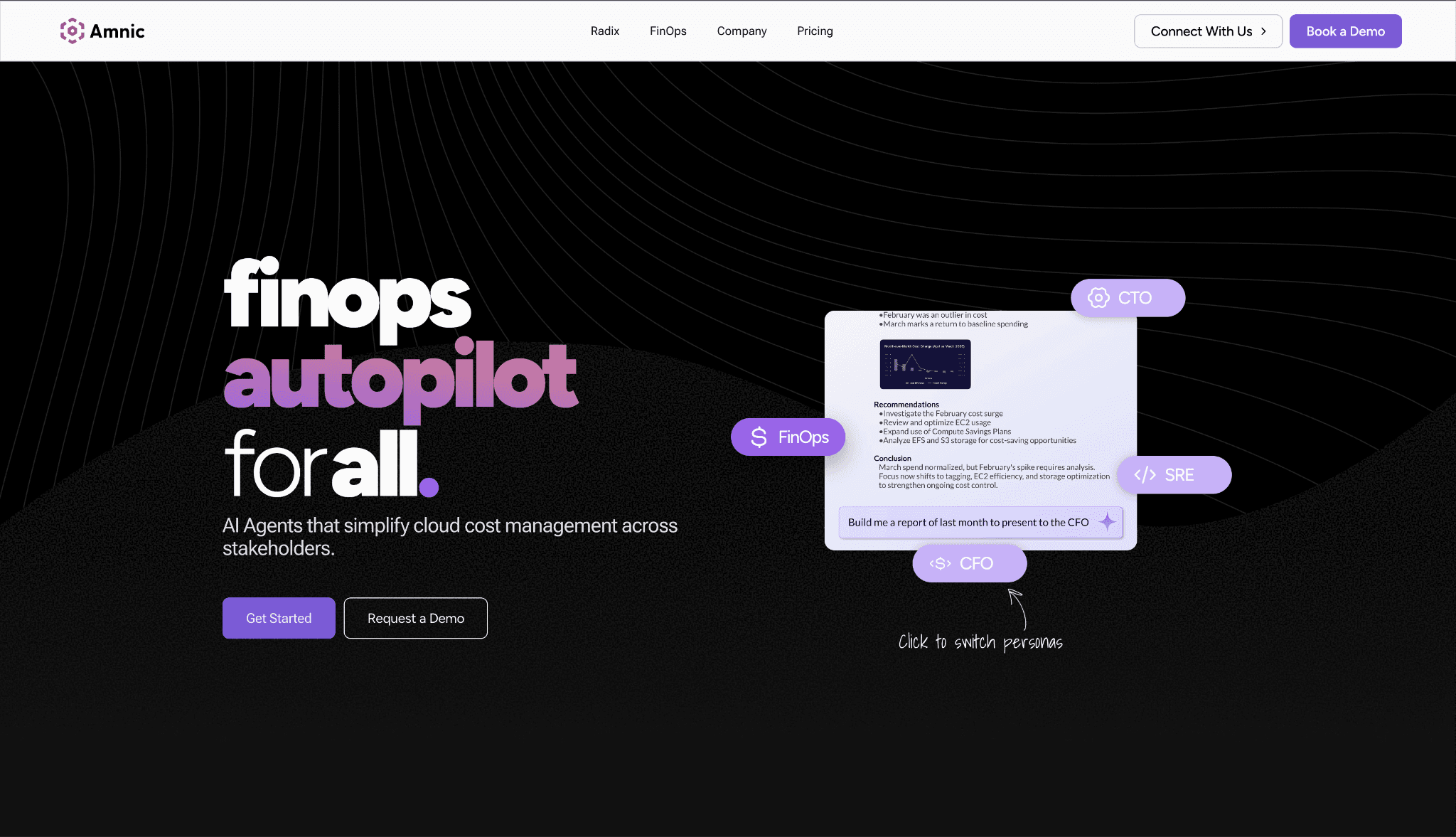
Amnic is a FinOps OS powered by context-aware AI agents. It connects to your cloud billing data with read-only permissions and delivers role-specific intelligence to every team in your organization, without needing a FinOps analyst to translate findings between engineering and finance.
The four AI agents cover the workflows that consume most of a FinOps team's time. The X-Ray Agent benchmarks cloud spend and surfaces inefficiencies in under 30 seconds. The Insights Agent answers questions like "why did our AWS bill spike this week?" in natural language, tailored for a CFO or an SRE, not just a power user. The Governance Agent monitors budget drift, enforces tag hygiene, assigns ownership across environments and runs root cause analysis on anomalies. The Reporting Agent builds and schedules stakeholder-ready reports in seconds, no slide deck assembly required.
The underlying platform handles cost allocation down to the container, pod, PVC and DNS level for Kubernetes. Virtual tags retroactively normalize inconsistent native tagging without touching any infrastructure. Persona-specific dashboards for CTO, FinOps, SRE and CFO come pre-built and ready on day one. Onboarding takes about five minutes.
Key Features:
Cost Attribution - ties every dollar to the app, service, team, or business unit that generated it across AWS, Azure, GCP, Oracle and Alibaba, without depending on native tag completeness.
Cost Allocation: maps cloud spend to teams and services using business logic rules, not just raw cloud tags
Virtual Tags: applies consistent attribution labels across all five cloud providers and Kubernetes without touching native tag configurations useful when tagging hygiene is below 70%
Unit Economics: measures cloud ROI at the transaction, customer, or service level so finance and product teams have cost per unit numbers they can act on, not just aggregate totals
Cost Views - flexible, multi-dimensional analysis layer that lets any stakeholder slice costs the way their role demands.
Cost Analyzer: filters spend across provider, service, team, region and custom dimension simultaneously with real-time surge detection
Cost Dashboards: detailed cost breakdowns and trend analysis in role-appropriate views, updated in real time rather than batched nightly
Cost Control - governance and budget management layer that catches problems before the end-of-month review.
Budgeting: set spend thresholds at the team, project, or service level and get alerts when burn rates are trending over
Forecasting: ARIMA-powered spend prediction that accounts for seasonality and growth patterns, not just a linear extrapolation of last month
Anomaly Detection: identifies unusual cost patterns, runs root cause analysis and routes alerts via Slack, Teams, or email to the team that owns the spend
Reporting: automated, role-based reports scheduled for CFO, CTO, FinOps lead and SRE without manual dashboard exports
Recommendations: rightsizing and commitment suggestions ranked by savings impact, with enough context to act on them rather than just review them
Utilization - resource efficiency layer covering compute, AI and Kubernetes alongside traditional cloud billing.
Kubernetes Cost Management: cluster-level utilization metrics for compute, memory and network with rightsizing recommendations, covering the gap between the cloud bill and actual container usage
AI Token Management: tracks LLM API spend at the model, team and product level across OpenAI, Anthropic, Bedrock and Vertex so AI costs get attributed like any other service rather than pooled into a single line item
Inventory Management: maintains a live catalog of active resources across accounts and regions, flagging idle, orphaned and untagged assets before they compound into waste
FinOps AI Agents - four purpose built agents (X-Ray, Insights, Governance, Reporting) that let finance and engineering query cost data in plain language, automate tag hygiene checks and schedule persona-specific reports without touching the dashboards.
Read-only architecture - the platform reads billing data and resource metadata but never writes to production infrastructure. That removes the security review cycle that delays write access tools by several weeks in most enterprise procurement processes. See Amnic's security page for full details.
Five cloud native - AWS, Azure, GCP, Oracle and Alibaba in a single cost view alongside Kubernetes. Most tools on this list cover three providers and treat the others as an add-on.
What customers say:
"Using Amnic has been nothing short of transformational. The platform is able to analyze our cloud costs at a depth that would take us several hours, if not days to understand better. We are able to spend a few hours each week and save costs that run into thousands of dollars"
Ajeesh Achuthan, Co-Founder and CTO, Open Financial (30% reduction in overall cloud costs)
"Amnic's astute recommendation engine helped us reduce our cloud bill through optimization of Network and CloudWatch costs. A key differentiator for Amnic remains its strong team which has channelized its significant experience in building a product uniquely suited to address pain points of fast-growing companies"
Mayank Bhola, Co-Founder and Head of Products, LambdaTest (30% reduction in NAT and CloudWatch costs)
Customer results:
Customer | Result |
|---|---|
30% reduction in NAT and CloudWatch costs | |
40% reduction in compute costs, 50% reduction in S3 storage costs | |
50% reduction in Kubernetes cluster costs | |
33% reduction in EC2 costs | |
30% reduction in overall cloud costs | |
20% reduction in cloud infrastructure costs |
Pricing: 0.25% to 1% of monthly cloud spend. One month free trial for the startup tier, no credit card required. Enterprise pricing includes dedicated Amnic cost experts.
Pros:
Agentless, read-only deployment means no security review delay and no write access risk to your infrastructure
AI agents cover anomaly detection, governance, reporting and root cause analysis in one platform rather than four separate tools
Multi-cloud and Kubernetes coverage from day one, including Alibaba Cloud and Oracle Cloud
Persona-specific views for CFO, CTO, SRE and FinOps come pre-built, not configured
SOC 2 Type II, ISO 27001 and GDPR certified
One month free trial, no credit card required, 5-minute onboarding
Cons:
Newer platform compared to legacy tools like Apptio, so some enterprise procurement teams want more reference accounts in specific verticals
At 0.25% to 1% of cloud spend, costs accumulate for very large footprints
Commitment automation (autonomous RI and Savings Plans purchasing) is not part of the feature set; Amnic recommends actions but does not execute purchases on your behalf
Start your free Amnic trial - no credit card, no write access required
2. ProsperOps
Best for: AWS-focused engineering and finance teams whose primary cost problem is commitment underutilization, not multi-cloud complexity. If you're running significant EC2, Lambda or Fargate workloads and your Effective Savings Rate is below 30%, ProsperOps handles commitment purchasing continuously without requiring any FinOps headcount to operate it.
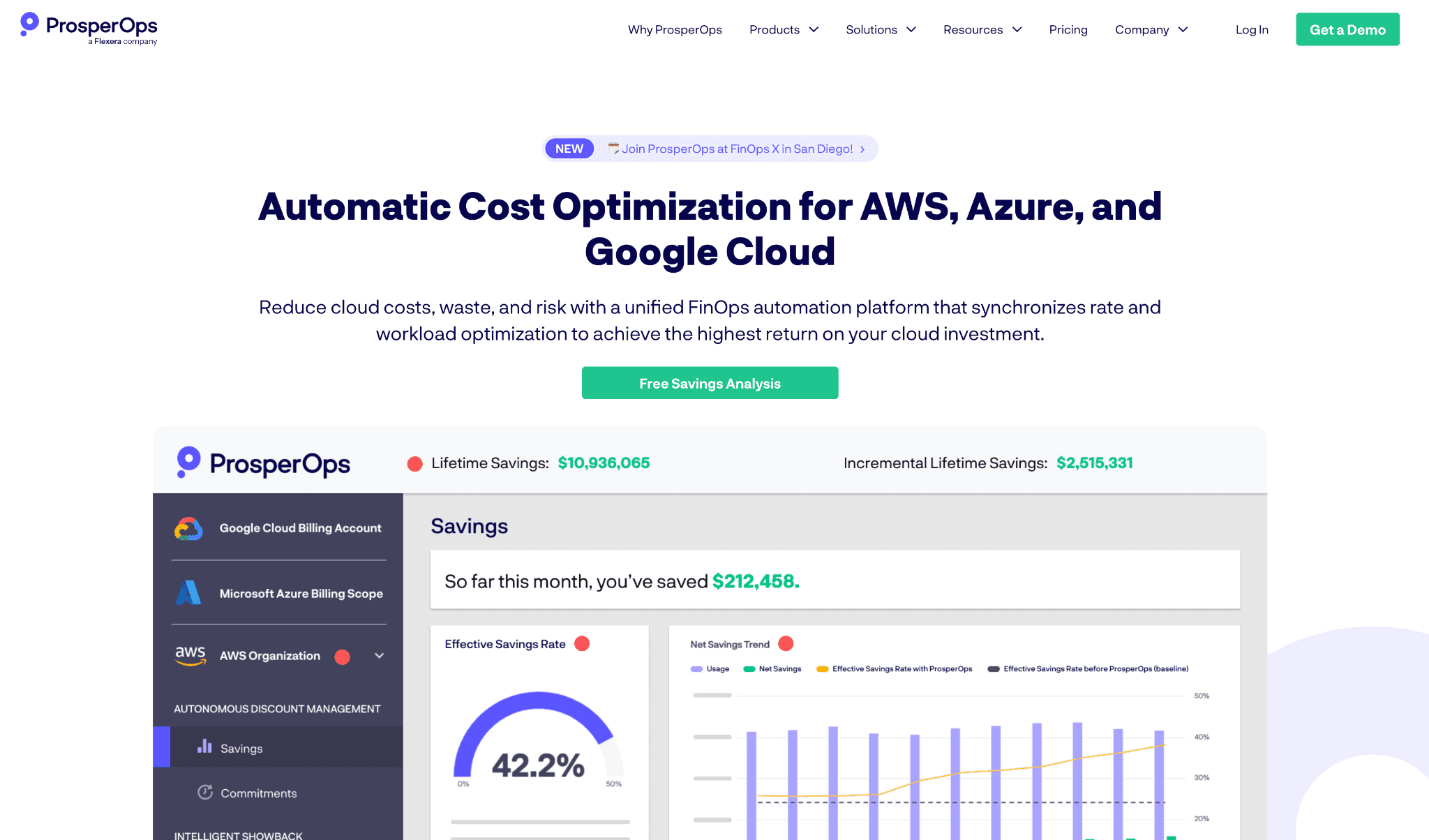
ProsperOps is a cloud commitment management platform that autonomously handles Reserved Instance and Savings Plans purchasing across AWS, Microsoft Azure, and GCP. It monitors your usage continuously and purchases, modifies and exchanges Reserved Instances and Savings Plans autonomously to maximize your Effective Savings Rate. It is not a cost visibility tool. It does not give you dashboards or anomaly alerts. The product does one thing: it handles the commitment portfolio so you don't have to.
The platform requires write access to execute commitment transactions on your behalf, which is worth noting during security review. The pricing model is straightforward: a percentage of savings delivered, nothing if savings don't materialize.
Key Features:
Autonomous RI and Savings Plans purchasing, modification, and exchange across EC2, Lambda and Fargate
Effective Savings Rate tracking as the primary performance metric
Risk-managed portfolio approach that rebalances continuously against actual usage to avoid over-commitment
Automated rightsizing recommendations for compute fleet
Commitment analytics and coverage reporting for finance teams
Available on AWS Marketplace for consolidated billing
Pricing: Percentage of savings delivered. No platform fee at the base tier. Enterprise pricing available for larger AWS footprints.
Pros:
Fully autonomous once set up; no ongoing FinOps work required to capture savings
Performance-based pricing: if it doesn't save you money, you pay nothing
A risk-managed approach specifically designed to avoid the over-commitment trap
No in-house FinOps expertise needed to get value from it
Cons:
AWS only; no support for Azure, GCP, or multi-cloud environments
Requires write access to your AWS account to execute purchases
No broader cost visibility, dashboarding, or allocation capabilities
Not a standalone FinOps platform; needs to be paired with a visibility tool if reporting or governance are also requirements
3. CloudZero
Best for: SaaS companies and product-led engineering teams that need cloud spend mapped to features, customers and product lines, not just service level or account level totals. If your pricing decisions or gross margin analysis depend on knowing the per customer infrastructure cost, CloudZero is the tool built for that specific problem.
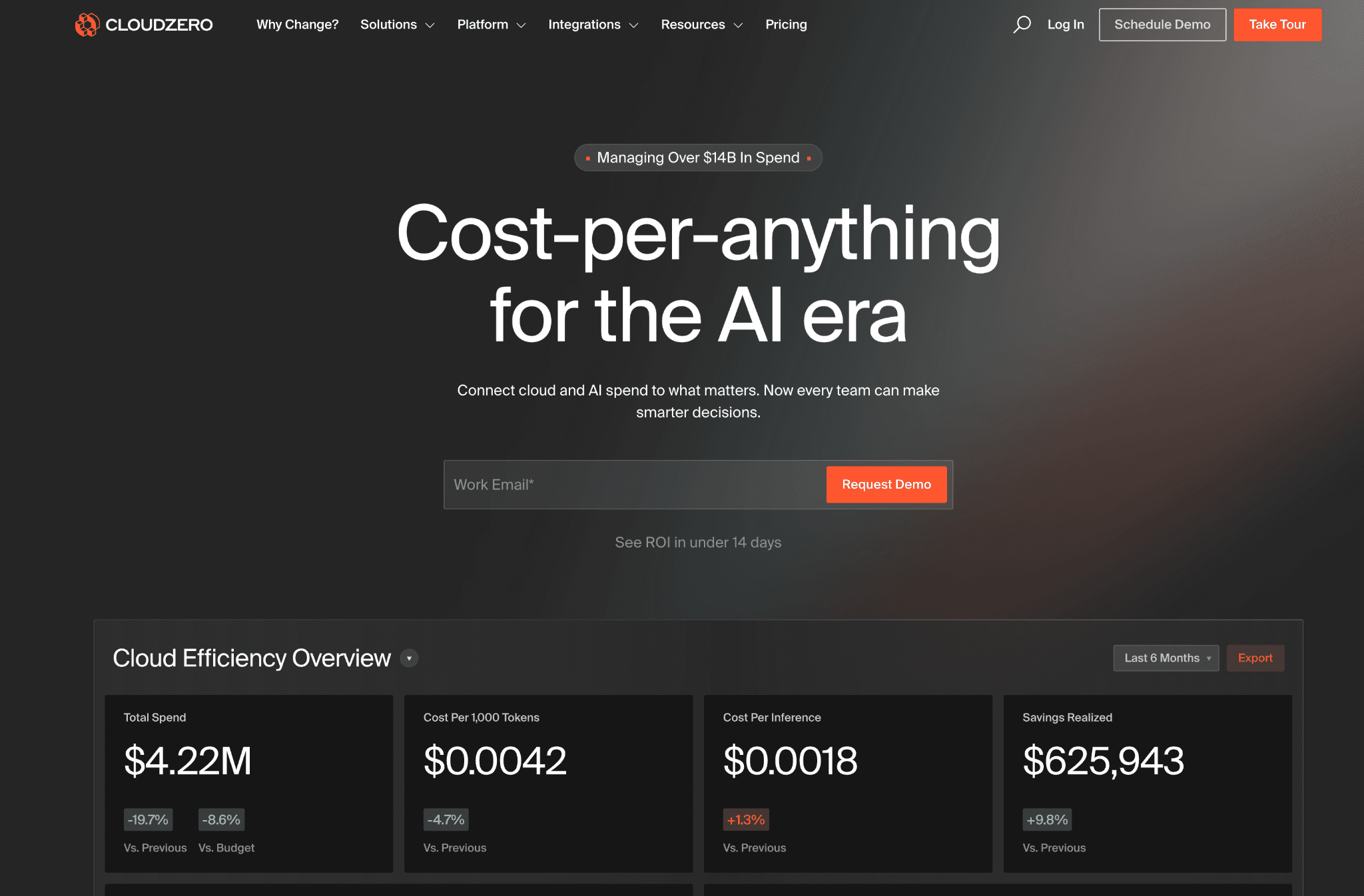
CloudZero calls its approach Cost Intelligence: the idea that cloud spend should make sense in business terms, not just infrastructure terms. Its core differentiator is an allocation engine that can map raw cloud costs to engineering and business constructs (features, microservices, customer cohorts, revenue segments) even when native tagging is incomplete. This requires setup work upfront, but the output is a unit economics view that most other platforms cannot replicate.
It supports AWS, Azure and GCP and integrates with Datadog, Kubernetes and CI/CD pipelines to pull in the context that makes cost attribution meaningful.
Key Features:
Unit cost mapping: cost per customer, cost per feature, cost per transaction, built from raw cloud telemetry
Business-context cost allocation that works even without perfect native tagging
Anomaly detection with cost spike attribution to specific services or features
Cost reporting aligned to product and engineering team structure, not just cloud account hierarchy
Multi-cloud support across AWS, Azure and GCP
Integrations with Datadog, Kubernetes and CI/CD pipelines
Executive and team level cost reporting with customizable dimensions
Pricing: Custom enterprise pricing. Demo required. No self-service free tier.
Pros:
Best in class unit economics attribution for cost per customer and per feature spend
Can build meaningful allocation views even when native tagging is inconsistent
Strong fit for SaaS companies where pricing and margin analysis depend on per customer infrastructure cost
Multi-cloud support is genuine, not an afterthought
Cons:
Enterprise pricing with no self-service option or free tier; a demo is required to get a number
Allocation setup takes time to get right; expect several weeks before the data is reliable
If unit economics is not a core requirement, the platform's main advantage doesn't apply
Less AI automation and natural language querying compared to newer platforms
4. Apptio Cloudability
Best for: Large enterprise finance and IT teams that need audit-ready chargeback reports, multi-cloud cost close aligned to existing finance workflows and governance at the scale of 2,000+ employee organizations. Particularly relevant for companies with existing Apptio or IBM Technology Lifecycle Services relationships.
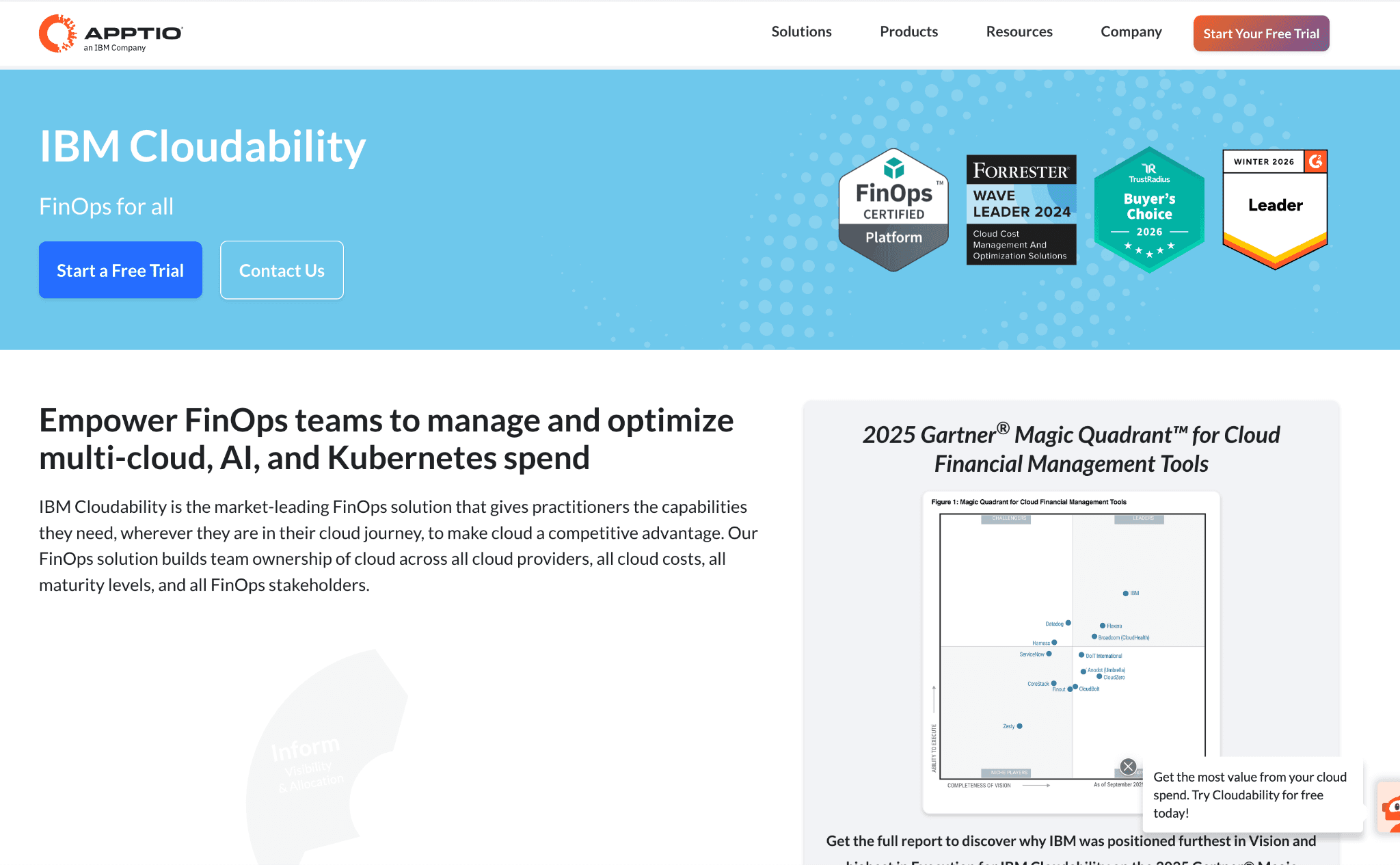
Apptio Cloudability, now part of IBM's IT financial management portfolio, is among the most established cloud cost management platforms available. It was designed for the finance and IT alignment use case: translating raw cloud spend into allocation models, showback and chargeback reports and budget vs actual variance analysis that finance teams can work with directly. It is not designed for engineering-first organizations that want fast, self-service access to cost data.
The platform covers AWS, Azure and GCP and can bring on-premises infrastructure costs into the same view, which is a meaningful differentiator for large enterprises running hybrid environments.
Key Features:
Chargeback and showback reporting aligned to existing finance and ITFM structures
Multi-cloud cost close: AWS, Azure, GCP consolidated in a single ledger
Budget vs. actual variance tracking with service level drill down
Reserved Instance and Savings Plans management across cloud providers
Tag governance and cost allocation policy enforcement at enterprise scale
Executive and board-level reporting dashboards
Integrations with ServiceNow, Apptio TBM and IBM ecosystem tools
On-premises infrastructure costs alongside cloud spend in one view
Pricing: Custom enterprise pricing. Contact IBM or Apptio directly for a quote. No free tier or self-service trial.
Pros:
The most mature ITFM-aligned platform on this list, with deep enterprise finance workflow support
Handles chargeback and showback at a level of detail that few platforms match
Can combine cloud and on-premises infrastructure costs in one reconciled view
Strong integration with ServiceNow and existing IBM toolchains
Cons:
Implementation is heavyweight; expect a multi-week professional services engagement before you see useful data
Built for finance and ITFM teams, engineering-first organizations typically find it too slow and complex
Custom enterprise pricing with long procurement cycles
The UI and product experience feel dated compared to newer platforms on this list
5. nOps
Best for: AWS-first engineering and FinOps teams that want Savings Plans managed automatically alongside Kubernetes cost visibility, without standing up a dedicated FinOps function. Strong for teams already running EKS who want to address both compute commitment efficiency and container cost allocation in the same tool.
nOps is an AWS-native FinOps platform that combines commitment automation (the ShareSave product) with cost visibility, rightsizing and Kubernetes cost allocation. It is primarily an AWS tool. Multi-cloud support exists but is not where nOps invests most of its product development.
ShareSave manages Savings Plans purchasing through a risk-pooled model, similar in concept to ProsperOps, while the broader nOps platform adds cost allocation, anomaly detection and K8s visibility in one interface.
Key Features:
ShareSave: automated Savings Plans and spot instance management for EC2 and EKS
Kubernetes cost allocation at pod, node and namespace level for EKS clusters
Rightsizing recommendations for EC2 instances backed by utilization data
Multi-account AWS cost visibility with tag-based allocation
Anomaly detection and budget alerting
Historical cost trend dashboards
Integration with Terraform and AWS Organizations for governance
Well Architected Framework alignment checks
Pricing: ShareSave charges a percentage of savings delivered. Platform tier pricing is available separately. Free tier for small AWS footprints.
Pros:
Combines AWS commitment automation and Kubernetes cost allocation in one product, which reduces the vendor count for AWS-heavy teams
Risk pooled Savings Plans model specifically addresses the over-commitment problem
Strong AWS Organizations and multi-account support
Free tier available for smaller AWS footprints
Cons:
Primarily AWS-focused; Azure and GCP capabilities are limited compared to multi-cloud first platforms
Requires write access for commitment purchases, which adds to the security review process
Less AI automation and natural language querying than AI native platforms
Can feel complex for smaller teams without a dedicated FinOps function to operate it
6. Vantage.sh
Best for: Engineering teams and startups that need a working multi-cloud cost dashboard with minimal setup and no mandatory sales conversation. The free tier and self-service onboarding make it the fastest path from zero visibility to basic cost reporting for teams that need to start somewhere today.
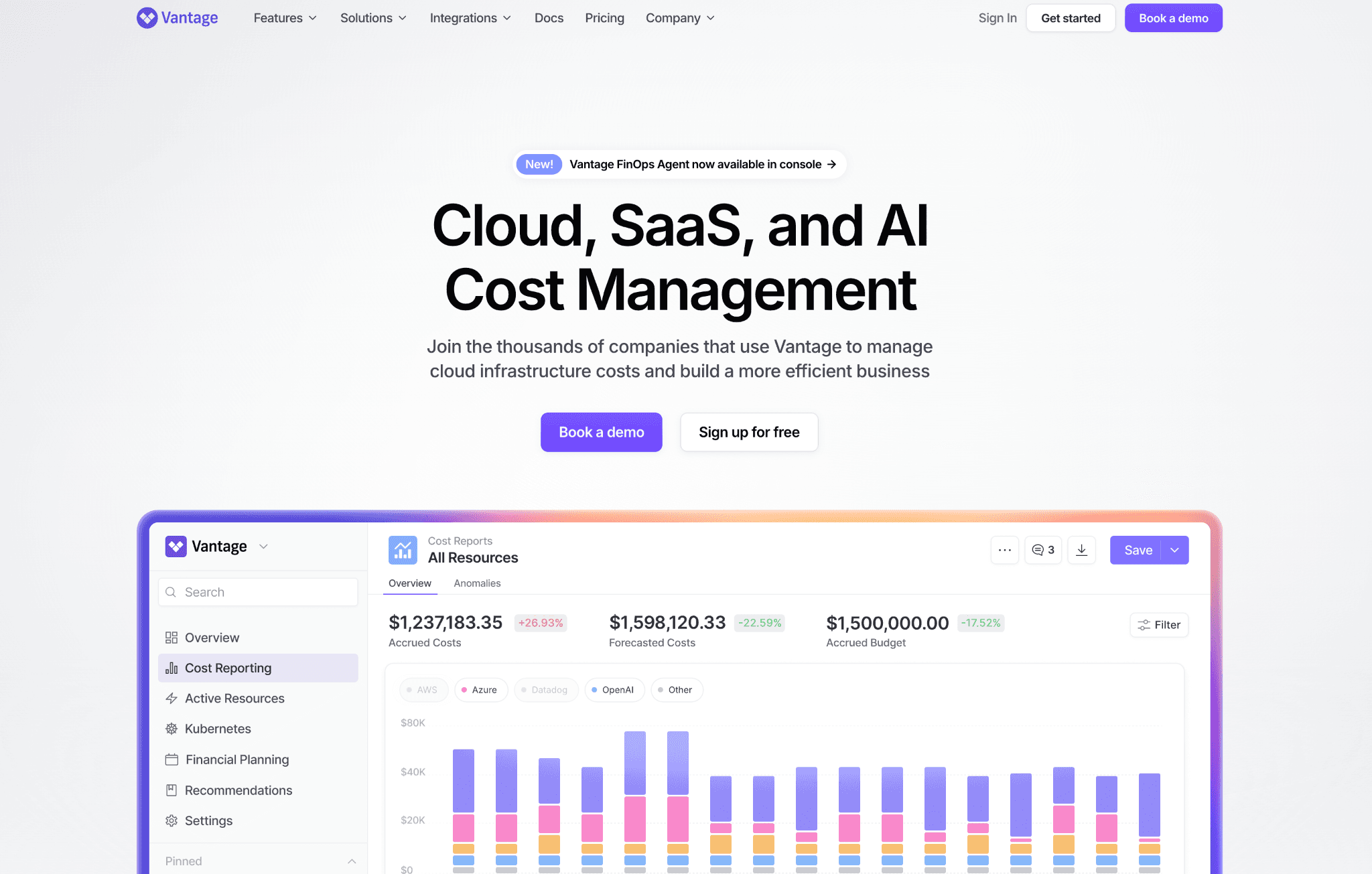
Vantage covers more cloud and SaaS providers than any other platform on this list: AWS, Azure, GCP, Kubernetes, Datadog, Fastly, MongoDB, Snowflake and over 15 others. The product's philosophy is accessibility. Cost reports are easy to build, anomaly alerts are straightforward to configure and the free tier gives real visibility without requiring a sales conversation first.
It is not the right tool if you need enterprise governance, AI automation, unit economics, or chargeback reporting. But for teams that need to get cost visibility working quickly without a heavyweight deployment, it is the most accessible option on this list.
Key Features:
Multi-provider cost reports covering AWS, Azure, GCP, K8s, Datadog, Snowflake, MongoDB, Fastly and 15+ others
Cost report builder with filters, groupings and saved views
Anomaly detection with configurable cost threshold alerts
Savings recommendations: RI, Savings Plans, rightsizing
Kubernetes cost allocation at the namespace and workload level
Per-seat pricing with a functional free tier
Self-service onboarding with no sales call required
Terraform provider for IaC-friendly governance workflows
Pricing: Free tier available with limited providers and users. Per-seat and usage-based paid plans. No sales call required for most tiers.
Pros:
Broadest provider coverage on this list; 15+ cloud and SaaS services connected
Free tier available with no sales process required
Fastest time to visibility for teams starting from zero
Clean, intuitive interface that engineering teams adopt without training
Cons:
Not designed for enterprise governance, audit-ready chargeback, or complex allocation models
No AI agents or natural language cost querying
Less depth for unit economics or per customer cost attribution compared to CloudZero
Free tier has meaningful limits on users and provider connections
7. Finout
Best for: Engineering and FinOps teams where third-party SaaS tool costs (Datadog, Snowflake, MongoDB Atlas, Confluent) represent a meaningful share of the overall infrastructure budget alongside cloud spend and you want both in one view without running separate audits.
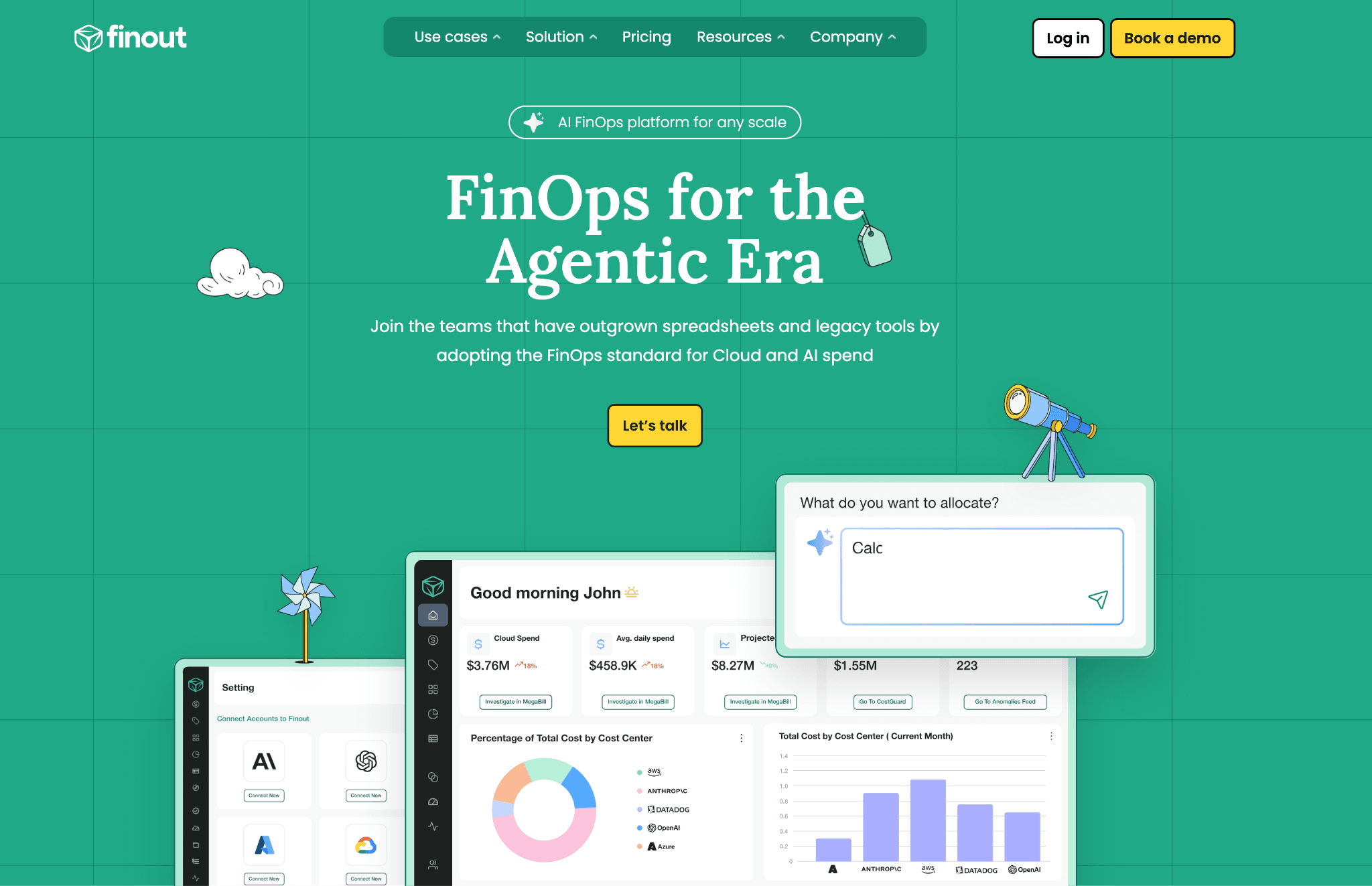
Finout is built around the MegaBill concept: a single cost ledger that brings together AWS, Azure, GCP, Kubernetes and third-party SaaS tool costs in one view. For engineering teams where Datadog or Snowflake spend rivals EC2 costs, this removes a category of manual reconciliation work that most platforms leave unaddressed.
The platform handles cost allocation, anomaly detection, budget alerts and showback and chargeback across all connected cost sources, not just cloud providers.
Key Features:
MegaBill: unified view combining AWS, Azure, GCP, K8s and SaaS tool costs in one dashboard
SaaS integrations: Datadog, Snowflake, MongoDB Atlas, Confluent, Fastly and others
Virtual tagging to normalize cost allocation across both cloud and SaaS sources
Anomaly detection across cloud and SaaS spend categories
Showback and chargeback reports by team, product, or business unit
Budget alerts with Slack and PagerDuty integrations
Cost allocation that works without requiring perfect native tagging
Kubernetes cost visibility at the namespace and workload level
Pricing: Custom pricing based on cloud and SaaS spend covered. Demo required for a quote.
Pros:
The MegaBill is a genuinely unique capability; no other platform on this list unifies cloud and SaaS tool costs as cleanly
Useful for teams where Datadog or Snowflake spend is large enough to distort cloud-only cost views
Virtual tagging works across cloud and SaaS sources, not just cloud providers
Reasonable Slack and PagerDuty integration for alert routing
Cons:
Smaller team with less enterprise-scale validation than Apptio or CloudZero
Custom pricing with no publicly available rates; a demo is required to get a number
If SaaS tool costs aren't a significant line item for your team, the core value proposition weakens considerably
Less AI automation compared to Amnic
How to Choose the Right Cloud Financial Management Software
You don't need to evaluate all seven platforms. Three questions narrow it down quickly: what's your cloud footprint, who owns the FinOps function at your company and what problem are you trying to solve in the next 90 days?
You need AI native FinOps across multi-cloud and Kubernetes -Amnic
If you're running across two or more cloud providers, managing Kubernetes at scale and your team spends real hours each week on manual reporting or anomaly investigation, Amnic is the right fit. The AI agents automate the workflows that consume most FinOps time. The agentless, read-only deployment means no security review delay. And the persona-specific views mean your CFO, CTO and SRE all get value from the same platform without each team running a different tool.
You are AWS only and commitment underutilization is your primary problem - ProsperOps or nOps
If 80% of your cloud bill is AWS and your Effective Savings Rate is below 30%, ProsperOps is the fastest path to automated commitment optimization with essentially no operational overhead. If you also run EKS and want Kubernetes cost allocation alongside commitment management, nOps covers both in one platform.
You need cost per customer and unit economics for a SaaS product - CloudZero
If your engineering and product teams need to understand the cloud cost of a specific feature, customer cohort, or product line and service-level billing data isn't enough, CloudZero's unit economics attribution is best in class for this use case.
You are a large enterprise aligning cloud costs to finance and IT financial management - Apptio Cloudability
If your finance team needs chargeback reports that fit into existing ITFM workflows, audit-ready allocation models and multi-cloud cost close aligned to monthly close cycles, Apptio Cloudability is the most mature platform for this use case, particularly in IBM ecosystem environments.
You need fast visibility today with no procurement friction - Vantage.sh
If you need a working cost dashboard across multiple providers this week and can't wait for an enterprise procurement cycle, Vantage's free tier and self-service onboarding deliver multi-cloud visibility faster than any other platform on this list.
You want unified cloud and SaaS cost visibility - Finout
If Datadog, Snowflake, or other SaaS tools represent a meaningful portion of your infrastructure budget and you want one view across all of it, Finout's MegaBill is the most practical solution for this specific gap.
The AI Native FinOps Shift: Why 2026 Is Different
Every platform on this list has anomaly detection. Most have some form of automated recommendations. What's actually changed in 2026 is the emergence of AI agents that operate across the full FinOps lifecycle: not just alerting, but diagnosing, reporting, governing and explaining in natural language to whoever needs to act.
The old FinOps workflow looked like this: a cost spike appears, a FinOps analyst opens Cost Explorer, manually traces the spike to a service, exports a CSV, builds a Slack message and waits for an engineer to confirm. The cycle takes hours, sometimes days. With AI agents, the same workflow runs in under 30 seconds, with root cause attribution, business context and a recommended action delivered to the right stakeholder in the language they actually use.
The platforms that lead in 2026 are not the ones with the most dashboards. They're the ones that eliminate the need to open a dashboard for routine FinOps work entirely.
Amnic's X-Ray, Insights, Governance and Reporting agents are the most complete implementation of this model available today. The Amnic Assistant adds the ability to build custom agents for workflows specific to your environment, a capability no other platform on this list currently offers.
For teams still evaluating platforms, the right question to ask isn't "does this tool have anomaly detection?" It's "does this tool eliminate the manual work that comes after the alert?" That's the gap that separates AI-native FinOps from everything else.
Frequently Asked Questions
What is cloud financial management software?
Cloud financial management software helps organizations track, allocate, optimize and govern cloud infrastructure spending across AWS, Azure, GCP and Kubernetes. It replaces fragmented native billing tools with a unified view that serves engineering, finance and FinOps teams simultaneously, with cost allocation, anomaly detection, budget enforcement, forecasting and AI-driven automation.
What is the difference between cloud financial management and FinOps?
FinOps is the practice: a set of principles, processes and cross-functional behaviors for managing cloud costs responsibly. Cloud financial management software is the tool that makes FinOps practice sustainable at scale. You can run FinOps without a dedicated CFM platform using spreadsheets and native tools, but most organizations beyond 50 engineers find that manual approaches break down quickly as cloud footprints grow.
What features should I look for in cloud financial management software?
The essentials: multi-cloud cost visibility (AWS, Azure, GCP, K8s in one view), cost allocation by team, product, or BU, anomaly detection with root cause analysis, budget forecasting and alerting, Reserved Instance and Savings Plans management and chargeback and showback reporting. In 2026, AI-driven automation that surfaces insights without manual querying is increasingly the differentiator between leading platforms and legacy tools.
Can cloud financial management software work across AWS, Azure and GCP simultaneously?
Yes, most modern CFM platforms support multi-cloud cost consolidation. Amnic, CloudZero, Vantage, Apptio Cloudability and Finout all cover AWS, Azure and GCP. nOps is primarily AWS focused. ProsperOps is AWS only. If multi-cloud is a hard requirement, confirm native support for your specific cloud mix, particularly if you run Kubernetes or use providers like Alibaba Cloud or Oracle Cloud (currently supported by Amnic).
Who is responsible for cloud financial management in an organization?
Ownership is shared across functions. FinOps practitioners and leads own the tooling and the practice. Engineering teams own optimization and tagging. Finance owns budget approval and chargeback policy. Leadership (CTO, CFO) owns accountability at the business level. The problem most organizations hit is that each stakeholder uses different tools and sees different numbers, which is the core organizational problem that platforms like Amnic solve with persona-specific views built on a single shared data layer.
How much cloud spend do organizations typically waste?
FinOps Foundation benchmarks indicate that 20 to 30% of average cloud spend is recoverable waste: idle resources, over-provisioned instances, unattached storage and underused commitments. Amnic customer outcomes range from 20% to 50% reduction in targeted cost lines, depending on the maturity of existing FinOps practice at the time of deployment. Organizations with no prior cost management tooling tend to see the largest gains fastest.
How does AI change cloud financial management in 2026?
AI agents in FinOps automate the diagnostic and reporting workflows that previously required FinOps analysts to manually triage. Instead of opening a dashboard after an anomaly alert, investigating manually, translating findings for multiple stakeholders and scheduling a review, AI agents handle all of it in natural language, in real time, tailored to the recipient. In practice, this means organizations no longer need to scale FinOps headcount in proportion to cloud spend growth. Amnic's X-Ray, Insights, Governance and Reporting agents are the most complete implementation of this model currently available.
Which cloud financial management software is best for Kubernetes cost allocation?
Amnic provides the deepest Kubernetes cost management on this list: down to the container, pod, PVC and DNS level, across EKS, AKS and GKE, without requiring agent installation. nOps covers Kubernetes cost allocation for EKS-focused AWS teams. Vantage and CloudZero both provide namespace and workload-level K8s cost data. If Kubernetes cost management is a primary use case, Amnic's agentless, multi-cluster approach is the most comprehensive option available.
Ready to Fix Your Cloud Bill?
If your team is spending more time building cost reports than optimizing costs, or if your CFO and CTO are still looking at different numbers at the end of every month, the tooling gap is the root cause, not a process problem.
Start your free Amnic trial - no credit card, no write access required
Connect your AWS, Azure, or GCP account in five minutes. Get your first AI-powered cloud financial health check in under 30 seconds.
Better visibility and management into AI Tokens?
Start with a 30 day trial
Connect leading LLMs
24 hour time to value
Stay ahead of AI Spend

Make AI spend visible, controllable, and accountable.
Gain insights into your AI token costs at a team, customer, business unit and individual user level to measure and manage AI utilization.
Recommended Articles

8 Best Llama Cost Management Tools in 2026
Read More
8 Best Amazon Bedrock Cost Optimization Tools for 2026
Read More

7 Best Amazon Bedrock Cost Monitoring Tools
Read More

8 Best Gemini Cost Visibility Tools for 2026
Read More

7 Best Multimodal Cost Optimization Tools for 2026
Read More

5 Best Anthropic Cost Allocation Tools for 2026
Read More