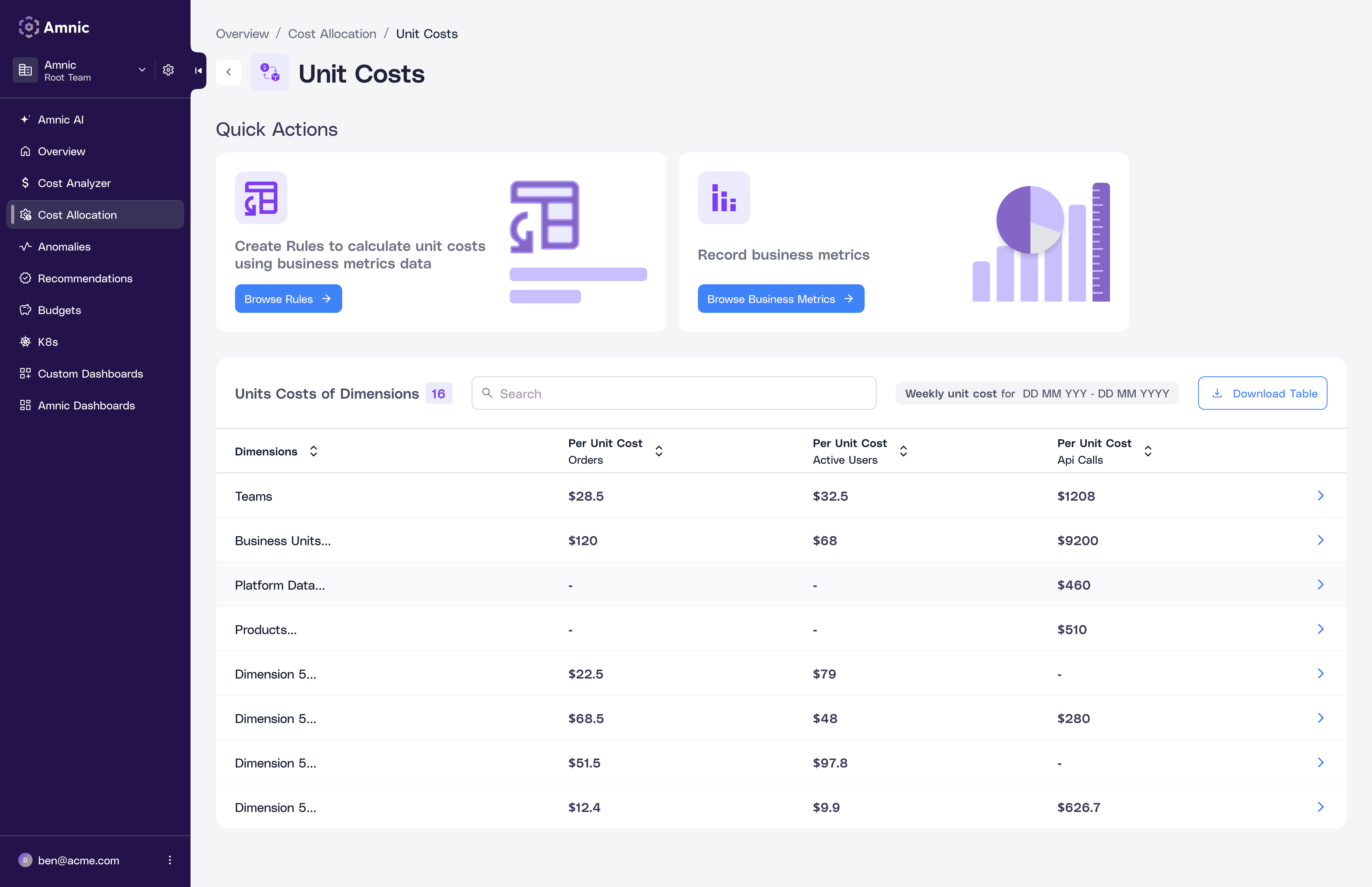









Allocate cloud costs to specific teams, product lines, cloud resources, and categorize expenses to measure unit economics more effectively. Understand customer and business patterns by benchmarking customer interactions with infrastructure costs.

Gain detailed visibility into how every cloud dollar contributes to the business’s financial and operational health. Enable finance teams and business leaders to track ROI in real-time by mapping cloud costs to services, applications, and teams. Align infrastructure spend with revenue outcomes and COGS to ensure lean, optimized operations across environments.

Get a unified view of the unit economics of the business and associated cloud spend. Understand and track costs per transaction, order, customer, and service. for a given timeframe for more efficient cloud usage going forward.
Easily integrate business metrics with cloud cost data using APIs. Automatically sync data from key platforms or manually import it for a unified view of cost per transaction, order, customer, or service.


Create Rules To Calculate Unit Costs Using Business Metrics Data
Define custom rules to calculate unit costs without any complex setup. Select key business metrics like daily transactions, allocate them to relevant elements (e.g., teams or applications), and apply filters to refine cost attribution.

Record Business Metrics
Easily record and track business metrics by creating meters for key data points like daily transactions. Define the metric name, set frequency, and add relevant labels for granular insights. Leverage API endpoints to automate data ingestion, updates, and retrieval for accurate cost analysis and reporting.



Benchmark maturity,close governance gaps,
and drive ROI in under 20 minutes








Frequently Asked Questions
1. What are cloud unit economics and why should I track them?
Cloud unit economics measure the infrastructure cost behind every business unit that matters, think cost per transaction, per order, per customer, or per API call. Tracking them turns your cloud bill from a black box into a clear story about profitability, margins, and ROI. It's how modern finance and engineering teams prove that every dollar spent on the cloud is actually driving revenue.
2. How does Amnic calculate unit costs without heavy engineering work?
In just two simple steps. First, you define rules that tie business metrics (like daily transactions or active users) to cloud cost elements such as teams, services, or applications. Second, you record those metrics through meters or API endpoints for automated ingestion. No complex pipelines, no massive tech lift, just clean unit cost visibility in minutes.
3. Can I connect my business data and cloud cost data in one view?
Yes. Amnic integrates business metrics with cloud cost data through APIs, so you can sync from platforms you already use or import manually. The result is a unified dashboard showing cost per transaction, order, customer, or service, all in one place. No more flipping between finance tools and cloud consoles to stitch the story together.
4. How do unit economics help improve margins and COGS?
By mapping cloud spend directly to revenue generating activities, you'll see exactly which products, customers, or services are profitable and which are quietly eating into margins. That clarity helps finance teams sharpen pricing, engineering teams right size infrastructure, and leadership make smarter calls about scaling, all while keeping COGS lean and predictable.
5. Who should use Amnic's Unit Economics feature?
It's built for cross functional alignment. CFOs and finance leaders get real time ROI tracking, engineering leaders spot cost inefficiencies per workload, FinOps teams benchmark usage patterns, and product managers understand the true cost of delivering each feature or service. One unit economics engine, powering smarter decisions across the entire business.