Cast AI Alternatives: 7 Platforms Compared by a Practitioner
11 min read
Comparisons
Table of Contents
Cast AI is a strong autonomous Kubernetes optimizer, but it is not the only one teams shortlist. The seven platforms covered in this guide are 1. Amnic, 2. ScaleOps, 3. PerfectScale, 4. Kubecost, 5. CloudChipr, 6. nOps and 7. CloudZero. This guide sorts them by allocation depth, automation, AI cost coverage and pricing transparency.
The best Cast AI alternative tools:
Amnic: Multi-cloud FinOps platform with Kubernetes allocation, AI spend coverage and a quick self-serve audit.
ScaleOps: Autonomous Kubernetes pod and node resource management, closest direct peer to Cast AI on automation.
PerfectScale: AI rightsizing focused on workload-level Kubernetes recommendations, now part of DoiT.
Kubecost: Granular Kubernetes cost visibility with OpenCost lineage, now part of IBM.
CloudChipr: Multi-cloud FinOps with Kubernetes utilization analysis and idle-resource automation workflows.
nOps: Automation-first platform with commitment management plus Kubernetes optimization.
CloudZero: Unified view of Kubernetes spend alongside non-Kubernetes cloud cost, allocation-oriented.
Why teams look for Cast AI alternatives
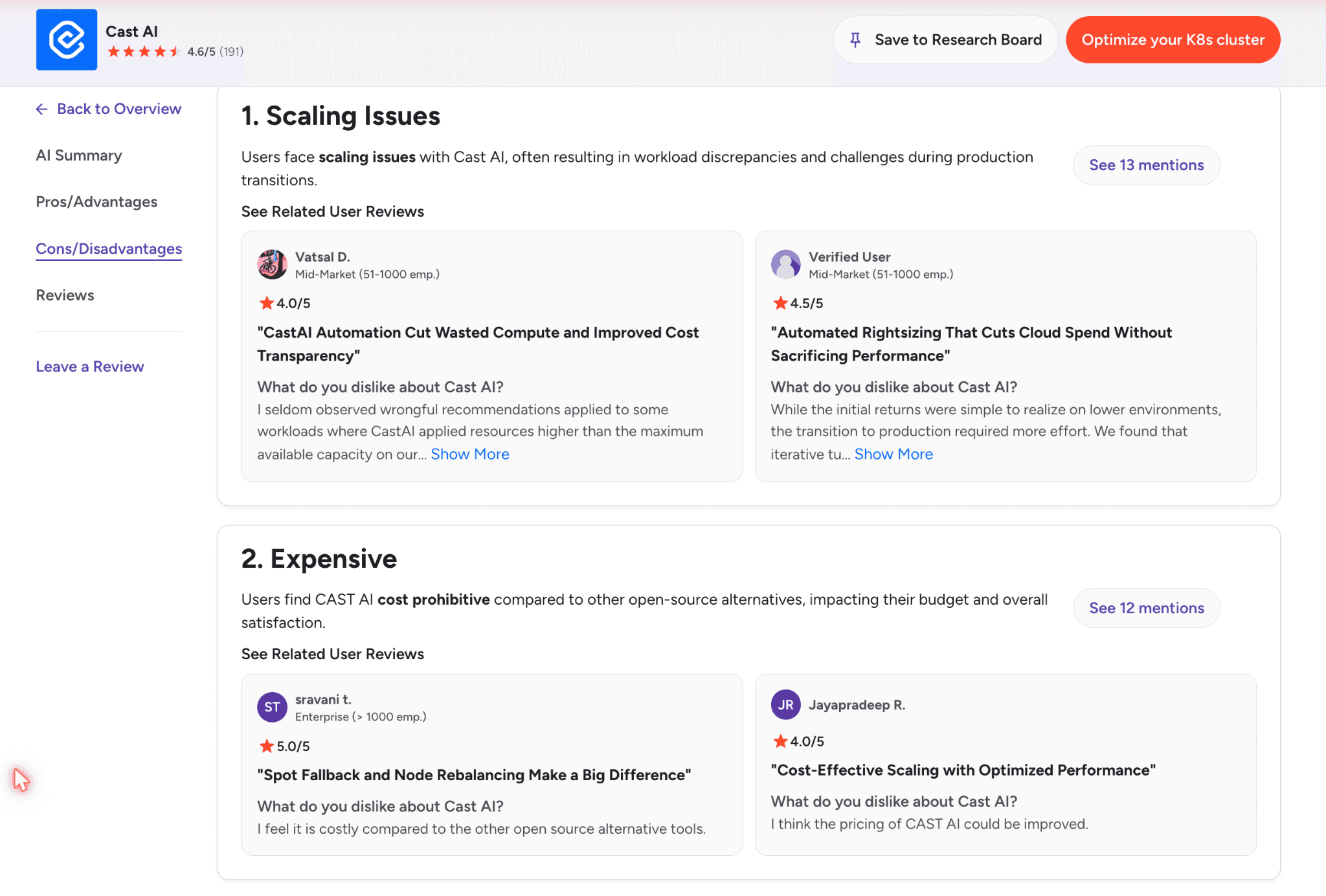
Cast AI does one thing well: it replaces the native Kubernetes autoscaler and rebalances clusters in real time. Teams who outgrow that scope, or who hit friction during rollout, tend to start a vendor review. The pain points below come from public customer reviews on G2 and from Cast AI's own product documentation.
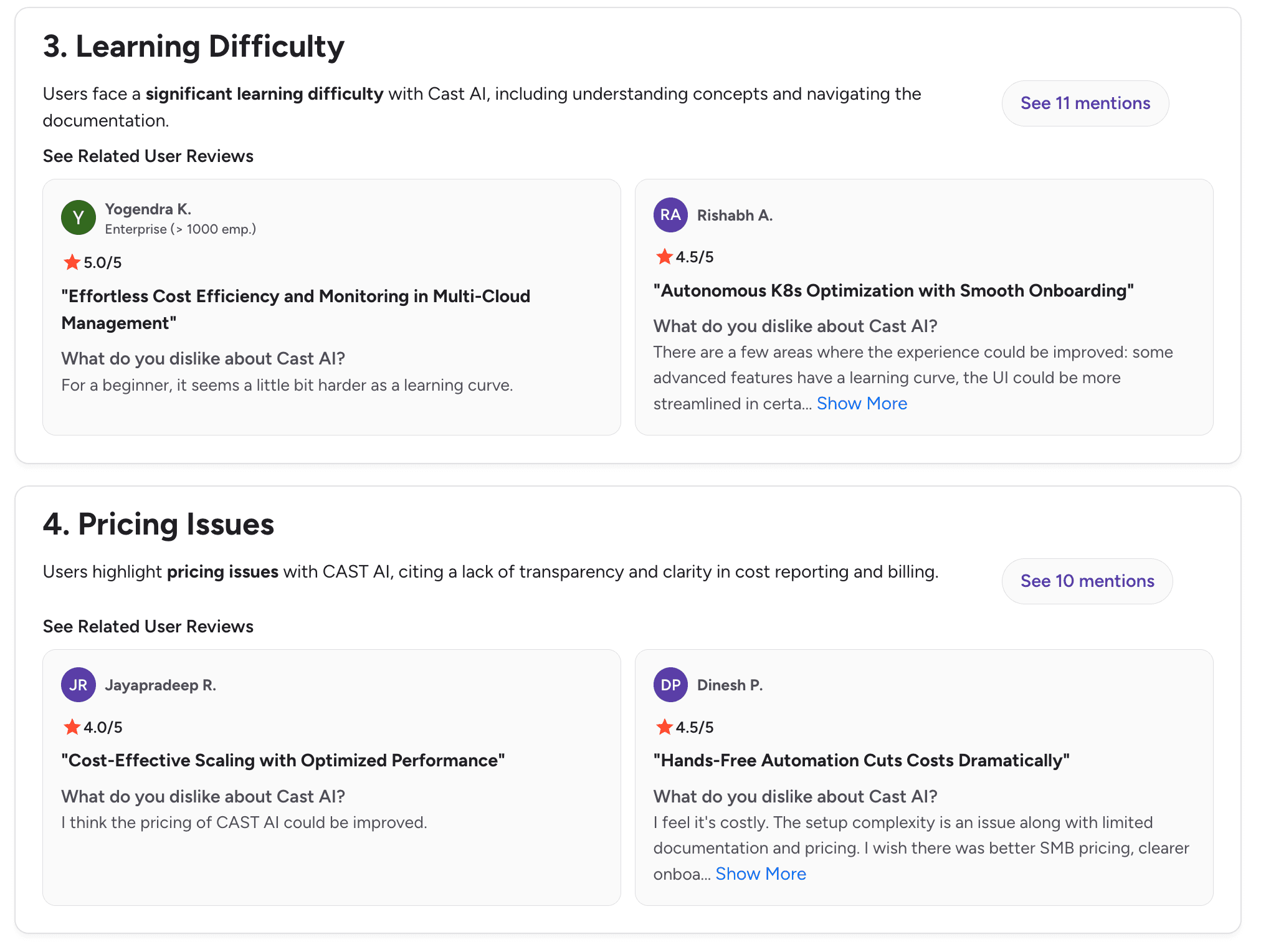
Onboarding friction with IAM and Terraform modules: Reviewers on G2 flag setup complexity, IAM permission gotchas and Terraform modules that feel light on features.
Steep learning curve for stateful workloads: Customers on G2 note a learning curve when fine-tuning policies for complex stateful workloads.
Recommendation accuracy gaps on EKS: G2 reviewers report cases where the platform proposed resource requests above the available EKS node capacity, leaving services stuck in pending state.
Pricing opacity for smaller teams: SMB reviewers on G2 ask for clearer published pricing rather than custom quotes.
Kubernetes-only scope: Cast AI focuses on Kubernetes clusters. RDS, S3, networking, SaaS and AI API spend are not unified into the same allocation view in the vendor's own product scope.
“There is a slight learning curve when it comes to fine-tuning policies for very complex stateful workloads.”
Cast AI G2 review screenshots (proof)
Top Cast AI alternatives: tools comparison
Platform | Best for | Multi-cloud and SaaS in one view | Allocation and unit economics | Optimization and automation | Kubernetes cost | Pricing model |
Amnic | Multi-cloud FinOps teams that also pay for AI APIs | Yes | Tag-based, account, service, workload, custom labels | Recommendations across compute, storage, network, with policy actions | Pod, namespace, cluster level | Flat-fee SaaS, no percentage-of-savings |
ScaleOps | Platform teams that want hands-off Kubernetes rightsizing | Kubernetes-only | Workload and namespace | Real-time pod and node automation | Yes, deep | Custom pricing, contact sales |
PerfectScale | SRE teams that want AI-driven workload recommendations | Kubernetes-only | Workload and namespace | Rightsizing recommendations, action via GitOps | Yes, deep | Free tier, paid tiers |
Kubecost | Engineering teams that want detailed Kubernetes spend visibility | Limited to cloud allocation tied to clusters | Pod, namespace, deployment | Recommendations, no native automation | Yes, deep | Free OpenCost, paid Enterprise |
CloudChipr | Cloud platform teams that want both K8s view and idle-resource cleanup | Yes, AWS, Azure, GCP | Account, service, tag | Automation workflows for idle resources | Yes, mid-depth | Tiered, free trial |
nOps | AWS-first teams optimizing both commitments and clusters | Multi-cloud, AWS-leaning | Account, service, tag | Commitment automation plus K8s | Yes, mid-depth | Percentage of savings |
CloudZero | Engineering-led teams that want unit-cost reporting | Yes, plus K8s and SaaS | Custom dimensions, unit cost | Recommendations, no native automation | Yes, mid-depth | Custom pricing |
How we evaluated these Cast AI alternatives
Cost visibility scope: Does the platform see Kubernetes only, or also non-Kubernetes cloud, SaaS and AI API spend?
Allocation model: How granular is the allocation and can untagged spend be attributed to a team or product?
Automation depth: Does the platform act, or only recommend?
AI cost coverage: Does the platform attribute model and inference spend back to teams or features?
Pricing predictability: Flat fee, percentage of savings, or contact-sales-only?
Time-to-first-insight: How long from signup to a credible cost view?
7 best Cast AI alternatives
1. Amnic: Best overall Cast AI alternative for multi-cloud FinOps with AI cost coverage
Who gets benefited: Engineering and finance leaders running multi-cloud workloads who also pay for AI APIs and SaaS and who want a single allocation view.
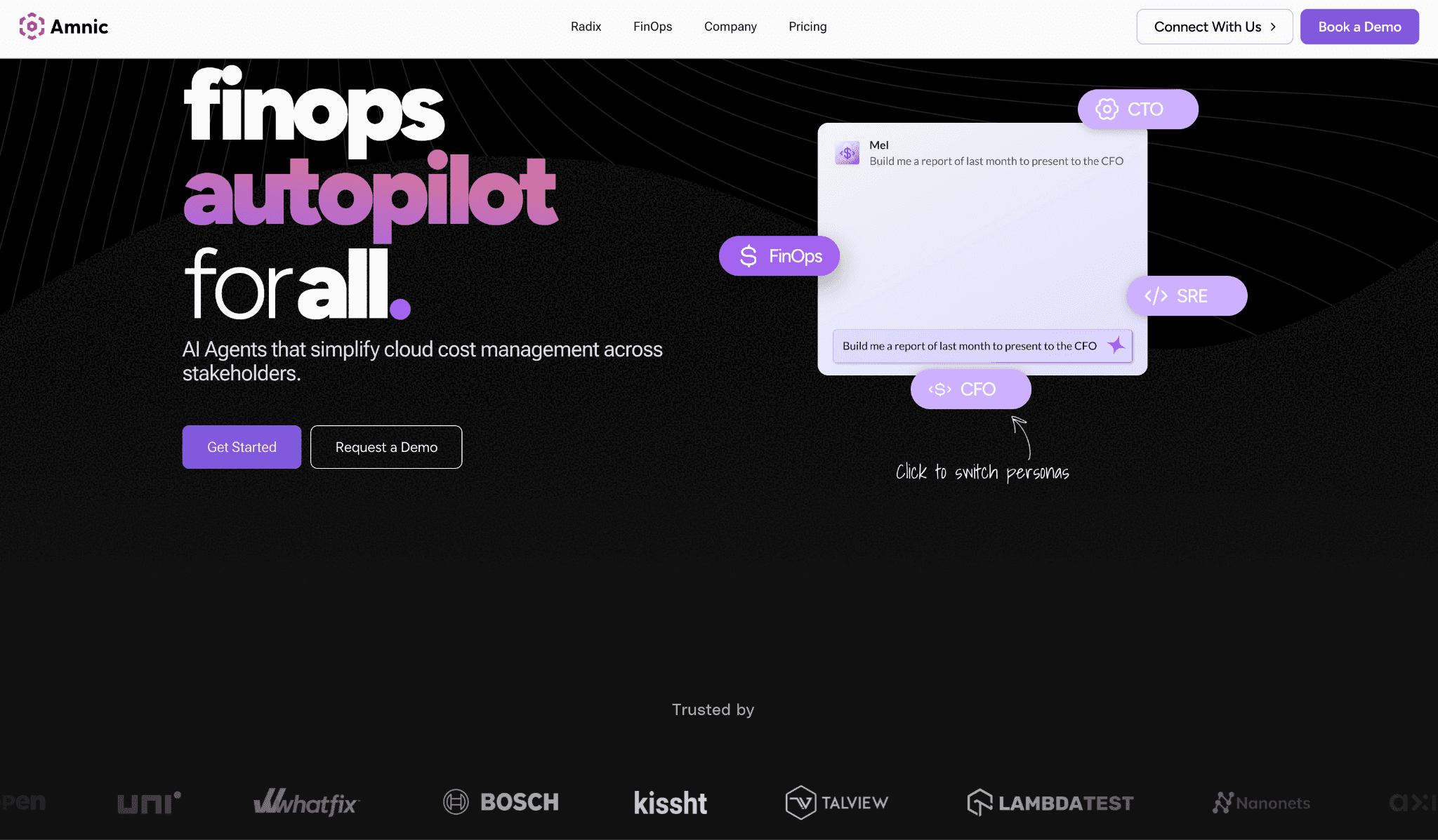
Amnic is a cloud cost intelligence platform that gives engineering and finance teams a unified view of cloud, container and AI spend with tag-based allocation, anomaly detection and policy-driven recommendations.
Why it is the strongest Cast AI alternative:
Scope goes beyond Kubernetes to cover RDS, S3, networking, SaaS and AI API spend in the same allocation view.
Transparent percentage-of-savings pricing tied to realised cloud cost reduction.
Self-serve audit available on the site without a sales call.
What the platform actually lets you do:
Allocate spend by tag, account, service, workload and custom labels, including untagged resources.
Track Kubernetes spend at pod, namespace and cluster level alongside non-K8s spend.
Detect anomalies and alert relevant stakeholders.
Apply policy actions on idle resources, oversized instances and unused storage.
Attribute AI inference and model spend back to product and feature.
Forecast spend based on historical patterns.
“Amnic's astute recommendation engine helped us reduce our cloud bill through optimization of network and cloudwatch costs.”
Mayank Bhola, Co-founder & CTO, LambdaTest.
Pricing model: Flat-fee SaaS based on annual cloud spend tier, no percentage of savings, free 30-second audit available (pricing as of May 2026 data).
Pros:
Unified view across cloud, Kubernetes, SaaS and AI spend.
Predictable flat-fee pricing.
Free audit that returns a savings number in 30 seconds.
Tag-based allocation that also handles untagged spend.
AI cost attribution at feature level.
Cons:
Newer entrant compared to Cloudability or Apptio (now under IBM).
Smaller partner ecosystem than legacy FinOps suites.
2. ScaleOps:
Who gets benefited: Platform teams running large Kubernetes fleets that want hands-off pod and node rightsizing in real time, with a high tolerance for autonomous change.
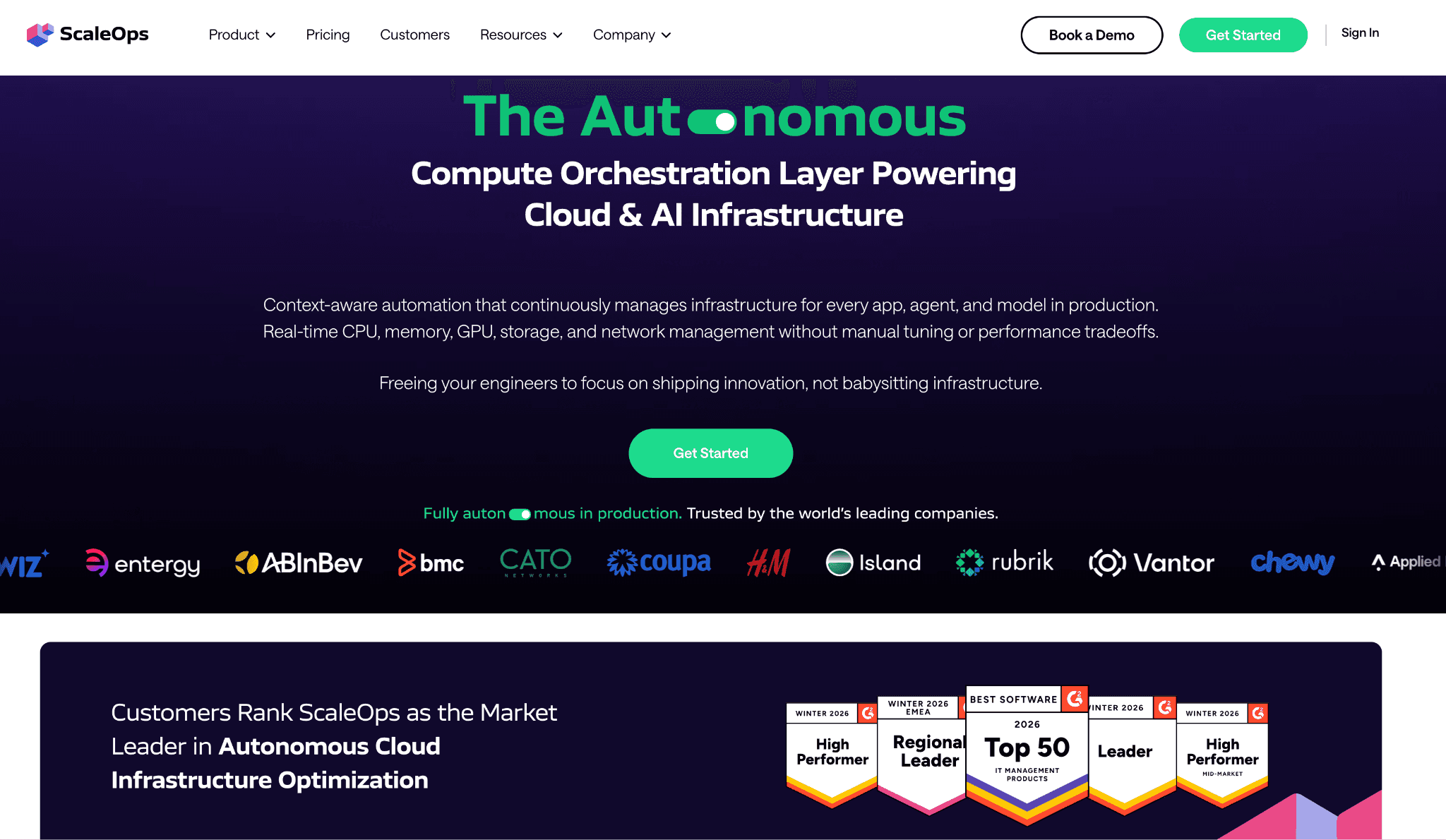
ScaleOps is an automated cloud resource management platform that rightsizes Kubernetes workloads, pods and nodes in real time. The company recently raised a Series C at over $800M valuation, per a TechCrunch report on the funding round, which signalled steady product investment in the autonomous resource management category and renewed focus on AI workload efficiency.
In practice:
Pod rightsizing adjusts CPU and memory requests live, without restarts in many cases, which matters for long-running stateful workloads and queue consumers.
Node optimization rebalances clusters across spot and on-demand pools based on workload tolerance, similar in spirit to what Cast AI does inside its own cluster.
AI workload support is a recent focus, with the funding announcement specifically calling out efficiency for GPU and inference workloads.
Pricing model: Custom pricing, contact sales. No public free tier is listed on the vendor pricing area (pricing as of May 2026 data). Direct link in the source list at the end.
Pros:
Closest functional peer to Cast AI on automation depth, with a similar real-time control loop.
Live request adjustment without pod restart for many workload types, reducing reboot churn.
Recent capital raise points to strong roadmap velocity.
Active focus on GPU and AI workload rightsizing.
Cons:
Kubernetes-only, so non-K8s cloud spend stays outside the view.
No public pricing, which slows SMB evaluation.
3. PerfectScale:
Who gets benefited: SRE and platform teams that want strong workload recommendations and prefer applying changes through their own CI or GitOps flow rather than handing control to a vendor agent.
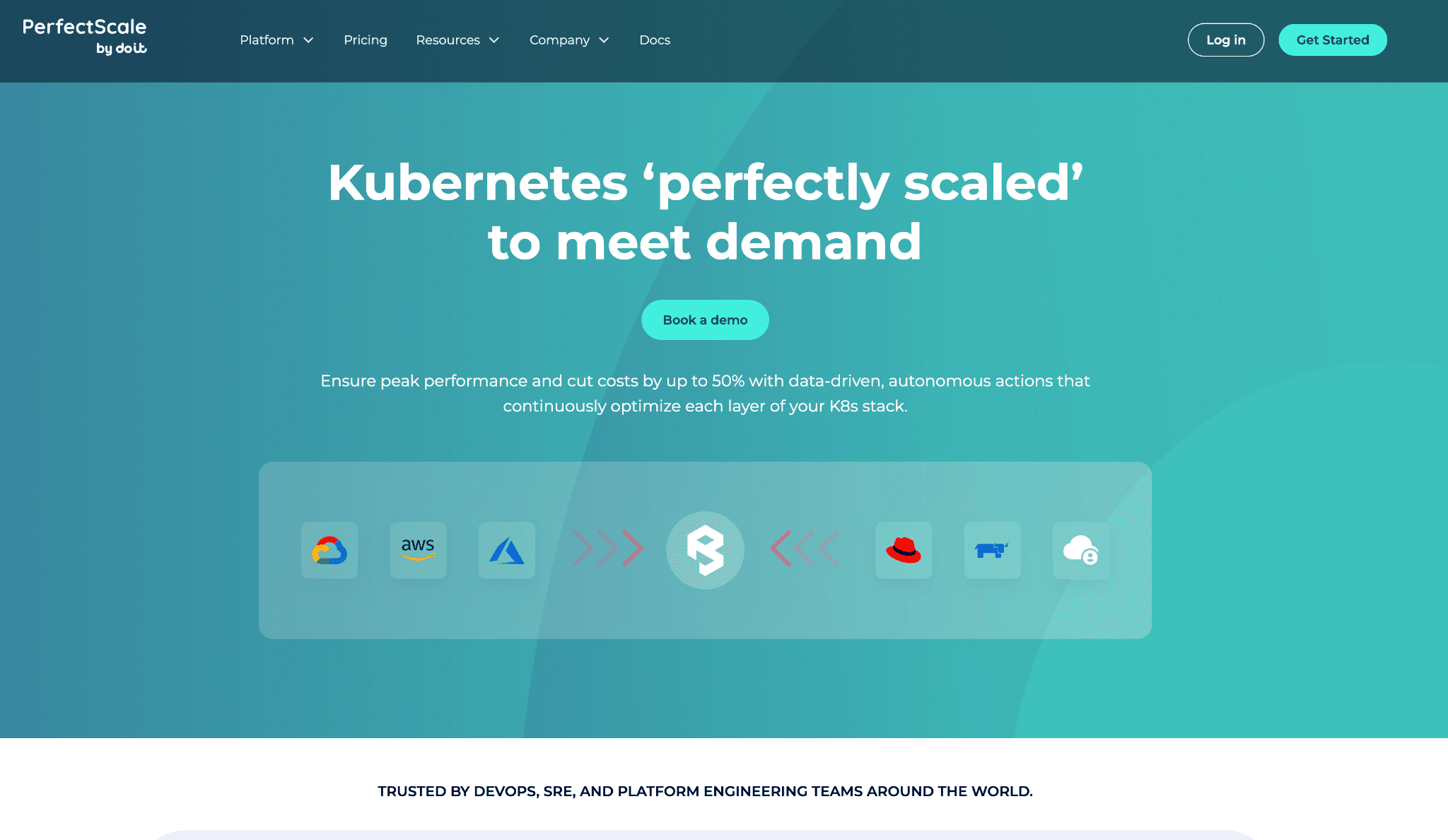
PerfectScale is a Kubernetes optimization platform focused on workload-level rightsizing recommendations across CPU, memory and replica counts. The platform is now part of DoiT after a DoiT acquisition announcement, which folded it into DoiT's wider cloud reseller and FinOps motion and broadened its enterprise distribution.
In practice:
Recommendations cover CPU and memory requests, limits and replica counts at the workload level.
GitOps-friendly apply path means approved changes ship through the team's existing pipeline.
DoiT bundling pairs the product with DoiT's wider cloud reseller and FinOps motion following the acquisition.
Pricing model: Free tier with paid plans on the vendor pricing page (pricing as of May 2026 data). Direct link in the source list.
Pros:
Workload-level rightsizing focused on Kubernetes specifically.
Free tier lowers the evaluation barrier for smaller teams.
DoiT backing brings broader cloud reseller and billing context post-acquisition.
Cons:
Recommendations require manual or GitOps apply, which differs from Cast AI's live action.
Kubernetes-only scope, no view of cloud-wide spend.
The road map is now shaped by DoiT priorities, per the acquisition note above.
4. Kubecost:
Who gets benefited: Engineering teams that want pod, namespace, deployment and label-level Kubernetes spend reporting and are comfortable owning the action side themselves.
Kubecost is a Kubernetes cost monitoring platform with an OpenCost open-source lineage. It is now part of IBM following the IBM newsroom acquisition note and will continue to be offered both as a standalone product and as a component inside IBM's FinOps suite alongside Cloudability and Turbonomic.
In practice:
Pod, namespace and deployment cost reports tie back to Prometheus metrics that most clusters already export.
OpenCost (the open-source core) covers free, on-cluster visibility without a vendor tie and is a CNCF Incubating project.
The Enterprise tier adds federation across many clusters, governance, alerting and SSO.
Allocation by label means teams can map cost back to product or feature once labels are in place.
Pricing model: Free OpenCost tier plus paid Enterprise plans, with terms listed on the vendor pricing area (pricing as of May 2026 data).
Pros:
Strong open-source foundation via OpenCost, useful for teams that want a no-vendor entry point.
Mature pod, namespace, deployment and label cost reporting.
IBM backing gives roadmap weight for enterprise procurement.
Light install via Prometheus.
Cons:
Visibility-first, with no native cluster automation in the way Cast AI provides.
Non-Kubernetes spend lives in a separate IBM product (Cloudability), so unification requires two purchases.
Enterprise tier is required for governance and alerting that smaller teams sometimes expect by default.
Label hygiene is a prerequisite for clean allocation and that prep work falls on the platform team.
5. CloudChipr:
Who gets benefited: Cloud platform teams that want a Kubernetes utilisation view alongside broad idle-resource cleanup workflows across AWS, Azure and GCP.
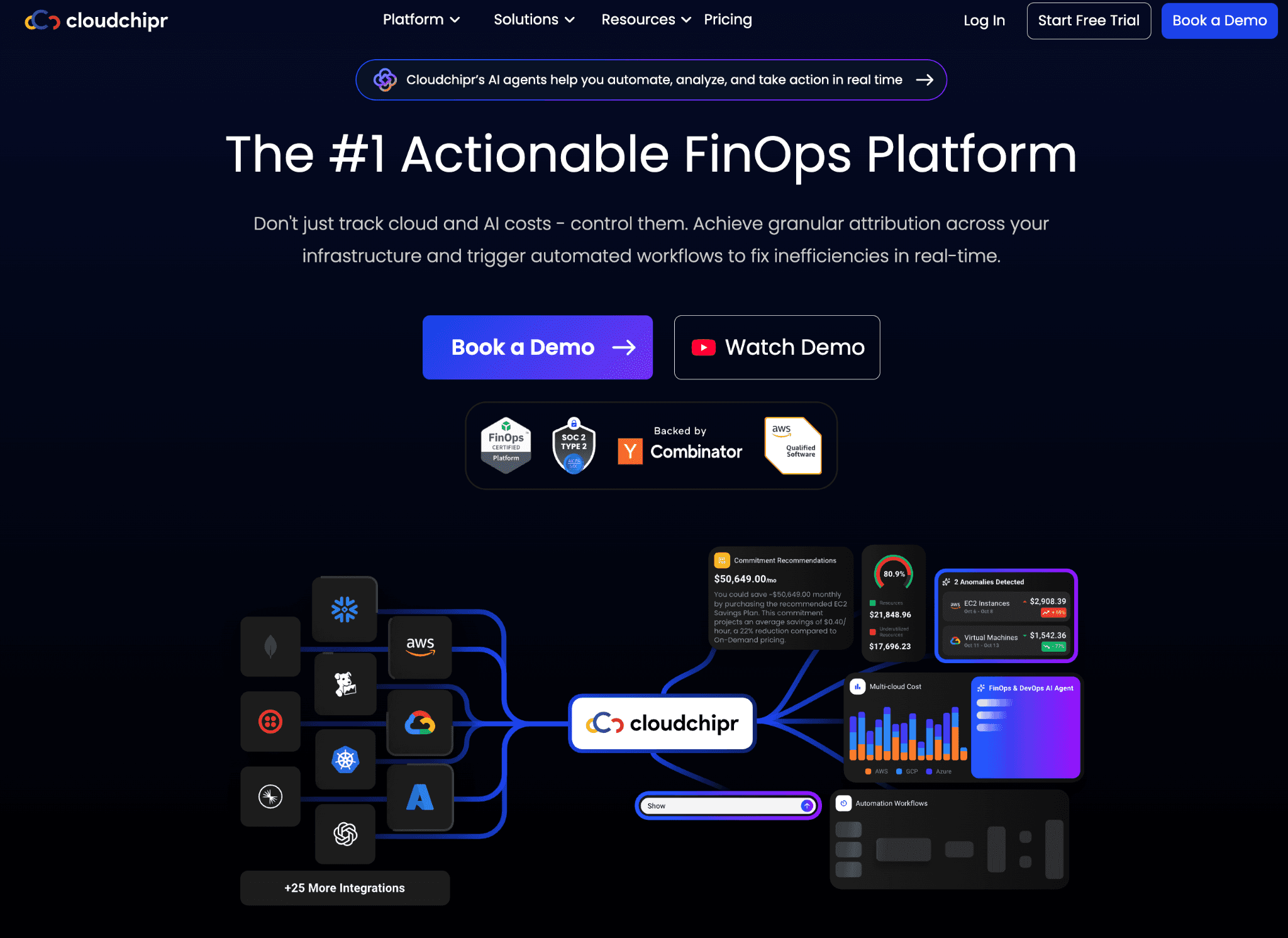
CloudChipr is a multi-cloud FinOps platform that combines Kubernetes utilisation analytics with automation workflows for idle and orphaned resources. The vendor positions the product as an “actionable FinOps platform” rather than a visibility-only dashboard, as outlined in the CloudChipr cloud cost optimization overview.
In practice:
Cluster overview shows idle and reserved percentages across all three major clouds in one screen, useful for platform leads with multi-cloud footprints.
Namespace and pod views point to over-provisioned deployments, with CPU and memory traces over time.
Automation workflows shut down idle EC2, EBS, RDS and similar resources on schedule or trigger, which compounds with K8s rightsizing.
Alerting on underutilisation runs continuously rather than as a one-time scan.
Pricing model: Tiered plans with a free trial, listed on the vendor pricing area (pricing as of May 2026 data).
Pros:
Real multi-cloud reach across AWS, Azure and GCP, not AWS-only.
Idle-resource workflows compound the Kubernetes rightsizing savings.
Free trial lowers the evaluation barrier.
Continuous underutilisation alerting, not one-time scans.
Cons:
Less deep on Kubernetes automation than Cast AI or ScaleOps. The action layer is broader but shallower on K8s specifically.
Public review volume is lower than legacy FinOps players.
Custom workflow setup carries a learning curve for teams new to FinOps tooling.
6. nOps:
Who gets benefited: AWS-heavy teams that want commitment automation (Savings Plans, Reserved Instances, CUDs) alongside Kubernetes rightsizing in one platform.
nOps is an automation-first cloud cost platform with strong AWS commitment management plus Kubernetes optimization. The vendor's own positioning describes the platform as automation-first across commitments, compute, Kubernetes, SaaS and AI workloads..
In practice:
Commitment automation continually rebalances Savings Plans and Reserved Instances, which is a savings lever distinct from K8s rightsizing.
Kubernetes spend is one module among several, not the centre of gravity, so K8s depth is less than Cast AI or ScaleOps.
Strongest fit for shops running primarily on AWS where commitments form a large share of the bill.
Pricing model: Percentage of savings, per the vendor's own pages (pricing as of May 2026 data). Free tier and pricing details at the source link in the bottom list.
Pros:
Commitment automation is a real cost lever, distinct from Kubernetes rightsizing.
Broad AWS coverage across compute, Kubernetes and commitments.
Cons:
Percentage-of-savings pricing scales the bill with the savings, which some buyers dislike.
Best on AWS. Azure and GCP coverage is shallower than AWS.
Kubernetes depth lags pure-K8s automation players like Cast AI and ScaleOps.
7. CloudZero:
Who gets benefited: Engineering-led teams that want unit-cost reporting (cost per customer, cost per feature, cost per environment) across both Kubernetes and broader cloud spend.
CloudZero is a cloud cost intelligence platform that unifies Kubernetes spend with broader cloud and SaaS cost in a single allocation view. The platform's CostFormation layer maps untagged spend to a logical cost model and customer feedback aggregates on the CloudZero PeerSpot page.
In practice:
CostFormation maps untagged spend to a logical cost model defined by the customer.
Kubernetes views sit next to RDS, S3 and SaaS spend, not in a separate product.
Engineering teams use it to report cost per customer or per feature back to product leadership.
Pricing model: Custom pricing, contact sales (pricing as of May 2026 data). Direct link in the source list.
Pros:
Unit-cost reporting that engineering teams find useful for product decisions.
Same view covers Kubernetes and non-Kubernetes spend, plus SaaS.
CostFormation handles untagged resources without requiring tag-hygiene cleanup first.
Cons:
No native automation in the way Cast AI provides; recommendations require human apply.
Custom pricing only, no public starter tier.
How to choose between Cast AI and these alternatives
You want autonomous Kubernetes rightsizing and accept Kubernetes-only scope: ScaleOps, PerfectScale, Amnic.
You want recommendations that ship through GitOps: PerfectScale, Kubecost, Amnic.
You want deep Kubernetes visibility with an open-source core: Kubecost via OpenCost, Amnic, PerfectScale.
You want multi-cloud cost + K8s plus AI spend in one view: Amnic, CloudChipr, CloudZero.
You run mostly AWS and want commitments automated: nOps, Amnic, CloudZero.
You want a multi-cloud view with idle-resource cleanup: CloudChipr, Amnic, nOps.
You want unit-cost reporting that engineers can use: CloudZero, Amnic, Kubecost.
Frequently asked questions
What is Cast AI?
Cast AI is an autonomous Kubernetes cost optimization platform that replaces the native cluster autoscaler, rebalances pods across spot and on-demand nodes and rightsizes workloads in real time, per the Cast AI product overview.
What is the best Cast AI alternative?
The right answer depends on scope. If you want autonomous Kubernetes rightsizing, ScaleOps is the closest direct peer. If you want a single view across cloud, Kubernetes, SaaS and AI spend with flat-fee pricing, Amnic is the strongest pick.
Why do teams switch from Cast AI?
Common reasons surfaced in verified user reviews include onboarding friction with IAM and Terraform, recommendation accuracy issues on EKS, opaque pricing for smaller teams and Kubernetes-only scope when the rest of the bill also matters.
Is Cast AI free or open-source?
Cast AI offers a free tier on its own Cast AI pricing page, with paid plans starting at custom rates above that. It is not open-source. The open-source path closest to Cast AI is Karpenter for node provisioning plus OpenCost for visibility.
How does Amnic compare to Cast AI?
Amnic covers Kubernetes spend alongside non-Kubernetes cloud, SaaS and AI spend in one allocation view, with flat-fee pricing rather than percentage of savings and a 30-second free audit. Cast AI goes deeper on autonomous Kubernetes node and pod automation. Buyers usually pick by scope: full-stack FinOps with Amnic, or Kubernetes-only automation with Cast AI.
Does Amnic cover Kubernetes and AI spend?
Yes. Amnic tracks Kubernetes spend at pod, namespace and cluster level, attributes AI inference and model spend back to product and feature and surfaces both in the same allocation view as the rest of your cloud bill.
The category is shifting from visibility to action and from cloud to AI
For a decade, FinOps tools mainly answered the question “where did our money go?” Dashboards, allocation reports and cost-per-team views were the deliverable. The good ones got very good at it.
The current generation, including Cast AI, ScaleOps and Amnic, is closing the loop. Recommendations are no longer the output. The platform either acts on the workload itself, or it ships a change that engineers can apply in their normal pipeline. That difference shows up directly in the savings rate.
The second shift is what counts as cloud spend. Inference cost, model training cost and SaaS line items are now a large share of the bill for AI-native companies. Platforms that only see Kubernetes, or only see AWS, are getting less useful as the spend mix broadens. Amnic was built for this scope from the start.
Start your free audit on Amnic. See your cloud savings in 30 seconds.
Sources
Pricing data referenced from the vendor's own pricing page for each platform listed above.
Cast AI customer feedback referenced from the verified-user reviews aggregation on G2 (link in the body).
Cast AI product scope and pricing referenced from the vendor's own product and pricing pages (linked in the FAQ).
ScaleOps Series C funding context referenced from the TechCrunch report linked in the body.
PerfectScale ownership change referenced from the DoiT announcement linked in the body.
Kubecost ownership change referenced from the IBM newsroom note linked in the body.
Apptio ownership context referenced from the IBM newsroom close-of-acquisition note linked in the body.
nOps positioning referenced from the vendor blog comparison linked in the body.
CloudChipr product positioning referenced from the vendor blog linked in the body.
CloudZero allocation feedback referenced from the PeerSpot reviews page linked in the body.
Amnic customer testimonial referenced from the amnic.com homepage.
Better visibility and management into AI Tokens?
Start with a 30 day trial
Connect leading LLMs
24 hour time to value
Stay ahead of AI Spend

Make AI spend visible, controllable, and accountable.
Gain insights into your AI token costs at a team, customer, business unit and individual user level to measure and manage AI utilization.
Recommended Articles

Compare Input vs Output Token Pricing: Why Output Costs More and How to Budget for It
Read More

Vertex AI vs Bedrock: The Enterprise Platform Decision That Outlives the Token Price
Read More

Gemini vs GPT: Which AI Model Fits Your Workflow and Budget
Read More
H100 vs A100: Specs, Cost and Which GPU Wins for Your Workload
Read More
OpenCost vs Kubecost: Key Differences and How to Choose
Read More
6 Best Datadog Alternatives for Cloud Cost Management in 2026
Read More