CloudZero Alternatives: A Buyer's Guide to FinOps and Cloud Cost Platforms
12 min read
Comparisons
Table of Contents
CloudZero is a strong product, so most people who search for an alternative are not unhappy with the category. They have hit one of four specific walls.
Price and contract: CloudZero does not publish a rate card. Its pricing page asks you to request a quote and describes a "tiered pricing model that's steady and predictable." Teams that want to see a number before a sales call, or that prefer a free tier to test, start looking elsewhere.
Setup effort: CloudZero builds its unit economics on cost allocation defined in code. That is precise, but it takes engineering time to set up and to keep current as your products change, which is more than some finance-led teams want to own.
Scope: CloudZero is built around visibility and unit economics. It surfaces savings and hands the fix to your engineers rather than executing rightsizing or commitment changes itself, so teams that want automation outgrow it.
Coverage: Teams that go multi-cloud, add heavy SaaS and AI spend, or want deeper Kubernetes and role-based access often want a platform that covers all of it in one place.
This guide compares seven platforms against those four walls.
Quick comparison table
Platform | Best for | Multi-cloud and SaaS in one view | Allocation and unit economics | Optimization and automation | Kubernetes cost | Pricing model |
Amnic | One platform for cloud, SaaS, and AI cost with agentic AI and engineering-grade Kubernetes rightsizing, without enterprise-only pricing | Yes (AWS, Azure, GCP, Oracle, Alibaba, plus SaaS and AI) | Virtual Tags, shared-cost split rules, unit cost per transaction | Recommendations, anomaly detection, commitment alerts (read-only by design) | Dedicated module, rightsizing to core level | Percentage of monitored spend, free trial |
Finout | Enterprise teams wanting no-code allocation across cloud, SaaS, and AI | Yes (AWS, Azure, GCP, OCI, plus Snowflake, Databricks, AI) | Virtual tagging, retroactive and no-code | CostGuard waste scans, forecasting | Yes | Custom enterprise, sales-gated |
Vantage | Fast, self-serve visibility with a free tier | Yes (AWS, Azure, GCP, plus 30+ integrations) | Virtual tagging, cost reports | Autopilot for AWS Savings Plans, waste detection | Yes | Fixed-rate subscription, free tier |
Apptio Cloudability (IBM) | Large enterprises wanting a mature, FinOps-certified platform with services | Yes (AWS, Azure, GCP, plus AI and SaaS) | Business mapping, 100% allocation, unit economics | Rightsizing and commitment recommendations | Yes | IBM enterprise agreement, sales-gated |
nOps | AWS-heavy teams that want automated savings, not just charts | Partial (AWS first, GCP and Azure supported) | Cost allocation and reporting | Strong: commitment automation, rebalancing, scheduling, rightsizing | Yes (EKS) | Results-based, tied to savings |
Datadog Cloud Cost Management | Teams already on Datadog wanting cost tied to observability metrics | Yes (AWS, Azure, GCP, OCI, plus SaaS via FOCUS) | Allocation by team, product, service | Automated cost recommendations | Yes (container-level) | Add-on, per cloud account monitored |
CloudHealth by Broadcom | Large enterprises wanting multi-cloud governance and policy automation | Yes (AWS, Azure, GCP) | Perspectives for allocation | Policy-driven governance, rightsizing and reservation recs | Limited | Enterprise, sales-gated |
How to read this table fast:
Want everything in one place with self-serve pricing: look at Amnic or Vantage.
Want deep enterprise allocation and have budget plus a rollout team: Finout or Apptio Cloudability.
Want the tool to actually cut the bill on AWS, not just show it: nOps.
Already living inside Datadog: Datadog Cloud Cost Management.
Big multi-cloud estate that needs governance and policy guardrails: CloudHealth by Broadcom.
How the market splits (so you compare like for like)
Cloud cost tools sit in three layers. Most buying mistakes happen when a team buys from the wrong layer.
Layer | What it answers | Tools that lead here |
Visibility | Where is my spend going, by service, account, and environment | Amnic, Vantage, Datadog CCM |
Allocation and chargeback | Which team, product, or customer owns which cost | Finout, Cloudability, CloudHealth, Amnic |
Unit economics | What does one customer, transaction, or AI call actually cost me | CloudZero, Amnic, Finout, Cloudability |
CloudZero's reputation sits in the third layer. So if you are replacing it, the alternative has to reach allocation and unit economics, not just draw nicer charts. That is the filter this guide uses.
Is CloudZero actually a problem?
For most teams, no. CloudZero is well rated. It holds 4.5 out of 5 across 30 reviews on Gartner Peer Insights, and buyers consistently like its cost visibility and its FinOps account management.
People leave or skip it for the four reasons in the intro, not because the product is weak: the sales-gated pricing, the engineering effort behind code-defined allocation, the visibility-first scope that stops short of executing changes, and the wish for one tool that also covers multi-cloud, SaaS, AI, and Kubernetes. If none of those four describe you, CloudZero is a fine choice and you can stop here.
If you want to hear unfiltered peer experience before you decide, the r/FinOps subreddit is the most active community for this, with threads such as Seeking advice on cloud cost optimization tools and Apptio alternatives. The wider r/devops discussion on why cloud gets so expensive is good background, and the Cloud Cost Management topic on Quora collects practitioner questions on the same trade-offs.
The 7 best CloudZero alternatives
1. Amnic
Best for: teams that want cloud, SaaS, and AI cost in one platform, with AI agents that answer cost questions in plain language and Kubernetes rightsizing down to the core, without an enterprise-only contract to get started.
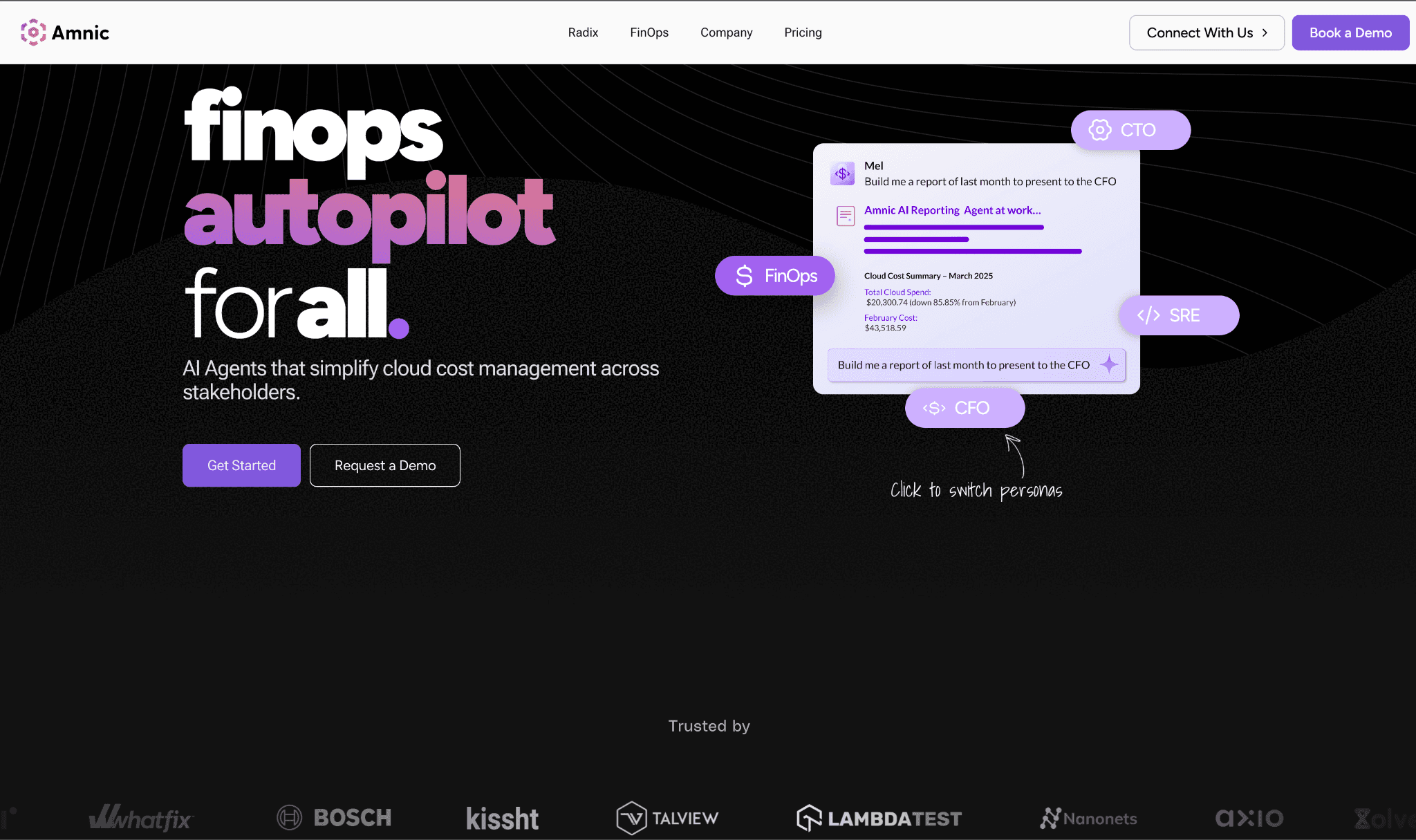
Amnic is a FinOps platform that brings spend from AWS, Azure, GCP, Oracle, and Alibaba into one Cost Analyzer, then layers anomaly detection, Kubernetes rightsizing, allocation, and AI agents on top. The pitch is range plus accessibility: you get unit-economics depth and engineering-grade Kubernetes work in the same place a finance user can self-serve.
Key features
Cost Analyzer with multi-cloud unified view and up to six levels of group-by, down to bucket and operation level, so you can trace a bill to the exact resource.
Amnic AI agents (X-Ray, Insights, Reporting) plus AI embedded in the Cost Analyzer and dashboards, so non-experts can ask questions like "show my S3 cost by bucket for the last three months" and get the right chart.
Kubernetes module that compares requested versus used cores at the 90th percentile and recommends a rightsized number, with node pool and PVC rightsizing.
Anomaly detection with custom and trend rules, plus Slack, email, and Jira alerting on both anomalies and recommendations.
Virtual Tags to unify inconsistent tags (prod, Prod, PROD) and shared-cost split rules, including a meter mode that splits a shared bill by actual usage instead of a fixed ratio.
FinOps for AI to track model and token spend, starting with Amazon Bedrock, with OpenAI and Anthropic on the roadmap.
Pricing: a percentage of the cloud spend Amnic monitors, in the range of 0.25 to 1%. There is a one-month free trial on the startup tier with no credit card, and enterprise plans support a negotiated spend cap (per Amnic).
Pros
Cloud, SaaS, and AI spend really do sit in one view, which removes the multi-console stitching CloudZero leaves you doing for non-AWS spend.
You can start on a free trial and self-serve, instead of waiting on a sales cycle.
Allocation works even when tagging is messy, because Virtual Tags fix it after the fact.
Kubernetes rightsizing is concrete, down to individual cores, not a generic "you could save" estimate.
Cons
A percentage of spend model can feel less predictable than a flat subscription once your bill is very large, so model the cost at your spend before signing.
SaaS and AI integrations are still expanding. Bedrock is live, OpenAI and Anthropic are not yet.
It is a read-only platform on purpose. It tells you the exact change to make but will not execute it in your cloud, so a person still applies the fix.
It is a newer name than Cloudability or CloudHealth, so it carries less of a long enterprise track record.
Where Amnic beats CloudZero: range. You get unit economics and Kubernetes rightsizing and SaaS visibility and self-serve pricing in one tool. Where CloudZero still wins: a longer reference list for pure AWS unit-economics at large enterprises.
2. Finout
Best for: enterprise FinOps teams that need accurate allocation across cloud, Kubernetes, SaaS, and AI without first fixing every upstream tag.
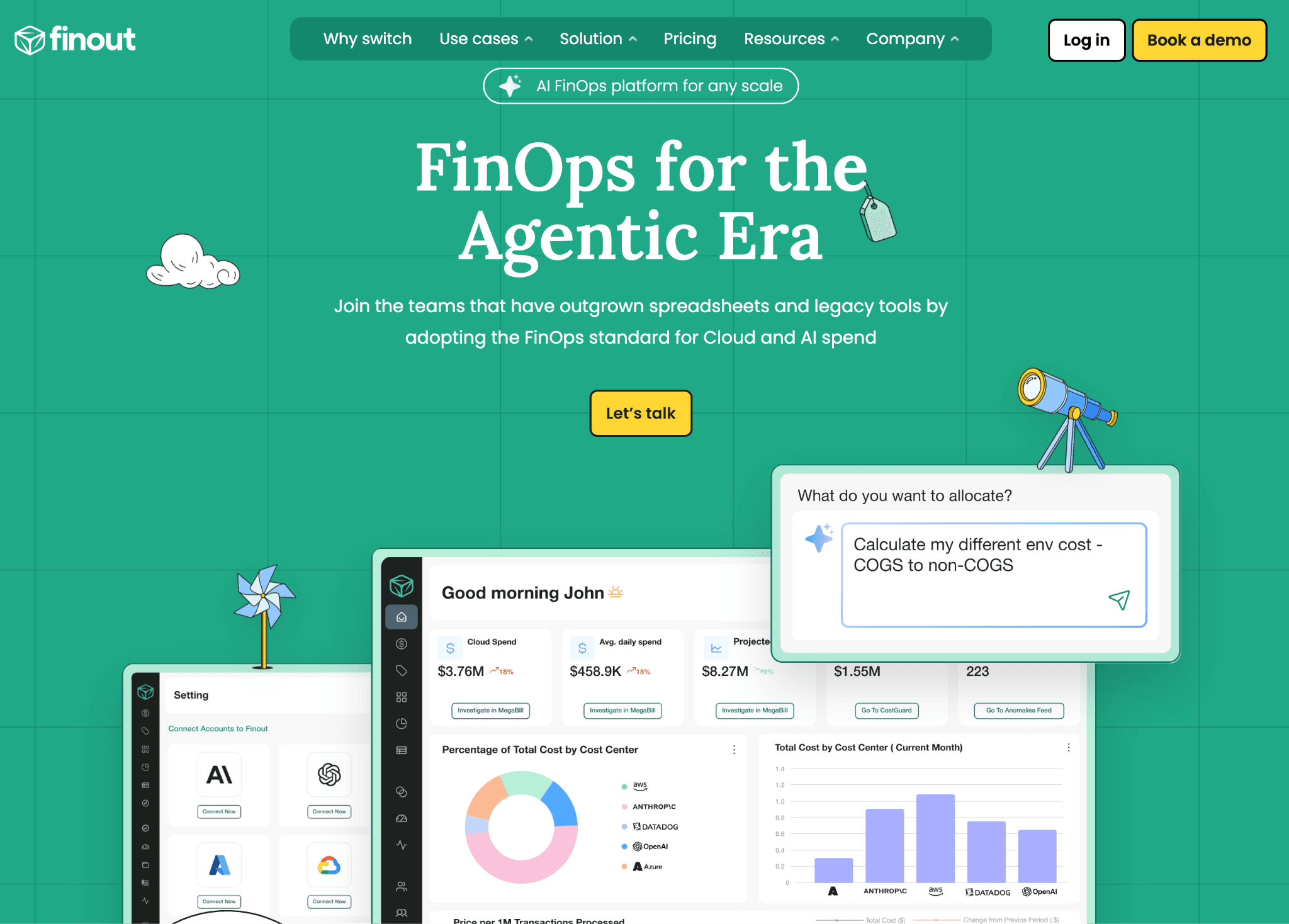
Finout positions itself as an "AI FinOps platform for any scale." Its MegaBill pulls cloud, Kubernetes, SaaS, and AI spend into one bill, and its Virtual Tagging applies allocation logic retroactively, in its own words letting you "allocate your entire cloud stack in seconds."
Key features
Virtual Tagging is the headline. You write allocation rules once and Finout applies them across cloud, Kubernetes, AI, and SaaS spend, including resources that were never tagged correctly in the first place. That is the main thing teams reach for when their tag hygiene is too far gone to fix at the source.
MegaBill brings every cost source into one normalized bill, and it ingests AI provider spend such as OpenAI, Anthropic, and Cursor the same way it ingests cloud, so your AI line items sit next to your infrastructure.
CostGuard connects to waste and savings scans across AWS, Azure, GCP, Kubernetes, and Snowflake, so recommendations live in the same place as your allocation.
Budgets, forecasting, and anomaly detection are built in and aligned to the FinOps FOCUS standard, which keeps your data portable if you ever move tools.
Coverage spans AWS, Azure, GCP, and OCI on the cloud side, plus data platforms like Snowflake and Databricks.
Pricing: Finout uses custom enterprise pricing tied to your spend under management, and there is no public rate card, so every deal goes through a sales conversation. There is no free tier, which is worth knowing if you want to trial before you commit.
Pros
No-code allocation is genuinely fast, which is the main reason teams move off CloudZero's code-based setup.
Covers SaaS and AI spend natively, not as an afterthought.
Built for organizations that have already done the FinOps basics and need to scale.
Cons
Pricing is sales-gated, so you cannot self-serve or price-check quickly.
Aimed at teams past the basics, which can make it heavy for a small startup.
Optimization is lighter than execution-first tools like nOps.
3. Vantage
Best for: teams that want clean visibility across cloud, SaaS, and AI quickly, with a free tier to start.
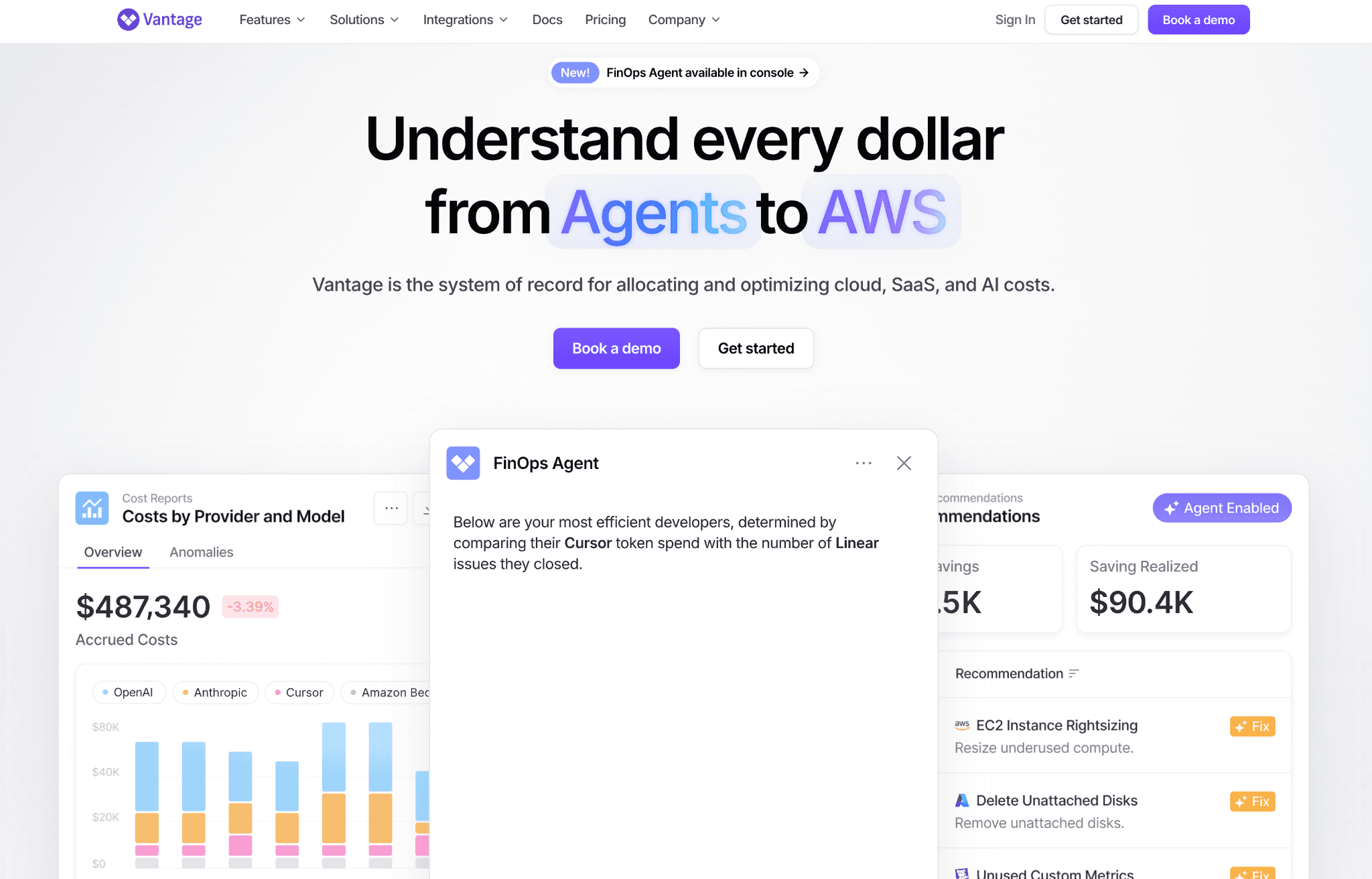
Vantage calls itself "the system of record for allocating and optimizing cloud, SaaS, and AI costs." It is the easiest of this group to switch on, with more than 30 integrations and a free tier that does not expire.
Key features
Cost Reports and Budgets are the core, wrapped in a clean interface that finance and engineering can both read without a training session. This is the reason teams call Vantage the fastest to get value from.
Virtual Tagging handles allocation, and Anomaly Detection flags spend spikes, so you get the two things most teams need on day one without a heavy setup.
Autopilot automatically manages AWS Savings Plans on your behalf, which is real automation rather than just a recommendation to act on.
Automated waste detection surfaces idle and oversized resources with concrete cost recommendations.
More than 30 integrations cover AWS, Azure, GCP, Kubernetes, Datadog, Snowflake, OpenAI, and Anthropic, so SaaS and AI spend show up alongside cloud out of the box.
Pricing: Vantage charges a fixed-rate subscription, not a percentage of spend, so your bill does not climb just because your cloud usage grew. There is a free tier with no time limit, and paid tiers add longer data history, team access controls, and priority support (per Vantage). The free tier makes it the easiest tool here to try before you buy.
Pros
Fastest setup here, and the free tier lets you prove value before paying.
Broad integration list covers SaaS and AI out of the box.
Predictable subscription pricing, so the bill does not climb with your spend.
Cons
Lighter on deep optimization and rightsizing automation than nOps or Amnic.
Enterprise governance and role-based access are less deep than Cloudability or CloudHealth.
Unit-economics depth is good for allocation but not as engineering-specific as CloudZero.
4. Apptio Cloudability (IBM)
Best for: large enterprises that want a mature, FinOps-certified platform and are comfortable with a services-led rollout.
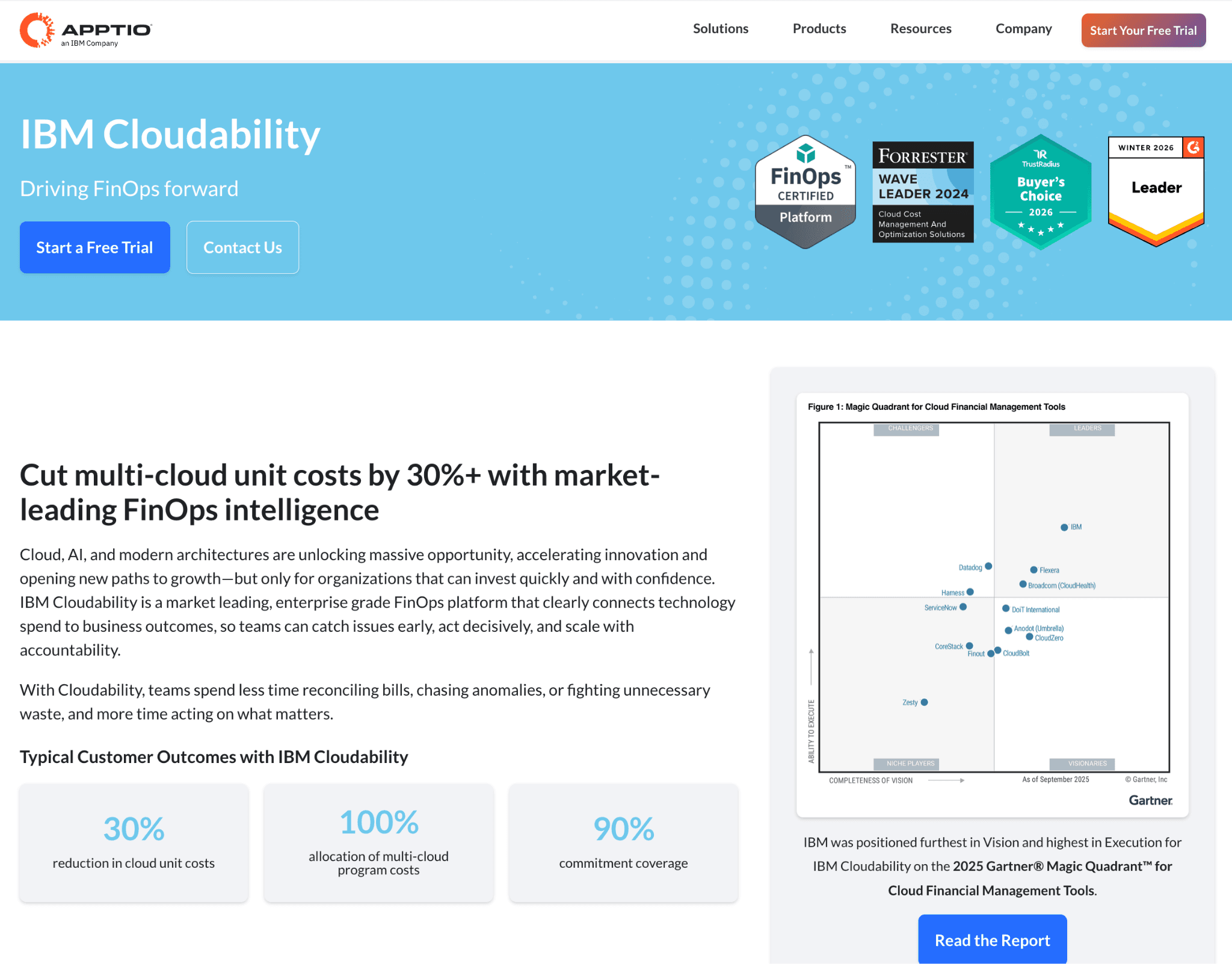
IBM positions Cloudability as a "single pane of glass for FinOps across cloud, AI and SaaS" and claims teams can "cut multi-cloud unit costs by 30%+." It is one of the original enterprise FinOps platforms, which is both its strength and its weight.
Key features
Business mapping is the centerpiece. It lets you allocate 100% of multi-cloud program costs to the business units, products, and teams that own them, which is what large enterprises buy Cloudability for.
Rightsizing recommendations, anomaly detection, budgeting, and forecasting are all included, so it covers the full FinOps cycle rather than one slice of it.
Unit economics tracking and commitment optimization let you connect spend to business output and manage Reserved Instances and Savings Plans in the same platform.
It is a FinOps-certified platform offered in Essentials, Standard, and Premium tiers, which map to how mature your FinOps practice is.
Pricing: Cloudability is sold as an IBM enterprise agreement priced on your cloud spend volume and account count, with no self-serve option and no free trial (per IBM). Rollout is typically services-led rather than a quick self-signup, so plan for a guided implementation rather than a same-day start.
Pros
Comprehensive and battle-tested at enterprise scale.
FinOps-certified, which matters for mature practices and procurement.
Deep allocation and unit-economics coverage.
Cons
Carries the architectural weight of a first-generation platform.
No self-serve and no free trial, so evaluation is slower.
Rollout is services-led rather than self-signup, so time to first value is longer than a self-serve tool.
5. nOps
Best for: AWS-heavy teams that want the tool to actually reduce the bill, not just report on it.
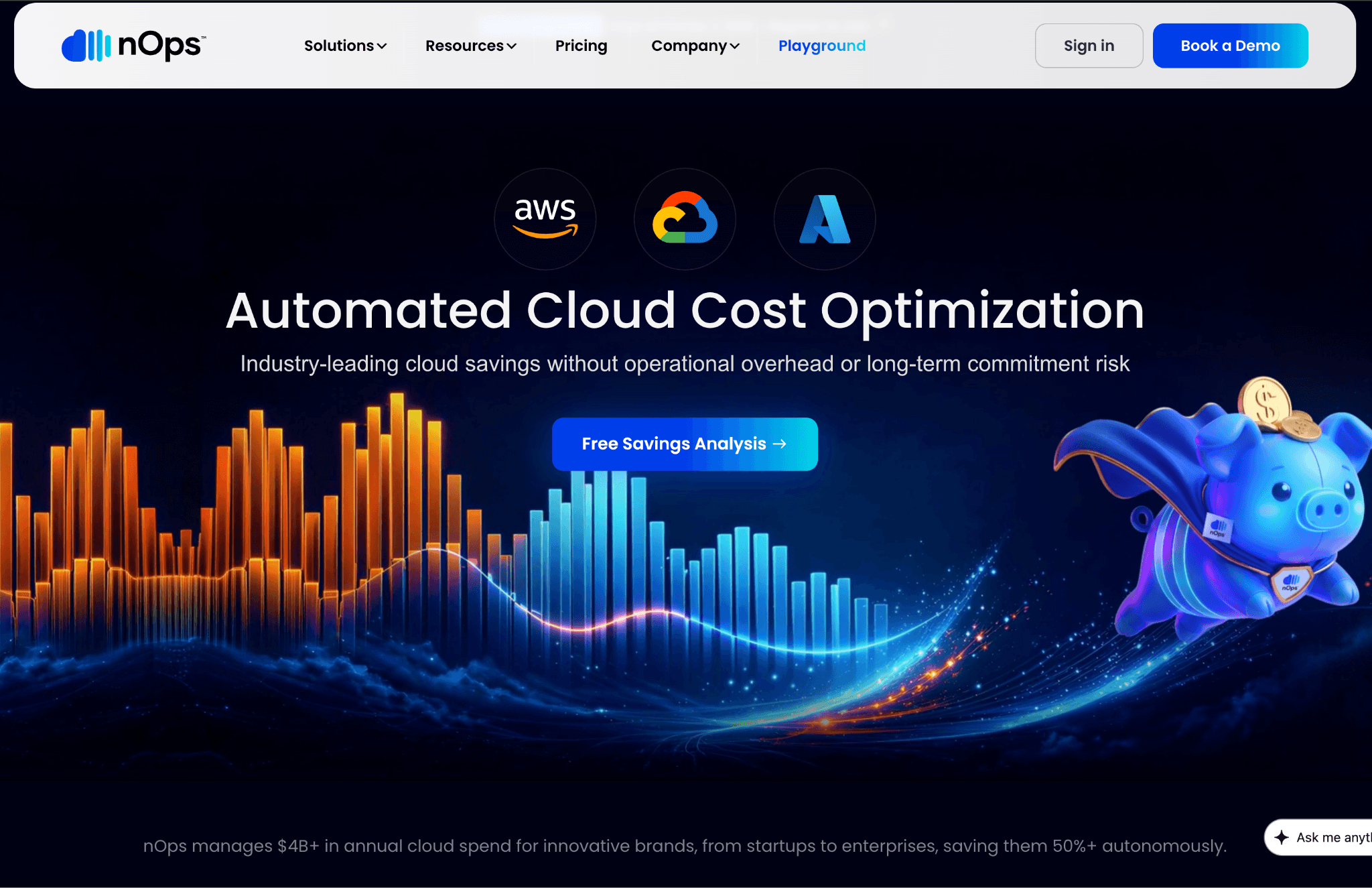
nOps describes itself simply as "automated cloud cost optimization." Where most tools on this list show you savings, nOps acts on them, with a commitment engine and a rebalancing engine that adapt continuously.
Key features
Commitment management across Reserved Instances, Savings Plans, and CUDs is the core. nOps buys, sells, and reshuffles commitments for you to push your effective discount up, rather than just telling you a commitment is expiring.
A continuous rebalancing engine adapts your compute hour by hour, so coverage keeps tracking your real usage instead of a once-a-quarter purchase decision.
EKS and Kubernetes optimization, rightsizing, and resource scheduling let you shut down or shrink workloads that do not need to run at full size around the clock.
Clara is its FinOps AI agent, so the team can ask cost questions in plain language instead of building reports.
Cost reporting and allocation are included, with the deepest support on AWS and stated support for GCP and Azure.
Pricing: nOps uses a results-based model tied to the savings it generates rather than a flat SaaS subscription, so you pay in proportion to what it saves you (per nOps). That lowers upfront risk, but it also means the cost grows with your savings, so model it at your scale before signing.
Pros
Real automation and execution, which is exactly what CloudZero leaves to your engineers.
Strong AWS savings track record, with a pay-from-savings model that lowers upfront risk.
Cons
AWS-centric, so multi-cloud depth is thinner than Amnic, Finout, or CloudHealth.
Built around optimization and savings more than allocation and unit economics.
A share-of-savings model can get expensive once savings are large, so model it.
6. Datadog Cloud Cost Management
Best for: teams already running Datadog who want cost sitting next to their observability data.
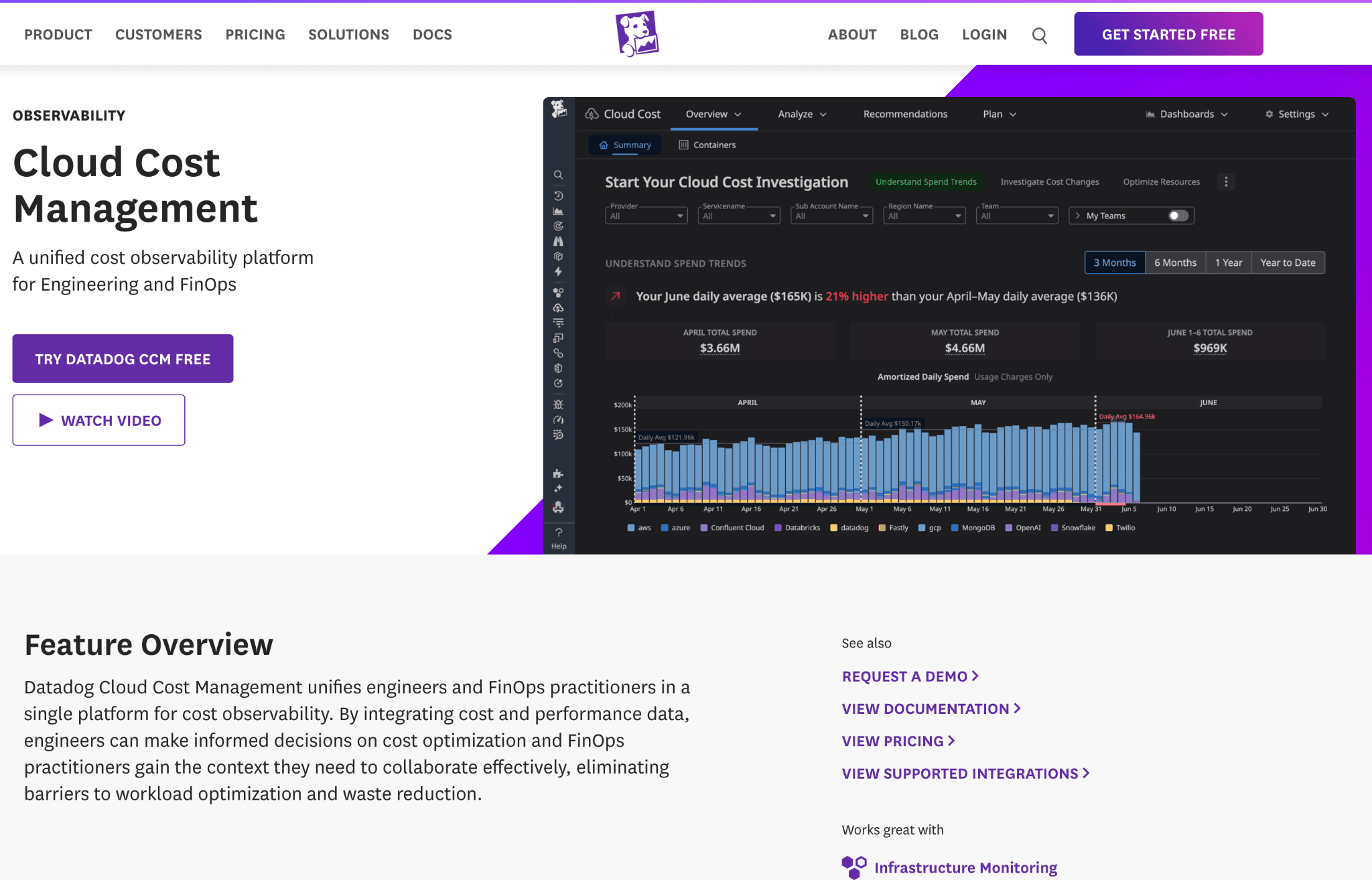
Datadog calls this a "unified cost observability platform for Engineering and FinOps." Its edge is correlation: it puts cost next to the CPU, memory, and APM data you already collect, so you see cost and the usage driving it in one place.
Key features
Cost data lives next to the dashboards, Software Catalog, Resource Catalog, and container monitoring you already use, so an engineer can jump from a cost spike to the service and infrastructure behind it without switching tools.
Automated cost recommendations cover AWS, Azure, and Google Cloud resources, so the platform suggests where to trim, not just where money went.
Allocation works across teams, products, and services, with granular container-level cost tracking for Kubernetes workloads.
Anomaly monitors detect unexpected cost movements and add root-cause analysis, reusing the same alerting engine teams already trust for performance.
It accepts any cost data source in the FinOps FOCUS format, so non-cloud spend can be folded in.
Pricing: Datadog Cloud Cost Management is an add-on to your existing Datadog subscription, billed per cloud account monitored, while the core platform scales with hosts and ingestion separately. It makes the most financial sense when you already pay for Datadog rather than as a standalone purchase.
Pros
Correlating cost with usage metrics is genuinely useful for engineers diagnosing a spike.
Almost no extra tooling if you already live in Datadog.
FOCUS support keeps the data portable.
Cons
The value is concentrated inside the Datadog ecosystem. It makes less sense as a standalone FinOps tool.
It is another line item on top of an already metered platform.
Allocation and unit economics are less specialized than dedicated FinOps tools.
7. CloudHealth by Broadcom
Best for: large enterprises with sprawling multi-cloud estates that need governance and policy guardrails, not just cost charts.
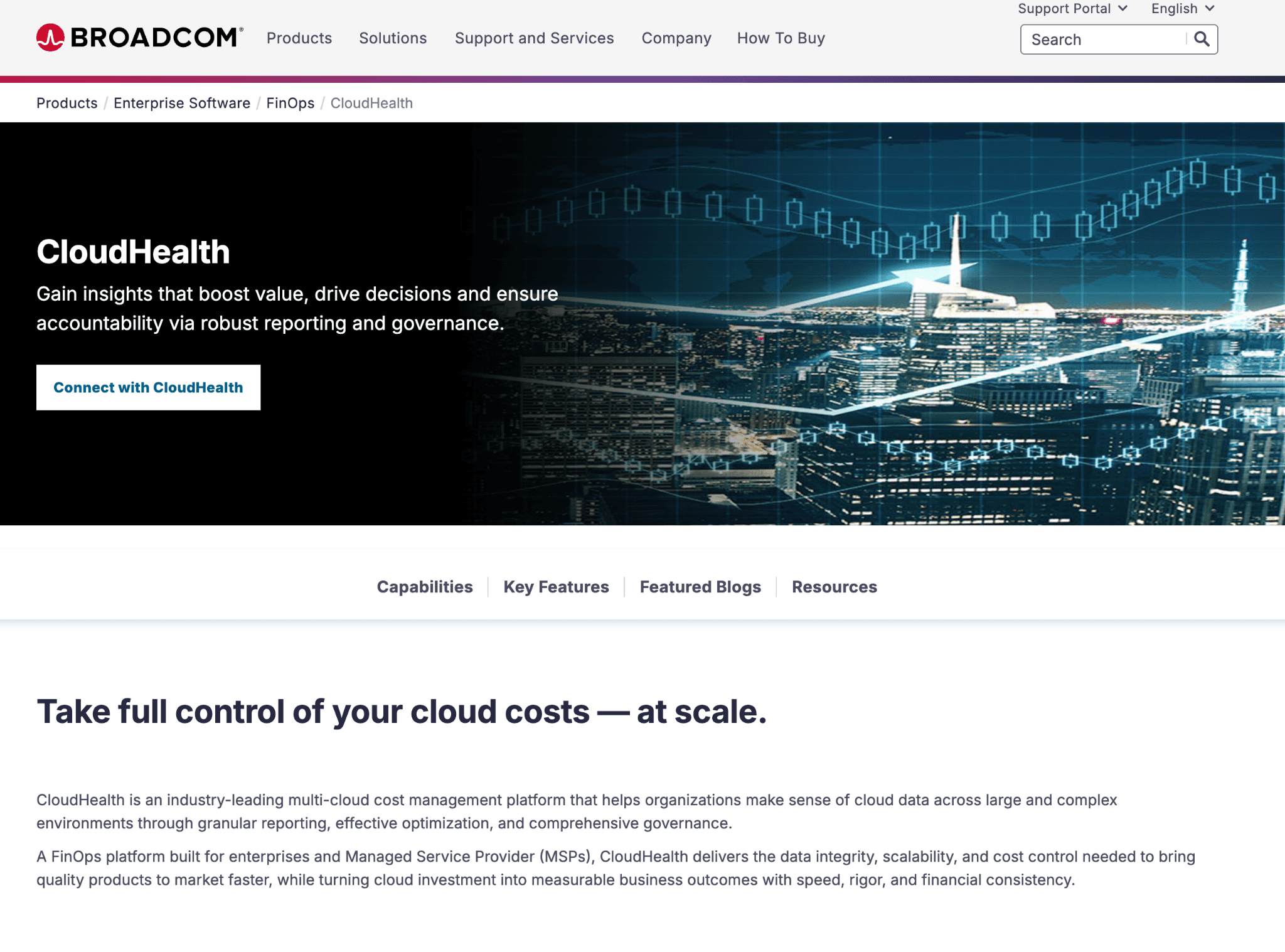
CloudHealth is one of the oldest names in the category. It was founded as CloudHealth Technologies, later acquired by VMware, and is now CloudHealth by Broadcom after Broadcom completed its VMware acquisition (per Broadcom and Wikipedia). It leans toward governance: policies, guardrails, and multi-cloud reporting at scale.
Key features
Multi-cloud cost reporting across AWS, Azure, and GCP is the foundation, built to handle large and complex estates rather than a single account.
Policy-driven governance lets you write rules that flag or enforce cost and configuration standards automatically, which is the feature that sets CloudHealth apart from pure reporting tools.
Perspectives is its allocation model, a way to slice spend by business group, team, or project so chargeback and showback have a consistent structure.
Rightsizing and reservation recommendations help trim waste and improve commitment coverage.
It has a long track record with managed service providers who run cloud on behalf of many clients, so its multi-tenant and reporting features are mature.
Pricing: CloudHealth is sold as an enterprise platform with no public rate card, so pricing comes through Broadcom sales (per Broadcom). There is no self-serve or free entry point, which makes it a poor fit for a quick evaluation.
Pros
Mature governance and policy engine built for large, complex estates.
Proven at enterprise multi-cloud scale and popular with service providers.
Cons
Ownership has changed twice, from CloudHealth Technologies to VMware to Broadcom, so confirm the current roadmap, support, and licensing terms before you commit.
Enterprise pricing and sales-gated evaluation with no free tier.
Kubernetes cost depth is limited compared with Amnic or nOps.
How to choose, in one screen
Replacing CloudZero mainly to save money on the contract: Vantage (free tier, fixed price) or Amnic (start on a trial, pay a percentage).
Replacing it because setup was too heavy: Finout or Amnic, both of which fix allocation without perfect upstream tags.
You want the tool to cut the AWS bill, not just show it: nOps.
You need enterprise governance across a large multi-cloud estate: Cloudability or CloudHealth by Broadcom.
You want unit economics plus Kubernetes plus SaaS plus AI in one place with self-serve pricing: Amnic.
Frequently asked questions
How much does CloudZero cost?
CloudZero does not publish a public rate card. Its pricing is tiered and requires a sales conversation, and CloudZero describes it as "steady and predictable," with the goal that you "know exactly what you'll pay every month" (per CloudZero's pricing page). For a published number or a free tier, the alternatives in this guide are more transparent.
Is there a free CloudZero alternative?
Vantage offers a free tier with no time limit, and Amnic offers a one-month free trial with no credit card. Both let you prove value before committing, which CloudZero's sales-gated model does not.
What is the best CloudZero alternative for multi-cloud and SaaS?
Finout and Amnic both unify AWS, Azure, GCP, SaaS, and AI spend in one view. Finout leans enterprise with no-code virtual tagging. Amnic adds agentic AI and Kubernetes rightsizing with self-serve pricing.
What is the best CloudZero alternative for unit economics?
CloudZero is known for unit economics, so a real replacement has to reach that layer. Amnic supports unit cost per transaction with shared-cost split rules, Finout supports it through virtual tagging, and Apptio Cloudability supports it through business mapping.
What is the best CloudZero alternative that actually optimizes spend?
nOps is the most execution-focused, with automated commitment management, rebalancing, and scheduling, primarily on AWS. CloudZero and most visibility tools recommend changes but leave the execution to your team.
Which alternative is closest to CloudZero for AWS engineering teams?
Apptio Cloudability and Amnic are the closest on allocation and unit-economics depth. nOps is closest if your priority is automated AWS savings rather than reporting.
Better visibility and management into AI Tokens?
Start with a 30 day trial
Connect leading LLMs
24 hour time to value
Stay ahead of AI Spend

Make AI spend visible, controllable, and accountable.
Gain insights into your AI token costs at a team, customer, business unit and individual user level to measure and manage AI utilization.
Recommended Articles

Compare Input vs Output Token Pricing: Why Output Costs More and How to Budget for It
Read More

Vertex AI vs Bedrock: The Enterprise Platform Decision That Outlives the Token Price
Read More

Gemini vs GPT: Which AI Model Fits Your Workflow and Budget
Read More
H100 vs A100: Specs, Cost and Which GPU Wins for Your Workload
Read More
OpenCost vs Kubecost: Key Differences and How to Choose
Read More
6 Best Datadog Alternatives for Cloud Cost Management in 2026
Read More