6 Best AI Cost Governance Tools for 2026
14 min read
Tools

Table of Contents
Comparing the top AI cost governance tools are 1. Amnic, 2. Finout, 3. Kong AI Gateway, 4. DigiUsher, 5. Astuto and 6. Mavvrik.
AI cost governance tools set the policies, budgets and guardrails that decide how much teams are allowed to spend on models, agents and the infrastructure behind them, then hold each team accountable for what they used. The pain is sharp right now.
One company reported a 500 million dollar Claude bill after it forgot to set usage limits for employees and analysts expect over 40% of agentic AI projects to be canceled by the end of 2027 on the back of runaway costs and weak controls. A real FinOps platform turns that risk into a set of rules people can actually follow.
Amnic ranks first because it brings AI and cloud spend into one read-only plane and pairs allocation with policy. Finance can attribute every model call to a team, set budgets and catch a spike without an engineer pasting an SDK into the request path.
The rest of this list covers gateways that stop a call before it runs, FinOps platforms that allocate and alert and policy engines that block untagged provisioning, so you can match the enforcement style you need for real cost control.
Top 6 AI Cost Governance Tools
Amnic: Agentless, read-only FinOps that unifies AI and cloud spend, then governs it with budgets, anomaly alerts, allocation and chargeback.
Finout: Consolidates AI and cloud billing into one view and allocates agent cost to teams without code changes.
Kong AI Gateway: Sits in the request path and enforces dollar budgets at runtime before a model call is ever paid for.
DigiUsher: A policy engine that blocks untagged AI provisioning and encodes token caps and throttles as machine-enforced rules.
Astuto: A policy-driven cloud and AI cost platform with a free tier, anomaly routing and unit-economics tracking.
Mavvrik: Full-stack governance that instruments agentic workflows step by step for accurate per-agent chargeback.
What Are AI Cost Governance Tools?
AI cost governance tools are systems that control and account for AI spending before it gets out of hand, not just after the invoice lands. They combine four jobs: visibility into every dollar, allocation of that dollar to a team or feature, policy enforcement that caps or stops spend and accountability through chargeback so the people spending feel the cost.
Governing that spread works more like a multi-provider LLM cost management tool than a single dashboard, because these systems watch token usage across OpenAI, Anthropic, Amazon Bedrock, Azure OpenAI and Google Vertex AI, plus the GPU and inference layers running below them. The strongest tools enforce a budget at the point of access. A request-time guardrail can stop an agent before the next call when it crosses a dollar threshold, which is the part a dashboard alone cannot do.
Because cost scales with consumption, the underlying token economics decides how fast that spend grows. For a CFO or FinOps lead, the value is a chain of accountability. Budgets map to teams, anomalies route to an owner and unit economics show whether a feature earns more than it costs to run. That is the difference between governance and a report you read after the money is gone and it is why buyers now ask for FinOps for AI rather than another usage graph.
AI Cost Governance Tools Comparison Table
Information reflects vendor sources as of June 2026. Confirm current pricing with the vendor.
Tool | Governance Controls | Enforcement Point | Multi-Provider + Cloud | Chargeback / Accountability | Pricing | Best For |
|---|---|---|---|---|---|---|
Amnic | Budgets, anomaly alerts, allocation policies | FinOps plane (alert + allocate) | AI providers + AWS, Azure, GCP | Full allocation, showback, chargeback | 0.25 to 1% of monitored spend | Finance + platform teams wanting one accountable plane |
Finout | Budget alerts, Virtual Tagging, CostGuard | FinOps plane (alert + allocate) | AI providers + cloud + Kubernetes | Virtual Tagging allocation | Enterprise, quote-based | Enterprises wanting one bill across AI and cloud |
Kong AI Gateway | Cost-based rate limits, entitlements | Gateway runtime (hard stop) | LLMs, MCP, APIs, events | Metering and billing per consumer | ~$105/mo per service + usage | Hard pre-spend enforcement in the request path |
DigiUsher | Tagging enforcement, policy engine | Provisioning + runtime rules | Bedrock, Azure OpenAI, Vertex | Unit economics by policy | Custom, quote-based | Policy-as-code across multi-cloud AI |
Astuto | 100+ policies, anomaly routing | FinOps plane (policy + alert) | AWS, Azure, GCP, OCI + AI | Cost Centers, Virtual Tags | Free tier + custom | A free start with a policy engine |
Mavvrik | Per-step budgets, forecasting | FinOps plane (instrument + allocate) | GenAI, agentic, cloud, on-prem | Per-agent chargeback | Quote-based | Instrumenting agentic workflows for chargeback |
How We Evaluated AI Cost Governance Tools
Enforcement strength: whether the tool can stop spend before it happens or only report it afterward.
Allocation and chargeback: how cleanly it ties cost to a team, feature, or customer for real accountability.
Coverage breadth: whether it spans AI providers, GPU and inference and the cloud underneath in one view.
Policy depth: how flexible the budget, throttle and access rules are and whether they enforce at runtime.
Time to value: how fast a team can deploy, tag and see controls take effect without heavy services.
Pricing transparency: how predictable the cost is, including whether governance features sit behind a high tier.
Top 6 AI Cost Governance Tools in 2026
1. Amnic
Best for: Finance and platform teams that want one accountable plane across AI and cloud spend.
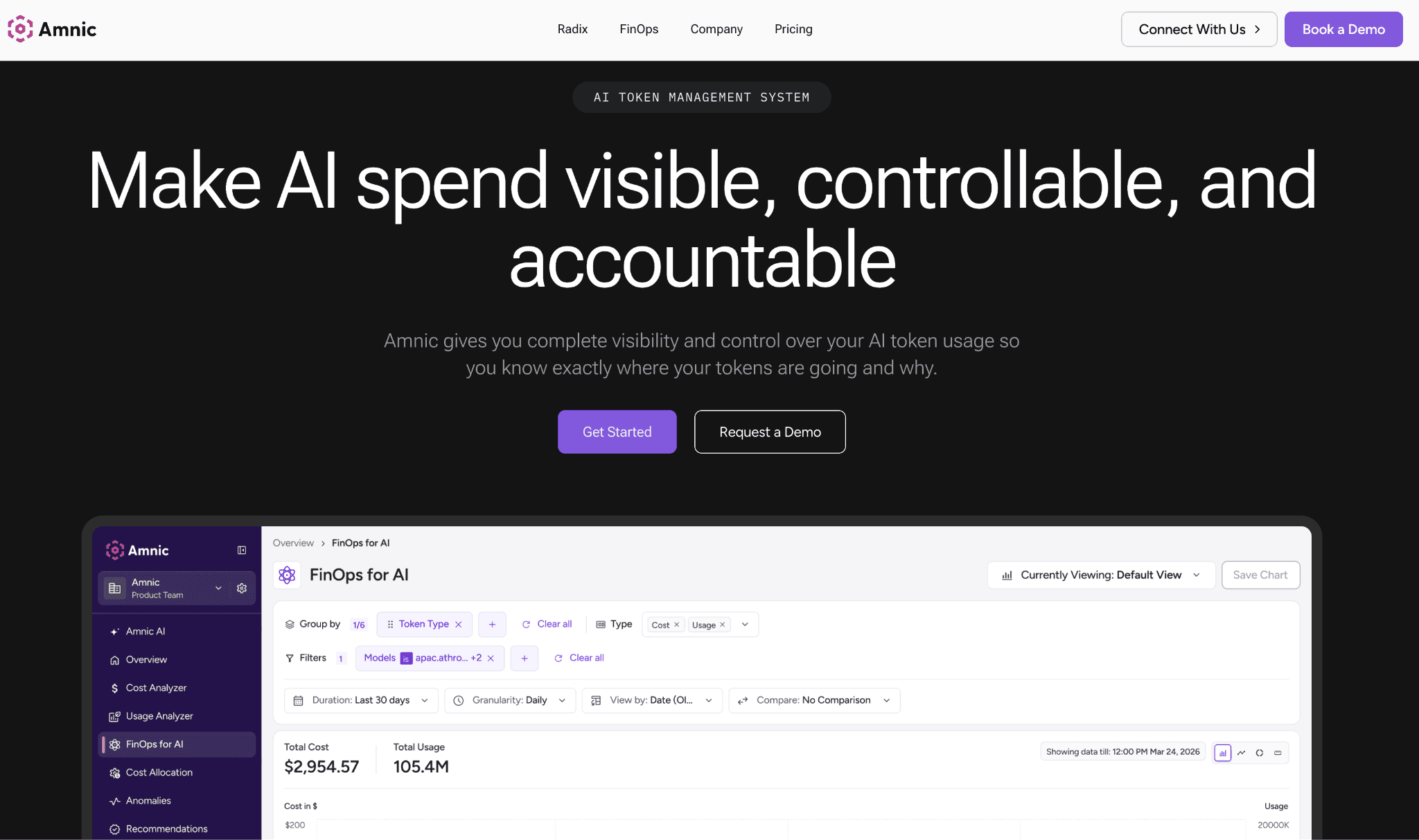
Amnic governs AI and cloud cost from a single agentless, read-only plane, so it reads your spend data without sitting in the request path or holding write access. That design keeps the security review short and lets finance own controls without waiting on engineering. It carries SOC 2, ISO and GDPR posture, which matters when the data is your full cost surface.
Governance here means budgets that map to teams, anomaly detection that flags a spike to an owner and allocation that splits every model call across the people who made it. Amnic also tracks AI token management so token spend sits next to GPU and cloud cost rather than in a separate tab, which is where most accountability breaks down.
Key features:
Agentless read-only ingestion, so it never sits in the request path and clears security review faster.
Budget policies tied to teams and products, with alerts routed to the owner who can act.
Anomaly detection that catches a spend spike early instead of at the month-end invoice time.
Cost allocation, showback and chargeback across AI providers and AWS, Azure and GCP in one view.
Unit economics that show cost per customer and per feature, so governance ties to revenue.
A built-in governance agent that surfaces breaches and recommended actions in plain language.
Forecasting that projects spend against your current model mix and token prices.
Pricing: Amnic prices as a percentage of monitored spend, roughly 0.25 to 1 percent, so the cost scales with what you actually track rather than a flat platform fee. You can see the model on its pricing page and start without a long procurement cycle.
Pros:
One plane for AI and cloud means accountability does not fall through the gaps between tools.
Read-only and agentless lowers the security and engineering lift to almost nothing.
Allocation plus budgets gives real chargeback, not just dashboards.
Cons:
Because it is read-only by design, it surfaces and alerts on a breach rather than hard-blocking a single request at the gateway, so pair it with a gateway when you need a runtime kill switch.
Explore the AI cost governance agent that runs these policies for you.
2. Finout
Best for: Enterprises that want one consolidated bill across AI and cloud with allocation baked in.
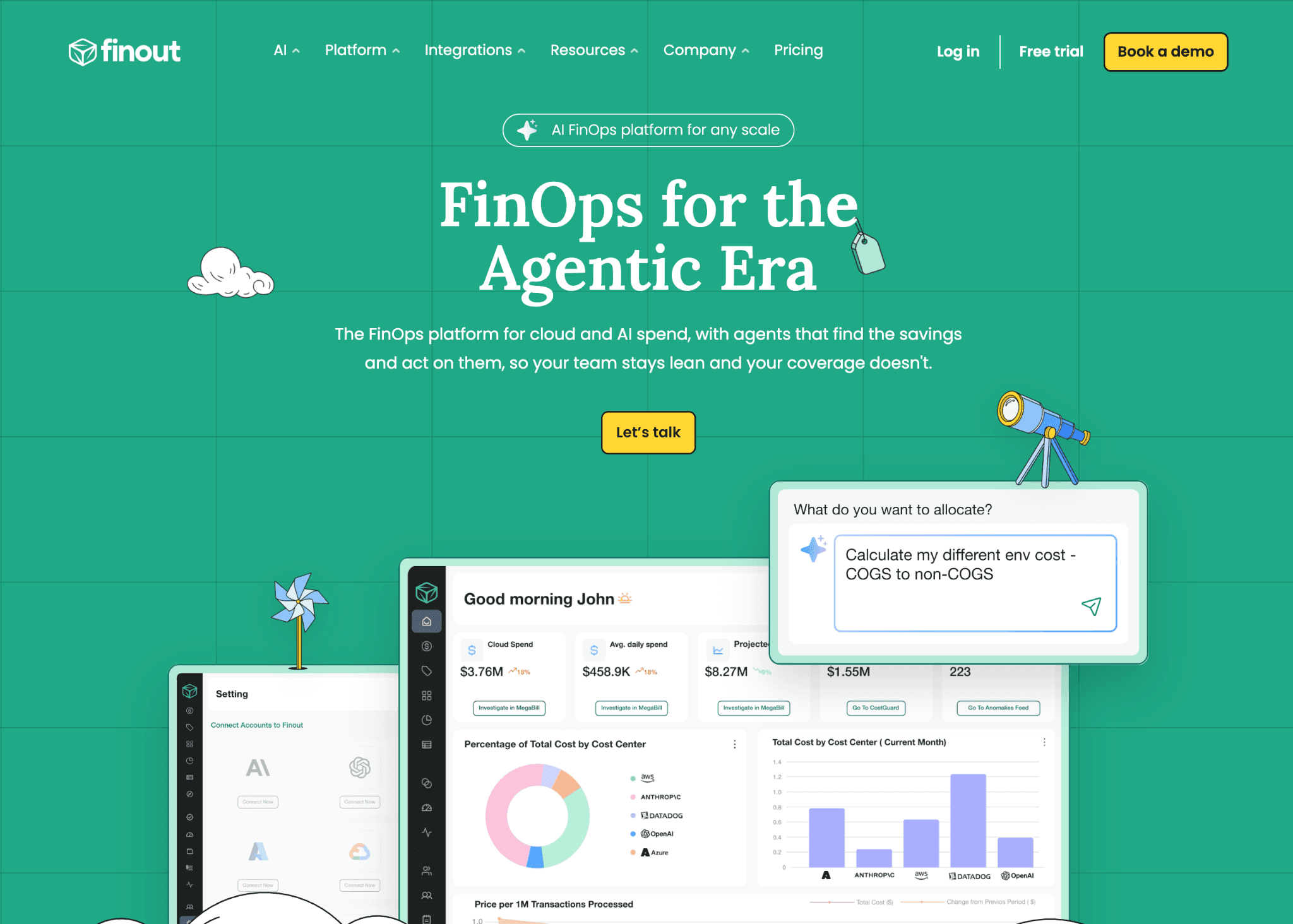
Finout pulls OpenAI, Anthropic, cloud infrastructure and Kubernetes into a single bill it calls MegaBill, then uses Virtual Tagging to map agent cost to teams and customers without changing application code. That code-free allocation is the draw for finance teams who cannot wait on engineering to instrument every service. Its CostGuard layer flags waste across the same surface.
Where Finout frames itself for agentic workloads is in the language of governance: policies, visibility and accountability for autonomous systems. The controls lean toward allocation and alerting rather than a runtime stop, so it tells you fast when an agent runs hot but does not cut the next call at the model.
Key features:
MegaBill consolidates AI provider spend with cloud and Kubernetes into one normalized view.
Virtual Tagging allocates cost to teams and customers without code changes.
CostGuard surfaces waste across both AI and cloud spend.
Anomaly detection routes unusual spend patterns to the right owner.
Budget alerts warn when a team approaches its defined limit.
Unit-economics views connect cost to product and customer.
Coverage spans the major LLM providers plus the cloud underneath them.
Pricing: Finout sells on an enterprise, quote-based model with no public free tier, so expect a sales conversation and annual commitment. Pricing tracks the scale of spend under management.
Pros:
Strong code-free allocation that finance can run without engineering.
One bill across AI and cloud reduces the reconciliation work.
Mature anomaly and waste tooling.
Cons:
Governance is allocation and alert led, so it warns about an overspending agent rather than stopping the call at the model and the opaque enterprise pricing raises the entry bar.
3. Kong AI Gateway
Best for: Platform teams that need a hard pre-spend stop sitting in the request path.
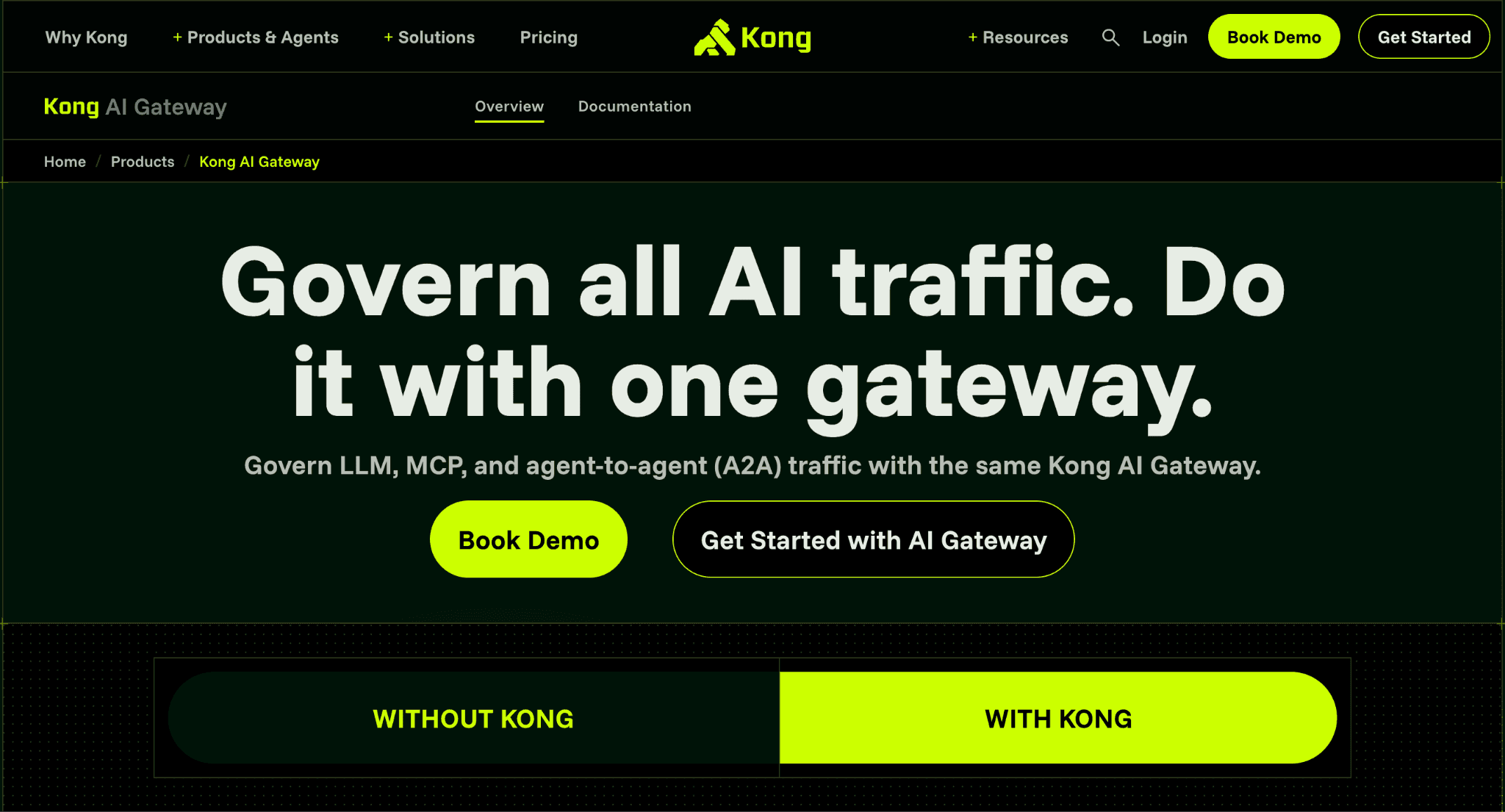
Kong AI Gateway lives at the runtime layer, so it can enforce limits at the point of access before a model call is ever paid for. Its cost-based rate limiting enforces dollar budgets, not just token counts, by computing the actual cost of each response from per-model input and output prices. For teams that want a kill switch rather than a warning, that placement is the whole point.
Through Konnect Metering and Billing, Kong meters and governs across LLMs, MCP servers, APIs and event streams in one engine. It also stacks cost techniques like semantic routing, caching and prompt compression. The trade is that it is infrastructure, not a finance dashboard, so allocation for a CFO is thinner than a FinOps platform.
Key features:
Cost-based rate limiting that enforces dollar budgets at runtime, not after the fact.
Per-model input and output cost computation for accurate per-response pricing.
Entitlements and limits enforced at the point of access.
Konnect Metering and Billing across LLMs, MCP, APIs and events.
Semantic routing to send queries to the cheapest adequate model.
Semantic caching to eliminate redundant calls entirely.
Prompt compression to cut token counts before the provider sees them.
Pricing: Kong is consumption-based, around 105 dollars per month per gateway service plus roughly $34.25 per million requests, per its published pricing. The plugin that limits by tokens and cost, AI Rate Limiting Advanced, is a premium enterprise feature.
Pros:
Genuine pre-spend enforcement in the request path.
Dollar-denominated budgets, not just token counts.
Strong stacked optimization techniques.
Cons:
It is a gateway, not a finance allocation system, so chargeback and showback are weaker and the key token and cost limiting plugin is gated to the enterprise tier.
4. DigiUsher
Best for: Organizations that want policy-as-code enforcement across multi-cloud AI.
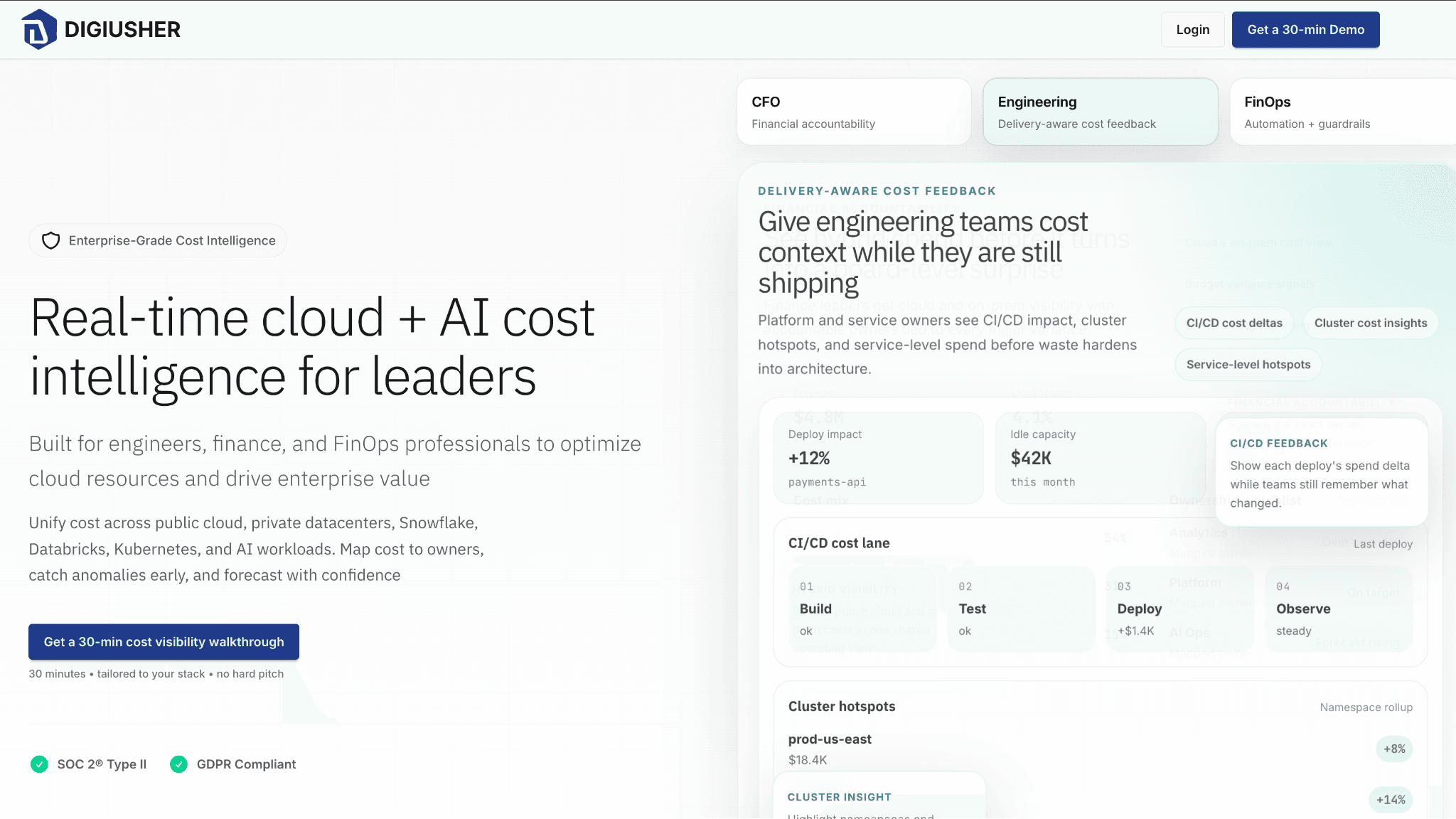
DigiUsher takes a policy-engine approach to governance. Its tagging enforcement blocks provisioning of AI resources that arrive without model-level metadata, which kills the untagged-spend problem at the source. Its policy engine then encodes token budget caps, GPU idle rules and inference throttle triggers as machine-enforceable rules that apply across AWS Bedrock, Azure OpenAI, GCP Vertex AI and third-party APIs from one plane.
That cross-provider, rule-driven enforcement is its differentiator against dashboard-first tools. Lifecycle automation rightsizes GPU clusters, terminates idle endpoints and schedules batch jobs. The catch is quote-only pricing and a broad cloud focus, so LLM-token depth can vary by setup.
Key features:
Mandatory tagging enforcement that blocks untagged AI provisioning.
A policy engine encoding token caps, GPU idle rules and throttles as enforceable rules.
Cross-provider reach across Bedrock, Azure OpenAI, Vertex AI and third-party APIs.
Predictive unit-economics modeling from token usage signals.
Lifecycle automation that rightsizes GPU and terminates idle endpoints.
Batch-job scheduling to smooth spend.
A single governance plane across cloud and AI.
Pricing: DigiUsher uses custom quotes with unlimited users and accounts, plus discounts for multi-year, nonprofit and self-hosted setups. There is no public self-serve tier, so plan for a sales conversation.
Pros:
Policy-as-code that blocks bad spend before it provisions.
Broad multi-cloud and multi-provider enforcement.
Strong lifecycle automation.
Cons:
Pricing is quote-only with no transparent tier and the broad cloud focus means LLM-token depth depends on configuration, with a smaller community than incumbents.
5. Astuto
Best for: Teams that want a free starting point with a real policy engine across cloud and AI.

Astuto, through its OneLens product, organizes governance around four pillars it labels Observe, Optimize, Automate and Govern. It ships more than 100 live policies, routes anomaly alerts to Slack, Jira, or ServiceNow and allocates cost through Cost Centers and Virtual Tags across AWS, Azure, GCP, OCI and AI services. The free plan lowers the barrier to trying real policy enforcement.
For governance specifically, the strength is the policy library and the unit-economics tracking that ties cost per customer or feature to usage. The honest limit is that enforcement leans on policy plus alert routing rather than a runtime kill switch at the model call and the product is rooted in cloud cost first.
Key features:
A policy engine with over 100 live policies across cloud and AI.
Anomaly alerts routed to Slack, Jira, ServiceNow, or email.
Cost Centers and Virtual Tags for allocation.
Unit-economics tracking by customer, feature and service.
Coverage across AWS, Azure, GCP, OCI, plus AI and observability spend.
Prebuilt dashboards and customizable reports.
A free plan to start before committing.
Pricing: Astuto offers a free plan with cost reports and optimization tools, then custom paid plans with a free pilot option. That makes it one of the lower-friction ways to test policy enforcement.
Pros:
A genuine free tier with a working policy engine.
Flexible anomaly routing into existing workflows.
Solid unit-economics tracking.
Cons:
Governance leans on policies and alert routing rather than a hard runtime stop at the model call and the product is younger and cloud-cost rooted.
6. Mavvrik
Best for: Teams instrumenting agentic workflows that need accurate per-agent chargeback.
Mavvrik positions itself as full-stack AI cost governance, connecting agent, model, GPU, SaaS and cloud spend for real-time accountability. Its SDK, built on the OpenTelemetry standard, captures token usage, latency, tool calls and cost for every step of a multi-agent workflow without code changes and lets developers attach business context like customer ID and feature to each interaction. That step-level capture is what makes per-agent chargeback accurate.
The platform delivers chargeback to teams, projects, or customers and forecasts across GenAI, agentic, cloud, on-prem and SaaS. It deploys as SaaS without professional services. The trade is that its strength is visibility, chargeback and forecasting, with lighter hard enforcement at spend time and pricing is not public.
Key features:
An OpenTelemetry-based SDK capturing token, latency, tool-call and cost per workflow step.
Business context attached to each interaction for accurate attribution.
Chargeback to teams, projects and customers.
Forecasting across GenAI, agentic, cloud, on-prem and SaaS.
Full-stack coverage connecting agent, model, GPU and SaaS spend.
Immediate SaaS deployment without professional services.
Availability through Google Cloud Marketplace and channel partners.
Pricing: Mavvrik does not publish pricing, so cost requires a direct conversation or a marketplace listing. Expect terms to track the scale of workflows under management.
Pros:
Step-level instrumentation gives precise per-agent chargeback.
Broad full-stack coverage, including agentic workflows.
Fast deployment without services.
Cons:
The strength is visibility, chargeback and forecasting, with lighter pre-spend runtime enforcement and pricing is not public.
How to Choose the Right AI Cost Governance Tool
You need to hard-stop an agent mid-run before the next call: look at Kong AI Gateway, which enforces dollar budgets in the request path before a call is paid for.
You need finance-grade allocation and chargeback across AI and cloud: Amnic, Finout and Mavvrik tie spend to owners cleanly. Pair this with strong cost allocation so accountability is clear.
You want policy-as-code that blocks untagged provisioning: DigiUsher enforces tagging and budget rules at the source.
You want a free starting point with a working policy engine: Astuto offers a free tier to test before committing.
You want unit-cost intelligence per feature or customer: Amnic, Finout and Mavvrik break spend into per-unit metrics. Compare them against dedicated AI cost visibility tools before deciding.
You run agentic workflows and need per-step cost: Mavvrik and Finout capture agent-level detail for agentic AI workloads that span many calls.
Common Mistakes When Choosing AI Cost Governance Tools
Treating alerts as enforcement: A budget alert notifies you after the spend happened. Real governance stops the next call when a threshold is crossed, so check whether the tool acts or only warns.
Governing only the LLM bill: Token cost is the visible part. The GPU, inference and cloud underneath often cost more, so a tool that ignores them governs half the problem. Tie token spend to your GPU cost optimization tools view.
Skipping allocation: Governance without chargeback is just dashboards. If you cannot map spend to a team, no one owns the overspend, so settle chargeback and showback before you roll out budgets.
Buying one half and expecting both: A gateway stops calls but rarely allocates for finance and a FinOps platform allocates but may not hard-stop. Know which half you bought.
Setting budgets once and forgetting forecasts: Model prices and traffic shift, so a static budget goes stale fast. Pair budgets with forecasting that updates against your real model mix.
Why Decision Makers Choose Amnic for AI Cost Governance
Amnic governs AI and cloud spend from one agentless, read-only plane, so finance gets controls without an engineer placing code in the request path and without granting write access to production. That keeps the security review short while still covering the full cost surface, the layer where clean chargeback vs showback decisions usually break down.
The platform pairs enforcement-minded policy with real allocation. Budgets map to teams, anomalies route to an owner and every model call is attributable, so chargeback is honest rather than estimated. Teams like LambdaTest and Nanonets run their cloud and AI accountability on Amnic. The same single plane that tracks token spend next to GPU and cloud cost also reports unit economics, so you can see whether a feature earns more than it costs to run.
Pricing stays proportional at roughly 0.25 to 1 percent of monitored spend, so governance does not become its own cost problem. If you want the policy and reporting handled by software, an AI governance agent can surface breaches and next steps in plain language and you can compare the broader set in our guide to FinOps tools for AI cost management.
Frequently Asked Questions
What are AI cost governance tools?
AI cost governance tools control and account for AI spending before the invoice lands. They combine visibility, allocation, policy enforcement like budgets and guardrails and chargeback, so teams stay within limits and own what they use across models, agents, GPU and cloud.
How is AI cost governance different from AI cost visibility?
Visibility shows you what was spent after it happened. Governance adds policy enforcement, guardrails and accountability that act before or at spend time. Visibility is a dashboard, governance is a set of rules that caps, stops, or assigns the spend.
Can AI cost governance tools stop an agent before it overspends?
Gateway tools like Kong AI Gateway can, because they sit in the request path and enforce dollar or token budgets before a call runs. FinOps platforms allocate and alert instead, so many teams pair a gateway for the hard stop with a FinOps plane for accountability.
What should an AI cost governance policy include?
A strong policy sets budgets per team and feature, mandatory tagging so spend is attributable, anomaly thresholds that route to an owner, access rules on which models a team can use and a forecast that updates as prices and traffic change.
Do I need a gateway or a FinOps platform for AI cost governance?
It depends on the goal. A gateway gives you a runtime stop but thin finance allocation. A FinOps platform gives allocation, chargeback and budgets across AI and cloud. Many teams run both, using the platform for accountability and the gateway for hard enforcement.
How much do AI cost governance tools cost?
Pricing varies widely. Amnic charges roughly 0.25 to 1 percent of monitored spend, Kong runs about 105 dollars per service per month plus usage and Astuto offers a free tier. Several vendors like Finout, DigiUsher and Mavvrik are quote-only, so confirm current pricing directly.
Get AI Spend Under Control
AI cost governance is the difference between a budget people follow and a surprise bill no one owns. The right tool gives you policy, allocation and accountability in one place instead of a report you read too late. See how Amnic governs AI and cloud spend from a single read-only plane and request a demo.
Better visibility and management into AI Tokens?
Start with a 30 day trial
Connect leading LLMs
24 hour time to value
Stay ahead of AI Spend

Make AI spend visible, controllable, and accountable.
Gain insights into your AI token costs at a team, customer, business unit and individual user level to measure and manage AI utilization.
Recommended Articles

8 Best Llama Cost Management Tools in 2026
Read More
8 Best Amazon Bedrock Cost Optimization Tools for 2026
Read More

7 Best Amazon Bedrock Cost Monitoring Tools
Read More

8 Best Gemini Cost Visibility Tools for 2026
Read More

7 Best Multimodal Cost Optimization Tools for 2026
Read More

5 Best Anthropic Cost Allocation Tools for 2026
Read More