7 Best OpenAI Cost Optimization Tools for 2026
12 min read
Tools

Table of Contents
Comparing the top OpenAI cost optimization tools for 2026 are 1. Amnic, 2. Portkey, 3. Helicone, 4. LiteLLM, 5. OpenRouter, 6. Martian and 7. Langfuse.
OpenAI cost optimization tools cut your API bill by pulling three levers: caching repeated context, routing simple calls to cheaper models and batching non-urgent work. The need is real because OpenAI charges per token, output tokens cost four to six times more than input tokens and a single dashboard total cannot tell you which feature or team is burning the spend.
These tools split into two jobs. Gateways and routers reduce the bill at request time. A FinOps layer attributes the bill, budgets it and reports it the way finance handles cloud cost. Amnic ranks first for that second job, then connects to OpenAI alongside Anthropic, Gemini and Bedrock plus AWS, Azure and GCP so AI and cloud reconcile in one place.
Here is a detailed comparison of the best OpenAI cost optimization software for 2026, starting with Amnic. Book a 30-minute Amnic demo to see OpenAI cost optimization in action, then where your wider cloud spend leaks, before the call ends.
Top OpenAI Cost Optimization Tools at a Glance
Amnic: OpenAI spend attribution, model budgets and anomaly alerts inside a full FinOps platform that also covers your cloud bill.
Portkey: AI gateway with semantic caching, model routing, budgets and guardrails across a very large model catalog.
Helicone: Drop-in proxy that logs OpenAI cost and latency and serves repeated requests from cache with one line of setup.
LiteLLM: Open-source proxy that routes and load-balances across 100+ providers with per-key budget caps.
OpenRouter: Routing layer that sends each call to the cheapest qualifying provider with a hard price ceiling.
Martian: Adaptive model router that downgrades calls to a cheaper model when quality allows.
Langfuse: Open-source tracing platform with token cost tracking, prompt versioning and evaluations.
OpenAI Cost Optimization Tools Comparison Table
Information reflects vendor sources as of June 2026. Confirm current pricing with the vendor.
Tool | Best for | OpenAI coverage and cost levers | Free option | Pricing model |
|---|---|---|---|---|
Amnic | FinOps and finance teams owning AI plus cloud spend | OpenAI, Anthropic, Gemini, Bedrock; attribution, model budgets, anomaly alerts | One-month trial | % of monitored spend |
Portkey | Multi-model teams wanting a production gateway | Semantic caching, routing, budgets, guardrails, virtual keys | 10k logs/mo | Tiered, from $49/mo |
Helicone | Fast request-level cost visibility plus caching | Logging, response caching, rate limits, cost analytics | 10k requests/mo | Tiered, from $79/mo |
LiteLLM | Engineers standardizing many providers behind one API | Routing, load balancing, per-key budgets, Redis caching | Open-source self-host | Free OSS + enterprise |
OpenRouter | Routing every call to the cheapest provider | Lowest-cost routing, price ceilings, quality-cost dial | Pay as you go | Passthrough + credit fee |
Martian | Teams routing between a strong and a cheap model | Adaptive model routing on quality and cost | 2,500 requests | Usage-based + enterprise |
Langfuse | Deep tracing and prompt-level cost data | Trace-level cost, prompt versioning, evals | 50k units/mo | Tiered + self-host |
What Are OpenAI Cost Optimization Tools?
OpenAI cost optimization tools are software that reduce what you pay OpenAI for API calls and make the remaining spend visible, owned and predictable. They turn a single monthly token total into a bill you can cut at the source and assign to the team or feature that caused it.
Each OpenAI response returns a usage object with input, output and sometimes cached token counts. Optimization tools act on that flow in three places. They cache repeated prefixes so the model is not billed twice for the same system prompt, where cached input tokens run 75 to 90% cheaper than standard input. They route simple calls to a cheaper model, since a mini-class model can be roughly an order of magnitude cheaper per token than a flagship. They move non-urgent jobs to the Batch API for a flat discount.
For a FinOps lead or AI platform engineer, the harder half is accountability. They need to answer who spent what on OpenAI and why, then tie it to cost allocation so a feature that burns tokens shows up against the revenue it earns. The seven tools below cover both halves, starting with the finance layer.
The OpenAI Savings Stack: What Each Lever Is Worth
Before you buy a tool, it helps to know which lever moves the bill the most, because the tools below are just ways to pull these levers at scale. OpenAI documents each of these in its own cost-management guidance and stacking them is how teams take a large share off the bill in a quarter without users noticing.
Model right-sizing is the biggest single win: Most calls do not need a flagship model. Routing the simple ones to a mini or nano model can turn a four-figure monthly workload into a two-figure one, since the cheaper tiers run far less per token. This is the first thing to fix and most teams over-provision here.
Prompt caching is free money you are probably leaving on the table: OpenAI automatically discounts repeated prefixes, billing cached input at roughly a tenth of the standard rate. The catch is structure: the shared system prompt and context have to sit at the start of the request or none of it qualifies.
The Batch API is the lazy 50% off: Anything that does not need an instant answer, nightly classification, bulk tagging, report generation, can run asynchronously for half price. Teams skip it because it needs a queue, not because it is hard.
Output limits and streaming control the expensive half: Output tokens cost several times more than input, so an uncapped response quietly burns money. Capping length and cancelling abandoned streams claws back real spend.
A tool earns its place by automating one or more of these. A finance layer earns its place by proving the savings held, which is the part the gateways skip.
How We Evaluated These Tools
Cost-reduction levers: does it actually cut the bill through caching, routing or batching, not just chart it.
OpenAI coverage: how well it handles OpenAI models, cached tokens and the usage object.
Attribution granularity: can it split OpenAI cost by team, feature, user or customer, not only by model.
Budget and governance: can it cap spend per team or model before the invoice lands.
Deployment fit: managed, open-source or self-hosted for data control.
Finance connection: whether OpenAI spend joins the wider cost practice and unit economics or stays stuck in engineering.
Best OpenAI Cost Optimization Tools Reviewed
1. Amnic
Best for: FinOps and finance teams that need OpenAI spend to behave like every other governed cost line, with attribution and budgets the CFO can read.
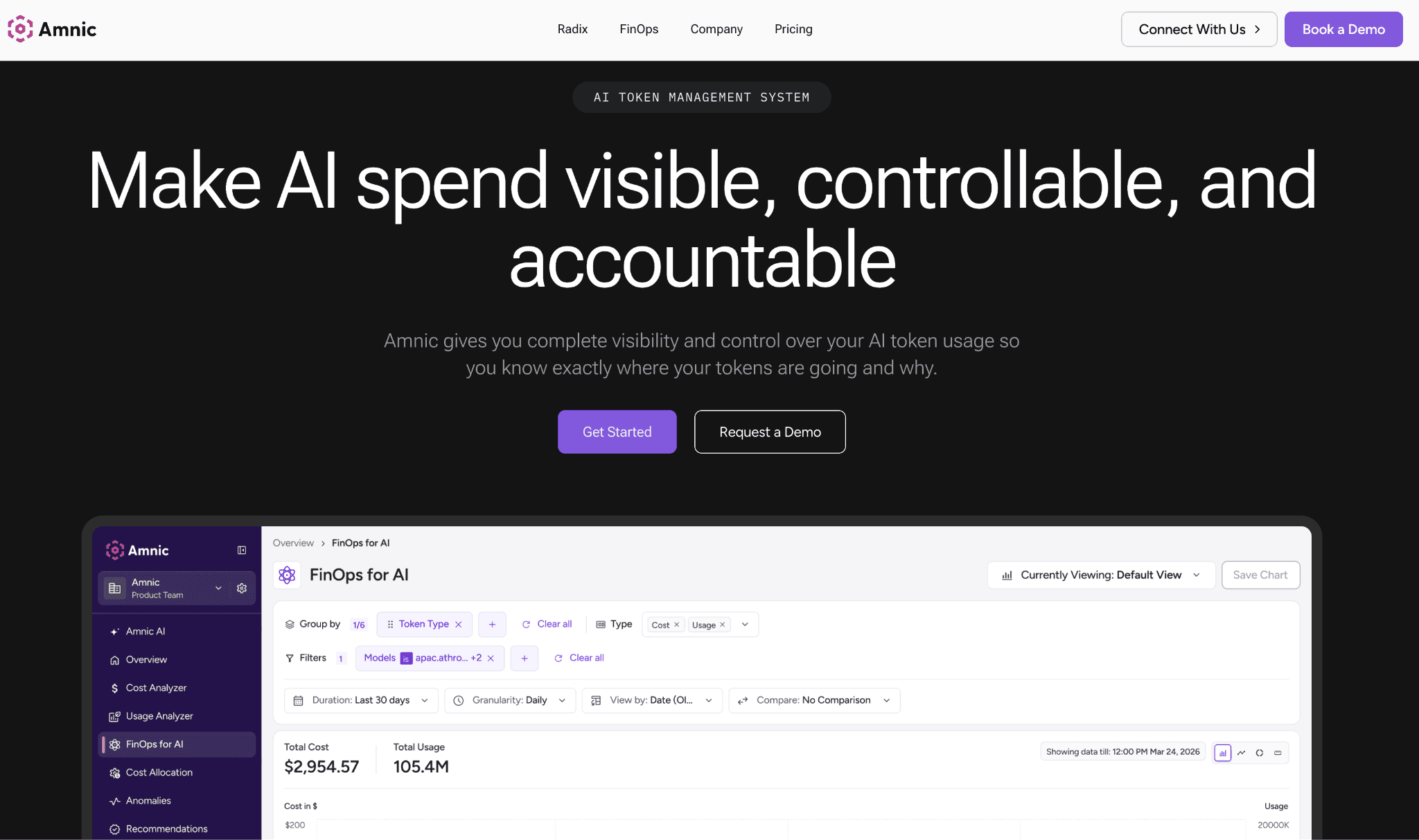
Amnic tracks input and output token consumption across OpenAI, Anthropic, Gemini and Amazon Bedrock, then attributes it to teams, users and cost centers for real chargeback. Budgets sit across teams and models and trip before the invoice, not after.
The platform is agentless and read-only, so it reads provider and billing data without write access to your stack. Because OpenAI spend lives in the same place as AWS, Azure and GCP cost, finance reconciles AI and cloud together instead of in two disconnected tools. That is the gap most gateways leave open, since they reduce the bill but never tie it back to the business.
Key features:
Tracks input and output tokens per call across OpenAI, Anthropic, Gemini and Bedrock, so every provider rolls into one number instead of four dashboards
Maps that spend back to the team, feature or customer that caused it, which is what makes real chargeback possible rather than a guess
Lets you set budgets per team and per model that alert and trip before the invoice lands, not three weeks after
Flags cost spikes the moment they start with anomaly detection, so a runaway agent loop does not quietly run all weekend
Shows cost and margin per feature, so you can see which AI feature actually pays for itself and which is a money pit
Puts OpenAI spend right next to AWS, Azure and GCP cost in a view finance already reads
Reads data agentless and read-only, with SOC 2, ISO and GDPR posture, so security signs off without a long review
Pricing: Amnic charges a percentage of the spend it monitors, roughly 0.25% to 1%, so the cost scales with the bill it helps you cut instead of a flat per-seat fee. A one-month free trial is available.
Pros:
It answers the question finance actually asks, who spent this and on what, instead of charting a total nobody can break down
AI and cloud cost sit in one place, so month-end stops being a reconciliation between two tools
Read-only access means engineering never has to hand over write keys just to get visibility
Cons:
It governs and attributes spend rather than routing or caching calls, so you still want a gateway alongside it for request-time cuts
Percentage pricing is worth a sizing conversation once your bill gets very large
Amnic suits the team that has to explain the OpenAI line to finance. Start a free Amnic trial to attribute your AI spend in days.
2. Portkey
Best for: engineering teams running many models in production that want caching, routing and budgets in one gateway.
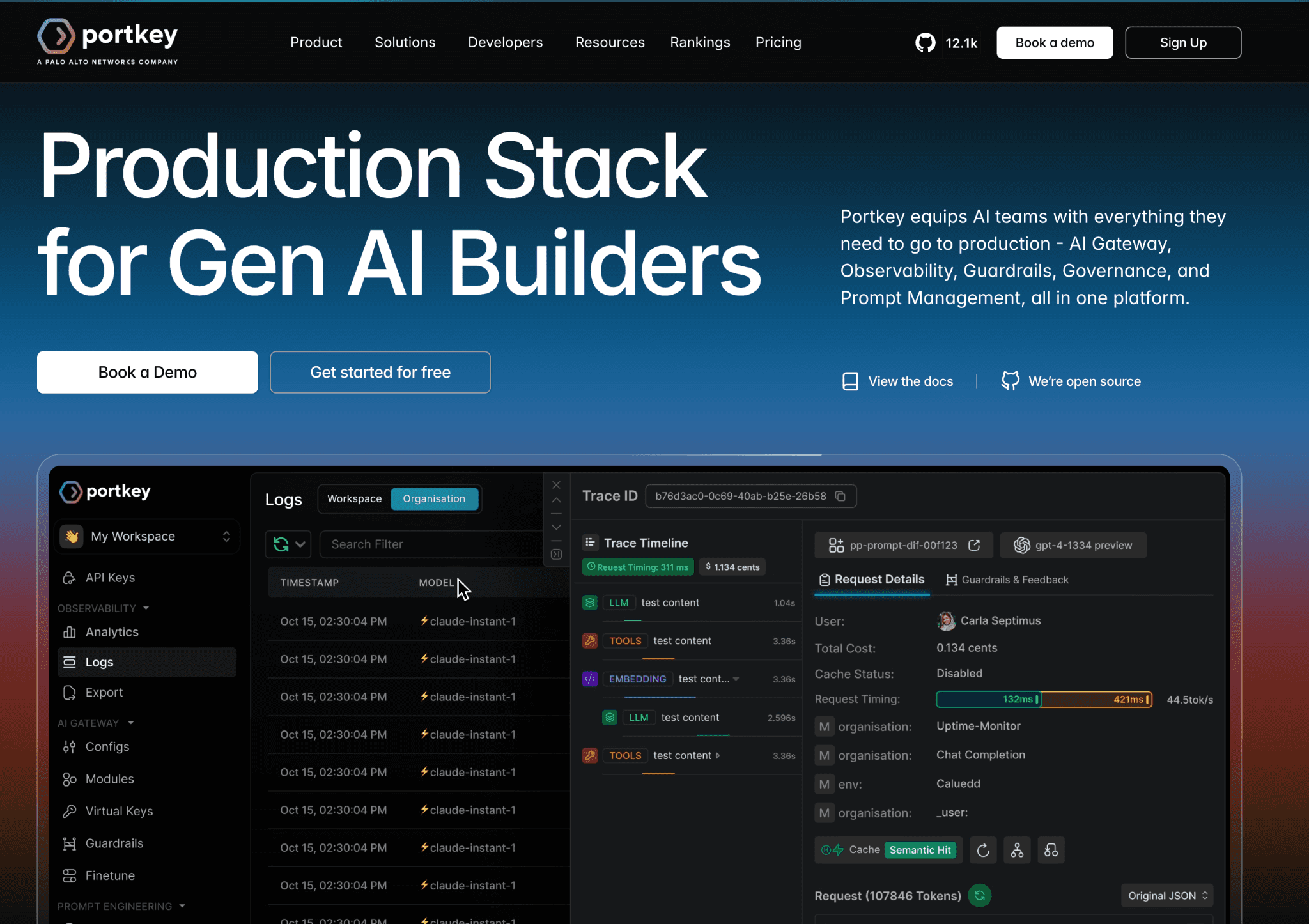
Portkey sits in front of your model calls as a gateway and tracks the token spend on every request, so you can see AI cost build up live and attribute it by model, key, or team. On top of that visibility it applies semantic caching, which returns a stored answer when a new prompt is close enough to a previous one rather than only on an exact match. That fuzzy match helps repetitive workloads like support, where users ask the same thing in different words, and it shows up directly as lower token cost.
Around the cost data it adds routing, fallbacks, virtual keys, and real-time budget alerts that cap token spend per key or team, plus production controls like guardrails and PII redaction. It covers a very large model catalog, so OpenAI calls share one control plane and one cost view with the rest of your providers. Its token cost tracking is request-time and engineering-facing, so many teams still pair it with a FinOps for AI layer for finance-grade attribution.
Key features:
Semantic caching that matches prompts by meaning, so a slightly reworded question still hits the cache instead of paying full price again
Model routing with automatic fallbacks, so a provider outage reroutes instead of erroring out
Budget limits per key and per team with alerts, which stops one runaway service from eating the whole quota
Production guardrails including PII redaction and jailbreak detection, handled at the gateway rather than in app code
Virtual keys, so you can hand a team its own scoped access without sharing the real provider key
A large model catalog behind one endpoint, so OpenAI and everything else share one control plane
Real-time spend tracking you can watch as traffic flows
Pricing: The free Developer tier includes 10,000 logs per month with short retention. Paid plans start around $49 per month for the Production tier and Enterprise is priced on request.
Pros:
The production-safety features go well beyond cost, which is rare in a gateway
Semantic caching is genuinely good at squeezing repeated-prompt spend
One gateway covers a long list of providers, so you are not locked to OpenAI
Cons:
The free tier stops logging after 10,000 records a month, so most of your traffic goes dark until you pay
It controls cost at request time but does not attribute it, so finance still needs a separate view
3. Helicone
Best for: teams that want OpenAI cost and latency visibility fast, with caching as a bonus.
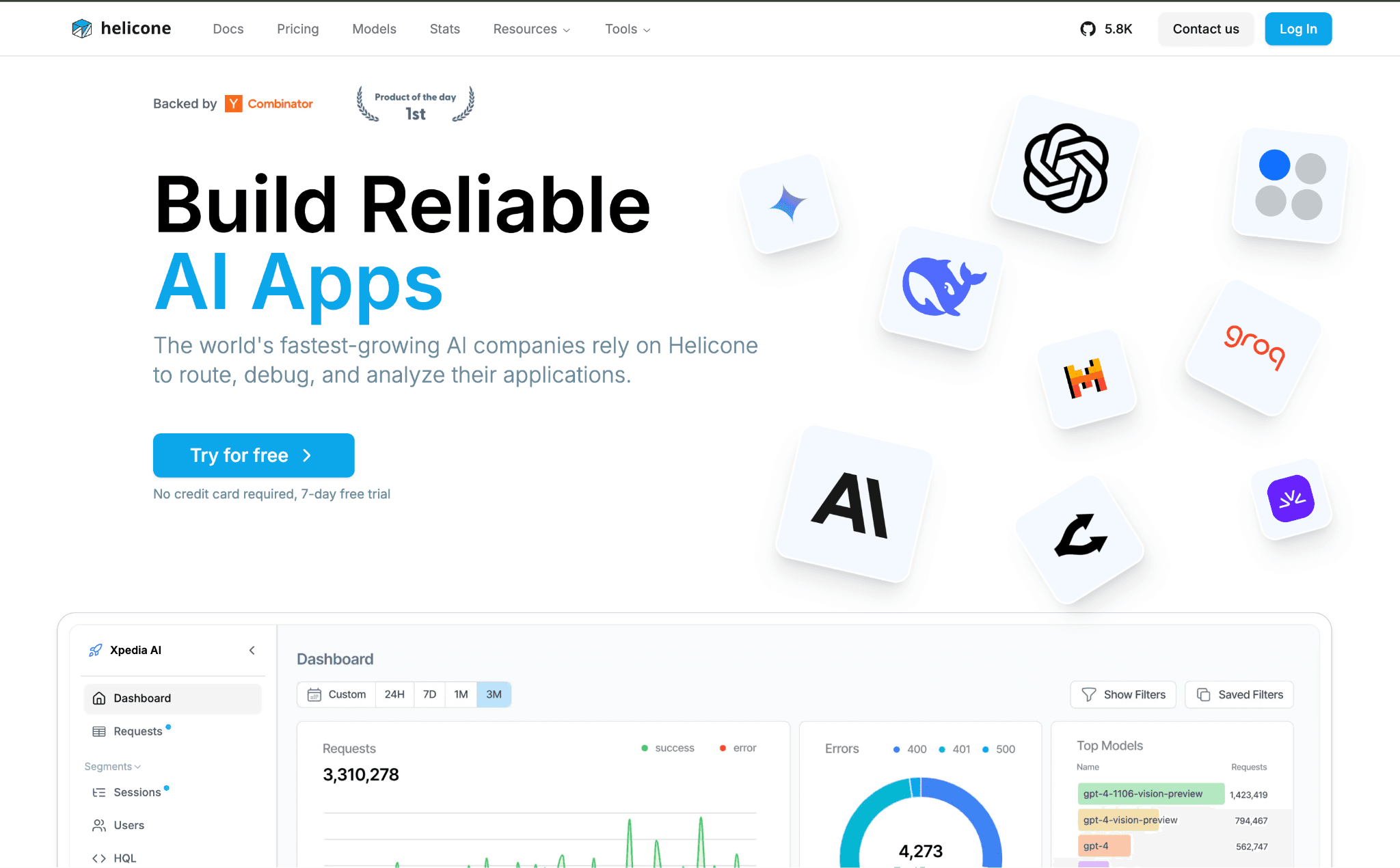
Helicone is a proxy you add with roughly one line of setup, after which every OpenAI request is logged with input, output, token counts, latency and cost. The analytics view makes it easy to spot a spend spike or a slow endpoint, which is the first step in any LLM cost comparison exercise.
Its gateway layer also caches repeated requests, which the vendor cites as cutting roughly 20 to 30% of API cost on repetitive traffic. Helicone leans toward observability rather than aggressive routing, so teams chasing the deepest cuts often pair it with a router. For a quick read on where OpenAI money goes, it is one of the lowest-effort options here.
Key features:
A one-line proxy change to start, so you get data the same afternoon you install it
Full request and response logging, which is what you want the first time a bill jumps and you have no idea why
Response caching that serves repeat calls from store instead of re-billing them
Cost, token and latency analytics in one view, so a spike and a slowdown are easy to spot
Rate limiting and custom property tags, so you can slice spend by whatever label matters to you
Session and trace views built for agents and multi-step chains, not just single calls
Alerting when cost or latency drifts, before it shows up on the invoice
Pricing: The free Hobby plan covers 10,000 requests per month with short retention. The Pro plan is around $79 per month and a Team plan adds compliance features.
Pros:
It is the fastest way here to see where OpenAI money is going
Caching takes a real bite out of repeated-request spend
The free tier is generous enough to run a small app on
Cons:
It leans observability, so for aggressive routing or deep cuts you will add a second tool
Per-request logging costs climb once you are at high volume
4. LiteLLM
Best for: engineers who want one OpenAI-compatible API across many providers with budget caps built in.
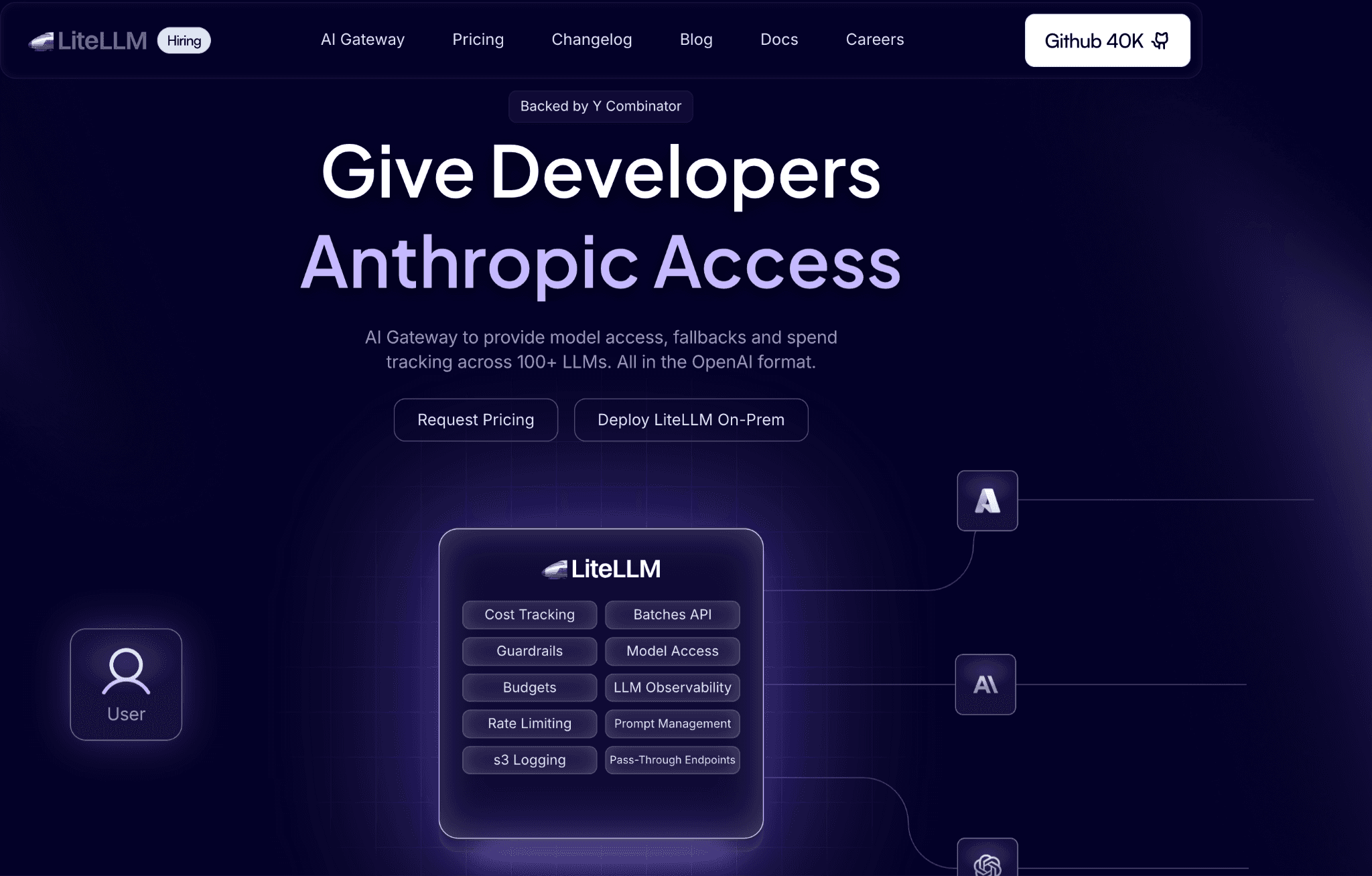
LiteLLM is an open-source proxy that wraps 100+ providers behind a single OpenAI-style endpoint, so you can switch or load-balance models without rewriting code. Its main cost lever is routing, sending traffic across models and providers, with budget and rate limits set per team, user or API key.
It supports Redis-based caching for exact matches, with semantic caching available as a secondary feature. Because it is free to self-host as a Docker container, the trade-off is operational: you run and maintain it. Teams already standardizing their stack often place LiteLLM at the gateway and feed its spend data into FinOps tools for AI cost management for reporting.
Key features:
One OpenAI-compatible endpoint in front of 100+ providers, so swapping a model is a config change, not a code rewrite
Routing and load balancing across models, so you can shift traffic to whatever is cheapest or fastest that day
Budgets and rate limits set per key, per user and per team, enforced at the proxy
Access keys you can issue and revoke without touching the underlying provider account
Redis-backed caching for exact-match prompts, with semantic caching available if you wire it up
Built-in spend tracking and logs, so the gateway doubles as a usage record
Runs as a Docker container you host yourself, which keeps data inside your perimeter
Pricing: The open-source proxy is free to self-host. An enterprise edition with support and extra controls is priced on request.
Pros:
Nothing else here covers as many providers behind a single API
The core is free and open-source, so there is no license to clear before testing
Budget controls are granular right down to the individual key
Cons:
You own the uptime, upgrades and scaling, which is real work if no one wants to run it
Caching is exact-match first; semantic matching is more of a bolt-on than a core feature
5. OpenRouter
Best for: teams that want every call routed to the cheapest qualifying provider with a hard price cap.
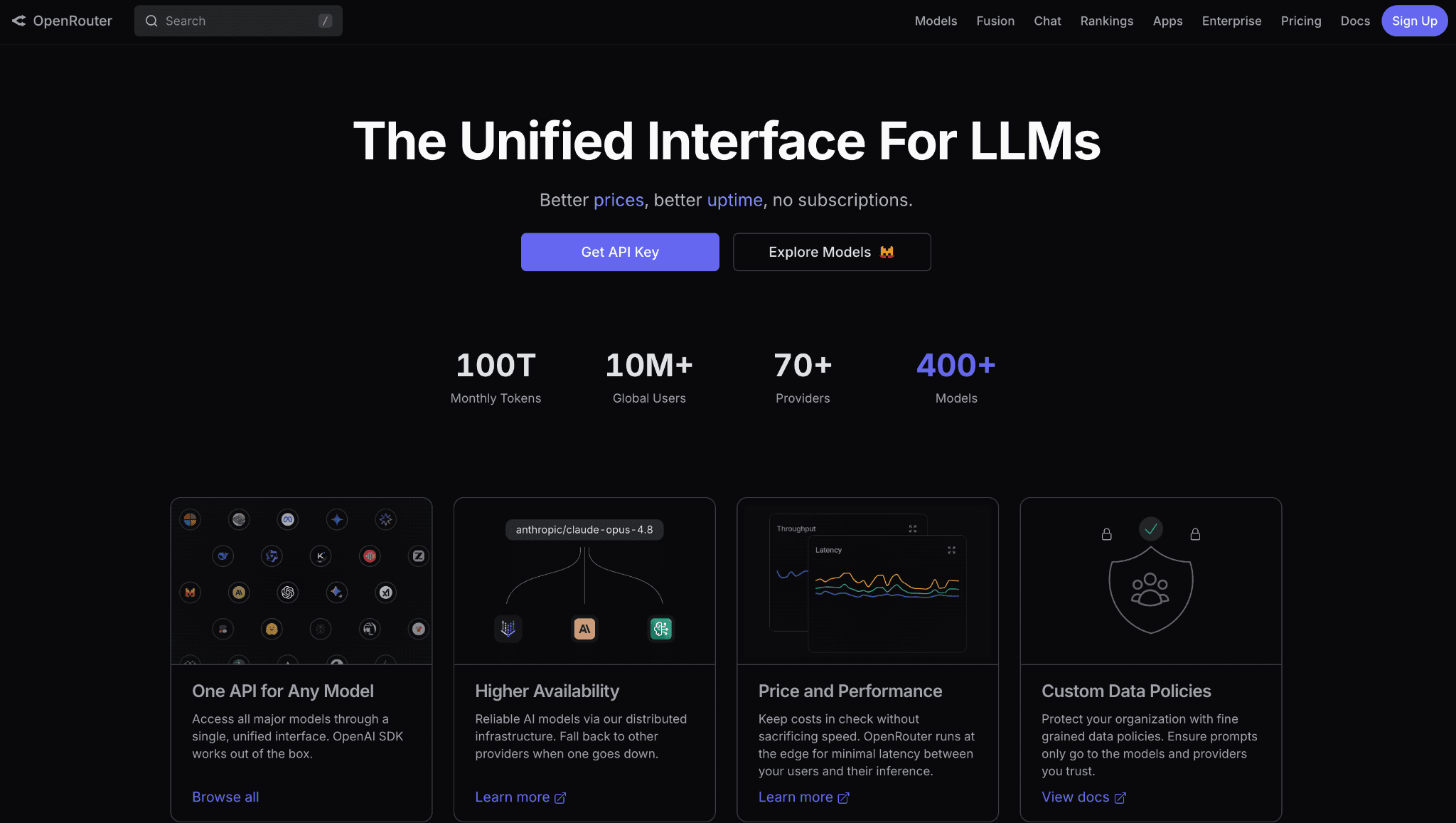
OpenRouter is a routing layer across hundreds of models that, by default, weights cheaper providers more heavily and lets you append a floor setting to always pick the lowest-cost option for a given model. A max-price control acts as a hard budget cap, failing a request instead of overspending, which is a clean guardrail for cost-sensitive pipelines.
Its Auto Router exposes a cost-quality dial so you can bias toward cheaper or stronger models per call. OpenRouter passes through provider pricing without markup and earns revenue through credit and usage fees instead.
It is a request-time cost tool, not an attribution platform, so OpenAI spend reporting still belongs elsewhere, for example a page on OpenAI API pricing for rate context.
Key features:
Routing that defaults to cheaper providers and lets you pin a model to its lowest-cost host with a floor setting
A hard max-price ceiling per request, so a call fails rather than quietly overspending your budget
An Auto Router with a cost-quality dial, so you decide per call whether to favor the cheap model or the strong one
Hundreds of models reachable through one API, including a set of free options for testing
Bring-your-own-key support, so you can route through your own provider contracts
Passthrough pricing, meaning you pay the provider's listed rate with no markup on tokens
One billing relationship instead of separate accounts at every provider
Pricing: Model rates pass through with no markup. OpenRouter takes about 5.5% when you buy credits and a 5% fee applies to bring-your-own-key usage past the first million requests a month.
Pros:
You pay the real provider rate on tokens, with the platform's cut sitting in the fees instead
The price ceiling and cheapest-provider routing are a clean guardrail for cost-sensitive jobs
The model selection is about as wide as it gets
Cons:
The credit and BYOK fees are small per call but add up once you are at serious volume
It cuts the bill but keeps no record of who spent what, so attribution lives somewhere else
6. Martian
Best for: teams routing between a strong model and a cheap model to cut spend without a visible quality drop.
Martian is an adaptive model router that predicts which model can handle a given request well, then sends easy calls to a cheaper model and hard calls to a stronger one. Routing is the single highest-impact lever for many OpenAI bills, since not every query needs a flagship model and Martian automates that decision per request.
It has clear enterprise traction, including investment and integration from Accenture for model routing in client systems. For smaller teams there is a developer tier and enterprises can deploy custom routers with SLA and VPC options. Like the other routers here, it reduces the bill but does not attribute it, so a GPU cost optimization or FinOps layer still owns the reporting side.
Key features:
Adaptive routing that predicts, per request, which model can handle the job and sends it to the cheapest one that can
Automatic downgrade of easy calls, so you are not paying flagship rates to answer simple questions
Custom routers tuned to your own tasks and data, rather than a one-size routing rule
Enterprise deployment with SLA and VPC options for teams that cannot send traffic to a shared service
A developer tier to test routing on real traffic before committing
Provider-agnostic model mapping, so it routes across vendors, not just OpenAI tiers
Dedicated support on the enterprise plan
Pricing: The developer tier includes 2,500 requests, then usage-based pricing of roughly $20 per additional 5,000 requests. Enterprise deployments are priced on request.
Pros:
Routing is the single biggest lever for most OpenAI bills and this automates the call
The enterprise validation is real, including investment and integration from Accenture
Once it is set up, model selection is hands-off per request
Cons:
It does one thing, routing, with no visibility or budgeting attached
The strongest value shows up at enterprise scale, less so for a small app
7. Langfuse
Best for: teams that want trace-level OpenAI cost data alongside prompt management and evaluations.
Langfuse is an open-source tracing platform that records each OpenAI call as a span with token cost, then ties that to prompt versions and evaluation scores. That trace-level view helps you find the prompt or chain that quietly drives spend, which is a different angle from gateway caching or routing.
It pairs cost data with prompt versioning and evals, so you can test a cheaper prompt and see both the cost and the quality change before shipping. Cloud and self-hosted options exist, though self-hosting carries real infrastructure overhead. Langfuse measures and improves spend rather than cutting it at the gateway, so it complements a router and an AI agents for FinOps workflow.
Key features:
Records every OpenAI call as a span with its token cost, so you can trace spend down to the exact prompt or chain step
Prompt versioning, so you can see which version of a prompt got more expensive and when
Evaluations sitting next to cost, so a cheaper prompt is judged on quality before it ships
An open-source core you can read and extend
Cloud or self-hosted, depending on whether data residency matters to you
Support for the major model providers, OpenAI included
Dataset and experiment tooling for testing changes on real traffic
Pricing: The free Hobby plan covers 50,000 units per month. The Core cloud plan starts around $29 per month. Self-hosting is free, but it needs Postgres, ClickHouse, Redis and object storage to run, so the infrastructure is not free.
Pros:
It is the best tool here for pinning down the exact prompt behind a cost
Open-source with a free tier you can actually build on
Cost and quality get tested side by side, so you do not trade one for the other blind
Cons:
It shows you the spend; it does not cache or route to cut it
Self-hosting is a heavy lift once you add up the four services it depends on
How to Choose the Right OpenAI Cost Optimization Tool
You need to explain the OpenAI bill to finance: choose Amnic for attribution, budgets and one view across AI and cloud.
You run many models in production: choose Portkey for caching, routing and guardrails in one gateway.
You want quick cost visibility with light caching: choose Helicone for one-line logging.
You are standardizing providers in code: choose LiteLLM for one API and per-key budgets.
You want the cheapest provider on every call: choose OpenRouter for floor routing and price ceilings.
You want automatic model downgrades: choose Martian for adaptive routing.
You want to find the prompt behind the spend: choose Langfuse for trace-level cost.
Common Mistakes When Choosing OpenAI Cost Optimization Tools
Treating visibility as optimization: A dashboard that shows the bill does not lower it. Pair an observability tool with a router or caching layer and connect both to a cost attribution view so the savings are owned.
Ignoring the Batch API: Moving non-urgent jobs to asynchronous processing earns a flat 50% discount, which no third-party tool can beat. Use it before adding more software.
Skipping output limits: Output tokens cost several times more than input, so an uncapped response is a silent cost driver. Set max output length first.
Buying a gateway and forgetting finance: Routing cuts the invoice but leaves no record of who spent what. Add a cloud budgeting and reporting layer so the savings hold over time.
Why Decision Makers Choose Amnic for OpenAI Cost Optimization
Amnic earns the top spot because it owns the part the routers leave behind: turning OpenAI spend into an attributed, budgeted, reported cost line that finance trusts.
One view for AI and cloud: OpenAI, Anthropic, Gemini and Bedrock spend sits next to AWS, Azure and GCP, so AI cost is reconciled with the rest of the bill, not in a separate tool.
Attribution and budgets that hold: Spend maps to teams, features and cost centers, with budgets that trip before the invoice and alerts on cost spikes.
Read-only and agentless: Amnic reads provider and billing data without write access, so engineering keeps control while finance gets the numbers.
Because the same view covers other providers, a team comparing Anthropic API pricing against OpenAI sees both bills in one place rather than two consoles. Customers report documented savings of 30% to 50%, including named teams such as LambdaTest, Nanonets and Jiffy.ai. The platform carries SOC 2, ISO and GDPR posture and reads cost data without touching your runtime.
Book a 30-minute Amnic demo to see your OpenAI and cloud spend attributed in one view.
Frequently Asked Questions
What are OpenAI cost optimization tools?
They are software that lowers your OpenAI API bill through caching, model routing and batching, then makes the remaining spend visible and assignable to the team or feature that caused it.
What is the fastest way to cut an OpenAI bill?
Route simple calls to a cheaper mini-class model and cache repeated prompts. Cached input tokens run 75 to 90% cheaper and a mini model can be far cheaper per token than a flagship.
Does prompt caching with OpenAI cost extra?
No. OpenAI applies caching automatically to repeated prefixes and discounts those cached input tokens. Structure shared context at the start of the prompt so more of it qualifies.
How much can model routing save?
It depends on traffic mix, but sending most simple queries to a cheaper model commonly cuts the input-token bill by a large share without a visible quality drop on those calls.
Do I need a separate tool for OpenAI cost attribution?
Often yes. Gateways and routers reduce the bill but rarely attribute it. A FinOps platform like Amnic assigns OpenAI spend to teams and features and ties it to revenue.
Is the OpenAI Batch API worth using?
For non-urgent work, yes. It processes requests asynchronously within 24 hours at a 50% discount, which is usually the single largest lever available before adding third-party tools.
See Your OpenAI Spend in One View
Caching, routing and batching cut the OpenAI bill at request time. Owning that spend, budgeting it and reporting it to finance is the other half and it is where most teams stall. Amnic brings OpenAI cost together with your cloud bill, attributes it to teams and features and flags spikes before the invoice. Book a demo to start.
Better visibility and management into AI Tokens?
Start with a 30 day trial
Connect leading LLMs
24 hour time to value
Stay ahead of AI Spend

Make AI spend visible, controllable, and accountable.
Gain insights into your AI token costs at a team, customer, business unit and individual user level to measure and manage AI utilization.
Recommended Articles

8 Best Llama Cost Management Tools in 2026
Read More
8 Best Amazon Bedrock Cost Optimization Tools for 2026
Read More

7 Best Amazon Bedrock Cost Monitoring Tools
Read More

8 Best Gemini Cost Visibility Tools for 2026
Read More

7 Best Multimodal Cost Optimization Tools for 2026
Read More

5 Best Anthropic Cost Allocation Tools for 2026
Read More