Best AI Agents for FinOps in 2026 (6 Platforms Compared)
12 min read
AI for FinOps
Tools
Table of Contents
Comparing the top AI agents for FinOps in 2026: 1. Amnic, 2. Vantage, 3. Clara by nOps, 4. Cloudgov.ai, 5. Akira.ai and 6. Mavvrik.
AI agents for FinOps read your cloud bill, find waste, answer cost questions in plain language and act on optimizations so finance and engineering stop doing that work by hand. The category sits on top of agentic AI, which moves a tool from showing you a dashboard to running the task for you.
Amnic leads our ranking on read-only access, multi-cloud plus Kubernetes depth and documented savings, for teams that want agent-driven FinOps without granting write access.
Here is a detailed comparison of the best AI agent FinOps software in 2026, starting with Amnic. Book a 30-minute Amnic demo to see your top cost leaks before the call ends.
Best AI Agents for FinOps at a Glance
Amnic: Four context-aware AI agents that let any role query cost data in plain language across AWS, Azure, GCP and Kubernetes, with read-only access so DevOps owns every change.
Vantage: An in-Slack FinOps Agent that answers cost questions and buys AWS commitments for you, with optional approval before it acts.
Clara by nOps: A prompt-driven AI agent that turns cost insights into action and autonomously manages spot, reserved instances and savings plans on AWS.
Cloudgov.ai: A read-only multicloud agent that monitors spend around the clock and generates approval-gated remediation, built for regulated teams.
Akira.ai: A fully agentic FinOps ecosystem where self-learning agents run budgeting, optimization and reporting with minimal human input.
Mavvrik: An AI cost agent that tracks GPU hours and LLM tokens across providers and rightsizes GPU clusters autonomously.
AI Agents for FinOps Software Compared
The table below summarizes the six platforms by what their agents do, how autonomous they are, what they cover and what they cost.
Tool | Best For | AI Agents and Autonomy | Coverage (Multi Cloud, K8s, AI Spend) | Access Model | Pricing |
|---|---|---|---|---|---|
Amnic | Multi-cloud teams wanting agent-led FinOps with zero write access | Four agents (X-Ray, Insights, Governance, Reporting); recommends and routes, human approves | AWS, Azure, GCP, Kubernetes, Amazon Bedrock | Read-only, agentless | Custom, % of cloud spend, free trial |
Vantage | AWS teams wanting an in-Slack agent that buys commitments | FinOps Agent; autonomous or owner-approval | AWS only, Azure and GCP planned | Read plus scoped write for purchases | 5% of commitment savings plus token fee |
Clara by nOps | AWS and Kubernetes teams wanting insight-to-action without dashboards | Clara agent plus Compute Copilot; executes changes | AWS-first, Kubernetes | Write access for automation | Fixed fee plus % of savings |
Cloudgov.ai | Regulated teams wanting autonomous FinOps with no write access | Agents monitor around the clock; approval-gated IaC remediation | AWS, Azure, GCP, Snowflake, MongoDB | Read-only | Free starter, then tiered |
Akira.ai | Mature teams automating the full FinOps lifecycle | Multi-agent orchestration; highly autonomous | AWS, Azure, GCP | Configurable | Custom quote |
Mavvrik | AI and ML teams with heavy GPU and LLM spend | Autonomous GPU rightsizing; agent-level cost tracking | Cloud, on-prem GPU, Kubernetes, LLM tokens | Read plus guardrails | Custom quote |
Pricing and access details reflect public sources as of June 2026. Confirm current terms with each vendor before you buy.
What Are AI Agents for FinOps?
AI agents for FinOps are software workers that watch your cloud spend, explain it in plain language and take or recommend cost actions so your team does less manual reporting and anomaly hunting. They sit on top of traditional FinOps tools and add a layer that reasons, explains and acts.
Technically, most run a supervisor agent that reads intent from a natural-language request, then calls specialized sub-agents for cost analysis, allocation, anomaly checks and optimization. Some only surface recommendations under read-only access, while others take scoped write access to execute changes like buying commitments or rightsizing clusters, usually with a human approval step.
These platforms fit CTOs, FinOps leads, SRE teams and finance leaders at SaaS, AI and fintech companies with real multi-cloud spend, the same teams that already run SaaS cloud cost optimization tools. The shared pain is the same: fragmented dashboards, slow root-cause analysis on cost spikes and finance teams that cannot read raw cost data without help.
How We Evaluated These AI FinOps Platforms
We scored each platform on how reliably its agents cut spend and how safely they fit into a real cloud environment, not on feature count.
Agent depth and autonomy: Does the agent only answer questions, or does it act, and how much human approval does action require?
Multi-cloud and Kubernetes coverage: Does it work across AWS, Azure, GCP and containers, or only one provider?
AI and token spend tracking: Can it track model and AI token management costs as that line item grows?
Access and trust model: Read-only by default, or write access that needs a security review?
Allocation and unit economics: Can it map every dollar to a team, product or customer, ideally aligned to the FOCUS specification?
Documented savings: Are there named customers with measurable outcomes, not just demo claims?
Best AI Agent FinOps Software in 2026
These six platforms cover the full agentic workflow, from natural-language cost answers to autonomous remediation across compute, Kubernetes and AI workloads.
1. Amnic
Best for: Multi-cloud teams that want agent-driven FinOps, plain-language cost answers for every role and waste reduction without granting any write access to their cloud accounts.
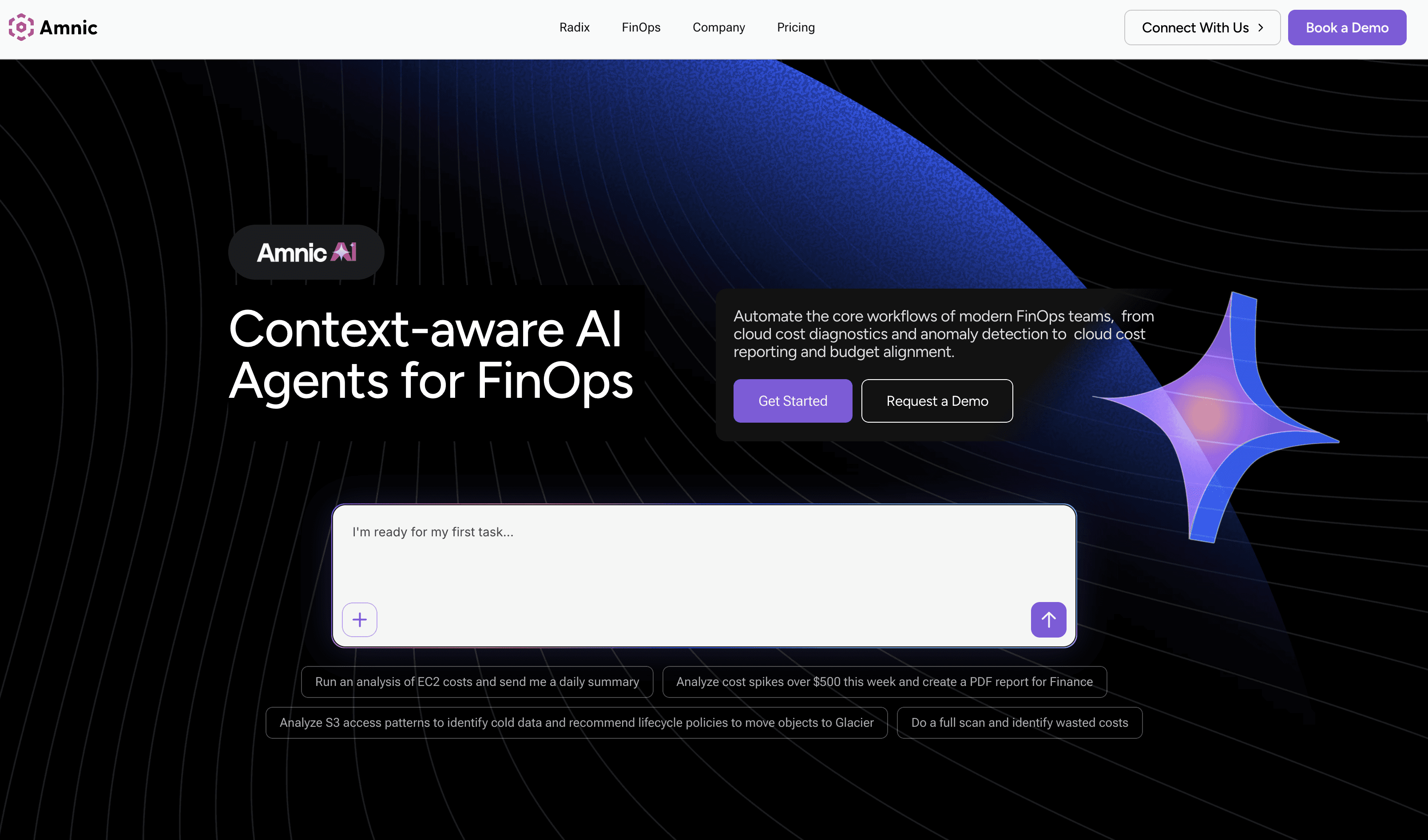
Amnic is a FinOps platform with four context-aware agents that sit on top of a unified cost view across AWS, Azure, GCP and Kubernetes. Amnic AI lets a CFO, SRE or FinOps analyst ask a question in plain English and get a filtered answer in seconds. The platform stays read-only, so your DevOps team owns every change and security teams approve it in days.
The agents map to real FinOps work. X-Ray benchmarks spend and returns a cloud financial health check in under 30 seconds. Insights gives role-aware answers. Governance watches budget drift and runs root-cause analysis. Reporting builds persona-specific reports on demand.
Key features that matter to decision makers:
Four context-aware agents (X-Ray, Insights, Governance, Reporting) plus a build-your-own Amnic Assistant, so any persona queries cost data without SQL
X-Ray cloud financial health check that benchmarks spend and surfaces inefficiencies in under 30 seconds
Governance agent that monitors budget drift, enforces tag hygiene, assigns ownership and runs root-cause analysis across environments
Anomaly detection with custom thresholds at tag, product or team level to catch surprise costs early
Recommendations that target 10% to 20% waste reduction by flagging idle instances and extended support charges
Virtual Tags that normalize inconsistent native tagging into one clean attribution rule across providers
Kubernetes cost management at container, pod, node pool and persistent volume level with rightsizing recommendations
Cost allocation and unit economics that tie spend to products, teams, customers and metrics like cost per query
Budgeting and cloud cost forecasting with alerts at defined consumption thresholds
AI spend tracking on Amazon Bedrock today, with OpenAI and Anthropic coverage rolling out, plus a Model Context Protocol for FinOps approach for agent workflows
Agentless, read-only deployment with SOC 2 Type II, ISO 27001 and GDPR, SSO and Jira integration for enterprise governance
Pricing: Amnic prices as a percentage of monitored cloud spend, with no per-seat fees. The startup tier includes a free trial with no credit card, and enterprise plans add access to dedicated Amnic experts. See the pricing page for current terms.
Pros:
The only platform here that keeps full read-only access while still running four working agents, so security signs off in days rather than months
Documented customer outcomes span 20% to 50% reduction on real cost lines, with named case studies across SaaS, AI and fintech
Covers AWS, Azure, GCP and Kubernetes plus unit economics in one view, so finance and engineering share the same cost truth
Cons:
Model cost coverage tracks Amazon Bedrock today, so teams that need OpenAI and Anthropic rightsizing now should confirm the rollout timeline
Cost scales with your cloud bill on the percentage model, so larger enterprises should negotiate a spend cap at contract stage
A FinOps lead summed up the agent experience in a verified G2 review: "The maturity of Amnic AI, along with how easily we were able to integrate it across our multi-cloud setup, was truly phenomenal. The team is also consistently open to ideas and prioritizes the roadmap based on our needs." Read the named outcomes on the Amnic customers page.
2. Vantage
Best for: AWS-heavy teams that want a conversational agent inside Slack that both answers cost questions and buys commitments, with the option to approve each action first.
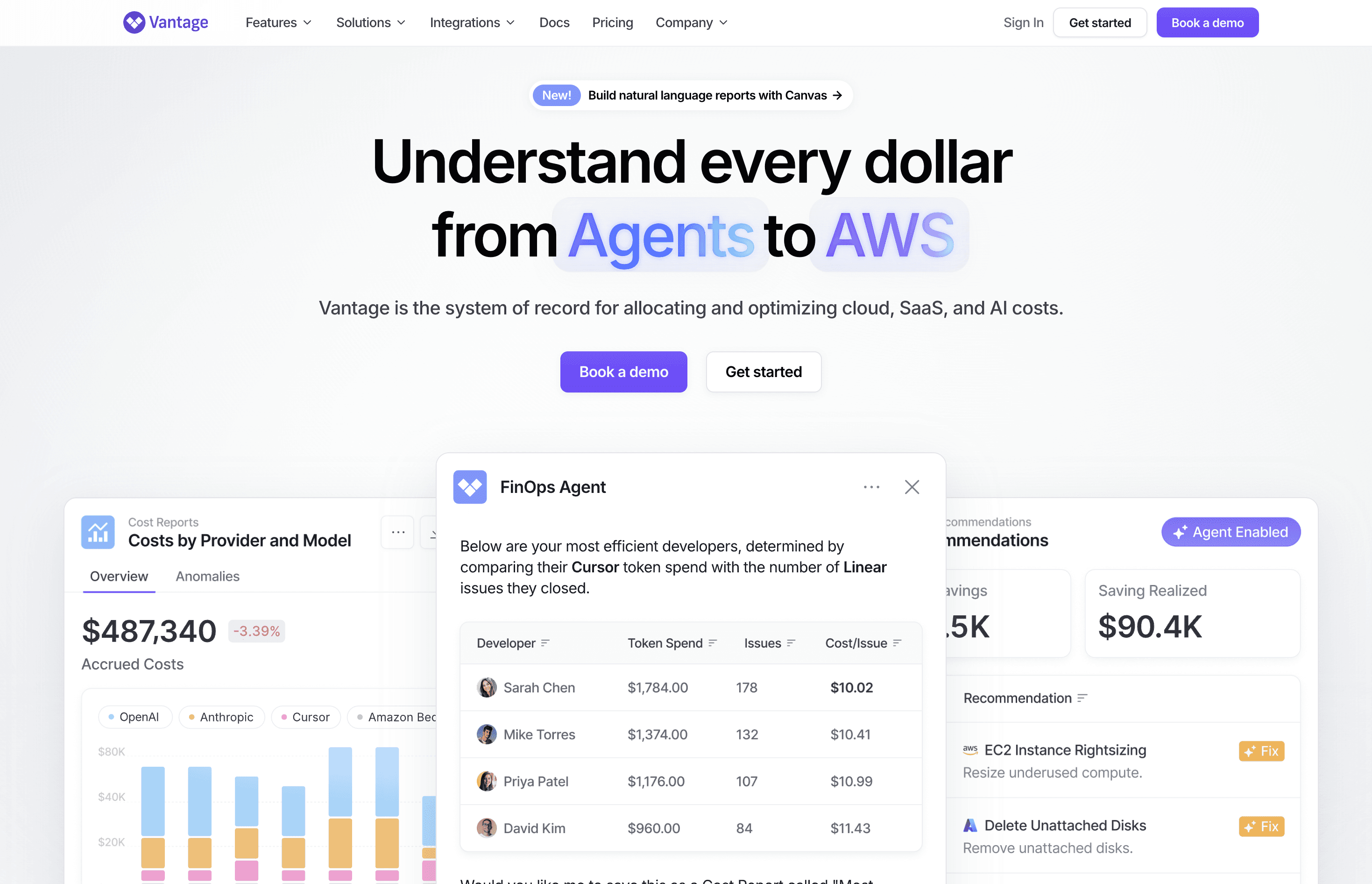
Vantage shipped its FinOps Agent in late 2025 as an interactive agent that understands your cloud infrastructure and acts on cost savings for you. It lives in Slack and in the Vantage console, answers natural-language questions about spend and generates cost reports on demand. You choose whether it runs autonomously or sends a Slack message for one-time approval before each change.
At launch the agent focuses on commitments. It can purchase AWS Compute Savings Plans and reserved instances for RDS, OpenSearch, ElastiCache and Redshift, with infrastructure changes and GitHub pull requests on the roadmap.
Key features:
In-Slack FinOps Agent that answers cost and usage questions in natural language
Autonomous or owner-approval execution, configurable per action
Automated purchase of AWS Compute Savings Plans and reserved instances
On-demand cost report generation inside your Vantage account
25 plus integrations for cloud and SaaS spend in one dashboard
Active anomaly notifications routed to the owning team
Free tier and self-serve onboarding for the core platform
Token and model cost views as part of broader spend tracking
Pricing: The FinOps Agent charges 5% of the savings from any financial commitment it purchases, plus a per-token conversation fee that was waived through July 1 2026. It is available to paying customers, not the free tier.
Pros:
Buying commitments from inside Slack removes the manual reserved-instance review that most teams run once a quarter
Optional approval keeps a human in the loop, which suits teams not ready for fully autonomous action
Fast self-serve setup with a genuine free tier on the core platform
Cons:
The agent only remediates AWS at launch, so multi-cloud teams wait for Azure and GCP support
Agent action is gated behind paid tiers, so free-tier users get visibility but not execution
Vantage describes the agent as "a first-of-its-kind, interactive AI agent that understands your cloud infrastructure and automates cost savings on your behalf" in its launch post.
3. Clara by nOps
Best for: AWS and Kubernetes teams that want a prompt-driven agent to turn cost insights into action and manage spot, reserved instances and savings plans without living in a dashboard.
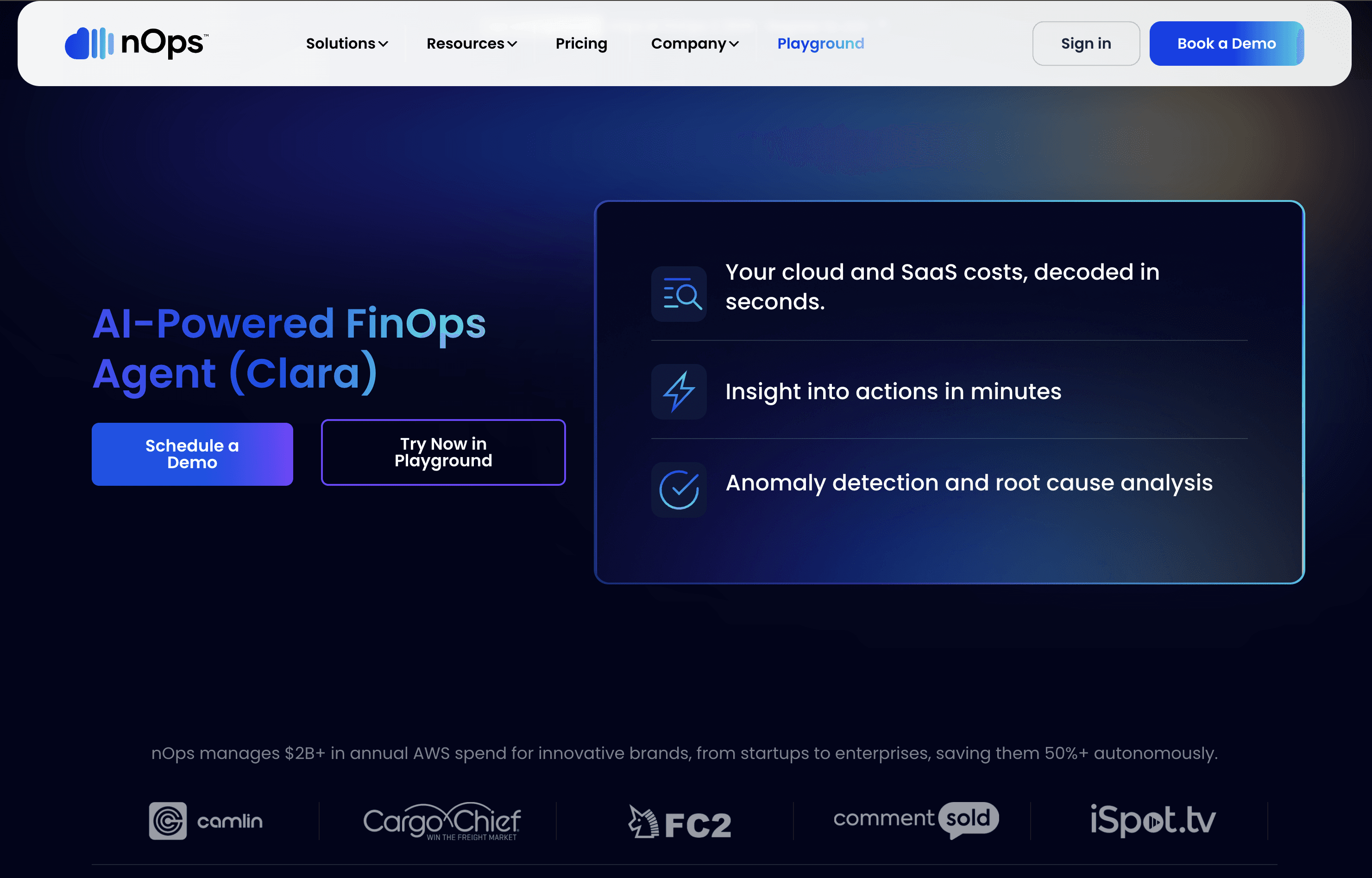
Clara is the AI FinOps agent from nOps, built for engineering-led teams on AWS. It decodes cloud and SaaS costs, answers questions in natural language and runs optimization workflows from a global prompt library. Behind it, Compute Copilot, built on open-source Karpenter, handles spot orchestration and commitment management, so the agent moves from insight straight to execution.
That focus on action is the point. Where many tools surface a recommendation and stop, Clara schedules and applies changes with execution context, which suits teams that want fast insight-to-action.
Key features:
Clara FinOps agent with natural-language querying and a global prompt library
Agent-based scheduling that turns recommendations into applied actions
Automated anomaly and waste detection across cloud and SaaS
Compute Copilot for autonomous spot orchestration on Karpenter
Reserved instance and savings plan management on a rolling basis
Kubernetes cost allocation at container, pod and node pool level
Cost allocation by team, service and environment
Free upfront savings analysis before any commitment
Pricing: Cost visibility and allocation is a flat, predictable fee based on your cloud spend, while autonomous rate optimization is billed as a share of realized savings. Every account starts with a free savings analysis.
Pros:
A prompt-driven agent that executes rather than only reports, so insights reach action fast
Container and pod level allocation supports accurate team chargeback and showback
Savings-share pricing aligns the vendor's incentive with real reduction
Cons:
Strongest on AWS, so Azure and GCP coverage is thinner for multi-cloud teams
Autonomous action requires write access, which security teams at regulated companies may need to review
An AWS Partner Network write-up details how nOps Compute Copilot and Karpenter automate spot scaling, noting the platform "consumes recommendations and translates them to corresponding NodePool configurations without manual input" (AWS APN blog).
4. Cloudgov.ai
Best for: Regulated and compliance-driven organizations that want autonomous multicloud FinOps and never want to grant write access to production infrastructure.
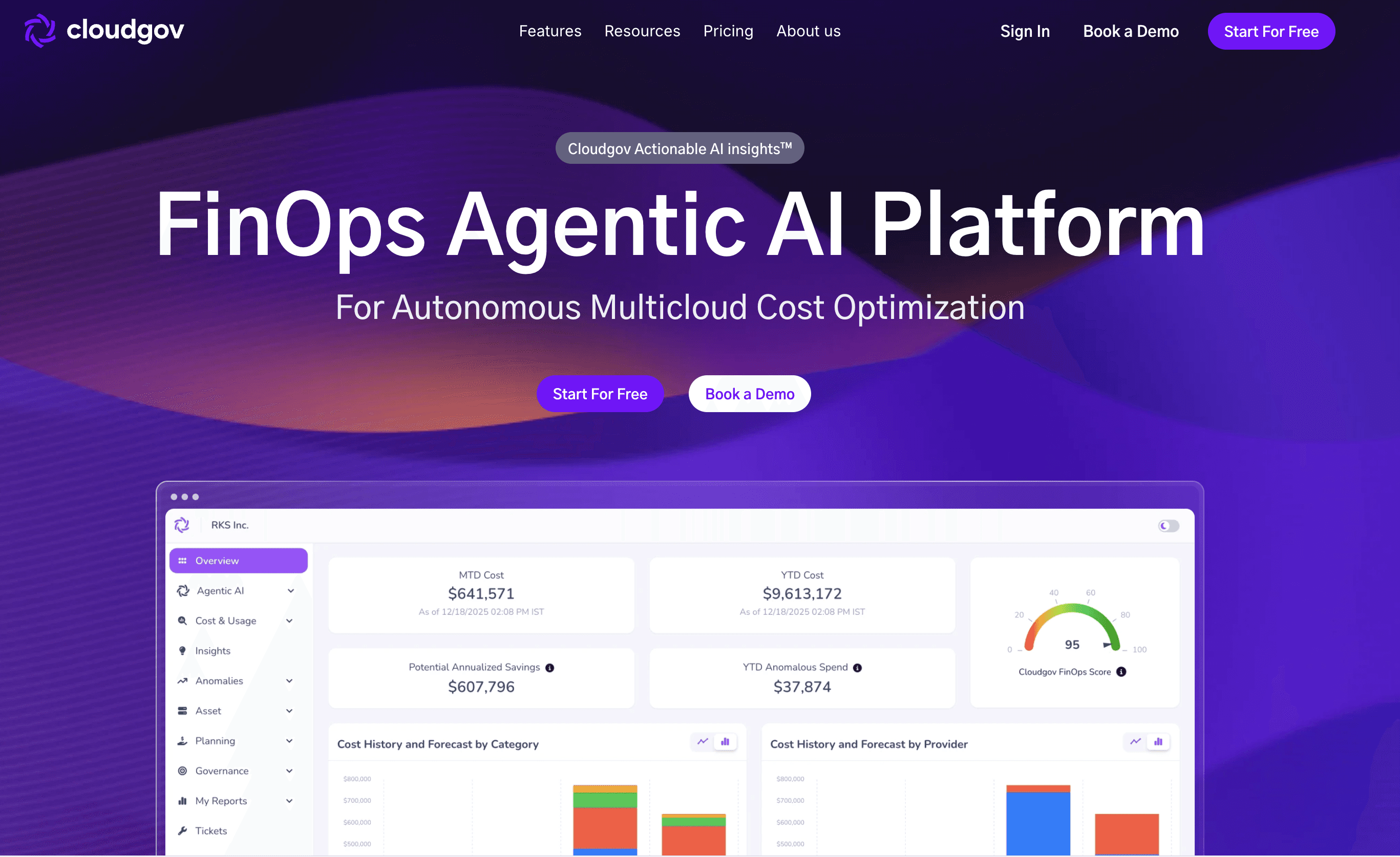
Cloudgov.ai positions itself as the first multicloud FinOps AI agents that acts, not just reports. Its agents monitor your cloud around the clock, detect anomalies in real time, generate infrastructure-as-code remediation and open tickets, all under read-only access. The platform leans into governance with audit trails and compliance certifications for teams that answer to both security and finance.
Because it stays read-only, your team approves each remediation before it runs, which keeps the autonomy without handing over production keys.
Key features:
AI agents that monitor cloud spend around the clock and detect anomalies in real time
IaC-based remediation code generated for approved fixes
Read-only access with no write permissions to production infrastructure
Smart tagging and unit economics alignment
Jira integration for automated ticket creation
Multi-cloud across AWS, Azure, GCP, Snowflake and MongoDB
Complete audit trails for every agent action
SOC 2 Type II, ISO 27001 and GDPR compliance
Pricing: A free Starter plan covers annual cloud spend up to $25,000, with Pro, Business and Enterprise tiers for larger footprints. Paid plans include a 14-day free trial.
Pros:
Acts autonomously while staying read-only, a rare combination for security-sensitive teams
Compliance certifications and audit trails suit regulated industries
Free starter tier lowers the barrier to a real trial
Cons:
Younger platform with a shorter track record than established vendors
Coverage beyond the core clouds, like Oracle and Alibaba, is still on the roadmap
Cloudgov.ai describes itself as "the world's first multicloud FinOps AI agents that acts, not just reports," with agents that "continuously monitor your cloud environment, detect cost anomalies in real time, generate IaC-based remediation code"
5. Akira.ai
Best for: Mature engineering teams that want to automate the full FinOps lifecycle with a system of autonomous, self-learning agents rather than another dashboard.
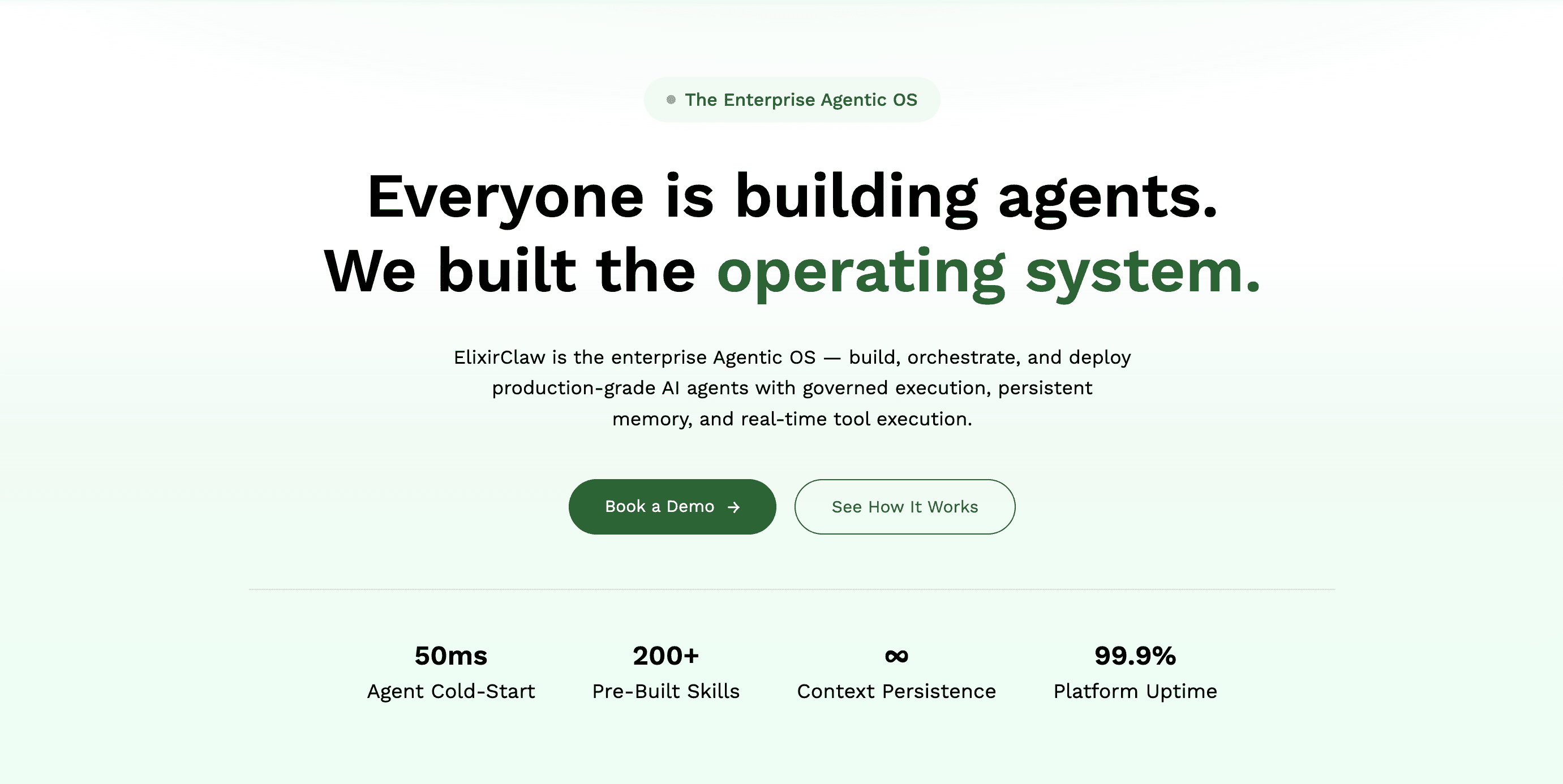
Akira.ai runs an agentic FinOps ecosystem where resource-level AI agents handle budgeting, optimization, tagging, cleanup and reporting with minimal human input. It coordinates multiple agents through agentic orchestration, replaces repetitive work with agentic automation and surfaces real-time recommendations through agentic analytics.
Pre-trained, no-code agent templates speed deployment across AWS, Azure and GCP, and the framework is designed to learn and improve over time. It suits teams ready to hand more of the FinOps lifecycle to agents.
Key features:
Agentic orchestration that coordinates multiple agents across the FinOps lifecycle
Agentic automation for tagging, cleanup and policy enforcement
Agentic analytics that generate real-time optimization recommendations
Resource-level agents with centralized financial governance
Pre-trained, no-code agent templates for AWS, Azure and GCP
Self-learning framework that adapts to your environment over time
Anomaly detection and budget visibility across cloud landscapes
Responsible AI controls on agent actions
Pricing: Akira.ai is sold through custom quotes scoped to your environment, with no public rate card. Expect a demo and a scoping conversation before access.
Pros:
One of the most autonomous options for teams ready to delegate the FinOps lifecycle
No-code agent templates shorten time to first value
Self-learning approach improves recommendations as it runs
Cons:
Custom-only pricing and limited public proof make evaluation slower
High autonomy fits mature teams more than those new to FinOps
Akira.ai describes its product as "a purpose-built agentic AI intelligence engine that brings orchestration, automation, and analysis into a single, self-learning FinOps framework" (Akira.ai).
6. Mavvrik
Best for: AI and ML teams running serious GPU and multi-provider LLM infrastructure that need cost visibility and governance built for tokens, inference and agent workloads.
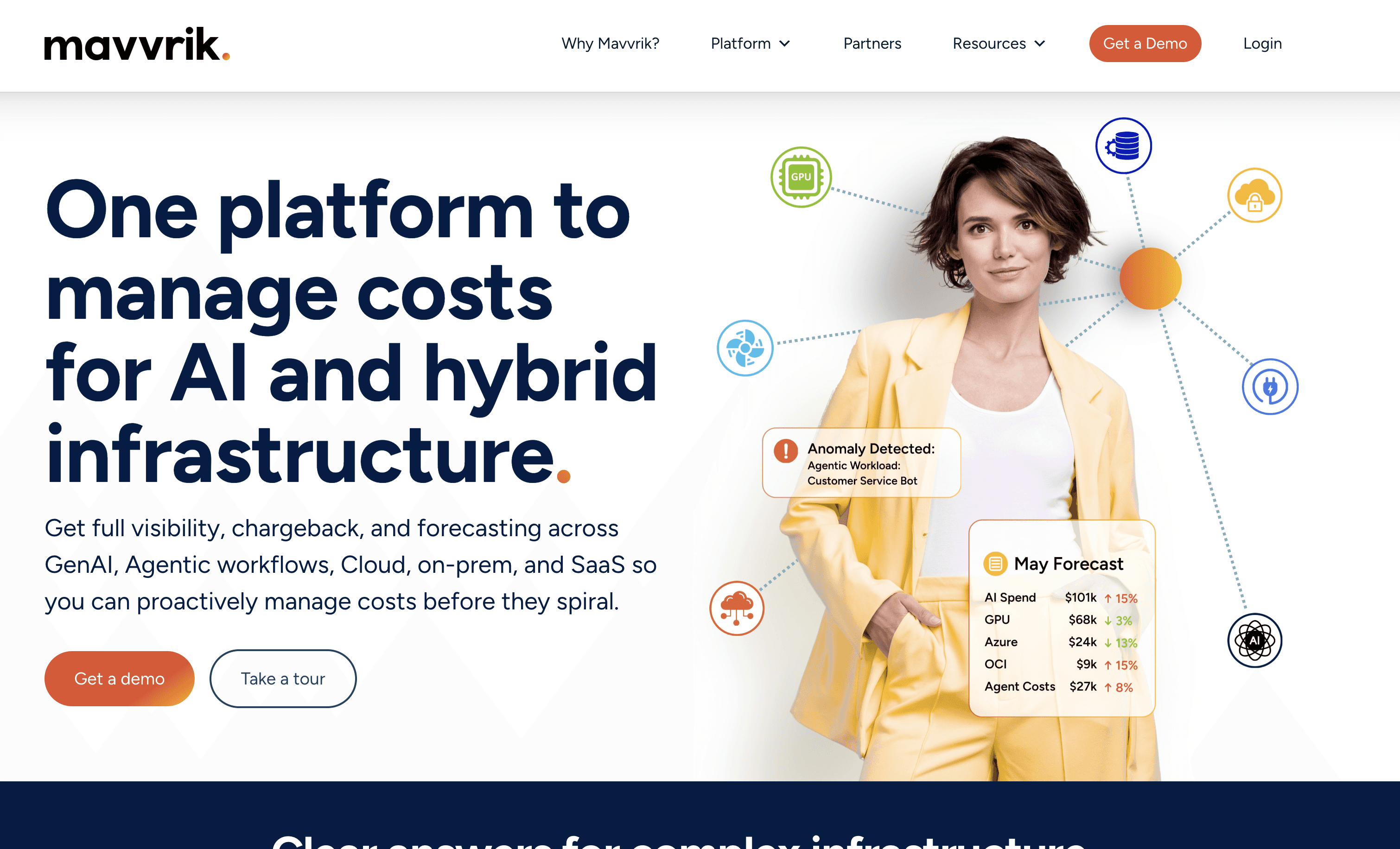
Mavvrik is an AI cost management platform built for the cost units that traditional FinOps tools miss. It tracks GPU utilization, LLM token spend across providers like OpenAI, Anthropic, Google and Meta, and inference and retrieval calls in real time across cloud, on-prem and private AI, giving one hybrid cloud view. The agentic layer adds autonomous GPU cluster rightsizing and agent-level cost tracking through a dedicated SDK.
For teams where the fastest-growing line item is model inference, that AI-native focus is the differentiator, and our LLM cost comparison shows how far per-token rates swing between providers. Mavvrik also enforces financial guardrails at the source, where the workloads actually run.
Key features:
Real-time tracking of tokens, inference jobs, retrieval calls and GPU hours
LLM spend visibility across providers like OpenAI, Anthropic, Google and Meta
Unified view across cloud, on-prem GPU clusters and Kubernetes
Autonomous GPU cluster rightsizing
Agent-level cost tracking through a dedicated SDK
Guardrails like usage thresholds, spend limits and alerts on runaway jobs
Cost-to-serve, chargeback and margin visibility for AI products
Available through Google Cloud Marketplace
Pricing: Mavvrik uses custom quote pricing scoped to your AI and cloud footprint, and is available through Google Cloud Marketplace. Expect a demo before access.
Pros:
The clearest fit for teams whose fastest-growing cost is AI tokens and GPU hours
Tracks emerging cost units like tokens, inference and agents that general FinOps tools miss
Guardrails and limits help catch runaway AI jobs at the source
Cons:
Specialized for AI and GPU spend, so it is not a general multi-cloud FinOps replacement
Custom-only pricing with limited public benchmarks
Mavvrik captures "AI-specific cost units, tokens, inference jobs, retrieval calls, GPU hours, in real time across hybrid environments," and is listed as a FinOps Foundation member.
How to Choose the Right AI FinOps Agent Tool
The right platform is the one that solves your single biggest cost problem in the first 90 days, not the one with the longest agent feature list. Agents are one slice of the broader cloud cost optimization tools market, so anchor on the job to be done.
Pick by the problem you actually face:
Plain-language access for every role: Choose agents any persona can query, like Amnic, where a CFO and an SRE ask the same tool in their own language.
Autonomous commitment buying on AWS: Look at Vantage or Clara by nOps, but confirm your security team allows write access first.
Autonomy without write access: Cloudgov.ai keeps agents read-only while they detect and propose remediation.
Fully automated FinOps lifecycle: Akira.ai suits mature teams ready to delegate budgeting, tagging and cleanup to agents.
AI, GPU and token spend: Mavvrik tracks the cost units that general tools miss, the focus of our FinOps for AI guide.
One read-only view across multi cloud and Kubernetes: Amnic is the broadest option with agents and unit economics in one place.
Write down your top two problems and compare only those two. You will decide faster and avoid paying for agent features you never use. If managing AI and model spend is the priority, start with our guide to FinOps tools for AI cost management.
Why Teams Choose Amnic
Amnic is built on a simple belief: cloud cost should be clear for every role, not just FinOps specialists, and the agents should do the manual work. It pairs that with proven cloud cost management strategies rather than dashboards alone.
Three things matter most to the decision makers we talk to each week. First, read-only by design. Amnic never touches your cloud, so DevOps owns every change and security approves the deployment in days.
Second, agents any role can use. The four agents turn natural-language questions into filtered answers, so a CFO can ask what the team spent on AI last month and get an answer in seconds. Third, depth across multi cloud and Kubernetes in one place, not three disconnected tools.
"Amnic's astute recommendation engine helped us reduce our cloud bill through optimization of Network and CloudWatch costs." That comes from Mayank Bhola, Co-founder and Head of Products at LambdaTest, after a 30% reduction in NAT and CloudWatch costs.
If you are a CFO, FinOps lead or VP of Engineering who wants agents to reclaim hours and cut spend before the next board review, request an Amnic demo and see your top three cost leaks before the call ends. For the wider playbook, our cloud cost management guide covers the fundamentals these agents automate.
Frequently Asked Questions
What is a FinOps AI agent?
A FinOps AI agent is software that monitors your cloud spend, answers cost questions in plain language and either recommends or executes optimizations. It automates work that finance and engineering used to do by hand, like anomaly hunting, allocation and reporting.
How is agentic AI different from traditional AI in FinOps?
Traditional AI is reactive. It generates a report or a recommendation and waits. Agentic AI is proactive. It sets a goal, calls tools, investigates a cost spike and either acts or proposes a specific fix, usually with a human approving the change.
Do AI agents for FinOps need write access to my cloud?
Not always. Read-only platforms like Amnic and Cloudgov.ai analyze, monitor and propose fixes without write access, so DevOps owns every change. Agents that buy commitments or rightsize automatically, like Vantage and Clara by nOps, need scoped write access, so check with your security team first.
Can AI agents fix cloud costs without human approval?
They can, but most teams keep a human in the loop. A clear trust gap remains around autonomous production changes, so leading agents offer approval gating and impact previews before any action runs. Start with approval required, then widen autonomy as confidence grows.
How do FinOps agents track OpenAI and Anthropic spend?
Some agents are built for this. Mavvrik tracks GPU hours and LLM tokens across providers like OpenAI, Anthropic, Google and Meta in real time, and Amnic tracks Amazon Bedrock today with OpenAI and Anthropic coverage rolling out. To model token costs first, see our OpenAI API pricing breakdown.
How fast can I deploy an agentic FinOps platform?
Read-only platforms like Amnic and Cloudgov.ai onboard in hours because they need only billing and monitoring access. Tools that take write access or run on custom enterprise contracts take longer, since security review and scoping add time before the agents act.
Who benefits most from AI agents for FinOps?
CTOs, FinOps leads, SRE teams and finance leaders at SaaS, AI and fintech companies with real multi-cloud spend. Anyone losing hours to manual reporting, slow root-cause analysis or finance teams that cannot read raw cost data gets the most value.
How much can AI FinOps agents save?
Most teams recover 10% to 20% of cloud spend in the first 90 days through rightsizing, anomaly catches and commitment cleanup. Documented Amnic outcomes reach 30% to 50% on specific lines like Kubernetes clusters and NAT gateways.
Better visibility and management into AI Tokens?
Start with a 30 day trial
Connect leading LLMs
24 hour time to value
Stay ahead of AI Spend

Make AI spend visible, controllable, and accountable.
Gain insights into your AI token costs at a team, customer, business unit and individual user level to measure and manage AI utilization.
Recommended Articles

How to Catch AI Cost Spikes Early (FinOps Playbook)
Read More

How to Forecast AI Spend: A FinOps Guide
Read More

8 Best Llama Cost Management Tools in 2026
Read More
How to Reduce Anthropic API Costs (Without Losing Quality)
Read More

How to Reduce OpenAI API Costs: A Practical Playbook
Read More

AI Cost Anomaly Detection: How to Catch Token, GPU and API Spend Spikes
Read More