6 Best Datadog Alternatives for Cloud Cost Management in 2026
12 min read
Comparisons
Table of Contents
Most teams searching for Datadog alternatives are not unhappy with the dashboards. They are unhappy with the bill, and with how little of it they can explain to finance.
This comparison focuses on Datadog's Cloud Cost Management feature, the module Datadog ships for tracking cloud spend, not Datadog's broader observability and APM suite. If you came here looking for a SigNoz or New Relic swap, you are in the wrong list.
Comparing the top 6 Datadog Cloud Cost Management alternatives in 2026 starts with Amnic, then CloudZero, Vantage, Apptio Cloudability, nOps and Finout. Each one connects your Datadog spend to the rest of your cloud bill so the cost is owned, attributed and reduced, not just observed.
Amnic ranks first for teams that want one FinOps view across multi-cloud and Datadog spend, AI-driven analysis and read-only deployment, with documented savings of 30 to 50% at customers like LambdaTest and Jiffy.ai.
Top 6 Datadog Alternatives for Cloud Cost Management in 2026
Amnic: One platform for CFO, CTO and SRE to see the same bill across multi-cloud, Kubernetes and Datadog spend, without write access.
CloudZero: For SaaS engineering teams that need cloud and Datadog spend mapped to product features and cost per customer.
Vantage: Fastest way to pull AWS, multi-cloud and Datadog costs into one dashboard with a free tier and no sales process.
Apptio Cloudability: For enterprise finance teams that need audit-ready chargeback and a monthly cloud close, not engineering tracing.
nOps: For AWS-heavy teams that want automated commitment and rate optimization handled without a quarterly manual review.
Finout: For teams that want Datadog, cloud and SaaS spend consolidated into a single MegaBill with strong shared-cost allocation.
Comparison Table: Best Datadog Cost Monitoring Software
The table compares the six tools by who they suit, whether they ingest Datadog spend natively, pricing model, free trial and G2 rating.
Tool | Best For | Datadog Spend Integration | Pricing Model | Free Trial | G2 Rating |
|---|---|---|---|---|---|
Amnic | Unified multi-cloud, Kubernetes and Datadog cost with AI querying and zero write access | Yes, native multi-SaaS cost view | Percentage of cloud spend | Yes | 4.8 / 5 |
CloudZero | SaaS teams needing cost per customer and per feature | Yes, via AnyCost API | Enterprise, spend-based | No | 4.5 / 5 |
Vantage | Startups wanting fast self-serve multi-cloud visibility | Yes, native integration | Tiered, from $0 | Yes | 4.7 / 5 |
Apptio Cloudability | Enterprise FinOps and audit-ready chargeback | Limited, SaaS spend only | Enterprise agreement | No | 4.3 / 5 |
nOps | AWS rate and commitment automation | No, AWS-focused | Percentage of savings | Yes | 4.8 / 5 |
Finout | Consolidating cloud, SaaS and Datadog into one MegaBill | Yes, native integration | Spend-based, from ~1% | No | 4.7 / 5 |
Pricing tiers and ratings reflect public sources at the time of writing. Always confirm current pricing with the vendor.
What Are Datadog Cloud Cost Management Alternatives?
Datadog alternatives, specifically alternatives to Datadog's Cloud Cost Management module, are platforms you use to control and reduce your cloud bill instead of only watching it. They pick up where Datadog CCM stops, by attributing spend and tying it to the teams and products that caused it.
Technically, these are FinOps platforms that ingest billing data from cloud providers and from Datadog itself, allocate every dollar to a team, product or service, and surface actions that cut waste. They normalize spend across sources that Datadog CCM keeps in separate buckets or does not ingest at all.
For an engineering or finance leader, the value is simple. You get a single bill view that includes Datadog spend, you know who owns each line, and you can act on it without exporting to a spreadsheet.
Why Teams Look Beyond Datadog Cloud Cost Management
Datadog CCM is an add-on inside the Datadog contract, so the tool meant to help you control cloud cost sits behind the same enterprise pricing that pushed many teams to start looking in the first place. That sets the wrong tone before the feature gap even shows up.
The feature gap itself is real. Datadog CCM covers your AWS, Azure and GCP bills but does not pull Datadog's own spend or SaaS spend into the same view, so observability cost stays in a separate place from the cloud cost it is supposed to inform. Allocation stops at account and native tag level, with no first-class cost per customer, cost per feature or cost per AI workload.
There is no native chargeback workflow either, so finance still rebuilds the monthly close in a spreadsheet. The six tools below close those four gaps: Datadog spend ingestion, deep attribution, AI and Kubernetes coverage and a real chargeback path.
How We Evaluated These Platforms
We scored each tool on what a buyer leaving Datadog actually cares about: does it ingest Datadog spend, how deep is cost allocation, how strong is anomaly detection and budget governance, can a non-engineer query it, and how predictable is the pricing. The order below reflects total score for mid-market and enterprise FinOps teams.
Best Datadog Alternatives for Cloud Cost Management
1. Amnic
Best for: Multi-cloud teams that want unified cost visibility across AWS, Azure, GCP, Kubernetes and Datadog spend, with AI-driven analysis and anomaly detection, and no write access to their accounts.
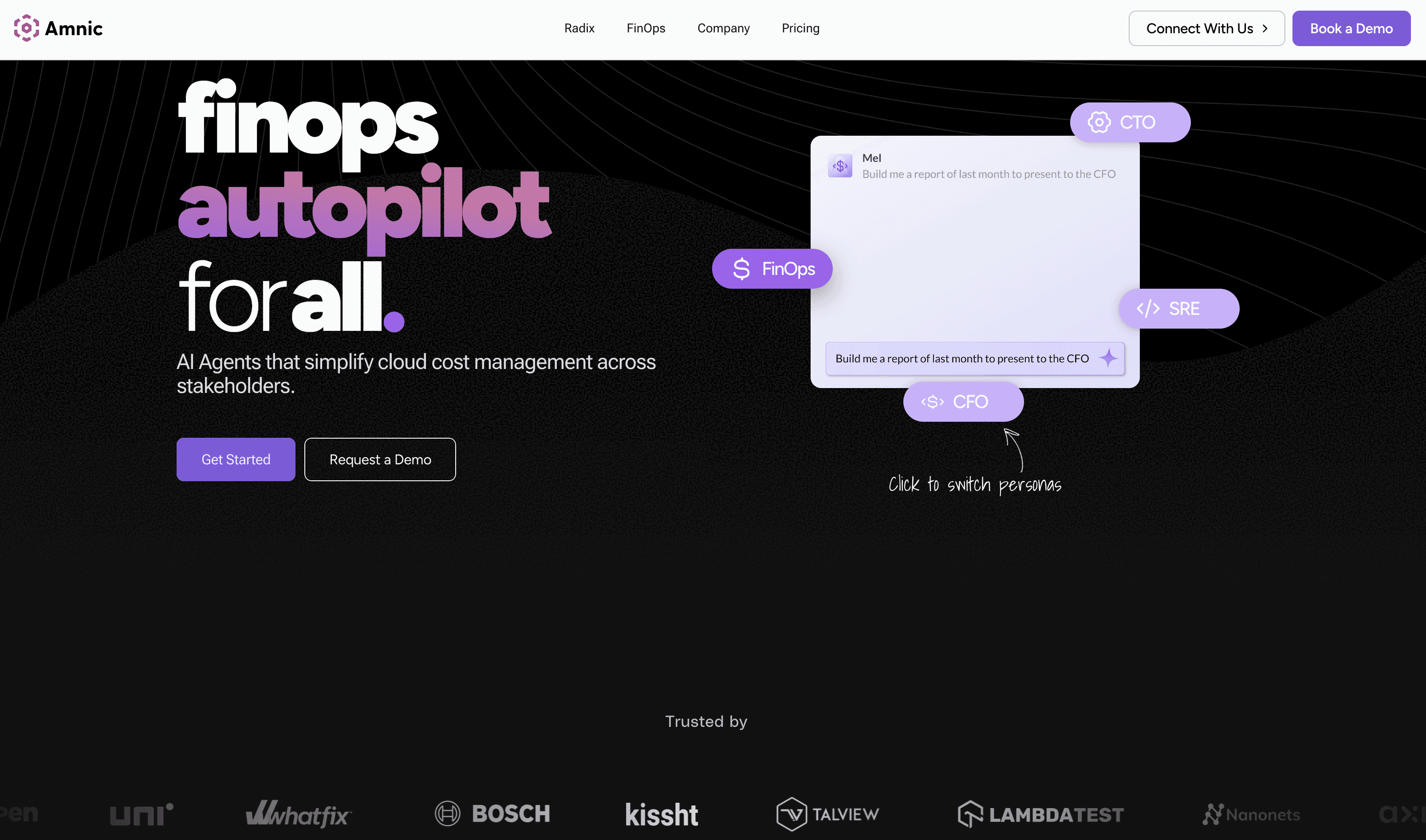
Amnic is a FinOps OS powered by context-aware AI agents, built on a cloud cost observability platform. It connects to multiple clouds and pulls Datadog spend into the same view through its Datadog cost integration, so engineering, finance and leadership share one cost truth instead of arguing across three dashboards.
The platform lets users drill from account to service to resource level, and any persona can ask cost questions in plain language. That role-based depth, paired with read-only access, is the clearest separation from both native cloud tools and Datadog's own module.
Key features that matter to decision makers:
Multi-SaaS cost view that brings Datadog, Azure and other spend into one cost analyzer alongside cloud bills
Amnic AI with four agents, X-Ray, Insights, Governance and Reporting, so a CFO, SRE or FinOps analyst can query cost data without SQL
Recommendations module that targets 10 to 20% waste reduction by flagging instances running below 2% utilization
Anomaly detection with custom thresholds at tag or product level that saves 10 to 15% of yearly spend
Virtual Tags that unify inconsistent tags like prod, production and PROD into one clean attribution rule
Kubernetes cost management with rightsizing at container, node pool and persistent volume claim level
Unit economics that tie spend to business metrics like cost per query or cost per customer
Budget tracking with alerts at 50, 70 and 85% consumption against product budgets
AI token management and FinOps for AI tracking on Amazon Bedrock, with OpenAI and Anthropic coverage rolling out
Read-only deployment, SSO and Jira integration, so DevOps owns every change
Pricing: Custom, typically a small percentage of monitored cloud spend. Amnic offers a one-month free trial for the startup tier with no credit card, and Enterprise plans scope to your footprint with access to dedicated cost experts.
Pros:
One view across multi-cloud, Kubernetes and Datadog spend, so the cost no native tool aggregates sits in a single place
Four AI agents let any persona query cost data in plain language, no cloud taxonomy needed
Read-only architecture clears security review in days, not months, unlike write-access tools
Documented customer outcomes span 20 to 50% reduction on specific cost lines, with named case studies across SaaS, AI/ML and fintech
Cons:
Active rightsizing of model usage is on the roadmap, so AI-heavy teams that need that today should confirm timing
Cost scales with your cloud bill on the percentage model, so large enterprises should negotiate a spend cap
"Amnic's astute recommendation engine helped us reduce our cloud bill through optimization of Network and CloudWatch costs." Mayank Bhola, Co-Founder and Head of Products, LambdaTest
2. CloudZero
Best for: Engineering-led SaaS teams that want cloud and Datadog spend tied to product features, cost per customer and cost per deployment.
CloudZero focuses on connecting spend to business outcomes. Its allocation engine, CostFormation, lets teams define custom cost dimensions without writing SQL, and the AnyCost API ingests non-native spend so a feature's full cost includes its Datadog and SaaS layers. It is one of the strongest fits for SaaS companies that already run product analytics.
Key features:
CostFormation engine that defines cost dimensions in code, so untagged and shared spend still gets attributed without per-resource tagging
AnyCost API that ingests Datadog, Snowflake, Databricks and MongoDB, so a feature's true cost includes its observability layer, not just compute
Cost per customer and cost per unit metrics that map straight into gross-margin reporting for the board
Anomaly alerts that name the service, deployment or customer behind a spike instead of just flagging a dollar figure
Dimensional views filtered per audience, so engineering, finance and product each see only what they own
Kubernetes cost monitoring that flags idle and over-provisioned containers at the pod level
Budgets tied to teams and services rather than raw accounts
Slack-native alerting that routes a spike to the engineer who caused it
Pricing: Enterprise contracts only, with no public rate card and no self-serve onboarding. Pricing ties to cloud spend under management, and there is no free trial, so evaluation runs through a formal proof of concept.
Pros:
Telemetry-based allocation reaches spend that tag-only tools miss, which is why SaaS finance teams trust its cost-per-customer number
AnyCost pulls Datadog and SaaS spend into the same margin math, closing the gap Datadog's own module leaves open
The clearest unit-economics story in the category for venture-backed SaaS reporting to investors
Cons:
No published pricing and no trial, so a proof of concept can run for weeks before you see your own data
Allocation accuracy depends on upfront CostFormation modeling, which is consulting-heavy in messy environments
Kubernetes granularity trails dedicated K8s tools, so heavy EKS or GKE shops often run a second tool alongside it
"Unit metrics like cost per feature connect budgets to shipped work and PRs, which improves accountability." CloudZero review, G2
See how Amnic compares in our CloudZero alternatives breakdown.
3. Vantage
Best for: Startups and mid-market teams that need fast, self-serve visibility across multi-cloud and Datadog costs without an enterprise contract.
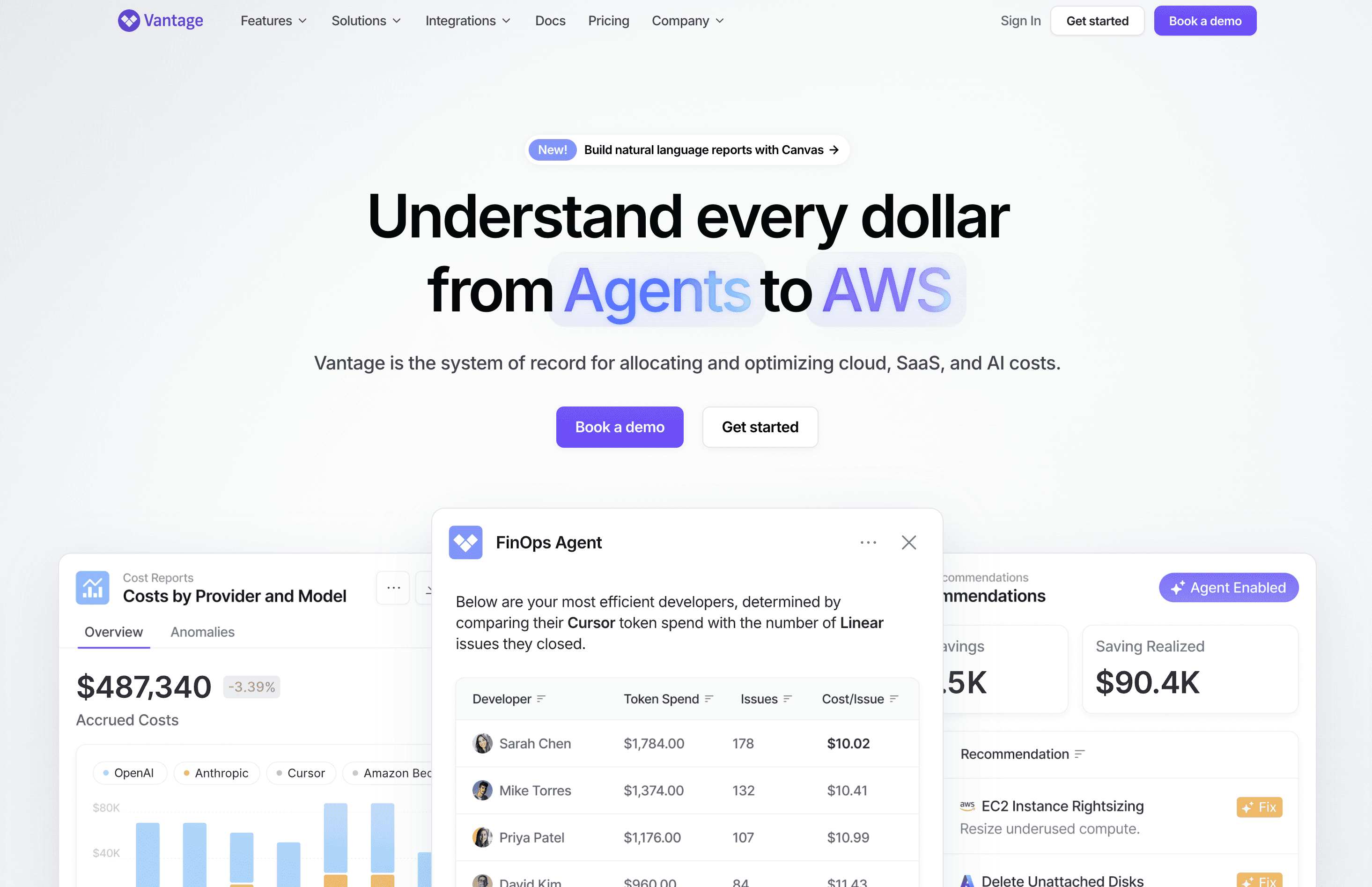
Vantage built its name as a developer-friendly layer over AWS Cost Explorer and grew into a multi-cloud platform. It pulls AWS, Azure, GCP, Kubernetes, Datadog, Snowflake, OpenAI and MongoDB spend into one place, which makes it a quick way to see Datadog costs next to the rest of the bill.
Key features:
More than 30 native integrations, including Datadog, Snowflake, MongoDB and OpenAI, so non-cloud spend lands next to AWS within a day
Cost reports with saved filters and folders that mirror your team structure
Resource-level recommendations for idle instances, stale snapshots and unattached volumes
Autopilot commitment management on paid tiers for savings plans and reserved instances
Network flow and Kubernetes cost views down to the workload
Virtual tagging to group untagged resources into a single cost owner
Budget thresholds with Slack and email alerts
Public Cloud Cost Report benchmarks to sanity-check your own unit rates
Pricing: The Starter tier is free, capped at $2,500 in tracked monthly spend, and paid plans start near 1% of tracked cloud cost on a fixed-rate subscription rather than a percentage cut.
Pros:
Self-serve signup gives you a working Datadog-plus-cloud dashboard in an afternoon, with no sales call
The broadest integration catalog among self-serve tools, so it doubles as a single pane for SaaS spend
Fixed-rate subscription stays predictable as spend grows, unlike percentage-of-savings models
Cons:
Reporting is strong but remediation is shallow, so you still act on findings in another tool
No natural-language querying, so a CFO depends on an analyst to read it
Autopilot optimization sits behind paid tiers, so the free plan only shows the problem
"Vantage is great for dashboards, but you still need something else to actually save money." Vantage review sentiment, G2
For a deeper look, see our Vantage alternatives guide.
4. Apptio Cloudability
Best for: Large enterprise finance teams that need audit-ready chargeback and a monthly cloud close inside an IBM stack, not engineering-level tracing.
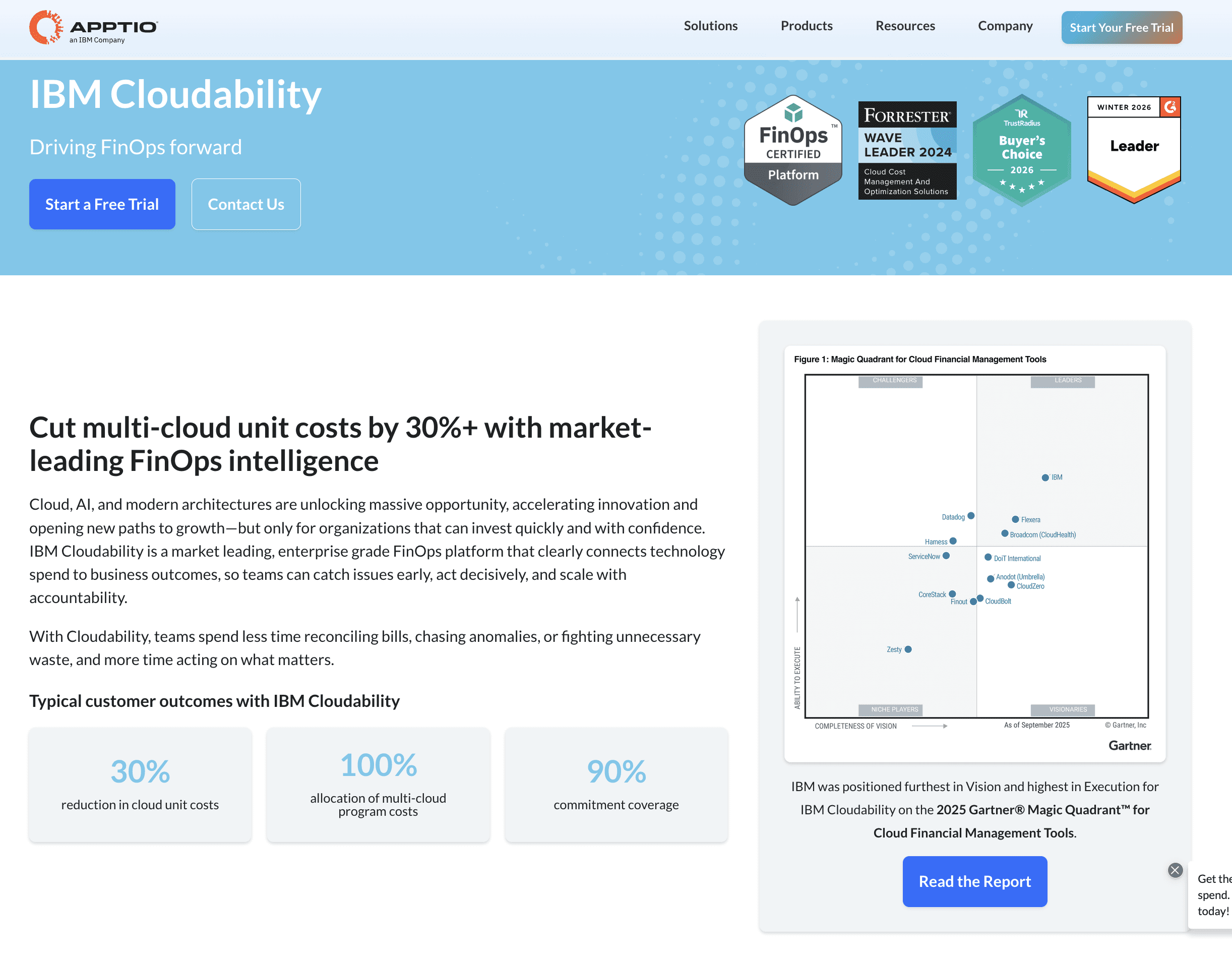
IBM Cloudability, formerly Apptio Cloudability, is one of the most established FinOps platforms. Its chargeback and showback engine holds up in front of an external auditor, which is why it stays the default at large banks, insurers and tier-one fintechs that need governance at scale.
Key features:
Chargeback and showback that survive an external audit, allocated down to shared and support charges
True Cost engine that amortizes reserved instances and savings plans into an accurate monthly cost of ownership
Container and Kubernetes spend mapped back to the owning business unit
Rightsizing and commitment planning with savings forecasts attached
Budgets, variance tracking and a monthly close workflow built for finance, not engineers
Executive and business-unit reporting aligned to a TBM taxonomy
Anomaly and budget alerting across thousands of accounts
Native tie-in to the wider Apptio TBM and IBM stack
Pricing: Sold through IBM enterprise agreements with no self-serve option. Mid-market deployments with $3M to $6M annual cloud spend can expect roughly $76,000 to $132,000 a year.
Pros:
The chargeback model is the one large banks and insurers defend in front of regulators
Amortized True Cost gives finance a defensible monthly number instead of a raw usage dump
Mature governance for multi-business-unit enterprises running thousands of accounts
Cons:
Visibility-first, so it tells you where waste is but rarely acts on it
Datadog and SaaS spend are not first-class, so observability cost stays in a separate tool
Heavy interface and onboarding, with a learning curve reviewers flag repeatedly
"The interface is difficult to navigate, making adoption challenging." IBM Cloudability review, G2
5. nOps
Best for: AWS-heavy engineering teams that want automated commitment and rate optimization handled continuously, without a quarterly manual review.
nOps is an AWS-focused optimization platform built around automated rate and commitment management. It runs a free savings analysis, then handles spot, reserved instance and savings plan decisions on autopilot, which suits teams whose cost problem lives mostly in AWS compute.
Key features:
Autonomous rate optimization that buys, sells and reshuffles savings plans and reserved instances as usage shifts
Spot automation for EKS and auto-scaling groups, with automated fallback to on-demand to protect availability
Effective savings rate dashboard that shows your real blended discount, not a list-price claim
Kubernetes rightsizing and bin-packing recommendations
Resource scheduler that powers down idle non-production at nights and weekends
Cost anomaly and budget alerts scoped per AWS account
Container and pod-level cost allocation
Free automated savings assessment before any commitment
Pricing: Results-based. For autonomous rate optimization, customers pay only a percentage of realized savings, with a free savings analysis and nothing owed without measurable results.
Pros:
You pay only a share of realized savings, so the cost is self-funding and the downside is near zero
One of the strongest automated AWS commitment engines, with documented double-digit effective savings rate gains
The free savings analysis proves value before you commit a dollar
Cons:
AWS-first, so Azure, GCP and Datadog spend get little to no coverage
Automation needs write access, which security teams scrutinize before approval
Light on finance-grade chargeback and executive reporting
"Saving around 20 to 30% cost after 2 months of using nOps." nOps review, G2
6. Finout
Best for: Teams that want Datadog, cloud and SaaS spend consolidated into one MegaBill with strong shared-cost allocation and no agents to deploy.
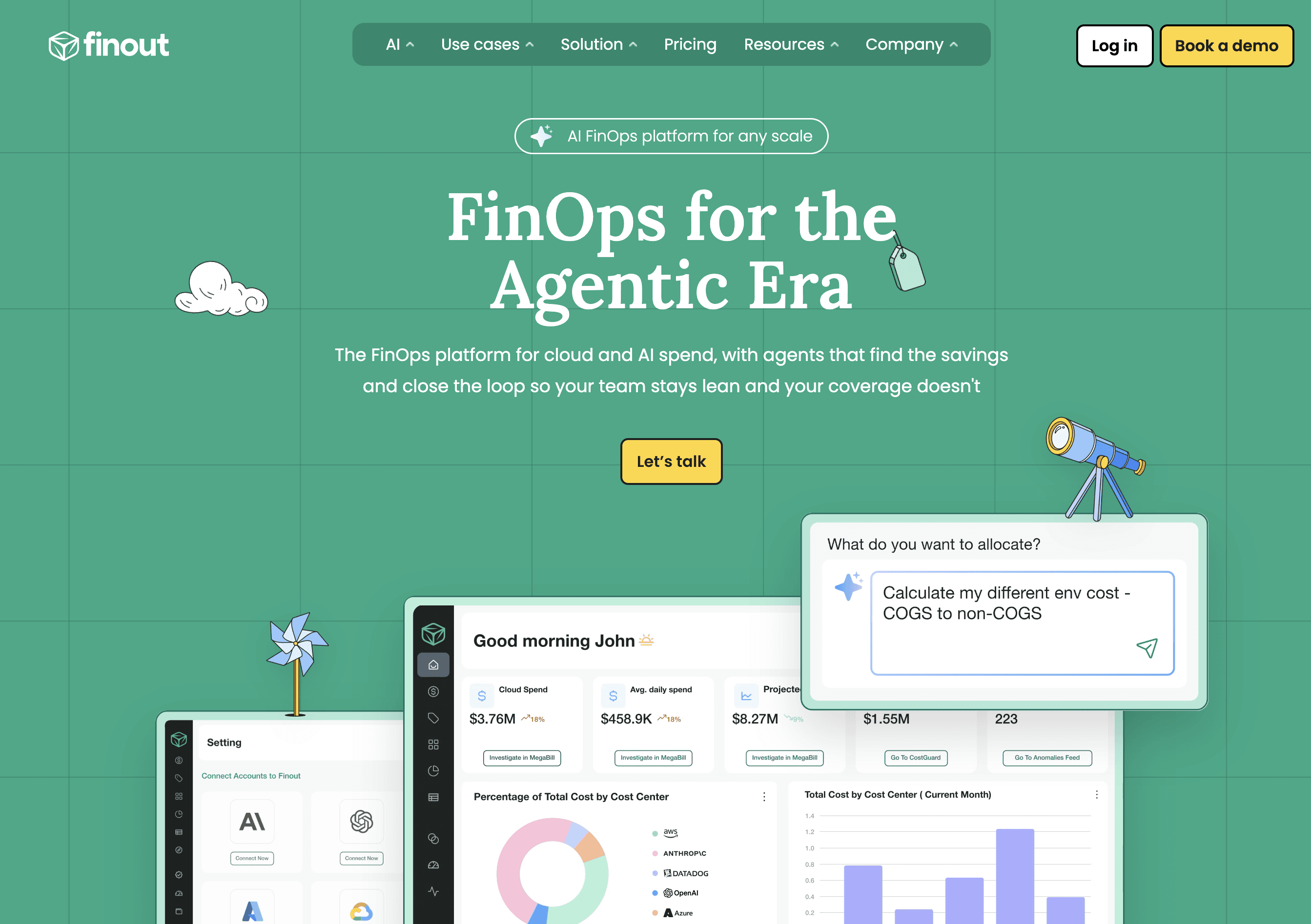
Finout consolidates cloud and SaaS costs into a single MegaBill. It ingests Datadog billing alongside AWS, GCP, Azure, OCI, Kubernetes, Snowflake, OpenAI and Anthropic, so APM, logs and custom metrics sit in one place and can be sliced by team, service or feature even when native tags are missing.
Key features:
MegaBill that merges AWS, Azure, GCP, OCI, Kubernetes, Datadog, Snowflake, OpenAI and Anthropic into one statement
Datadog billing ingestion that breaks APM, logs and custom metrics down by team and service
Virtual Tagging that attributes spend without touching infrastructure or native tags
Shared-cost allocation that splits common services to reach 100% attribution in multi-tenant setups
Cost anomaly detection with alerts routed to the owning team
Budgets and forecasts sliced by business dimension
Kubernetes and container cost breakdowns
Agentless, no-code ingestion that stands up in days
Pricing: Spend-based, starting near $6,000 a year and scaling at roughly 1% of the cloud bill under management. There is no public self-serve plan, so most contracts go through a sales conversation.
Pros:
Among the strongest at pulling Datadog spend apart and tying it to teams when native tags are missing
100% shared-cost allocation leaves finance with a complete MegaBill and no unattributed gap
Agentless setup means no code changes and a short path to first value
Cons:
No free tier or self-serve, so every evaluation runs through sales
Natural-language querying is limited next to Amnic's agents
Spend-based pricing climbs with your bill, so model the cost before signing
"Finout consolidates all cloud services and providers into a single MegaBill view." Finout review, G2
How to Choose Among Cloud Cost Monitoring Platforms
Start with where your problem lives. If most of your spend and pain sits in AWS compute, an automation-first tool fits. If finance needs audit-ready chargeback, an enterprise platform fits. If engineering, finance and leadership all need the same number, and that number has to include Datadog spend, a unified platform like Amnic fits.
The fastest filter is integration plus access. Confirm the tool ingests Datadog spend natively, then check whether it needs write access. Read-only platforms clear security faster and still deliver the cloud cost control and reporting that replace a sprawling cloud cost management tools stack.
FAQs
What does Datadog Cloud Cost Management actually do?
Datadog Cloud Cost Management is an add-on module that ingests AWS, Azure and GCP billing data and overlays it on your Datadog dashboards. It shows cloud spend by service and tag, but it does not ingest Datadog's own spend, AI tools or SaaS bills, and it has no native chargeback workflow.
What is the best Datadog alternative for cloud cost management?
Amnic ranks first for teams wanting unified cost across multi-cloud, Kubernetes and Datadog spend, with AI querying and read-only access. CloudZero suits SaaS unit economics, and Finout suits consolidating everything into one bill.
Does Datadog have its own cost management tool?
Yes, Datadog ships a Cloud Cost Management module, but it focuses on your cloud bill and does not connect that to Datadog's own spend or your SaaS tools. A dedicated FinOps platform ties all of it together.
Is there a cheaper alternative to Datadog Cloud Cost Management?
Several FinOps platforms cost less and cover more. Vantage has a free Starter tier, nOps charges only a percentage of realized savings, and Amnic prices on a small percentage of monitored cloud spend with a free startup trial.
Can I track Datadog spend alongside my AWS, Azure and GCP bill?
Yes. Amnic, Finout, Vantage and CloudZero all ingest Datadog spend into the same view as your cloud costs. This lets you attribute APM, logs and custom metrics to the same teams and products as your infrastructure.
Which Datadog alternative is best for unit economics?
CloudZero is built around cost per customer and cost per feature for SaaS teams. Amnic also models unit economics, tying spend to metrics like cost per query, while adding multi-cloud, Kubernetes and AI cost coverage in one platform.
Better visibility and management into AI Tokens?
Start with a 30 day trial
Connect leading LLMs
24 hour time to value
Stay ahead of AI Spend

Make AI spend visible, controllable, and accountable.
Gain insights into your AI token costs at a team, customer, business unit and individual user level to measure and manage AI utilization.
Recommended Articles

Compare Input vs Output Token Pricing: Why Output Costs More and How to Budget for It
Read More

Vertex AI vs Bedrock: The Enterprise Platform Decision That Outlives the Token Price
Read More

Gemini vs GPT: Which AI Model Fits Your Workflow and Budget
Read More
H100 vs A100: Specs, Cost and Which GPU Wins for Your Workload
Read More
OpenCost vs Kubecost: Key Differences and How to Choose
Read More
LLM Cost Comparison: OpenAI vs Anthropic vs Gemini vs Mistral API Costs Compared
Read More