4 Best Alibaba Cost Optimization Tools in 2026
12 min read
Tools
Cost Optimization
Table of Contents
Comparing the top Alibaba cost optimization tools for 2026 are 1. Amnic, 2. Alibaba Cloud Cost Center, 3. Hystax OptScale and 4. Ternary.
These five platforms cover the full Alibaba Cloud spend lifecycle, from raw billing ingest on ECS, OSS, PolarDB, MaxCompute and ACK clusters through to anomaly alerts, savings plan recommendations and AI workload tracking on PAI and Model Studio.
Amnic ranks first for teams that want one platform for Alibaba Cloud alongside AWS, Azure, GCP and Oracle, with AI agents that can query in plain language and a read-only deployment that security teams can approve in days.
Best Alibaba Cost Optimization Software at a Glance
Amnic: Multi-cloud Alibaba visibility with AI FinOps agents, read-only access and documented 20 to 50% savings on specific cost lines.
Alibaba Cloud Cost Center: Native cost analysis, budgets, savings plan tracking and anomaly detection, free with your Alibaba Cloud account.
Hystax OptScale: Open-source platform with dedicated Alibaba and ACK coverage, claims up to 35% monthly Alibaba Cloud bill reduction.
Ternary: Enterprise-grade Alibaba Cloud FinOps with chargeback, showback and monthly close reporting for finance teams.
What Are Alibaba Cost Optimization Tools?
Alibaba cost optimization tools are software platforms that ingest billing data from Alibaba Cloud services such as ECS, OSS, PolarDB, MaxCompute, ACK and PAI, then surface where money is being wasted and recommend specific actions to bring the bill down. The good ones connect to your Alibaba account in read-only mode, normalize the data across regions and accounts and present it for engineering, finance and FinOps in views each role can actually use.
On the technical side, these platforms ingest Cost and Usage Reports from Alibaba Cloud Billing, allocate spend through tags, resource groups, or virtual labels, run rightsizing analysis against ECS utilization metrics, model savings plan and reserved instance coverage and detect anomalies on a rolling baseline. The deeper platforms also break down ACK Kubernetes spend at the pod and namespace level, track OSS lifecycle waste and report GPU spend on PAI for AI workloads.
For a startup CTO watching ECS bills climb, a FinOps lead at a mid-market fintech trying to allocate cost per product line, or a CFO at a 2,000-person enterprise running ACK across three regions, the right Alibaba cost optimization platform is the one that closes the gap between what the engineering team is spending and what finance can defend at the next quarterly review.
Comparison Table: Top 5 Alibaba Cost Optimization Platforms in 2026
Tool | Alibaba Cloud Coverage | AI Features | Free Trial | Pricing |
|---|---|---|---|---|
Amnic | ECS, OSS, PolarDB, MaxCompute, RDS, ACK, PAI + AWS, Azure, GCP, Oracle | Yes (Amnic AI with 4 agents) | Yes | Custom, percentage of cloud spend |
Alibaba Cloud Cost Center | Full native coverage across all Alibaba services | Anomaly detection AI | Free with account | Free |
Hystax OptScale | ECS, ACK, RDS, OSS | Limited | Yes (open source) | Open source free tier, paid managed plans |
Ternary | ECS, OSS, ACK, PolarDB | Limited | No | Enterprise, custom |
Pricing and coverage reflect public information as of May 2026. Confirm current details with each vendor before signing.
How We Evaluated These Alibaba Cloud Cost Optimization Platforms
We scored every tool on how reliably it cuts an Alibaba Cloud bill, not on how many dashboards it ships. The six criteria below are the ones a real buyer asks about on the second call, after the demo dust settles.
Alibaba Cloud service depth: Does it go past ECS into OSS storage classes, PolarDB, MaxCompute, ACK pods and PAI GPU spend, or does it stop at the easy stuff?
Multi-cloud reality: For teams running Alibaba alongside AWS or Azure, can the platform present one view, or do you log into three dashboards?
Rightsizing and recommendation quality: How specific are the savings actions on Alibaba resources and is there a documented savings range?
Savings plan and reserved instance modeling: Does the tool show coverage gaps and project ROI before you commit?
AI assistance for non-experts: Can a finance lead query Alibaba spend in plain language without learning the cost taxonomy?
Time to first insight: How long from sign up to a dashboard a CFO will actually open?
The five platforms below score highest against these criteria for teams running material spend on Alibaba Cloud in 2026.
5 Best Alibaba Cloud Cost Optimization Software in 2026
1. Amnic
Best for: Teams running Alibaba Cloud alongside AWS, Azure, or GCP who want one platform for engineering, finance and leadership to see the same cost truth, with read-only access and AI agents that any role can query in plain language.
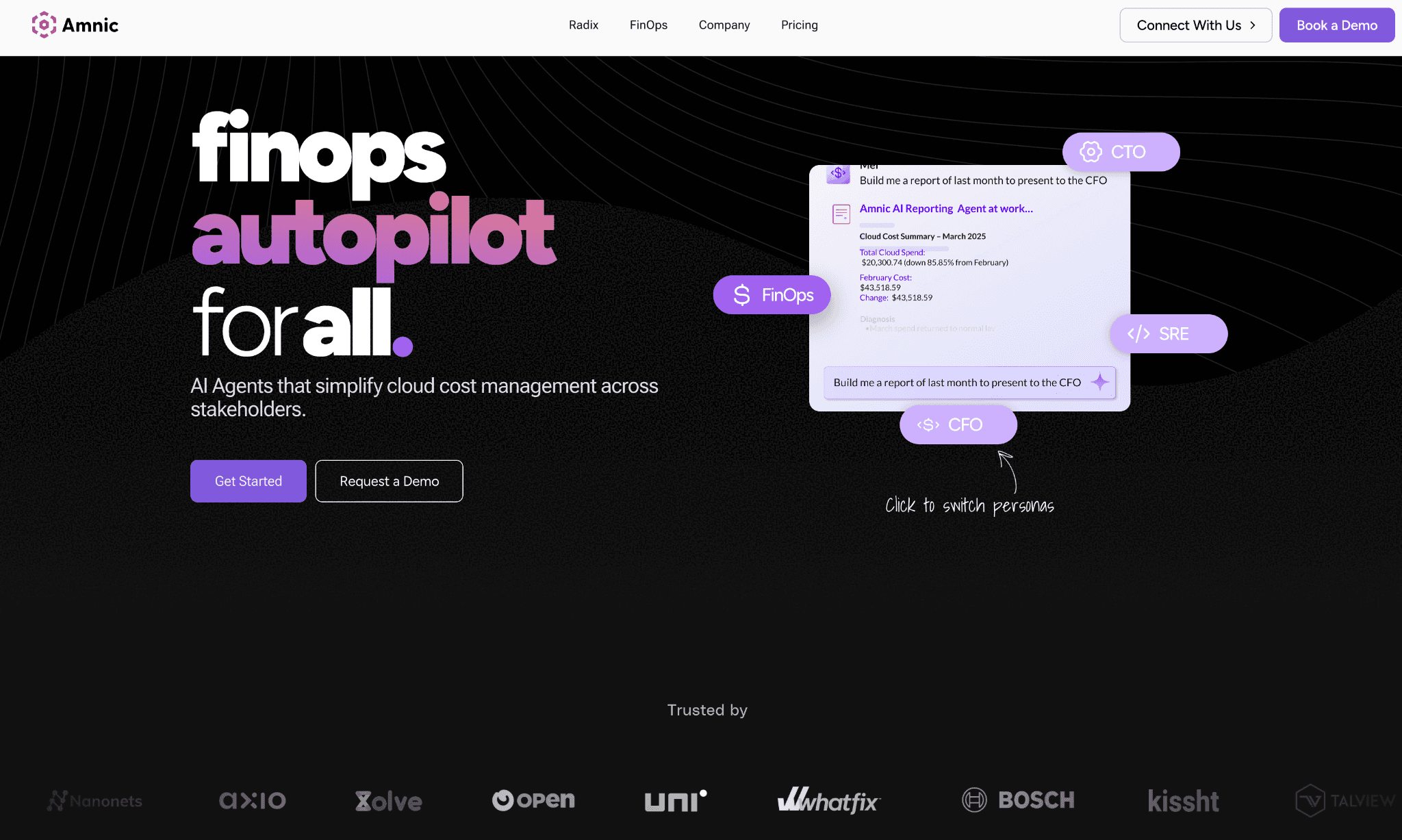
Amnic is a FinOps platform built so engineering, finance and FinOps share one cost view. It connects to Alibaba Cloud alongside AWS, Azure, GCP and Oracle, then breaks every yuan down by ECS compute, OSS storage, PolarDB, MaxCompute, ACK clusters and PAI GPU workloads.
The platform lets users drill from account to region to specific resource ID. A team can analyze OSS bucket cost by storage class and operation, audit ECS instances running below 5% CPU, or build custom dashboards tailored to engineers, FinOps leads and CFOs. That role-based granularity is what separates it from Alibaba Cloud Cost Center, which is built for one audience.
Key features that matter to decision makers:
Multi-cloud coverage including Alibaba Cloud, AWS, Azure, GCP and Oracle in a single dashboard, the only platform on this list that covers all five providers.
Amnic AI with four agents (X-Ray, Insights, Governance, Reporting) that let any user query Alibaba cost data in plain language without learning Alibaba taxonomy or SQL.
ECS rightsizing recommendations that flag instances running below 5% CPU and project specific monthly savings before any change is applied.
OSS lifecycle and storage class analysis that surfaces buckets with stale data eligible for Infrequent Access or Archive tiering.
ACK Kubernetes cost optimization at the container, pod and node pool level, with historical customer savings up to 50% on a single cluster, covered in detail on our ACK Kubernetes cost optimization page.
Cost anomaly detection tuned for Alibaba Cloud billing patterns, with custom thresholds at tag, product, or resource group level.
Virtual tags that unify inconsistent Alibaba resource group naming into one clean attribution rule without changes to your infrastructure.
Savings plan and reserved instance modeling for ECS, with projected coverage and ROI for each commitment before purchase.
Budget tracking with alerts at 50, 70 and 85% consumption against product or team budgets on Alibaba spend.
Shared infrastructure cost allocation with fixed percentage, proportional and usage-based split rules.
Unit economics that tie Alibaba spend to business metrics such as cost per customer or cost per query.
PAI and Model Studio cost tracking for GPU workloads, with Bedrock and OpenAI coverage available for teams running AI on multiple clouds.
Inventory module that maps every deployed Alibaba resource by IP, product and team for security and cost together.
Read-only access so DevOps owns every change, with SSO and Jira integration for enterprise governance.
Pricing: Custom, typically a small percentage of monitored cloud spend. Amnic offers a one-month free trial for the startup tier with no credit card required and enterprise plans are scoped to your actual Alibaba and multi-cloud footprint.
Pros:
The only platform on this list that covers Alibaba Cloud, AWS, Azure, GCP and Oracle in one view, useful for teams expanding from Alibaba to a second or third cloud.
Four AI agents let a CFO, FinOps lead, or SRE query Alibaba cost data in plain language without learning cloud taxonomy.
Read-only architecture means security teams approve the deployment in days, not months, which matters more on Alibaba where security review cycles tend to be conservative.
Unit economics modeling ties Alibaba spend to business metrics, giving finance leaders a view that Cost Center cannot produce on its own.
Documented customer outcomes span 20 to 50% reduction on specific cost lines, with named case studies across SaaS, AI/ML and fintech.
Cons:
LLM coverage on Alibaba PAI and Model Studio is active today, but teams that want active rightsizing of AI model usage rather than tracking alone should confirm roadmap timing with the team.
Pricing scales with the cloud bill under management, so larger enterprises should negotiate a spend cap at the contract stage.
2. Alibaba Cloud Cost Center and FinOps Suite
Best for: Single-cloud teams running entirely on Alibaba Cloud who want native cost analysis, budgets and savings plan tracking without paying for a third-party platform.
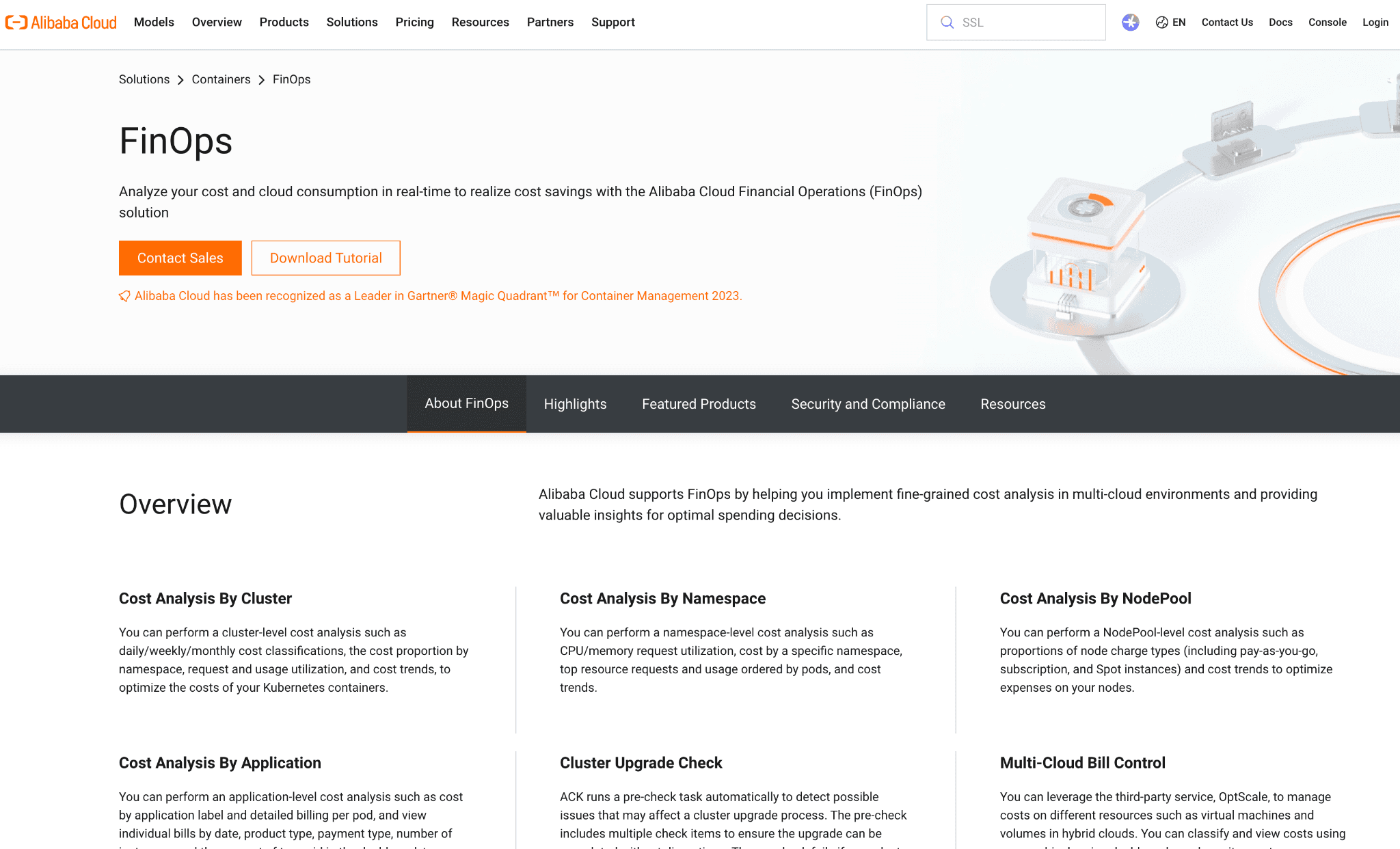
Alibaba Cloud Cost Center is the provider's built-in cost management product, available free with any Alibaba Cloud account. It pulls usage data from every Alibaba service, presents it through cost analysis dashboards and supports budgets, anomaly detection and savings plan recommendations from inside the Alibaba console.
The product covers the basics well for teams with one cloud and no need for multi-cloud comparison. The trade-off is that it does not allocate cost to non-Alibaba resources, has no unit economics layer and lacks the role-based views that finance and engineering both expect from a dedicated FinOps tool.
Key features:
Cost Analysis: Breaks down Alibaba Cloud spend across products, regions, resource groups and tags with daily granularity, useful for spotting which service is driving a monthly increase.
Budgets and alerts: Sets monthly and quarterly budgets against products, accounts, or tags, with email and SMS alerts when consumption crosses configured thresholds.
Savings plan recommendations: Models ECS and general-purpose savings plans against current pay-as-you-go usage and shows projected discount coverage before any commitment.
Anomaly detection: Applies provider-side AI to billing data and flags spend deviations, with feedback loops that improve detection accuracy over time.
Resource Optimization Recommendations: Surfaces underutilized ECS, idle OSS buckets and orphaned snapshots with specific cleanup actions and projected savings.
Cost Allocation: Allocates costs across accounts, tags and resource groups for chargeback and showback inside an Alibaba-only environment.
CloudMonitor integration: Pulls performance data alongside cost data so engineers can correlate spend with workload metrics inside the same Alibaba console.
Pricing: Free with any Alibaba Cloud account. There is no separate license fee, since the product is bundled into the platform itself.
Pros:
Zero additional cost for any team already on Alibaba Cloud, since the product is included in the standard account.
Native depth across every Alibaba service from day one, including newer products that third-party platforms often lag on supporting.
Savings plan and reserved instance modeling uses live Alibaba billing data with no integration delay, since the data never leaves the platform.
Cons:
No multi-cloud view, so teams running Alibaba alongside AWS, Azure, or GCP still need a second platform to unify cost data.
No unit economics or business metric layer, so finance leaders cannot tie spend to revenue, customers, or product features without external tooling.
Engineering and finance share one dashboard with no role-based persona views, so the CFO sees the same interface as the SRE and neither view is ideal.
3. Hystax OptScale
Best for: Engineering and FinOps teams that want an open-source platform with dedicated Alibaba and ACK Kubernetes coverage, willing to self-host or accept the managed tier.
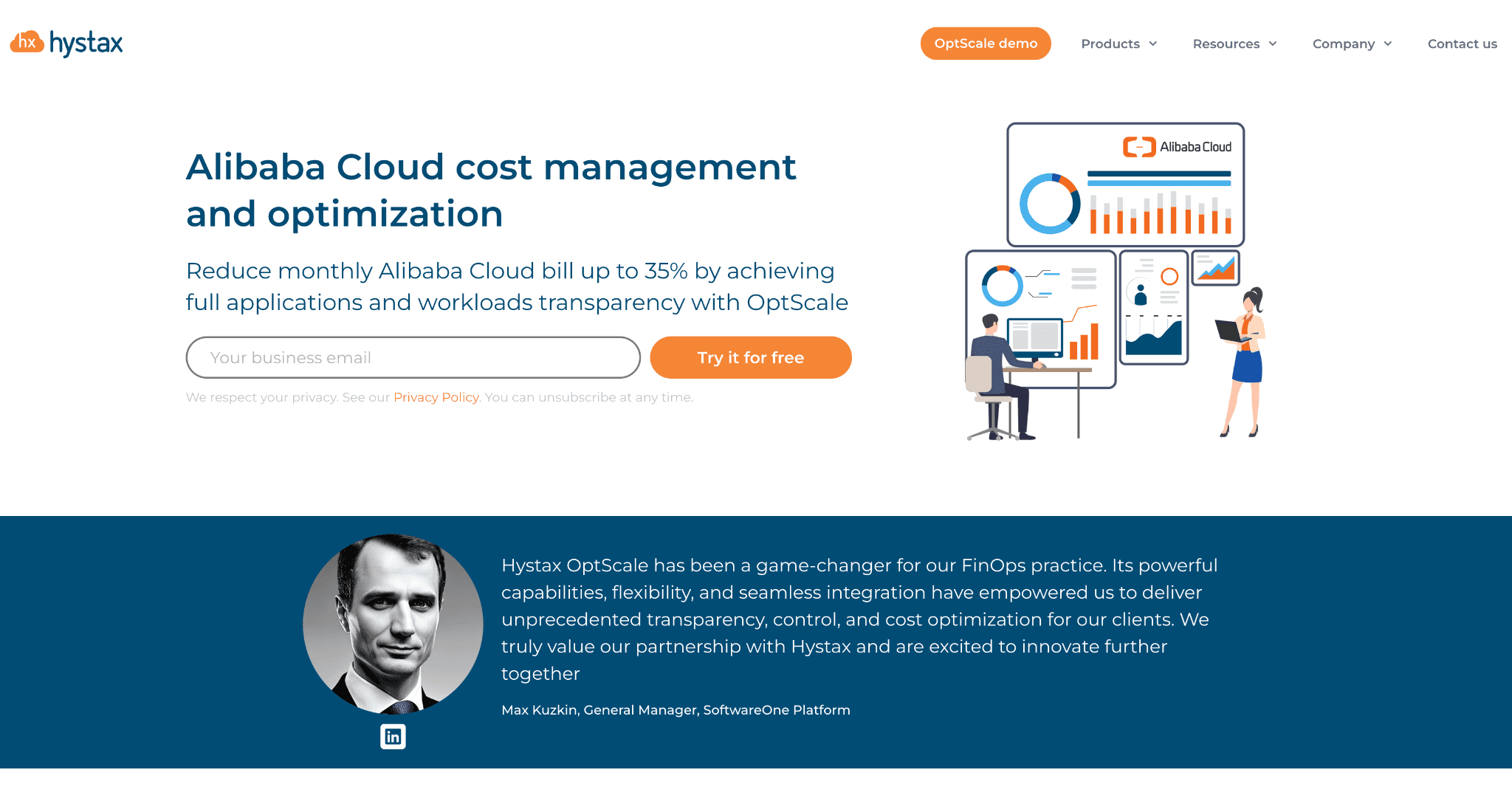
OptScale is a FinOps and cloud financial management software product from Hystax, available as open source on GitHub and as a managed service. It supports Alibaba Cloud alongside AWS, Azure, GCP and Kubernetes and is the only third-party tool with a dedicated Alibaba Cloud product page that goes past surface-level integration.
OptScale claims up to 35% monthly Alibaba Cloud bill reduction through rightsizing, reserved instance recommendations, anomaly detection and TTL-based resource cleanup. The platform has strong ACK Kubernetes depth, including pod rightsizing, node rebalancing and autoscaling guidance on Alibaba container clusters.
Key features:
Alibaba Cloud and ACK native integration: Pulls billing and resource metadata from Alibaba accounts and Kubernetes clusters running on ACK, with no separate connector configuration required for the open source build.
ECS and ACK rightsizing: Analyzes utilization across ECS instances and ACK pods, then recommends instance type changes and pod resource limits with projected monthly savings.
TTL rules and resource constraints: Sets time-to-live policies on dev and staging Alibaba resources to auto-terminate idle workloads after a configured window.
Cost anomaly detection: Catches Alibaba spend spikes on a rolling baseline and routes alerts to team owners through configured channels.
Reserved instance and savings plan modeling: Models Alibaba ECS commitment coverage against actual usage and recommends specific purchases.
Budget constraints: Enforces hard limits on Alibaba project spend, with optional automation to halt provisioning when budgets are exceeded.
Open source self-hosted option: Lets security-conscious teams run the platform inside their own environment without sending billing data to a vendor.
Pricing: OptScale is free as open source software for self-hosted deployments. Hystax offers a managed cloud tier with pricing tied to the volume of cloud spend under management, confirmed during a sales conversation.
Pros:
The only third-party platform with a dedicated Alibaba Cloud product page and proven Alibaba-specific feature work, including a published guide on Alibaba resource tagging.
Open source self-hosted option is rare in this category and useful for teams with security policies that prevent sending billing data outside the cloud account.
Strong ACK Kubernetes coverage at the pod and node level, comparable to dedicated K8s tools.
Cons:
Documentation and community activity around the Alibaba module are thinner than around the AWS or Azure modules, so teams should expect some self-service troubleshooting.
Finance reporting and unit economics are less mature than dedicated FinOps platforms, so CFOs and finance directors will find the interface engineering-oriented.
Self-hosting requires engineering effort to deploy and maintain, so smaller teams typically end up on the managed tier and pay platform fees similar to commercial alternatives.
4. Ternary
Best for: Mid-market and enterprise FinOps teams running Alibaba Cloud who need chargeback, showback and monthly close reporting alongside multi-cloud visibility.
Ternary is a purpose-built multi-cloud FinOps platform that manages Alibaba Cloud spend alongside AWS, Azure, GCP and Oracle. It was named a Leader in the 2025 ISG Provider Lens for FinOps Platforms and is built for organizations with a dedicated FinOps team running monthly business reviews.
The Alibaba Cloud integration supports cost allocation across teams, apps and products, with custom labeling, forecasting, anomaly detection and budget tracking. The platform leans toward finance and FinOps workflows, with Jira integration and trend analysis across projects.
Key features:
Native Alibaba Cloud integration: Connects to Alibaba accounts with no AnyCost API workaround, pulling cost and usage data directly into the unified dashboard.
Multi-cloud dashboards: Presents Alibaba spend alongside AWS, Azure, GCP and Oracle in one view, useful for finance teams running quarterly reviews across providers.
Granular cost allocation: Allocates Alibaba spend to teams, apps, products and environments using custom labeling rules independent of native resource group taxonomy.
Forecasting and trend analysis: Projects Alibaba spend across projects and teams over rolling 12-month windows, surfaces deviations against forecast and supports scenario modeling.
Anomaly detection alerts: Routes Alibaba cost spikes to team owners with Jira ticket creation and Slack notifications.
Custom reporting: Builds scheduled chargeback and showback reports for shared Alibaba infrastructure, formatted for monthly finance close.
ISG Provider Lens Leader 2025: Independent analyst validation that matters to procurement teams evaluating enterprise FinOps platforms.
Pricing: Ternary sells through enterprise contracts with no public rate card and no free trial. Pricing is tied to cloud spend volume under management and most deployments include a scoping engagement before access.
Pros:
Mature native Alibaba Cloud integration with no reliance on workaround APIs, which keeps data freshness and granularity consistent with AWS and Azure modules.
ISG Provider Lens 2025 Leader recognition gives procurement teams independent validation that is rare for Alibaba-supporting platforms.
Strong finance and FinOps workflows including chargeback, showback and monthly close reporting, with templates that hold up under finance audit requirements.
Cons:
Enterprise-only pricing with no self-serve tier rules it out for teams under a few hundred thousand dollars in cloud spend who cannot justify the sales cycle.
AI assistance for non-experts is limited compared to platforms with conversational interfaces, so a finance lead querying Alibaba spend will rely more on filters than natural language.
No native unit economics layer for tying Alibaba spend to product features or customers at the engineering level, so SaaS teams may need a complementary tool.
Common Mistakes When Choosing Alibaba Cost Optimization Software
Most buyers do not lose money on the tool itself. They lose it on the wrong decision. Six mistakes account for almost every regretted purchase in the Alibaba Cloud cost optimization space.
1. Picking a Multi-Cloud Tool with Surface-Level Alibaba Support
A platform that mentions Alibaba on its integration page is not the same as one that supports ECS rightsizing, OSS storage class analysis and ACK pod tuning at the same depth as its AWS module. Ask vendors for screenshots of Alibaba-specific dashboards, not the generic multi-cloud landing page.
2. Skipping the Savings Plan Modeling Step
Alibaba ECS savings plans can save up to 83% on eligible usage, but only if coverage is modeled against your actual workload pattern. Buyers who skip the modeling step end up either under-committing and missing savings, or over-committing and paying for unused capacity for the next 12 months.
3. Ignoring OSS Storage Class Optimization
ECS gets the attention, but OSS is where idle data quietly compounds. Buckets full of stale objects on Standard storage that should be on Infrequent Access or Archive can account for 10 to 20% of an Alibaba bill. A tool that does not flag this is missing one of the easiest wins.
4. Buying Without ACK Depth If You Run Kubernetes
Alibaba Container Service for Kubernetes is where most cost surprises live for engineering-heavy teams. Tools that only report ACK at the cluster level miss the per-pod and per-namespace waste that actually drives spend. Confirm pod and namespace granularity on a real cluster before signing.
5. Choosing on Demo Polish, Not Customer Outcomes
A polished demo is not a working deployment. Ask every vendor for named Alibaba Cloud customer outcomes with measurable savings. If they cannot share two within 48 hours, that tells you everything you need to know about their Alibaba book of business.
6. Treating AI Workload Cost as a Future Problem
PAI, Model Studio and GPU spend on Alibaba is the fastest-growing line item for AI-heavy teams. A platform that does not track AI workload cost today will miss your biggest cost center in 12 months. Confirm coverage of PAI GPU instances and Model Studio token spend before committing.
How to Choose the Right Alibaba Cloud Cost Optimization Platform
The right Alibaba cost optimization platform is the one that solves your single biggest cost problem in the first 90 days, not the one with the longest feature list.
Pick by the problem you are actually facing:
Visibility problem on Alibaba spend: Choose a platform with strong dashboards and virtual tags like Amnic or Ternary. The cloud cost visibility software breakdown covers this in more detail.
Waste problem on ECS, OSS, or ACK: Prioritize an engine with documented Alibaba savings and rightsizing recommendations like Amnic or OptScale.
Allocation problem across teams or products: Look for cloud cost allocation software with flexible split rules, like Amnic or Ternary.
Governance problem at scale: Look for budgets, cost anomaly detection and tag hygiene rules, like Amnic or Ternary.
AI cost problem on PAI or Model Studio: Choose a platform that tracks Alibaba AI workload spend, like Amnic.
Reporting problem for finance: Choose chargeback-grade reporting like Ternary or Amnic.
Multi-cloud problem if you run Alibaba plus AWS or Azure: Use the cloud cost management tools framework and platforms like Amnic that support all five providers natively.
Write down your top two problems. Compare only those two. You will pick faster and avoid paying for features you will never use.
If you are weighing pricing models across vendors, the Vantage pricing breakdown is a useful reference point for how percentage-of-spend pricing compounds at scale, even though Vantage itself does not support Alibaba.
Why Decision Makers Choose Amnic for Alibaba Cost Optimization
Amnic is built around a simple belief: Alibaba cost should be transparent for every role, not just FinOps specialists running monthly reviews inside the console.
The platform pairs deep granularity on Alibaba services with an AI layer that finance leaders, engineers and product managers can each use without training. Three differentiators matter most to the buyers we talk to every week.
Multi-cloud coverage that actually goes deep on Alibaba. Most competitors stop at AWS, Azure and GCP, or add Alibaba as a checkbox integration. Amnic supports Alibaba ECS, OSS, PolarDB, MaxCompute, ACK and PAI at the same depth as the other major providers, with drill-down from account to specific resource ID.
Read-only access by design. Amnic never touches your Alibaba account. Your DevOps team owns every change. That single architectural choice is why security teams approve Amnic in days instead of months, which matters more on Alibaba where security review cycles tend to be conservative.
AI that any role can use. Amnic AI ships four agents (X-Ray, Insights, Governance, Reporting) that turn natural-language questions into filtered Alibaba dashboards. A CFO can ask what we spent on PAI last month and get an answer in 30 seconds without learning Alibaba taxonomy. Explore the multi-cloud cost management overview for how this connects across providers.
"The maturity of Amnic AI, along with how easily we integrated it across our multi-cloud setup, was phenomenal. The team is consistently open to ideas and prioritizes the roadmap based on customer needs." - Senior FinOps Lead, G2 verified review
Read the full case studies on the Amnic customers page.
Frequently Asked Questions
What is the difference between Alibaba Cloud cost management and Alibaba cost optimization tools?
Alibaba Cloud cost management is about visibility and reporting. It shows where the money is going, who owns it and how it tracks against budget. Alibaba cost optimization tools take the next step. They add rightsizing recommendations, anomaly detection, savings plan modeling and automation so the team acts on the data instead of just reading dashboards. Most modern platforms, including Amnic, do both inside one product.
How much can I save with Alibaba cost optimization tools?
Most teams recover 10 to 20% of Alibaba Cloud spend in the first 90 days through ECS rightsizing, OSS lifecycle cleanup and savings plan coverage. Amnic customers have seen 30 to 50% savings on specific cost categories such as Kubernetes clusters and network costs. Hystax OptScale publicly claims up to 35% monthly Alibaba bill reduction. The actual number depends on your starting waste level, how much of the bill sits on ECS versus OSS versus ACK and whether your team acts on the recommendations consistently.
Do Alibaba cost optimization tools need write access to my Alibaba Cloud account?
Not always. Amnic operates with read-only access, so your DevOps team owns every change and security review takes days instead of months. Tools that automate provisioning or commitment purchases may require write access, which is harder to approve at most regulated companies. Always confirm the permission model with your security team before signing a contract, especially on Alibaba where security policies tend to be stricter than on AWS or Azure.
Can Alibaba cost optimization tools track PAI and Model Studio AI workload spend?
Yes. Amnic tracks Alibaba PAI GPU usage and Model Studio token spend alongside Bedrock and OpenAI on other clouds. This matters because AI workload spend is the fastest-growing line item for most teams in 2026 and some teams now exceed AI budgets by four times in a single quarter. Native Alibaba Cloud Cost Center reports PAI spend as well, but without rightsizing or unit economics tied to model usage, which is where third-party platforms add value.
Which Alibaba cost optimization platform is best for Kubernetes on ACK?
Amnic offers ACK Kubernetes cost optimization at the container, pod and node pool level alongside full multi-cloud visibility, which is the better choice if you want one platform for everything. Hystax OptScale has strong ACK depth and an open-source self-hosted option, useful for teams with strict data residency rules. Native Alibaba Cloud Cost Center reports ACK at the cluster level but lacks per-pod granularity. Confirm pod-level reporting on your actual cluster during a proof of concept rather than relying on demo dashboards.
How long does it take to deploy Alibaba cost optimization tools?
Read-only platforms like Amnic onboard in hours, since the integration is a permission setup rather than an agent install. Ternary and CloudZero typically run a scoping engagement before access, which adds two to four weeks. Hystax OptScale managed tier deploys in a day or two, but self-hosted open-source requires engineering time to stand up. Alibaba Cloud Cost Center is active by default with no deployment work, since it ships with every Alibaba account.
Is an Alibaba cost optimization platform worth it for a small team?
If your monthly Alibaba Cloud bill is under $10,000, native Alibaba Cloud Cost Center may be enough. Above that, the savings from a dedicated platform almost always exceed the subscription cost within the first quarter. The breakeven point comes faster if you run ACK Kubernetes or PAI workloads, since those generate waste at a rate that native tools struggle to surface. Most Amnic customers see the platform pay for itself in 30 to 60 days at the mid-market tier.
What is an Alibaba Cloud savings plan and which tools help manage it?
An Alibaba Cloud savings plan is a commitment to a consistent hourly spend on ECS or general-purpose resources in exchange for discounts of up to 83% on eligible pay-as-you-go usage. Amnic, Ternary and Hystax OptScale model coverage gaps against actual usage and recommend specific commitments before purchase. Alibaba Cloud Cost Center handles native modeling well for single-cloud teams. For teams running Alibaba alongside AWS or Azure, a cloud financial management software platform that unifies commitment modeling across providers reduces the risk of over-committing on any single cloud.
Cut Your Alibaba Cloud Bill in the Next Quarter
If you are a CFO, FinOps lead, or VP of Engineering looking to recover 10 to 20% of your Alibaba Cloud spend before the next board review, Amnic is built for you.
Book a 30-minute demo and see your top three Alibaba cost leaks before the call ends.
Better visibility and management into AI Tokens?
Start with a 30 day trial
Connect leading LLMs
24 hour time to value
Stay ahead of AI Spend

Make AI spend visible, controllable, and accountable.
Gain insights into your AI token costs at a team, customer, business unit and individual user level to measure and manage AI utilization.
Recommended Articles

8 Best Llama Cost Management Tools in 2026
Read More
8 Best Amazon Bedrock Cost Optimization Tools for 2026
Read More

7 Best Amazon Bedrock Cost Monitoring Tools
Read More

8 Best Gemini Cost Visibility Tools for 2026
Read More

7 Best Multimodal Cost Optimization Tools for 2026
Read More

5 Best Anthropic Cost Allocation Tools for 2026
Read More