7 Best AI Cost Management Platforms for Enterprise 2026
16 min read
AI for FinOps

Table of Contents
Comparing the top AI cost management platforms for enterprise are 1. Amnic, 2. Apptio Cloudability, 3. Flexera, 4. CloudZero, 5. Datadog Cloud Cost Management, 6. Vantage and 7. Finout.
Enterprise AI cost management platforms track and allocate LLM token usage, GPU compute and multi-cloud spend, then map those costs back to specific products, teams, or customers. They turn opaque provider invoices and API fees into structured cost centers a finance team can govern. The AI token management tools category shows how that per-token attribution has become a baseline enterprise requirement, not a nice-to-have.
The enterprise distinction is not tracking itself. It is governance at scale: role-based access, SOC 2 and ISO posture, multi-entity chargeback and a FinOps maturity path that holds up when hundreds of engineers ship AI features across several business units. A central finops function needs every AI dollar to land in the right cost center without manual reconciliation.
Amnic leads this list because it brings multi-cloud, Kubernetes and AI token spend into one read-only platform and allocates all of it through a single tagging and split-rule engine. An enterprise stops reconciling AWS Cost Explorer, Azure native tools, a Kubernetes cost view and a separate LLM dashboard. The platform pairs that unified AI and cloud cost platform view with an agentic FinOps layer, SOC 2 Type II, ISO 27001 and GDPR, which is the combination enterprise procurement and security teams ask for first.
Top 7 AI Cost Management Platforms for Enterprise
Amnic: Agentless, read-only FinOps platform that allocates multi-cloud, Kubernetes and AI token spend to products, teams and features through one virtual-tag engine.
Apptio Cloudability: IBM-owned enterprise FinOps incumbent with deep chargeback, WatsonX-backed forecasting and Kubernetes allocation across public cloud.
Flexera: Hybrid ITAM and FinOps suite whose new AI Cost Management product tracks token and credit consumption across ChatGPT, Claude and Bedrock models.
CloudZero: Engineering-led unit economics platform that ties cost per customer and per feature to revenue, including direct Anthropic and Azure OpenAI ingestion.
Datadog Cloud Cost Management: Cost module that correlates spend with live observability and prices 800-plus models at trace and span level through LLM Observability.
Vantage: Multi-cloud cost platform with Virtual Tagging, a FinOps Agent and native OpenAI, Anthropic and Cursor integrations.
Finout: Enterprise FinOps platform built on a patented MegaBill layer that normalizes cloud, Kubernetes, SaaS and AI provider spend for 100 percent allocation.
What Is an AI Cost Management Platform for Enterprise?
An AI cost management platform for enterprise is software that measures, allocates and governs the cost of AI workloads across an organization, then attributes every token, GPU hour and API call to the team, product, or customer that drove it. It answers one question finance keeps asking: who spent this and on what.
The technical job is harder than traditional cloud cost work. An LLM API call has no resource to tag, so the tags that live in AWS or GCP never reach the provider invoice. A platform built for this ingests usage at the model and request level, normalizes it against the cloud and Kubernetes cost management lines where GPU and inference workloads run and reassembles a per-customer or per-feature cost the raw bill cannot show.
This is the trace-versus-invoice gap that practitioners describe when a single inference session costs thousands while the cloud bill stays flat. Understanding what is LLM inference and how it generates cost is the foundation before any platform can allocate it. The seven platforms below were measured against that bar.
For an enterprise buyer, the platform also has to satisfy controls that the team will not waive. That means SOC 2 and ISO certification, single sign-on, role-based access, audit trails and chargeback that survives missing tags. The discipline of finops for ai is what separates a dashboard from a system finance trusts to drive budgets.
AI Cost Management Platforms for Enterprise Comparison Table
Information reflects vendor sources as of June 2026. Confirm current pricing and certifications with the vendor.
Platform | AI plus Cloud Coverage | Enterprise Controls | Compliance | Allocation | Pricing | Best For |
|---|---|---|---|---|---|---|
Amnic | LLM tokens (Bedrock live; OpenAI, Anthropic rolling out), GPU via Kubernetes, AWS/Azure/GCP/Oracle/Alibaba | SSO, RBAC/Teams, Jira | SOC 2 Type II, ISO 27001, GDPR | Virtual Tags, 5-level hierarchy, meter-based split, chargeback | 0.25 to 1% of monitored spend; 30-day trial, no card | Enterprises unifying cloud, Kubernetes and AI allocation |
Apptio Cloudability | Public cloud, Kubernetes; AI coverage recent | SSO (SAML), RBAC | SOC 2, ISO 27001, FedRAMP | Business Mapping, cost sharing, chargeback | Percent of cloud spend, custom quote; no free tier | Large FinOps teams standardized on Apptio |
Flexera | Tokens/credits across ChatGPT, Claude, Bedrock, Foundry; GPU, containers | SSO (SAML), RBAC | SOC 2 Type II, ISO 27001 | Showback across cloud, SaaS, license, AI | Custom enterprise quote; no free tier | Hybrid estates with software, SaaS and AI |
CloudZero | Anthropic, Azure OpenAI, Bedrock tokens, GPU hours | SSO (SAML, JIT) | SOC 1 and SOC 2 | Cost per customer/feature, 100% incl. untagged | Percent of annual spend, custom quote; no free tier | Engineering-led unit economics |
Datadog CCM | 800-plus models via LLM Observability, AWS/Azure/GCP/OCI | SSO (SAML), RBAC | SOC 2, ISO 27001/27017/27018/27701 | Tag enrichment, OOTB LLM tags for chargeback | Pro 0.5%, Enterprise 1% of monitored spend | Teams already standardized on Datadog |
Vantage | Native OpenAI, Anthropic, Cursor; Kubernetes, GPU | SSO (SAML), RBAC | SOC 2 (SOC 1 at Enterprise) | Virtual Tagging, retroactive allocation | Free Starter; Pro $30/mo; Business $200/mo; Enterprise custom | Mid-market to enterprise multi-cloud |
Finout | OpenAI, Anthropic, SageMaker, Vertex AI; GPU, Kubernetes | SSO, RBAC | SOC 2 Type II, ISO 27001, GDPR | MegaBill, Virtual Tags, 100% allocation | Percent of cloud spend, fixed annual; no free tier | Enterprises consolidating many cloud and SaaS sources |
How We Evaluated These Platforms
Six criteria decided the ranking, weighted for the enterprise buyer rather than the solo engineer.
Unified AI plus cloud coverage: Does it show LLM tokens, GPU compute and multi-cloud spend in one view, or only a slice? A platform that sees the cloud but not the provider invoice manages a fraction of the real AI cost.
Allocation and chargeback depth: Can it attribute spend to a team, product, customer, or feature and does that allocation survive missing tags? Showback is visibility without consequence; chargeback is accountability.
Enterprise security and access: SSO, role-based access, audit trails and read-only posture matter to the security review that gates any enterprise purchase.
Compliance posture: SOC 2 Type II and ISO 27001 are table stakes; GDPR and data residency decide regulated industries.
Governance and controls: Budget alerts, anomaly detection and policy enforcement that fit how a large org actually runs cloud cost governance without killing experimentation.
Pricing transparency and fit: A model an enterprise can forecast and defend in procurement, which is why published percentage-of-spend models score above opaque custom quotes.
Top AI Cost Management Platforms for Enterprise in 2026
1. Amnic
Best for: Enterprises that want cloud, Kubernetes and AI token spend allocated and governed in one agentless platform.
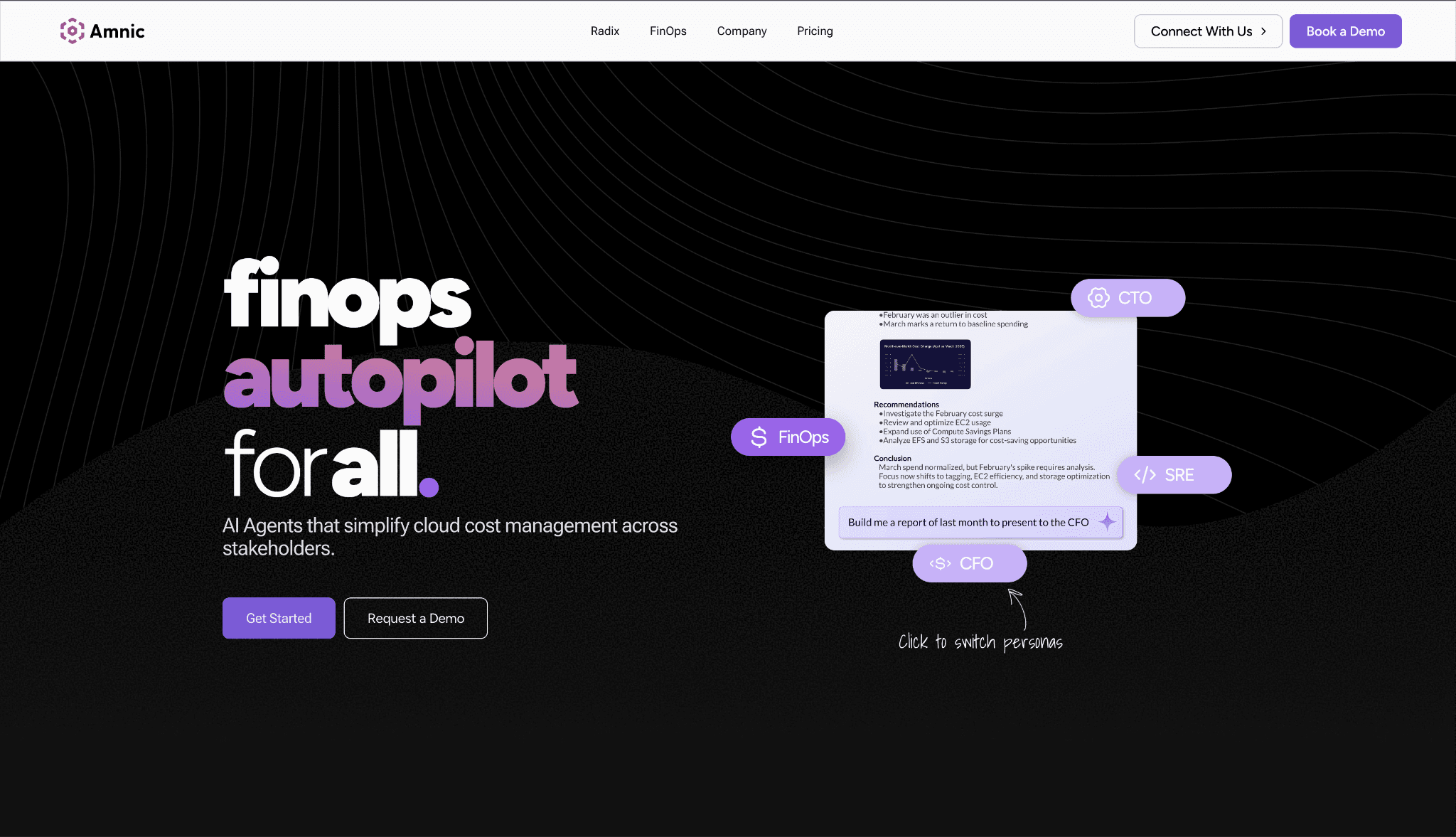
Amnic is a FinOps platform built around a Visibility, Optimization and Governance spine and it connects to AWS, Azure and GCP read-only with no agent to install. That posture matters for enterprise security review, because Amnic never holds write access to infrastructure and any change happens in the team's own console. The platform reads token usage across AI providers and places that AI line item next to the multi-cloud and Kubernetes lines.
The allocation engine is the reason it ranks first here. Virtual Tags unify inconsistent labels such as prod, production and PROD into one logical tag and shared-cost split rules divide a shared database, network, or load balancer across products by equal, proportional, percentage, or actual-usage meter. The result is cost per product, feature, or line of business that holds even when raw tags are missing, which is the exact failure mode enterprises hit with token spend.
Key features:
AI and LLM token tracking that connects Bedrock spend today and tracks usage and tokens per model, with OpenAI and Anthropic direct connectors rolling out, framed as tracking and allocation rather than request-time optimization.
Kubernetes and container cost across EKS, AKS, GKE and ECS with rightsizing at the 90th percentile down to per-core, the lever enterprises use to control GPU and inference cluster spend. Pair this with a focused GPU utilization view to catch idle capacity.
Multi-cloud analyzer across AWS, Azure, GCP, Oracle and Alibaba that normalizes compute, storage, network and database and drills from account to service to resource ID.
Cost allocation through Virtual Tags, a five-level virtual hierarchy and meter-based shared-cost split rules for finance-grade chargeback and showback.
Unit economics that tie cloud and AI cost to a business metric such as cost per loan processed, per delivery, or per query.
Anomaly detection with customer-defined thresholds and custom anomalies by tag or product, so experimentation is not blocked by rigid caps.
Budgets and forecasting tracked against actuals with staged alerts at thresholds such as 50, 70, 85 and 100 percent.
An agentic layer of prebuilt X-Ray, Insights, Governance and Reporting agents, plus an MCP Server that connects Amnic to Claude, Cursor and VS Code.
Enterprise controls, including SSO, RBAC through Teams and a Jira integration.
Pricing: Amnic charges 0.25 to 1 percent of monitored cloud spend, not a fixed per-seat or flat subscription, which keeps cost proportional to the estate it governs. A 30-day free trial runs on the startup tier with no credit card and enterprise plans support a negotiated spend cap. You can review amnic pricing to scope an enterprise rollout.
Pros:
One platform for cloud, Kubernetes and AI spend, so finance stops stitching four tools together.
Allocation survives missing tags through Virtual Tags and meter-based split rules.
Agentless and read-only, which clears enterprise security review faster than agent-based tools.
SOC 2 Type II, ISO 27001 and GDPR, plus an Everest Group PEAK Matrix 2025 listing.
Cons:
AI coverage is tracking, allocation and showback, not request-time optimization or a kill switch, so an enterprise that needs an in-line gateway to cap spend per request will pair Amnic with a proxy. Direct OpenAI and Anthropic connectors are still rolling out while Bedrock is live today.
2. Apptio Cloudability
Best for: Large FinOps teams already standardized on the Apptio suite that need mature public-cloud chargeback.
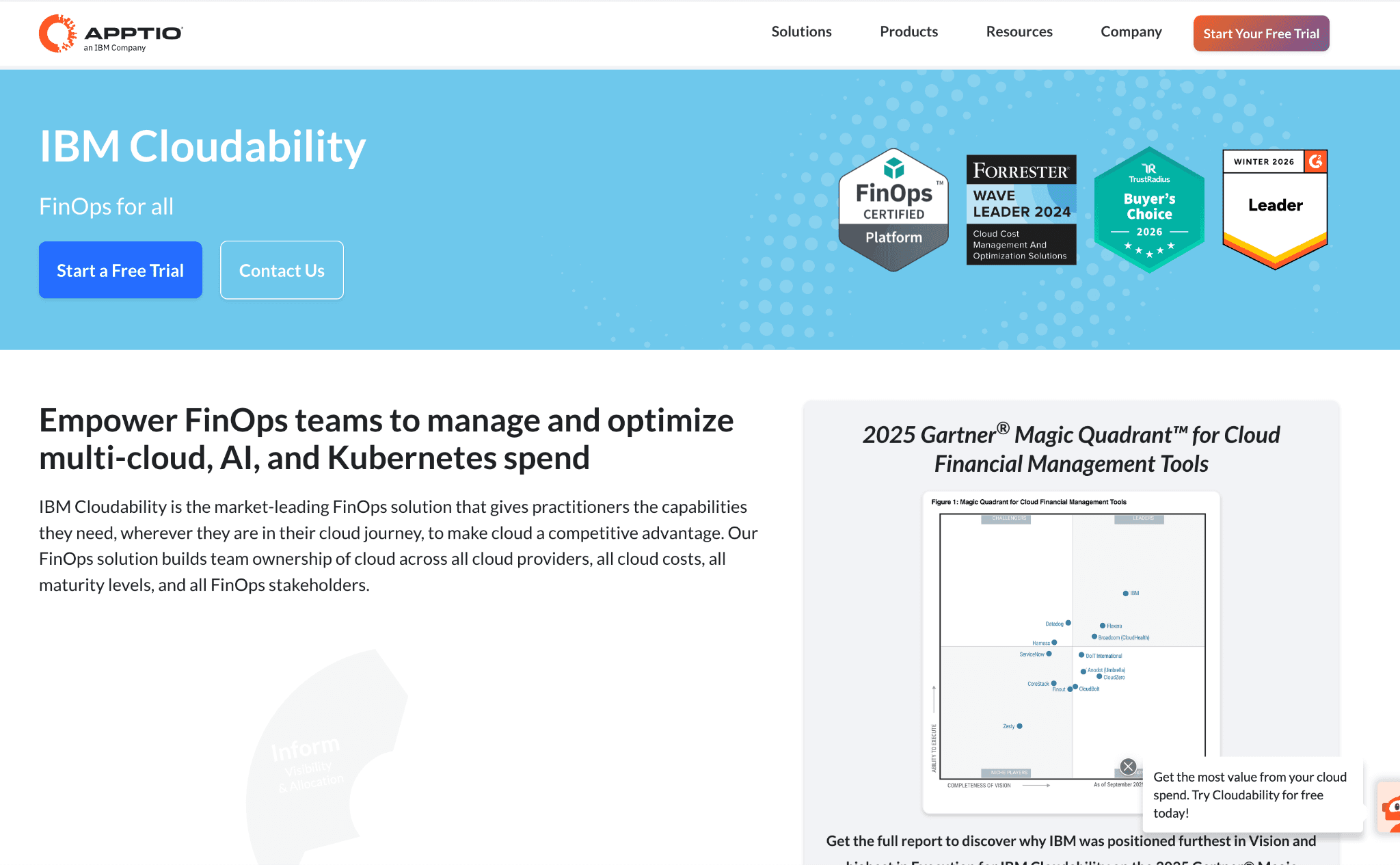
Apptio Cloudability, now owned by IBM after the 2023 acquisition, is one of the longest-running enterprise FinOps platforms and its strength is the depth of cost allocation. Business Mapping and cost-sharing rules let a large organization push chargeback and showback across hundreds of accounts and bottom-up forecasting now draws on IBM WatsonX. For an enterprise with an established FinOps practice, the governance model is proven.
The caveat for an AI-cost buyer is coverage. Cloudability is excellent at public cloud and Kubernetes container allocation, but native per-token LLM attribution is recent and partial. Teams that adopt it for AI spend often find they are still mapping the provider invoice manually.
Key features:
Business Mapping for cost allocation, chargeback and showback across multi-cloud accounts.
Anomaly detection with budget-breach alerts.
Bottom-up forecasting powered by IBM WatsonX.
Rightsizing plus reserved instance and commitment optimization.
Kubernetes container cost allocation with automated pod placement.
Multi-cloud visibility across AWS, Azure, GCP and IBM Cloud.
Near-real-time unit economics reporting.
Enterprise certifications including SOC 2 Type II, ISO 27001 and FedRAMP, with SAML SSO and RBAC.
Pricing: Cloudability is priced as a percentage of annual cloud spend under management on tiered annual contracts, with no public price list and no free tier, so expect a custom enterprise quote. Third-party estimates place it in the low single-digit percent of spend, which you should confirm directly.
Pros:
Deep, mature allocation and chargeback proven at enterprise scale.
Strong compliance stack including FedRAMP for public-sector estates.
Watsonx-backed forecasting for finance planning.
Cons:
Native LLM token attribution is recent and partial, so AI-first teams may still reconcile provider invoices by hand and setup leans heavily on consistent tagging with a real learning curve.
3. Flexera
Best for: Hybrid enterprises governing software licensing, SaaS and AI spend in one suite.
Flexera is an established IT asset management and FinOps vendor and it launched a dedicated AI Cost Management product in June 2026 to address exactly this category. The product tracks token and credit consumption across ChatGPT, Claude and Copilot, plus models from Anthropic, OpenAI, Gemini and Llama served through Bedrock and Microsoft Foundry. Its differentiator is breadth: the same platform that governs on-prem software and SaaS licensing now folds in AI.
That breadth is also the trade-off. The AI product is early, AI policy enforcement is partial and the wider Flexera One platform carries the configuration weight of an enterprise ITAM suite. Reviewers consistently flag a steep learning curve and a time-consuming initial setup, which is the cost of covering hybrid estates that AI-only tools ignore.
Key features:
AI Cost Management tracks tokens and credits across major chat tools and model providers via Bedrock and Foundry.
GPU clusters, containers, Kubernetes and VM coverage, plus Databricks and Snowflake.
90-plus out-of-the-box cost optimization policies with custom automation.
Hybrid visibility spanning AWS, Azure, GCP, on-prem software, SaaS and licensing.
Commitment management across AWS Savings Plans, Azure Hybrid Benefit and GCP CUDs.
FOCUS support, ingesting FOCUS v1.0-compliant data as a contributing member.
Anomaly detection and budget controls with a FinOps Assist natural-language assistant.
SOC 2 Type II and ISO 27001, with SAML SSO and RBAC.
Pricing: Flexera sells on a custom enterprise subscription with no public price list and no free tier, driven by accounts, spend under management and features. Third-party guides report five-figure annual minimums, which Flexera does not confirm publicly.
Pros:
Only suite here that governs software licensing, SaaS and AI in one place.
FOCUS-aligned ingestion and broad commitment management.
New AI product covers a wide model and tool surface.
Cons:
The AI Cost Management product is early-access with partial policy enforcement and the broader platform has a steep learning curve and heavy initial setup.
4. CloudZero
Best for: Engineering-led teams that want cost per customer and per feature tied to revenue.
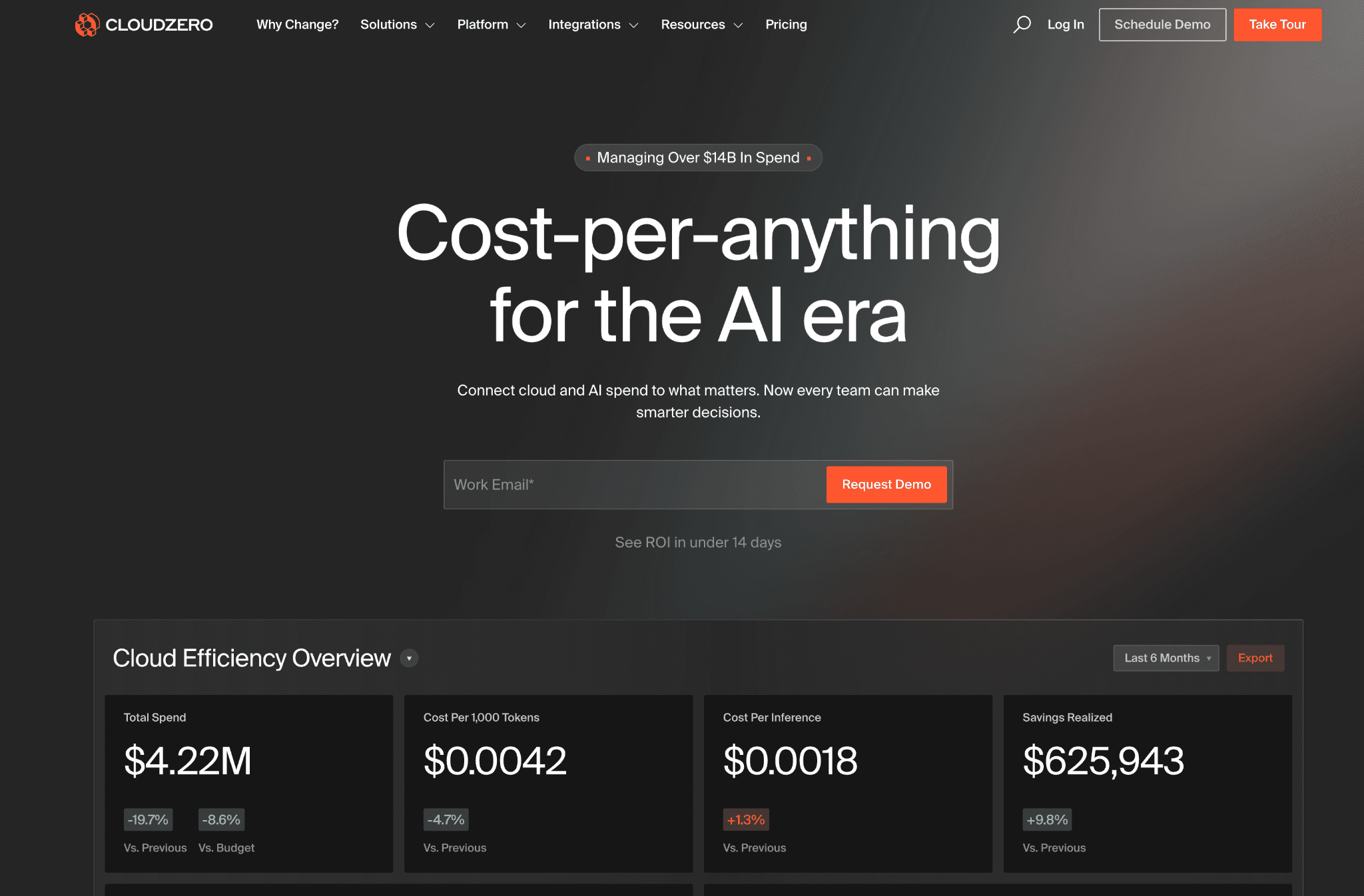
CloudZero approaches AI cost from the unit economics angle, which appeals to engineering and product leaders more than to a central license desk. It allocates 100 percent of spend including untagged resources through machine-assisted tagging and it claims a direct integration with the Anthropic Usage and Cost API that pulls Claude tokens alongside Azure OpenAI and Bedrock. The result is cost per customer and per feature that connects to margin.
If you want help here, this is a good moment to compare the broader field through our guide to finops tools for ai cost management, since CloudZero sits at the engineering end of it. Practitioners note that forecasting and financial planning depth is thinner than incumbents, with basic trend visualization that is still maturing, so finance-heavy planning may need a complement.
Key features:
AI coverage across Azure OpenAI tokens, Bedrock inference and a direct Anthropic API integration.
GPU cost tracking for self-hosted GPU hours.
Cost per unit, per customer and per feature including untagged spend.
Machine-assisted auto-tagging of untagged resources.
Anomaly detection to hourly granularity with auto-adjusting thresholds and chat alerts.
Budgets and alerting tied to business dimensions.
Broad ingestion across AWS, GCP, Azure, Anthropic, OpenAI, Kubernetes, Snowflake, Datadog and more.
SOC 1 and SOC 2 with SAML SSO and just-in-time provisioning.
Pricing: CloudZero is priced as a percentage of annualized cloud spend on a custom quote with no public pricing and no free tier and it bundles unlimited users plus a dedicated FinOps manager. Third-party estimates suggest roughly 1 percent at lower spend, declining at scale.
Pros:
Strong per-customer and per-feature unit economics tied to revenue.
Allocates untagged spend automatically, reducing tag-hygiene dependence.
Direct Anthropic and Azure OpenAI token ingestion.
Cons:
Forecasting and financial-planning depth lags incumbents and the lack of published pricing and a free tier slows evaluation for budget-conscious teams.
5. Datadog Cloud Cost Management
Best for: Engineering organizations already standardized on Datadog observability.
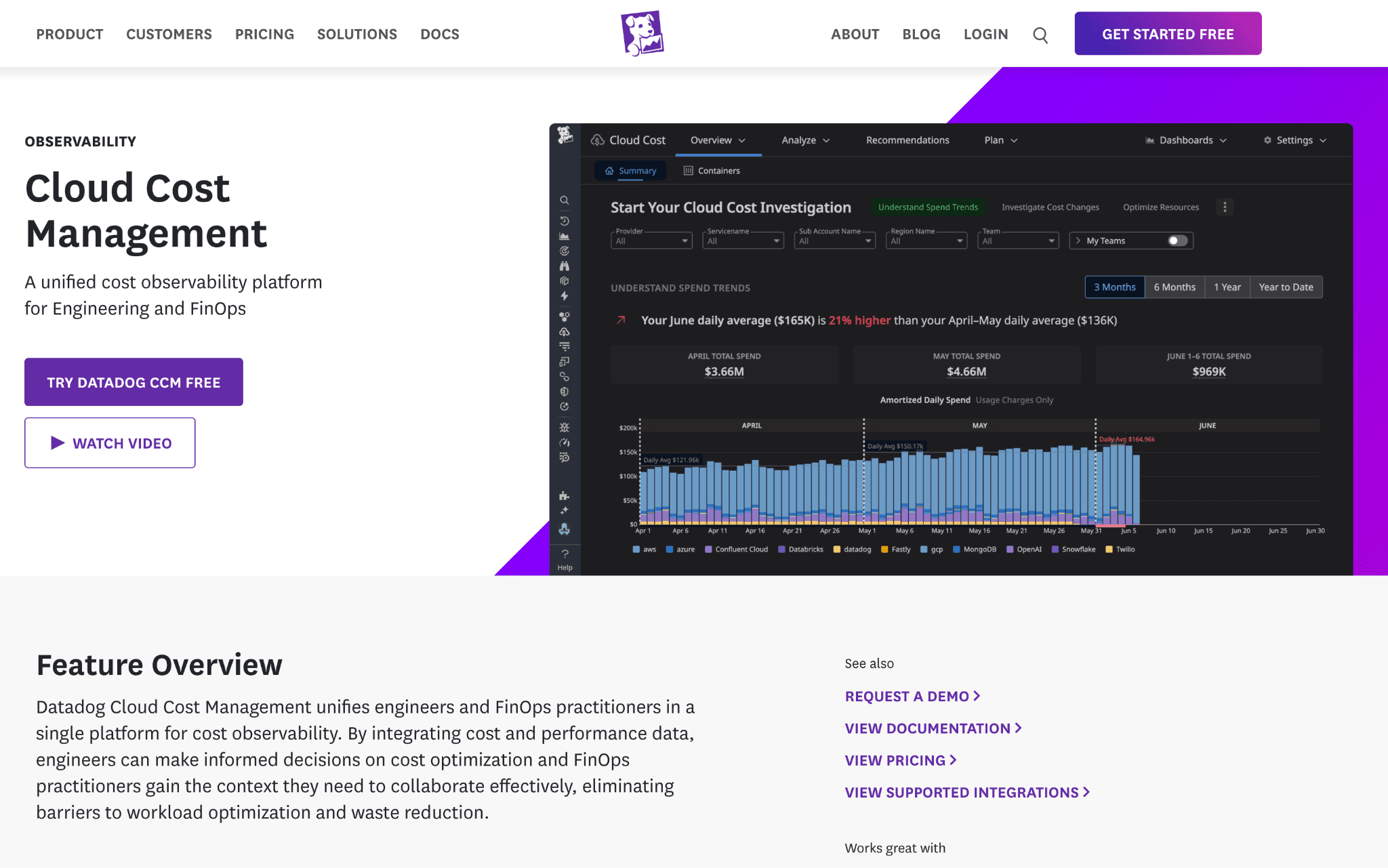
Datadog Cloud Cost Management earns its place because it correlates spend with the live observability data teams already collect. Through LLM Observability it prices more than 800 models at the request, trace and span level. Out-of-the-box tags such as model_name, model_provider and ml_app make chargeback for AI workloads straightforward for teams that instrument with Datadog.
The recurring complaint is cost itself. CCM bills as a percentage of monitored spend on top of an already expensive platform and a dedicated GPU cost line item and FOCUS support are not clearly documented. Teams not already committed to Datadog rarely adopt it for cost alone. If you are weighing observability-led options, our roundup of cloud cost management tools puts it in context.
Key features:
Multi-cloud and SaaS ingestion across AWS, Azure, GCP and OCI with custom sources.
AI coverage via CCM and LLM Observability pricing 800-plus models at trace and span level.
Cost allocation with tag enrichment and out-of-the-box LLM tags for chargeback.
Container, Kubernetes and ECS cost allocation at the pod level with idle detection.
Cloud Cost Monitors for cost-change and threshold anomaly alerting.
Correlation of cost with real-time observability and usage telemetry.
Metrics API with 15-month retention.
SOC 2 with ISO 27001, 27017, 27018 and 27701, plus SAML SSO and RBAC.
Pricing: Datadog publishes CCM pricing as a percentage of monitored spend, with CCM Pro at 0.5 percent and CCM Enterprise at 1 percent, billed annually as an add-on module with no free tier.
Pros:
Ties AI and cloud cost directly to live observability and usage data.
Per-request LLM cost across a very wide model catalog.
Strong compliance breadth and published pricing.
Cons:
Cost is the chief complaint, since CCM stacks a percentage of spend on an already expensive platform and it makes sense mainly for teams already on Datadog.
6. Vantage
Best for: Multi-cloud teams that want self-serve allocation and a FinOps agent.
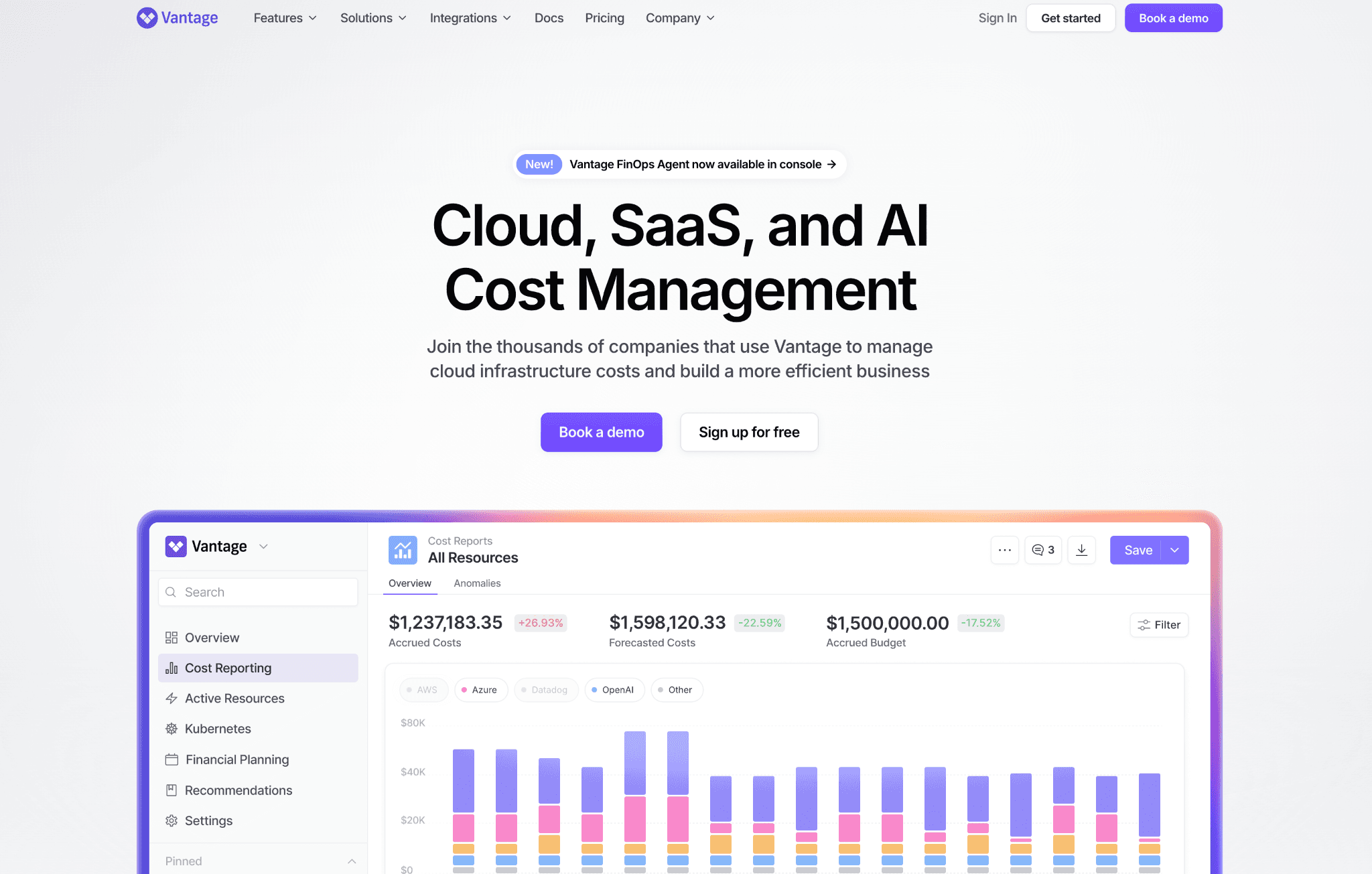
Vantage is a multi-cloud cost platform that has moved quickly on AI, with native OpenAI, Anthropic and Cursor integrations plus a Vantage MCP Server for querying costs through ChatGPT or Claude. Its Virtual Tagging allocates spend retroactively without changing infrastructure tags and its FinOps Agent builds reports and surfaces savings inside Slack and the console. The self-serve model and a free Starter tier make it easy to adopt before scaling up.
For depth comparison against agent-native options, our list of ai agent tools for finops covers where Vantage's agent fits. Reviewers cite limited advanced dashboard customization and a learning curve and the published model locks a rate at contract that begins around 1 percent of tracked cloud cost, so model the tier carefully before enterprise commitment.
Key features:
Native OpenAI, Anthropic and Cursor integrations plus a Vantage MCP Server.
A FinOps Agent in Slack and console that builds reports and surfaces savings.
Autopilot for automated AWS Savings Plan and reserved instance purchases.
Cost Reports with Virtual Tagging for retroactive allocation and chargeback.
Kubernetes and GPU cost at namespace and label granularity with rightsizing.
Anomaly detection, budgets, forecasting and unit costs.
FOCUS-compatible exports and Custom Providers via FOCUS-schema CSV or API.
SOC 2, with SOC 1 at Enterprise, plus SAML SSO and RBAC.
Pricing: Vantage publishes tiers, starting with a free Starter up to $2,500 tracked, Pro at $30 per month, Business at $200 per month and a custom Enterprise tier. Enterprise list pricing begins around 1 percent of tracked cloud cost, locked at contract initiation rather than floating with the bill.
Pros:
Transparent published pricing with a genuine free tier.
Native AI integrations and a capable FinOps agent.
Retroactive Virtual Tagging reduces tag-hygiene pressure.
Cons:
Advanced dashboard customization is limited and the platform has a learning curve, so deep enterprise reporting may need workarounds.
7. Finout
Best for: Enterprises consolidating many cloud, SaaS and AI sources into one allocated view.
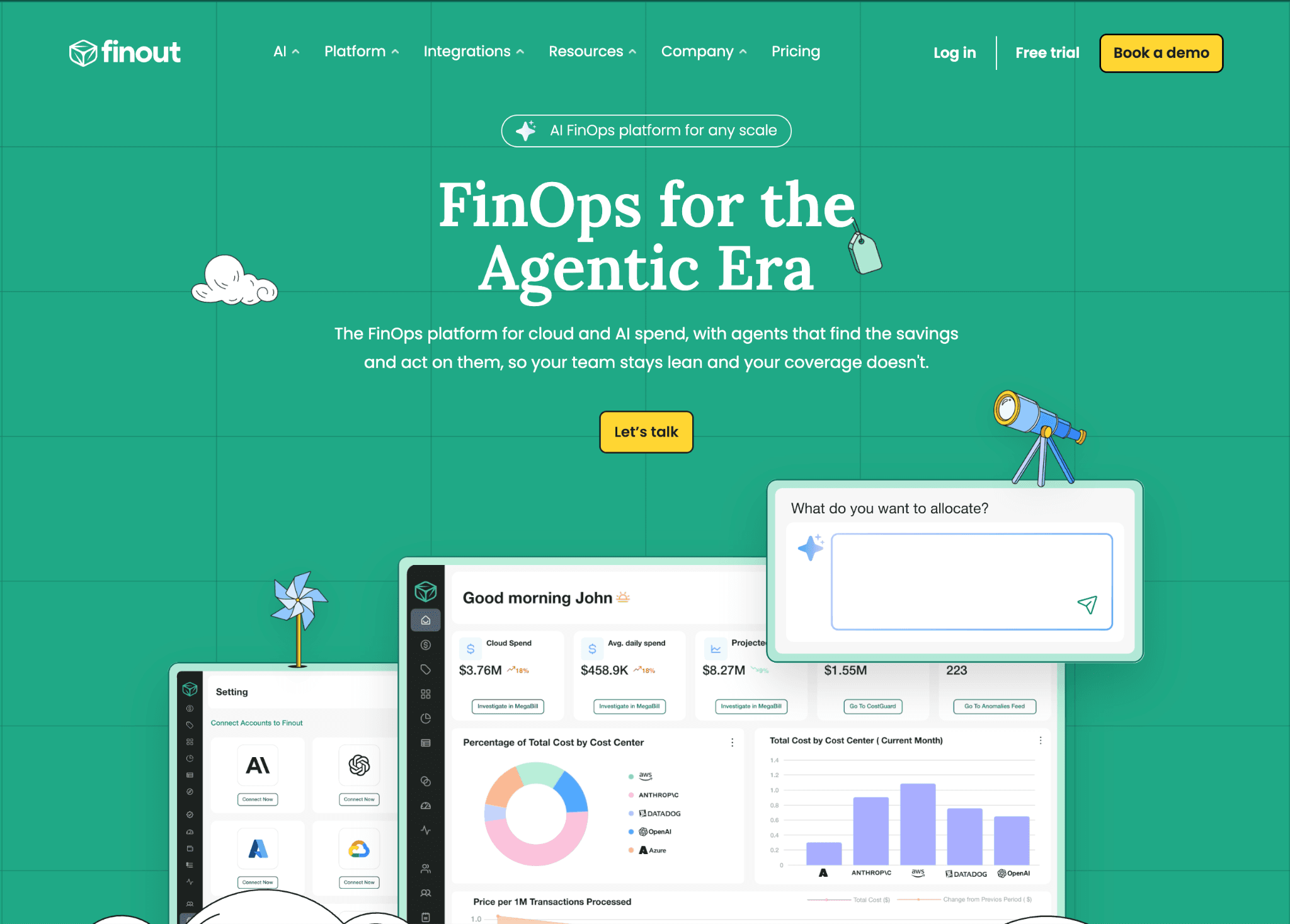
Finout is built on a patented MegaBill layer that normalizes every usage-based source, from AWS and Kubernetes to Snowflake, Datadog and AI providers, into one billing model. Virtual Tags then allocate 100 percent of spend without changing cloud tags, which is the consolidation story enterprises with sprawling estates want. Wiz used it to unify spend across seven cloud providers, a fair proxy for the scale Finout targets.
Its AI coverage spans OpenAI, Anthropic, SageMaker and Vertex AI with cost per token and per inference and CostGuard aggregates savings recommendations from native and third-party advisors. As with most platforms at this depth, reviewers note a complex initial setup and learning curve. If you are mapping the wider field, our guide to the genai cost management platform category places Finout among its peers.
Key features:
MegaBill, a patented unified billing layer normalizing all usage-based spend.
Virtual Tags for 100 percent allocation without changing infrastructure tags.
CostGuard aggregating savings recommendations across cloud advisors and third-party tools.
AI coverage across OpenAI, Anthropic, SageMaker and Vertex AI with cost per token and per inference.
GPU cost management alongside traditional metrics.
FOCUS alignment across AWS, GCP, Azure, Kubernetes, Snowflake, Datadog and AI providers.
Chargeback, showback and strong Kubernetes cost allocation with forecasting and dashboards.
SOC 2 Type II, ISO 27001 and GDPR with PII stored in the EU, plus RBAC and SSO.
Pricing: Finout charges a percentage of cloud spend billed as a fixed annual subscription, commonly cited around 1 percent and locked for the term with no overage surprises, with tiers by number of cost centers and a custom Enterprise quote. There is no free tier, only a trial or demo.
Pros:
MegaBill consolidates an unusually broad set of cloud, SaaS and AI sources.
100 percent allocation through Virtual Tags without tag changes.
Strong compliance posture with EU data residency for PII.
Cons:
Initial setup is complex with a learning curve and support, while strong, trails the highest-rated peers.
How to Choose the Right AI Cost Management Platform for Enterprise
Match the platform to the problem you are actually solving, not the longest feature list.
You need cloud, Kubernetes and AI in one allocated view: Amnic or Finout, which both normalize disparate sources rather than bolt AI onto a cloud tool and for the cluster layer, specifically compare dedicated Kubernetes cost optimization tools.
You already run a mature Apptio or Datadog estate: extend it with Cloudability or Datadog CCM before adding another vendor.
You govern software licensing and SaaS alongside AI: Flexera, the only suite spanning ITAM and AI here.
You want cost per customer and per feature for product decisions: CloudZero, built around unit economics.
You want transparent pricing and fast self-serve adoption: Vantage, with a published free tier.
Your security review is the gating factor: prioritize agentless, read-only platforms with SOC 2 Type II and ISO 27001, where Amnic and Finout score well. Our explainer on cloud cost observability helps frame the visibility baseline.
Common Mistakes When Choosing an Enterprise AI Cost Platform
Assuming your existing cloud tool already covers AI: Tools like Cost Explorer or older FinOps suites see infrastructure, not the provider invoice, so one audited team was managing roughly 15 percent of its real cost. Verify that a platform instruments the API calls themselves, not just the cloud around them.
Treating tagging as the whole answer: An API call is a transaction with no resource to tag and cloud tags do not propagate to the provider bill. Favor platforms with Virtual Tags and split rules that allocate spend even when raw tags are missing, which is the pattern strong cloud cost optimization tools share.
Trusting anomaly detection to catch a runaway agent: A several-thousand-dollar session can look like normal traffic while the cloud bill stays flat, so nothing fires. Confirm the platform monitors token and request-level spend, not only infrastructure thresholds.
Buying optimization before allocation: You cannot optimize what you cannot attribute. Get per-team and per-customer allocation working first, then layer reduction tactics, the same sequence behind effective container cost management tools.
Why Decision Makers Choose Amnic for Enterprise AI Cost Management
Three differentiators put Amnic first for enterprise buyers. It unifies multi-cloud, Kubernetes and AI token spend in one platform, so finance allocates everything through a single engine instead of reconciling separate tools. It is fully agentless and read-only, which clears security review without granting write access to the infrastructure. And it carries SOC 2 Type II, ISO 27001 and GDPR alongside an Everest Group PEAK Matrix 2025 listing.
Frequently Asked Questions
What is an AI cost management platform for enterprise?
It is software that tracks, allocates and governs AI workload cost across an organization, attributing tokens, GPU hours and API calls to the team, product, or customer that drove them, with enterprise controls like SSO, RBAC and SOC 2 compliance.
Why can't my cloud cost tool break down AI spend by team or customer?
Cloud tools see infrastructure, not the provider invoice. An LLM API call has no resource to tag and cloud tags do not propagate to OpenAI or Anthropic billing, so the spend arrives as one opaque line item with no team or customer breakdown.
How do you allocate AI costs when there is no resource to tag?
Platforms use virtual tags, metadata and shared-cost split rules to attribute token and inference spend by model, team, feature, or customer. This finance-grade allocation holds even when raw infrastructure tags are missing or inconsistent.
What is the difference between AI showback and chargeback?
Showback reports what each team or product spent without moving budget, building visibility. Chargeback bills that cost back to the owning team or cost center, adding accountability. Most enterprises start with showback and progress to chargeback as FinOps maturity grows.
Do enterprises need one platform or a stack of tools?
Many enterprises stitch a gateway, an observability tool and a FinOps layer together. A platform that unifies cloud, Kubernetes and AI allocation in one view, like Amnic, reduces that sprawl, though teams needing in-line request-level enforcement may still add a proxy.
Which platforms track LLM tokens and GPU compute together?
Amnic, Finout, CloudZero and Vantage track LLM token spend alongside GPU and Kubernetes compute, while Datadog and Flexera cover a broad model catalog. Coverage and allocation depth vary, so confirm provider connectors against your actual stack.
Bring Cloud, Kubernetes and AI Spend Into One Governed View
Enterprise AI cost is only manageable once every token, GPU hour and cloud dollar lands in the right cost center. Amnic unifies that view, allocates it with finance-grade accuracy and governs it with the security and compliance posture an enterprise review demands. See it on your own spend and request a demo.
Better visibility and management into AI Tokens?
Start with a 30 day trial
Connect leading LLMs
24 hour time to value
Stay ahead of AI Spend

Make AI spend visible, controllable, and accountable.
Gain insights into your AI token costs at a team, customer, business unit and individual user level to measure and manage AI utilization.
Recommended Articles

How to Catch AI Cost Spikes Early (FinOps Playbook)
Read More

How to Forecast AI Spend: A FinOps Guide
Read More
How to Reduce Anthropic API Costs (Without Losing Quality)
Read More

How to Reduce OpenAI API Costs: A Practical Playbook
Read More

AI Cost Anomaly Detection: How to Catch Token, GPU and API Spend Spikes
Read More

6 Best Unified AI and Cloud Cost Platforms for 2026
Read More