6 Best Unified AI and Cloud Cost Platforms for 2026
14 min read
AI for FinOps

Table of Contents
Comparing the top unified AI and cloud cost platforms are 1. Amnic, 2. CloudZero, 3. Harness, 4. Vantage, 5. Datadog Cloud Cost Management and 6. Finout.
A unified AI and cloud cost platform pulls traditional infrastructure spend and generative AI spend into one dashboard. It links cloud bills across AWS, Azure, GCP and Kubernetes with AI costs like LLM API tokens, inference and GPU hours. Bringing AI token management into the same view as compute and storage is the whole point.
The buyer's pain is simple. Most teams run a cloud FinOps tool on one screen and an LLM observability tool on another. Nobody owns the full number and AI spend hides in a corner of the cloud bill that no one reconciles.
Amnic is in the list as first because it was built for read-only, agentless deployment across AWS, Azure, GCP and Kubernetes and it tracks LLM token spend in the same model where your compute and storage already live.
Finance sees predictable unit economics while engineering keeps the granular request-level detail, with no write access to your infrastructure and a five-minute setup.
Top 6 Unified AI and Cloud Cost Platforms
Amnic: Combines multi-cloud and Kubernetes cost allocation with native LLM token tracking, so cloud and AI spend share one read-only, agentless model.
CloudZero: Ingests AWS, Azure, GCP, Kubernetes and AI providers like OpenAI, Anthropic and CoreWeave into dimensional cost intelligence tied to products and customers.
Harness: Pairs cloud cost management with request-level AI spend tracking and AI-authored policy guardrails that enforce budgets before overruns happen.
Vantage: Reports across 20-plus cloud and SaaS providers, ingests OpenAI and Anthropic usage as first-class providers and adds GPU cost visibility.
Datadog Cloud Cost Management: Adds an AI Costs view to its cost platform and joins it with LLM Observability, so AI spend sits beside infrastructure spend.
Finout: Normalizes AWS, Azure, GCP, Kubernetes, SaaS and LLM provider costs into a single MegaBill aligned with the FOCUS standard.
What Is a Unified AI and Cloud Cost Platform?
A unified AI and cloud cost platform tracks infrastructure spend and AI spend in a single system, from compute and storage to GPU utilization. It connects to cloud billing exports, Kubernetes clusters and AI provider APIs, then normalizes everything into one cost model you can slice by team, product, or customer.
Underneath, it ingests cost and usage from AWS, Azure, GCP and Kubernetes, then layers in token data from OpenAI, Anthropic, Amazon Bedrock and Vertex AI. It allocates untagged spend, reports unit metrics like cost per inference and runs anomaly detection so a runaway agent surfaces fast.
For a FinOps or platform buyer, the value is one source of truth that finance and engineering both trust. AI is the fastest-growing line on the bill and a single LLM inference call can swing from a fraction of a cent to several dollars by model, prompt length and context window. A unified platform keeps that volatility inside the same reporting that your cloud spend already uses.
Comparing the top options are 1. Amnic, 2. CloudZero, 3. Harness, 4. Vantage, 5. Datadog Cloud Cost Management and 6. Finout.
Unified AI and Cloud Cost Platforms Comparison Table
Information reflects vendor sources as of June 2026. Confirm current pricing with the vendor.
Tool | Cloud + Kubernetes Coverage | AI / LLM + Token Tracking | Free Option | Pricing | Best For |
Amnic | AWS, Azure, GCP, Kubernetes | Bedrock token tracking live; OpenAI, Anthropic, Gemini rolling out | One-month trial, no card | 0.25% to 1% of monitored cloud spend | Teams wanting agentless cloud plus AI allocation in one read-only model |
CloudZero | AWS, Azure, GCP, Kubernetes, Snowflake | OpenAI, Anthropic, CoreWeave, Gemini | Demo only | Enterprise contract, spend-based, no public rate card | Product and unit-economics reporting per customer |
Harness | AWS, Azure, GCP, Kubernetes | OpenAI, Anthropic, Bedrock, Vertex AI at the request level | Free tier to $250k/mo cloud spend | From about $250/mo, scales with spend | Enforcing budget guardrails on cloud and AI agents |
Vantage | 20-plus cloud and SaaS providers, Kubernetes | OpenAI, Anthropic, GPU usage | Free tier, no time limit | Fixed-rate tiered subscription | Developer-facing reporting and forecasting |
Datadog CCM | AWS, Azure, GCP, Kubernetes | Bedrock, Anthropic, Gemini, OpenAI, Vertex, Copilot, Cursor | Trial within Datadog | Add-on to Datadog, usage-based | Teams already standardized on Datadog |
Finout | AWS, Azure, GCP, Kubernetes, SaaS | OpenAI, Anthropic, SageMaker, Vertex, Azure OpenAI | Demo only | From about $6,000/yr, spend-based | Enterprise MegaBill across a diverse stack |
How We Evaluated These Platforms
Unified coverage: Does the platform ingest cloud, Kubernetes and AI provider costs into one model, or bolt AI on as an afterthought?
Cost allocation depth: How well it splits shared and untagged spend by team, product, customer, model and environment for showback or chargeback.
AI-native metrics: Whether it reports cost per token, per inference and per customer, not just a flat monthly AI total.
Deployment and access model: How invasive the setup is, whether access is read-only and how long onboarding takes.
Controls and detection: Quality of anomaly detection, budget alerts, forecasting and policy enforcement across both cost types.
Pricing transparency: Whether pricing is published and predictable, or locked behind an enterprise sales motion.
Top Unified AI and Cloud Cost Platforms in 2026
1. Amnic
Best for: Teams that want agentless, read-only allocation of cloud and AI spend inside one FinOps model.
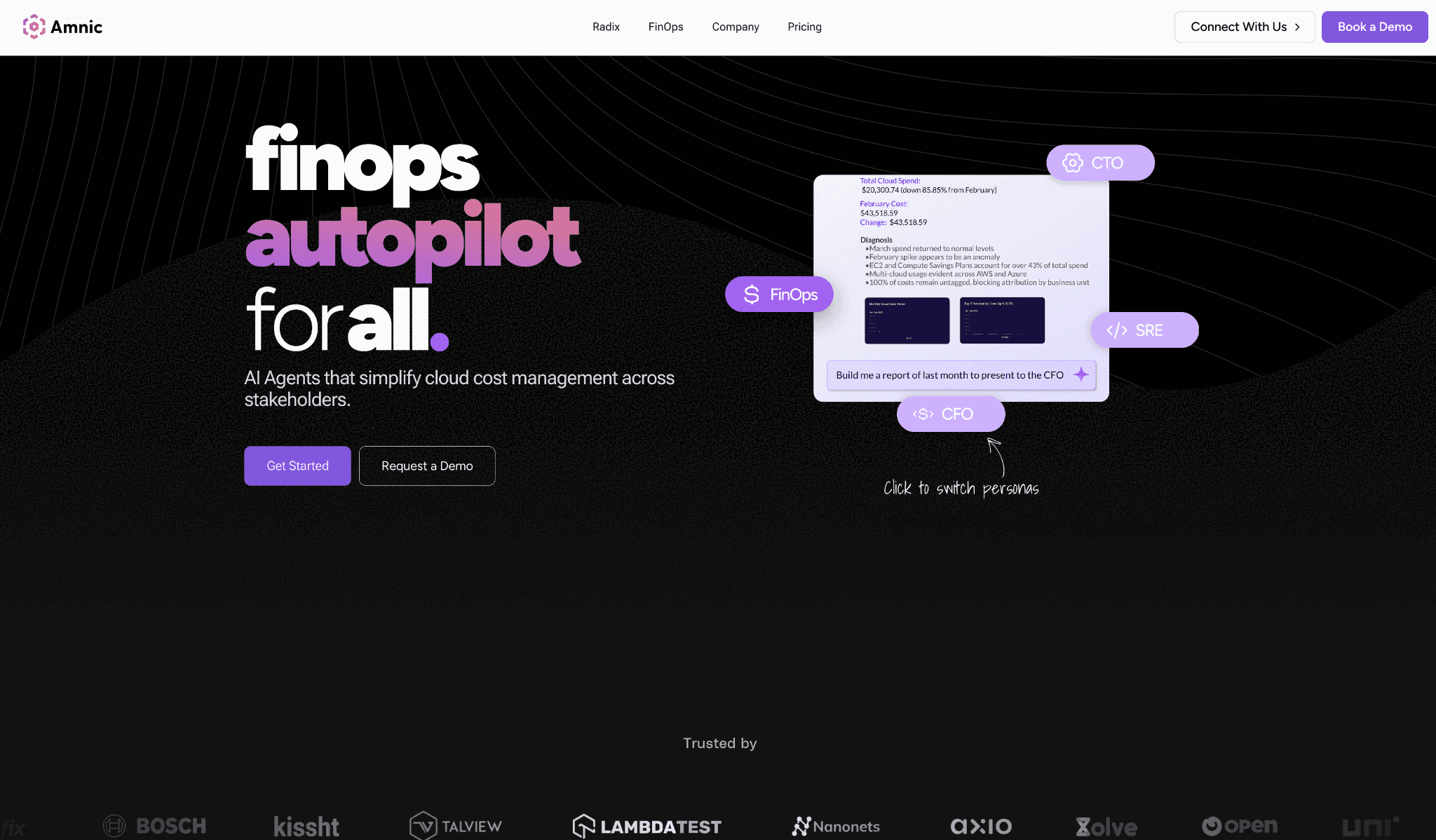
Amnic is a FinOps platform that brings AWS, Azure, GCP and Kubernetes spend together with LLM token tracking in the same cost model. It connects read-only to your billing and monitoring data, so it never gets write access to infrastructure and onboarding takes about five minutes. That posture matters to security teams who reject tools that need provisioning rights.
It tracks input and output token spend on Amazon Bedrock today, with OpenAI, Anthropic and Gemini rolling out and reports AI metrics like cost per inference next to cloud unit economics. Context-aware agents handle reporting, anomaly detection and governance and a natural-language assistant answers spend questions without dashboards. It holds SOC 2 Type II, ISO 27001 and GDPR compliance.
Key features:
Multi-cloud and Kubernetes cost management with per-cluster, per-namespace and per-pod breakdowns in one view.
Native LLM token tracking on Bedrock with input and output token spend, plus OpenAI, Anthropic and Gemini coverage rolling out.
Read-only, agentless connection to AWS, Azure and GCP billing and monitoring, with no write access to your environment.
Cost allocation that splits tagged and untagged spend across teams, products, customers and environments for showback and chargeback.
AI unit economics, such as cost per inference reported alongside cloud cost per customer and cost per feature.
Context-aware FinOps AI agents for reporting, anomaly detection, governance and a natural-language assistant.
Persona views for CTO, FinOps, SRE and CFO so each stakeholder sees the slice they own.
Pricing: Amnic charges 0.25% to 1% of monitored cloud spend, so the cost scales with what you manage rather than a flat platform fee. A one-month trial is available on the startup tier with no credit card and enterprise plans support a negotiated spend cap.
Pros:
Agentless, read-only setup clears most security reviews and goes live in minutes.
Cloud and AI spend share one allocation model, so finance reconciles a single number.
Spend-based pricing stays proportional for smaller teams instead of a large fixed contract.
Cons:
Native token tracking is live on Bedrock first, with other providers still rolling out.
Teams that want deep code-pipeline cost data will pair it with their CI tooling.
Amnic also surfaces unified cloud cost reporting so finance and engineering work from the same view.
2. CloudZero
Best for: Companies that report cost per customer and per feature across a mixed cloud and AI stack.
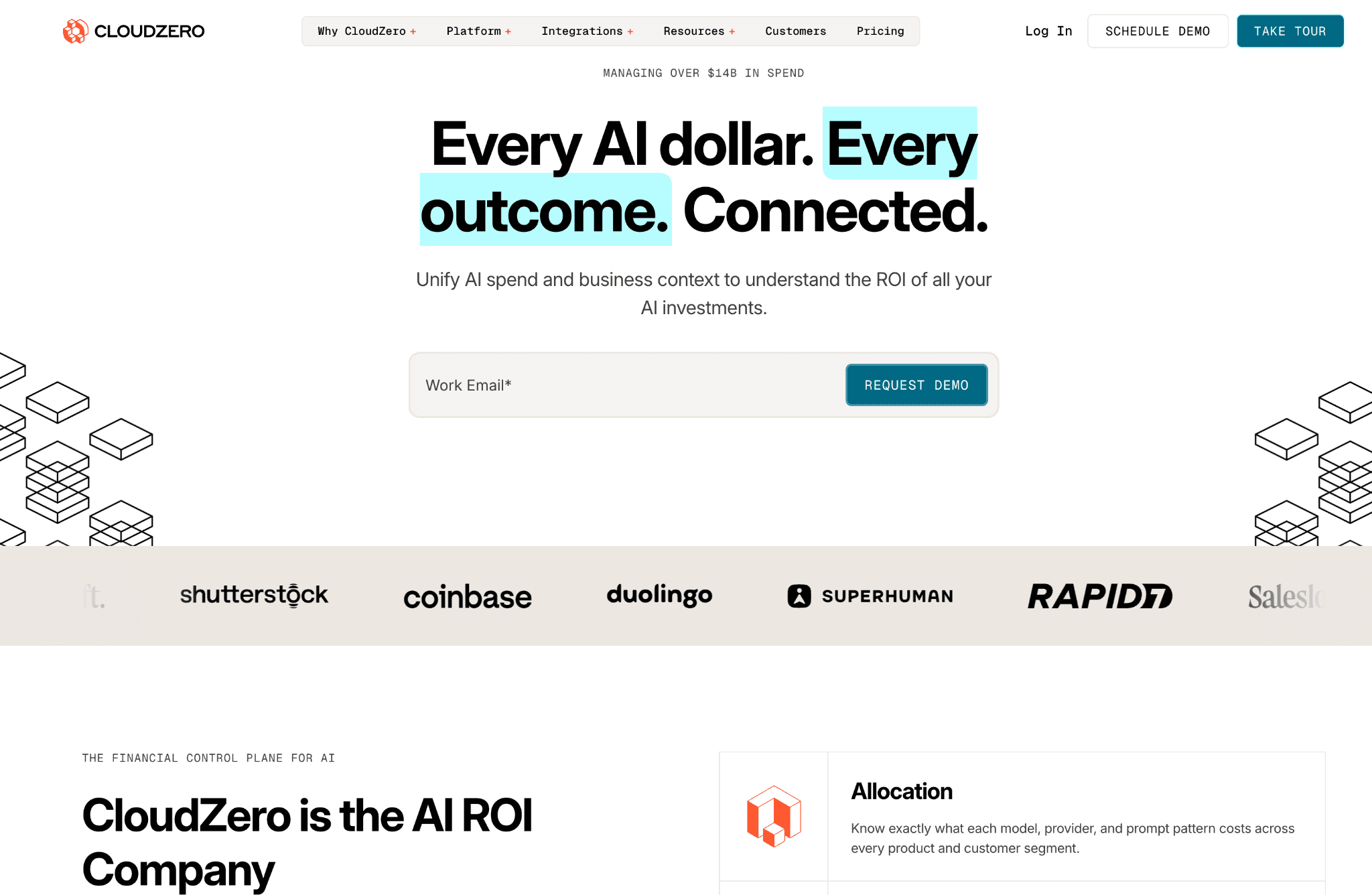
CloudZero positions itself around AI ROI and unit cost. It unifies data from cloud providers and AI services into a common data model, then presents it in a single pane of glass. It was the first cloud cost tool to integrate directly with Anthropic's cost API and it pulls AWS, GCP, Azure, OpenAI, CoreWeave and Snowflake into one picture.
Its strength is dimensional allocation. CloudZero calculates whatever unit metric matters most, including cost per customer, feature, team, or transaction, even on untagged spend. That fits product and finance leaders defending gross margin as AI features ship. The trade-off is that it runs as an enterprise platform with guided onboarding, not self-serve.
Key features:
Ingests AWS, Azure, GCP, Kubernetes, Snowflake and AI providers into one normalized cost model.
Direct integration with Anthropic's cost API plus OpenAI and CoreWeave for AI spend coverage.
Cost-per-unit metrics, including cost per customer, per feature and per transaction.
Allocation engine that assigns shared and untagged spend without requiring perfect tagging.
Anomaly alerts and budget tracking across cloud and AI lines.
Dashboards and reporting aimed at engineering and finance alignment.
Pricing: CloudZero sells enterprise contracts only, with no public rate card and no self-serve tier. Pricing is tied to cloud spend under management, so you book a demo to get a quote.
Pros:
Mature unit-economics modeling that handles messy, untagged environments well.
Early and direct AI provider integrations, especially Anthropic.
Strong fit for SaaS teams that report margin per customer.
Cons:
No published pricing or self-serve path raises the barrier for smaller teams.
Heavier implementation than a connect-and-go tool.
3. Harness
Best for: Platform teams that want to enforce spend guardrails on both cloud and AI agents.
Harness cloud and AI cost management
Harness folds cloud and AI cost into one product and leans hard into enforcement. It shows spend across every AI provider and managed service, from OpenAI and Anthropic to AWS Bedrock and GCP Vertex AI and captures spend at the request level tied to the agent, session, or workflow that triggered it. For teams shipping agents, that closes a real blind spot.
What sets it apart is policy. You describe governance intent in plain English and Harness translates it into enforced cloud rules with automatic remediation, plus configurable thresholds at 50%, 75%, 90% and 100% with forecasts of month-end spend. The risk that agents quietly burn the budget is now well documented, with the token bill becoming a board-level concern according to TechCrunch. Harness aims squarely at that problem.
Key features:
Cloud cost management across AWS, Azure, GCP and Kubernetes with rightsizing and AutoStopping.
Request-level AI spend tracking tied to agent, session, workflow, team and business unit.
AI-authored policy guardrails that turn plain-English intent into enforced cloud rules.
Budget thresholds at 50, 75, 90 and 100 percent with AI-generated month-end forecasts.
Anomaly surfacing and a natural-language interface for spend questions.
Coverage of OpenAI, Anthropic, Bedrock and Vertex AI in one place.
Pricing: Harness offers a Free Forever tier covering up to $250,000 per month in managed cloud spend, two Kubernetes clusters and 30 days of data. Paid plans start around $250 per month and scale with spend and advanced governance features.
Pros:
Genuine enforcement, not just visibility, with automated remediation.
Request-level AI tracking suits agentic and workflow-heavy stacks.
A usable free tier for teams under the spend threshold.
Cons:
Full value assumes you adopt the broader Harness platform.
Governance depth carries a learning curve for smaller FinOps teams.
4. Vantage
Best for: Engineering-led teams that want broad provider coverage and developer-friendly reporting.
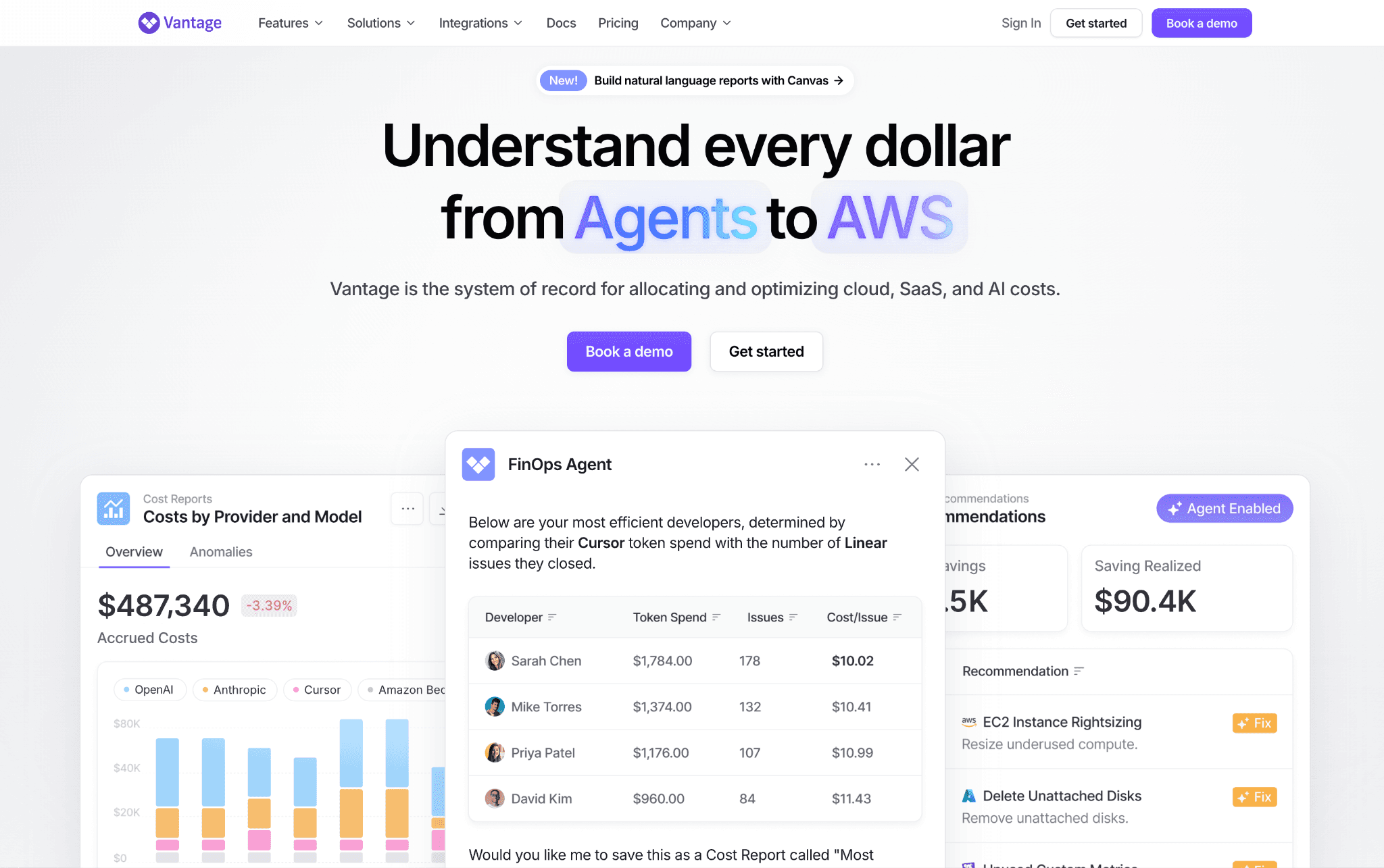
Vantage is a cost reporting platform built for developers, with native integrations across more than 20 cloud and SaaS providers. It ingests AI API usage from OpenAI and Anthropic as first-class providers, so Claude or GPT spend sits beside your AWS, Azure and GCP bill in the same dashboards, alerts and cost reports. It also surfaces GPU cost visibility across the major clouds.
The product is known for clean cost reports, active anomaly detection and machine-learning forecasting that fits into developer workflows rather than a separate finance tool. Allocation and segmentation are solid, though teams chasing deep per-customer AI unit economics sometimes layer extra modeling on top. Its self-serve free tier makes it easy to start without a sales call.
Key features:
Native integrations across 20-plus cloud and SaaS providers in one view.
OpenAI and Anthropic usage ingested as a first-class cost provider.
GPU cost visibility across major public clouds.
Continuous anomaly detection and machine-learning cost forecasting.
Cost reports and virtual tagging segmented by team, service, or project.
Developer-workflow integrations and a no-time-limit free tier.
Pricing: Vantage uses a fixed-rate tiered subscription, not a percentage of spend. A free tier exists with no time limit and paid tiers add longer data history, team access controls and priority support, with self-serve up to the mid tier.
Pros:
Wide provider coverage and a fast, self-serve start.
Strong forecasting and anomaly detection for engineering teams.
Predictable subscription pricing independent of spend volume.
Cons:
Deep per-customer AI unit economics may need extra modeling.
Finance-grade chargeback workflows are lighter than enterprise FinOps suites.
5. Datadog Cloud Cost Management
Best for: Teams already standardized on Datadog for monitoring and observability.
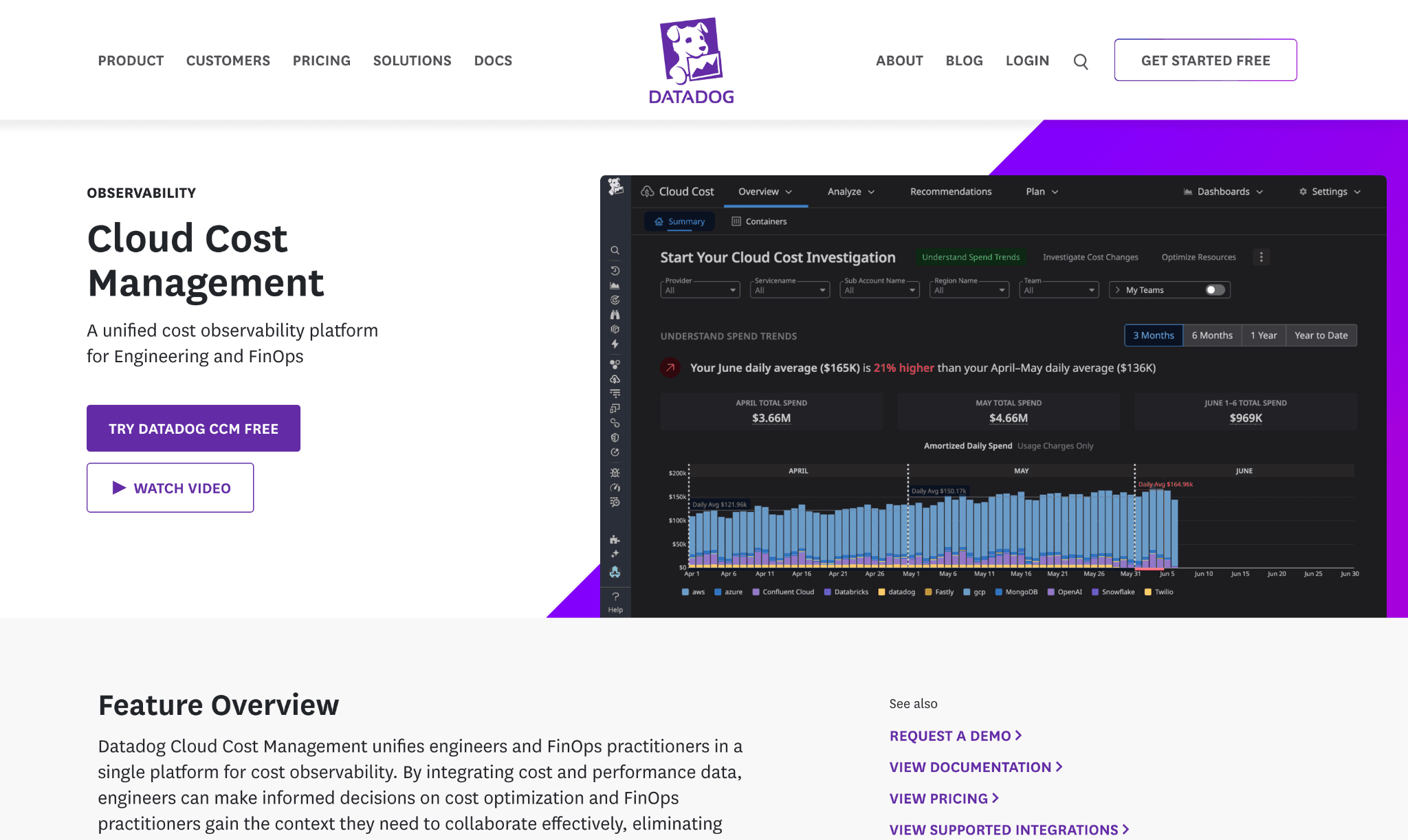
Datadog Cloud Cost Management added an AI Costs view that gives FinOps and engineering a single destination for AI spend across Amazon Bedrock, Anthropic, Google Gemini, OpenAI, Vertex AI, GitHub Copilot and Cursor. You see total AI spend next to existing cloud infrastructure costs, analyze it with normalized tags, track anomalies and attribute usage to the users and API keys driving it.
Paired with Datadog LLM Observability, the platform connects token-level cost to traces, latency and quality, so an engineer can move from a cost spike to the exact span that caused it. The catch is that the value assumes you already run Datadog. Costs stack across CCM, LLM Observability and the underlying platform, so the bill can grow if AI monitoring is not scoped carefully.
Key features:
AI Costs view inside Cloud Cost Management covering Bedrock, Anthropic, Gemini, OpenAI, Vertex, Copilot and Cursor.
Normalized tagging to attribute AI spend to users and API keys.
Token-level cost joined to traces, latency and quality via LLM Observability.
Anomaly tracking across AI and infrastructure spend.
Cloud cost coverage for AWS, Azure, GCP and Kubernetes.
One workflow for teams that already monitor apps in Datadog.
Pricing: Cloud Cost Management is an add-on to a Datadog subscription, billed relative to monitored cloud accounts. LLM Observability is usage-based at roughly $8 per 10,000 monitored LLM requests per month, so total cost depends on traffic and existing Datadog spend.
Pros:
Tightest link between AI cost and AI performance in one tool.
No new vendor if you already run Datadog.
Strong anomaly and tagging features inherited from the platform.
Cons:
Value depends on already paying for Datadog.
Stacked usage-based pricing can climb quickly without scoping.
6. Finout
Best for: Enterprises consolidating a diverse cloud, SaaS and AI stack into one bill.
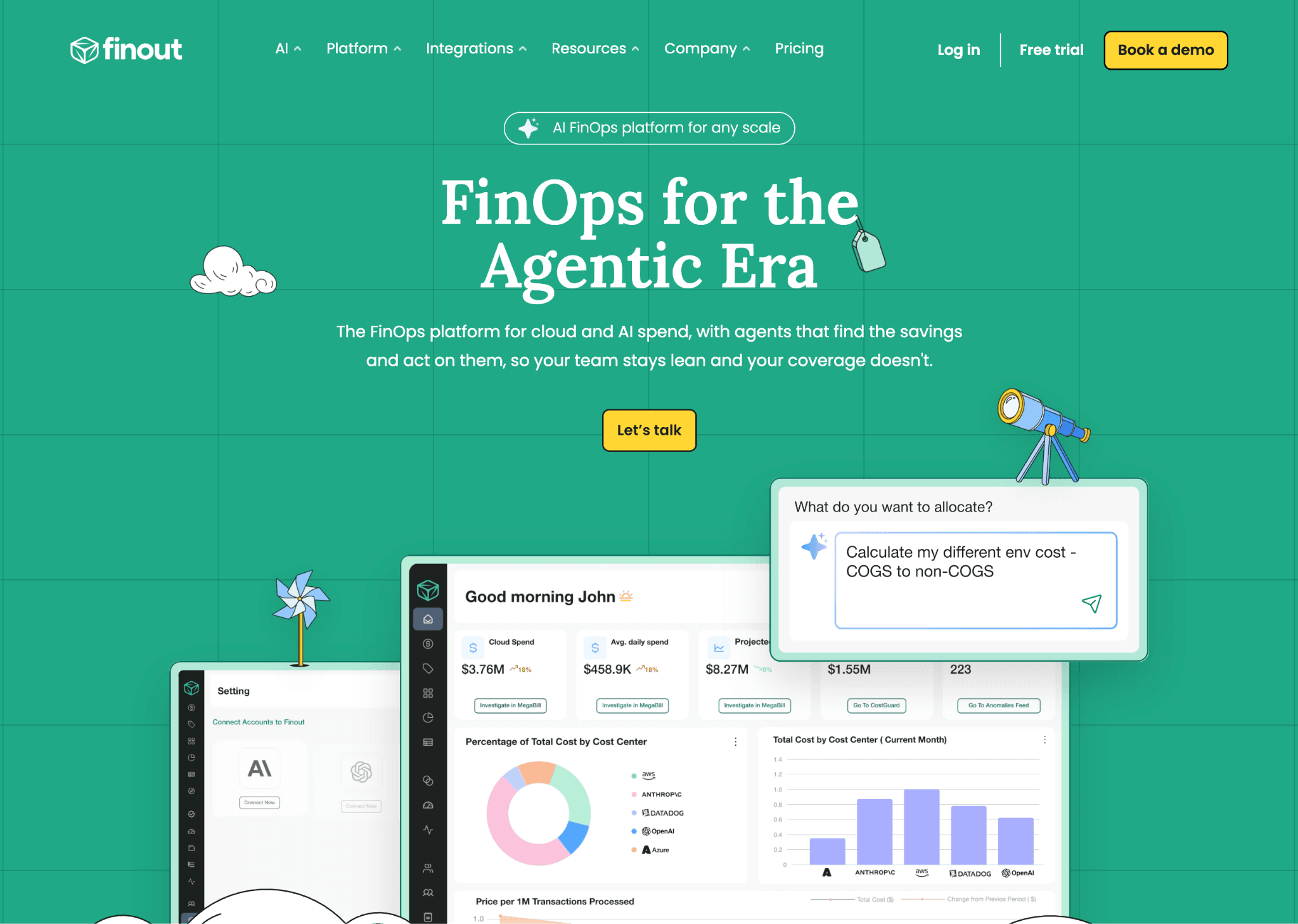
Finout centers on its MegaBill, a consolidated view that pulls every infrastructure and SaaS bill into one place. It normalizes data from AWS, GCP, Azure, Kubernetes, Snowflake, Datadog and AI providers into a consistent format aligned with the FOCUS standard, then uses AI to allocate tagged and untagged spend to the right owner or business unit.
On the AI side, Finout ingests OpenAI, Anthropic, SageMaker, Vertex AI and Azure OpenAI costs into the same MegaBill as cloud and Kubernetes spend, giving finance and engineering one source of truth. That breadth suits enterprises where AI is the fastest-growing line in a complex stack. As with most enterprise FinOps suites, it runs through a sales conversation rather than a self-serve sign-up.
Key features:
MegaBill that consolidates cloud, Kubernetes, SaaS and AI spend into one view.
FOCUS-aligned normalization across AWS, GCP, Azure, Snowflake and Datadog.
AI-driven allocation of tagged and untagged spend to owners and business units.
AI cost coverage for OpenAI, Anthropic, SageMaker, Vertex AI and Azure OpenAI.
Virtual tagging and shared-cost splitting for chargeback.
Reporting built for finance and engineering to share one number.
Pricing: Finout pricing starts from about $6,000 per year and scales by cloud and SaaS spend under management. There is no public self-serve plan and most contracts are negotiated through sales.
Pros:
Broad consolidation across a complex, mixed stack.
FOCUS alignment keeps data portable and standardized.
Strong automated allocation for untagged spend.
Cons:
No self-serve tier and an enterprise-oriented entry price.
Heavier than smaller teams need for a simpler stack.
How to Choose the Right Unified AI and Cloud Cost Platform
You need read-only, fast deployment: Choose Amnic for its agentless, five-minute setup that avoids write access and most security blockers.
You report margin per customer: CloudZero and Amnic lead on unit economics that tie cloud and AI cost to product and customer.
You must enforce budgets on agents: Harness offers policy guardrails and request-level AI tracking with automated remediation.
You want broad coverage and self-serve: Vantage spans 20-plus providers with a free tier and developer-friendly reporting.
You already run Datadog: Datadog CCM keeps AI cost beside the traces your engineers already watch.
You consolidate a complex enterprise stack: Finout's MegaBill normalizes cloud, SaaS and AI under the FOCUS standard.
Match the platform to your real constraint. If you are still mapping where AI spend hides, start with how to track AI cost before you commit to a vendor.
Common Mistakes When Choosing a Unified AI and Cloud Cost Platform
Treating AI cost as a single monthly number. A flat AI total hides the model, feature and customer driving it. Insist on cost per token and per inference joined to product dimensions, the way LLM cost allocation tools report it, so you can act on the spike instead of just seeing it.
Ignoring the access model. A platform that needs write access or weeks of provisioning often stalls in security review and delays your FinOps for AI rollout. Read-only, agentless tools clear that bar and ship value sooner, which matters when AI spend is growing every week.
Skipping allocation discipline. Unified visibility without chargeback vs showback leaves no accountable owner. Confirm the platform splits shared and untagged spend automatically, or your single pane of glass becomes a single pane of guesses.
Forgetting GPU and Kubernetes. AI cost is not only API tokens. Training and self-hosted inference live on GPUs and clusters, so check coverage of GPU cost optimization and container spend, not just managed model APIs.
Why Decision Makers Choose Amnic for Unified Cloud and AI Cost
Amnic wins on three fronts. First, deployment: the agentless, read-only model connects in about five minutes and never touches your infrastructure, so it passes the security reviews that stall heavier tools. Second, one model: cloud, Kubernetes and LLM token spend share a single allocation engine, so finance and engineering argue over one number instead of two dashboards.
Third, proportional pricing: at 0.25% to 1% of monitored spend, the cost scales with what you manage rather than a large fixed contract. That same model carries native AI token management, so token spend lands in the same allocation engine as compute and storage instead of a separate tool.
The outcomes back it up. LambdaTest cut its NAT and CloudWatch costs by 30%, Nanonets reduced compute 40% and S3 50% and Open Financial lowered overall cloud cost by 30%. "Using Amnic has been nothing short of transformational. It lets us analyze our cloud costs at a depth that would take us several hours, if not days," said Ajeesh Achuthan, Co-Founder and CTO of Open Financial.
Teams comparing a broader field can review AI cost visibility tools before they commit to a single vendor.
Frequently Asked Questions
What is a unified AI and cloud cost platform?
It is a tool that tracks traditional cloud spend and generative AI spend in one dashboard. It links AWS, Azure, GCP and Kubernetes bills with LLM token, inference and GPU costs, then attributes every dollar to the team, product, or customer responsible.
Can one platform really track both cloud and LLM token costs?
Yes. Platforms like Amnic, CloudZero, Harness, Vantage, Datadog and Finout ingest cloud billing and AI provider usage into one cost model. The best ones report cost per token and per inference next to cloud unit economics, not just a flat AI total.
How is AI cost different from traditional cloud cost?
AI cost is more volatile. A single LLM call can swing from a fraction of a cent to several dollars based on model, prompt length and context window and GPU costs are non-linear in usage. That is why AI needs token and inference metrics, not only standard cloud KPIs.
Do these platforms need write access to my infrastructure?
It varies by vendor. Amnic connects read-only and agentless, with no write access to AWS, Azure, or GCP, which clears most security reviews. Always confirm the access model before deployment, since write access often slows or blocks approval.
What pricing models do unified cost platforms use?
Models differ. Amnic charges 0.25% to 1% of monitored spend, Vantage uses a fixed-rate subscription, Harness offers a free tier then scales and CloudZero and Finout sell enterprise contracts tied to spend under management. Confirm current pricing with each vendor.
How do I allocate AI spend to teams or customers?
Use a platform that splits tagged and untagged spend automatically and joins it to product and customer dimensions. Decide between chargeback and showback up front, then report cost per customer and per feature so each team owns its share.
See Your Cloud and AI Spend in One Place
A unified AI and cloud cost platform ends the split between your cloud FinOps tool and your LLM observability tool, so finance and engineering finally trust one number. Amnic delivers that with an agentless, read-only setup, multi-cloud and Kubernetes coverage, native token tracking and pricing that scales with your spend. Book a demo to see your cloud and AI costs allocated in a single dashboard.
Better visibility and management into AI Tokens?
Start with a 30 day trial
Connect leading LLMs
24 hour time to value
Stay ahead of AI Spend

Make AI spend visible, controllable, and accountable.
Gain insights into your AI token costs at a team, customer, business unit and individual user level to measure and manage AI utilization.
Recommended Articles

How to Catch AI Cost Spikes Early (FinOps Playbook)
Read More

How to Forecast AI Spend: A FinOps Guide
Read More
How to Reduce Anthropic API Costs (Without Losing Quality)
Read More

How to Reduce OpenAI API Costs: A Practical Playbook
Read More

AI Cost Anomaly Detection: How to Catch Token, GPU and API Spend Spikes
Read More

7 Best AI Cost Management Platforms for Enterprise 2026
Read More