7 Best Fintech Cloud Cost Optimization Tools in 2026
15 min read
Cost Optimization
Tools
Table of Contents
Comparing the top fintech cloud cost optimization tools for 2026 are 1. Amnic, 2. Anodot, 3. Finout, 4. Apptio Cloudability, 5. CloudKeeper, 6. ProsperOps and 7. Sedai.
Amnic ranks first for fintech teams that want multi-cloud, multi-SaaS coverage, AI-driven analysis and read-only deployment, with documented savings of 20 to 30% at fintech customers like Uni and Open Financial.
We are going to see a detailed comparison of the best top fintech cloud cost optimization tools for 2026 covering pricing, compliance posture, fintech proof points, multi-cloud and SaaS reach and where each one wins.
Top 7 Fintech Cloud Cost Optimization Tools in 2026
Amnic: One FinOps platform for CFO, CTO and SRE at fintechs to see the same cost across AWS, Azure, GCP, Alibaba, Oracle, Kubernetes plus Cloudflare, MongoDB Atlas, Datadog, Redis, OpenAI and Anthropic without write access.
Anodot: For fintechs with high-volume transaction workloads that need AI-driven anomaly detection to catch cost spikes before finance close.
Finout: For fintechs with sprawling AWS, Azure, GCP and SaaS spend that need Virtual Tags to allocate shared infrastructure cleanly.
Apptio Cloudability: For enterprise BFSI finance teams that need audit-ready chargeback and monthly cloud close inside an IBM stack.
CloudKeeper: For AWS-heavy fintechs that want commitment-risk ownership and guaranteed day-one savings through a reseller model.
ProsperOps: For fintech platform teams that want autonomous Reserved Instance and Savings Plan management on AWS, Azure and GCP without manual review cycles.
Sedai: For fintechs that want autonomous remediation, not just recommendations, with SLO-safe action on rightsizing and storage tiering.
Comparison Table: Top 7 Best Cloud Cost Optimization Software for Fintech Companies in 2026
Tool | Provider Coverage | Fintech Compliance Posture | AI Features | Free Trial | Pricing Model |
|---|---|---|---|---|---|
Amnic | AWS, Azure, GCP, Oracle, Alibaba, Kubernetes + Cloudflare, MongoDB Atlas, Datadog, Redis, OpenAI, Anthropic, 25+ SaaS | SOC 2 Type II, ISO 27001, GDPR, agentless read-only | Yes, Amnic AI plus four agents | Yes, 1 month, no card | Custom, percentage of monitored cloud spend |
Anodot | AWS, Azure, GCP, Kubernetes | SOC 2 Type II, ISO 27001 | Yes, AI-driven anomaly detection | No, demo only | Enterprise, annual contract |
Finout | AWS, Azure, GCP, Kubernetes, 20+ SaaS | SOC 2 Type II, ISO 27001 | Limited | Yes | Enterprise, annual contract |
Apptio Cloudability | AWS, Azure, GCP, OCI | SOC 2, ISO 27001, FedRAMP via IBM | Limited | No, demo only | Enterprise, annual contract |
CloudKeeper | AWS, GCP | SOC 2 Type II, ISO 27001 | No | Yes, free audit | Percentage of savings + reseller margin |
ProsperOps | AWS, Azure, GCP | SOC 2 Type II | No | Yes, free analysis | Percentage of savings |
Sedai | AWS, Azure, GCP, Kubernetes | SOC 2 Type II | Yes, autonomous reinforcement learning | Yes | Enterprise, annual contract |
Pricing tiers and compliance posture reflect public vendor pages as of May 2026. Confirm current details with each vendor before signing.
What is Fintech Cloud Cost Optimization?
Fintech cloud cost optimization is the practice of cutting cloud waste at a payments, lending, banking or wealth-tech company while staying inside the compliance rules regulators expect. It pulls billing data from AWS, Azure, GCP and Kubernetes, then turns it into actions that reduce spend without breaking latency, audit or data residency.
It sits at the intersection of FinOps, observability and engineering governance. A fintech-grade platform ingests Cost and Usage Reports, normalizes them across providers and SaaS bills, attributes spend at a customer or transaction level and runs rightsizing, anomaly detection and commitment recommendations on read-only access.
For a fintech CFO, head of platform or VP of Engineering, this is what closes the gap between an unpredictable cloud bill and unit economics finance can report. It turns infrastructure into cost per loan disbursed, cost per card transaction and cost per API call, the numbers investors and auditors actually ask about.
How We Evaluated These Fintech Cloud Cost Optimization Platforms
Fintech buyers do not just care about visibility. They care about whether the platform can survive a SOC 2 audit, model cost per transaction and prove savings month over month to a CFO. We ranked each tool against six criteria a real fintech buyer cares about.
Provider reach for regulated workloads: Does it support AWS, Azure, GCP, Kubernetes and the SaaS long tail like Cloudflare, MongoDB Atlas, Datadog and Snowflake in one view that respects data residency rules?
Attribution depth for unit economics: Can it map every dollar to a customer, a transaction, a loan or a card swipe at daily granularity?
Compliance posture and deployment risk: SOC 2, ISO 27001, PCI DSS readiness and read-only versus write-access deployment.
Recommendation and savings quality: Documented savings outcomes from named fintech customers, not generic marketing claims.
AI assistance for non-engineers: Can a fintech CFO or finance director query the platform in plain English without learning cloud taxonomy?
Time to first insight: How long from contract signed to a working dashboard a CFO can present to a board.
The list below is ranked by total score against these six criteria for mid-market and enterprise fintech teams.
7 Best Fintech Cloud Cost Optimization Software Tools in 2026
These seven platforms cover the full optimization workflow, from raw billing ingest to anomaly alerts to autonomous rightsizing across compute, storage, network, Kubernetes and SaaS workloads, with explicit fintech proof.
1. Amnic
Best for: Multi-cloud fintech teams that want unified visibility across AWS, Azure, GCP, Kubernetes and 25+ SaaS providers in one view, AI-driven analysis and 20 to 30% waste reduction without granting write access to any account. Strongest fit for payments, lending and neobank platforms that need a CFO-readable view alongside SRE-grade Kubernetes and SaaS drilldowns.
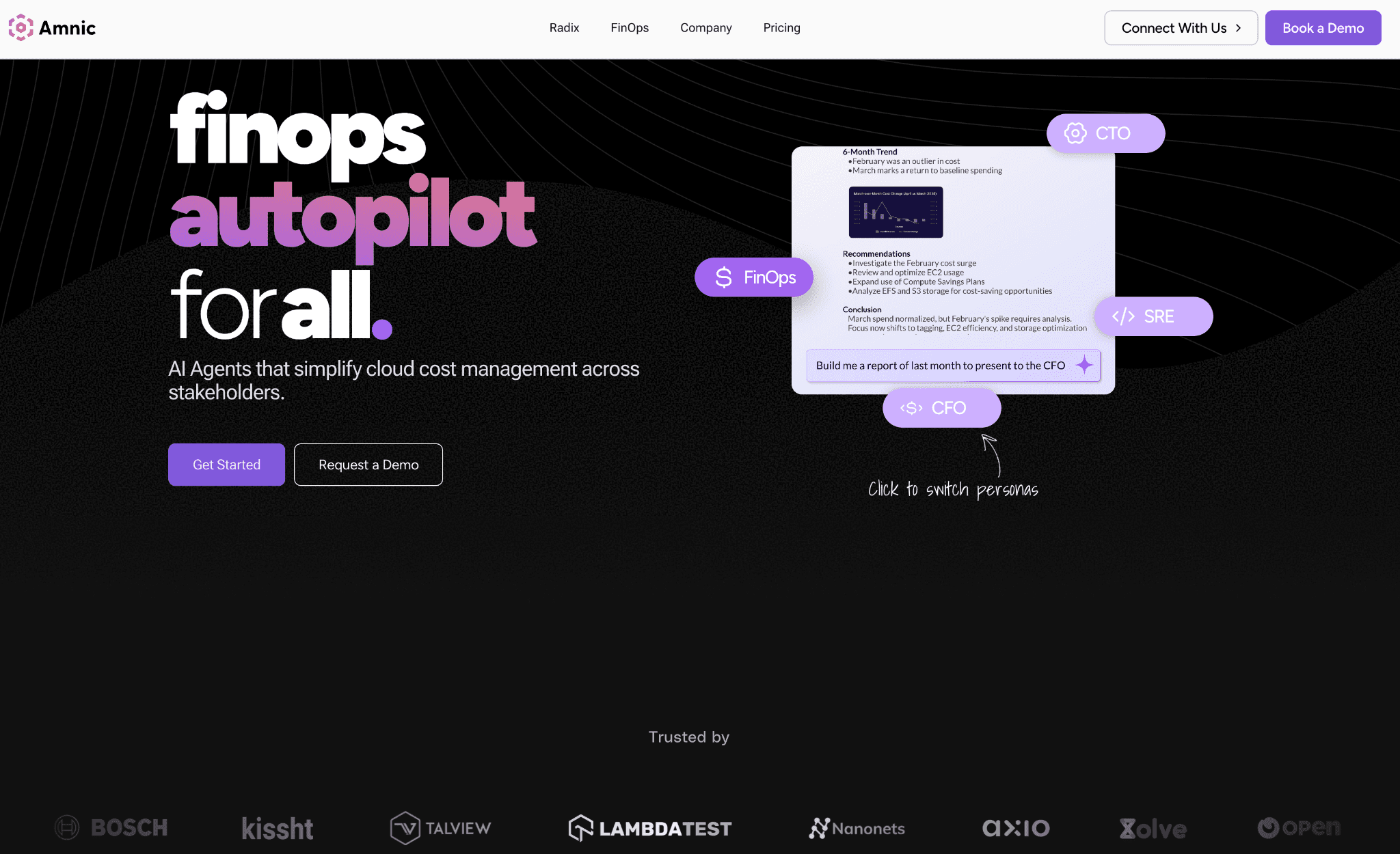
Amnic is the only platform in this list that connects cloud, Kubernetes and the SaaS layer fintechs actually pay for. The platform ingests cost data from AWS, Azure, GCP, Alibaba and Oracle, plus Cloudflare for edge and DDoS protection, MongoDB Atlas for transactional storage, Datadog for observability, Redis for in-memory caching, OpenAI and Anthropic for LLM spend, with Snowflake and Databricks on the roadmap. For a fintech where the cloud bill is only half the infrastructure spend, this is what makes the dashboard finance-grade.
The fintech relevance shows up in named customer outcomes. Uni, a fintech cards company, cut cloud infrastructure costs by 20%. Open Financial reduced cloud costs by 30%. Both deployments ran on read-only access, which is why Amnic clears fintech security reviews faster than write-access tools.
Key features that matter for fintech decision-makers:
Provider coverage spanning AWS, Azure, GCP, Oracle, Alibaba and Kubernetes plus 25+ SaaS providers including Cloudflare, MongoDB Atlas, Datadog, Redis, OpenAI, Anthropic, with Snowflake and Databricks rolling out
Recommendations Module that targets 10 to 20% waste reduction by spotting EC2 instances running below 2% utilization and flagging extended support charges
FinOps AI agents including X-Ray, Insights, Governance and Reporting that let any user query cost data in plain language
Cloud cost anomaly detection that catches sudden spikes and saves 10 to 15% of yearly cloud spend, with custom thresholds for tag, product and SaaS-tool level deviations
Virtual Tags that unify inconsistent tagging like "prod", "production" and "PROD" into one clean attribution rule, useful when fintechs run multiple business units in one account
Budget tracking with alerts at 50, 70 and 85% consumption against product-level budgets mapped to revenue lines like card-issuing, lending or wealth-tech
Kubernetes cost management that has saved customers in a single cluster, with container, node pool and persistent volume claim coverage
Shared infrastructure cloud cost allocation with fixed percentage, proportional and usage-based split rules
Cloud unit economics that ties cloud and SaaS spend to business metrics like cost per loan disbursed, cost per card transaction or cost per API call
AI token tracking for OpenAI, Anthropic and Amazon Bedrock, relevant for fintechs running fraud-detection, credit-scoring and customer-support models on LLMs
Inventory Module that maps deployed cloud resources by IP, product and team so security and FinOps share one ledger
Read-only access so DevOps owns every change, plus SSO and Jira integration for governance
Pricing: Custom, typically a percentage of monitored cloud spend at 0.25% to 1%. Amnic offers a one-month free trial for the startup tier with no credit card required and enterprise plans are scoped to your cloud footprint with access to dedicated cost experts.
Pros:
Only platform in this list that covers cloud, Kubernetes and 25+ SaaS providers (Cloudflare, MongoDB Atlas, Datadog, Snowflake, OpenAI, Anthropic, Redis) in one view, which fits the real shape of fintech infrastructure spend
Four AI agents let CFOs, SREs and FinOps analysts query cost data in plain language without SQL or cloud taxonomy knowledge
Read-only architecture means fintech security teams approve the deployment in days rather than months, which matters when PCI DSS scoping is in play
Cloud unit economics modeling ties cloud and SaaS spend to business metrics like cost per loan or cost per transaction, giving finance and product leaders a view native tools cannot produce
Documented customer outcomes span 20% to 50% reduction on specific cost lines, with named fintech case studies on Uni and Open Financial
Cons:
LLM cost coverage tracks Amazon Bedrock, OpenAI and Anthropic spend today, with deeper model-level rightsizing on the roadmap, so fintechs that want active optimization of token usage will need to wait for that release
Pricing grows with your cloud bill on the percentage of spend model, so larger fintechs should negotiate a spend cap at contract stage
Verbatim G2 quote: "Amnic has helped us optimize Kubernetes costs considerably. The non-intrusive approach makes it easier to maintain security posture while still getting actionable optimization insights”. Source: G2 Amnic reviews
2. Anodot (now rebranded as Umbrella)
Best for: Fintechs with high-volume transaction workloads that need AI-driven anomaly detection to catch cost spikes before finance closes. Strong fit for payments and trading platforms where a misconfigured cron or rogue Lambda can burn six figures in a weekend.
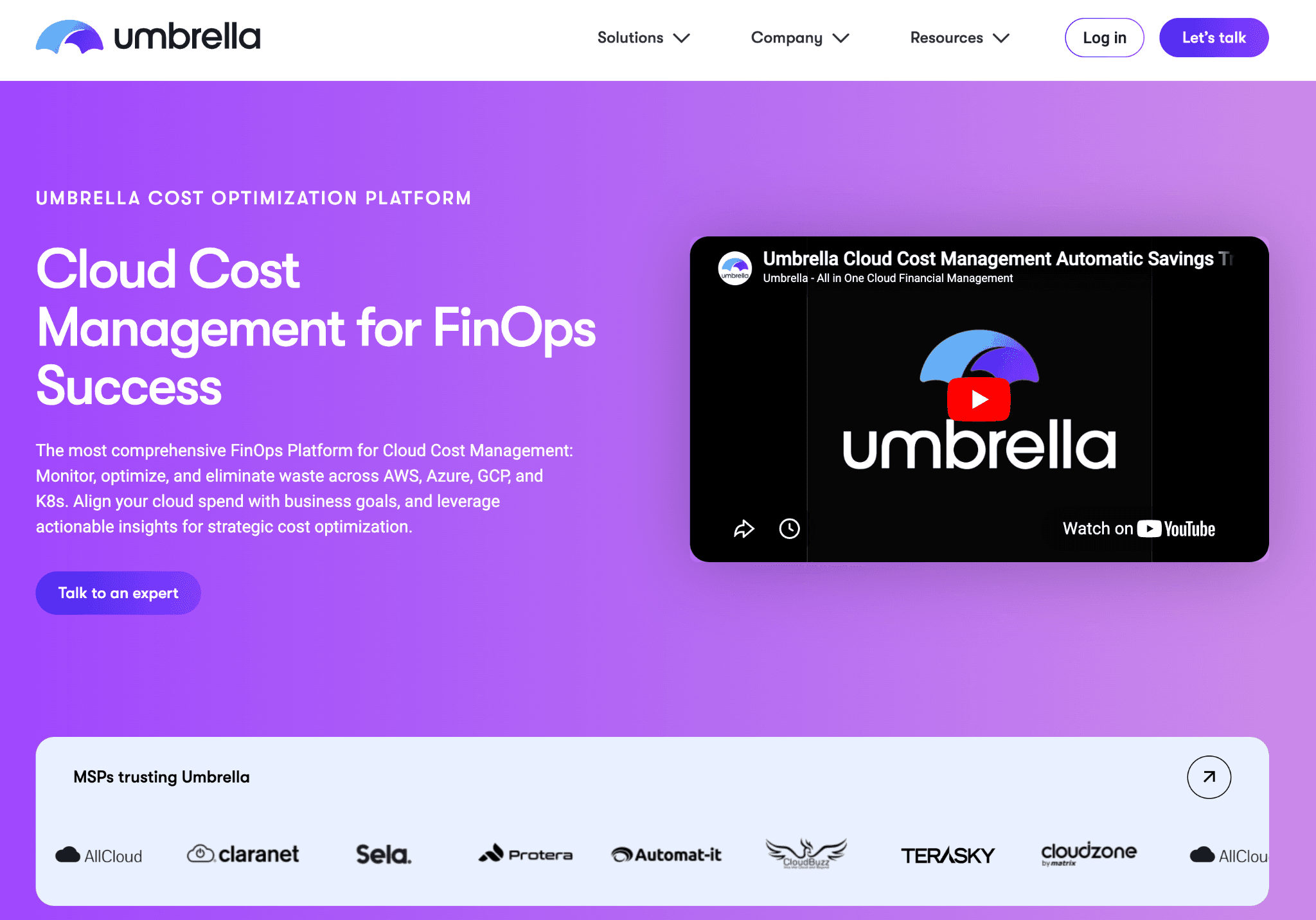
Anodot, now operating its cloud cost product under the Umbrella business unit, is one of the earliest movers in AI-driven FinOps. The platform applies machine learning models tuned for financial-services time series, the same models the company built for fraud detection, to cloud cost data. That means the anomaly engine knows the difference between a real spike and the daily peak of payment processing on a Monday morning.
Key features:
AI-driven anomaly detection trained on time-series patterns, with low false-positive rates compared to threshold-based alerting
100% cost allocation across business mappings, tags and Kubernetes labels, with automatic backfill for untagged spend
Multi-cloud ingestion across AWS, Azure and GCP with full Kubernetes drilldown
Forecasting that models seasonality, which matters for fintechs with month-end batch processing peaks
Business mapping that translates cloud spend into business-unit, product and customer views finance can act on
Recommendation engine for rightsizing, idle resource cleanup and commitment opportunities
Reporting that ties into FinOps Foundation FOCUS spec for cross-vendor cost reporting
Recognized as a Visionary in the 2024 Gartner Magic Quadrant for Cloud Financial Management Tools
Pricing: Enterprise contract, annual, custom pricing scoped to monitor cloud spend. No public free trial, demo gated.
Pros:
Strongest AI anomaly engine in the category for transaction-heavy fintechs where threshold-based alerting fails
Gartner-recognized in the inaugural Cloud Financial Management Magic Quadrant
Backed by Anodot's broader anomaly platform, which has a deep customer base in banking and financial services
Forecasting handles seasonality better than most peers, useful for batch-heavy fintechs
Cons:
No SaaS-bill ingestion beyond the three major clouds, so spend on Datadog, MongoDB Atlas or Cloudflare sits outside the platform
Sales-gated, no self-serve trial
Limited automated remediation, the platform alerts and recommends but does not act
Verbatim G2 quote: "Anodot provides cross-organizational visibility into costs and usage data, tracks business KPIs and is used by Finance teams for financial reporting, chargebacks and cost allocation”.
3. Finout
Best for: Fintechs running sprawling AWS, Azure, GCP and SaaS spend that need Virtual Tags to allocate shared infrastructure cleanly. Good fit for payments and trading platforms where one Kubernetes cluster serves multiple revenue products.
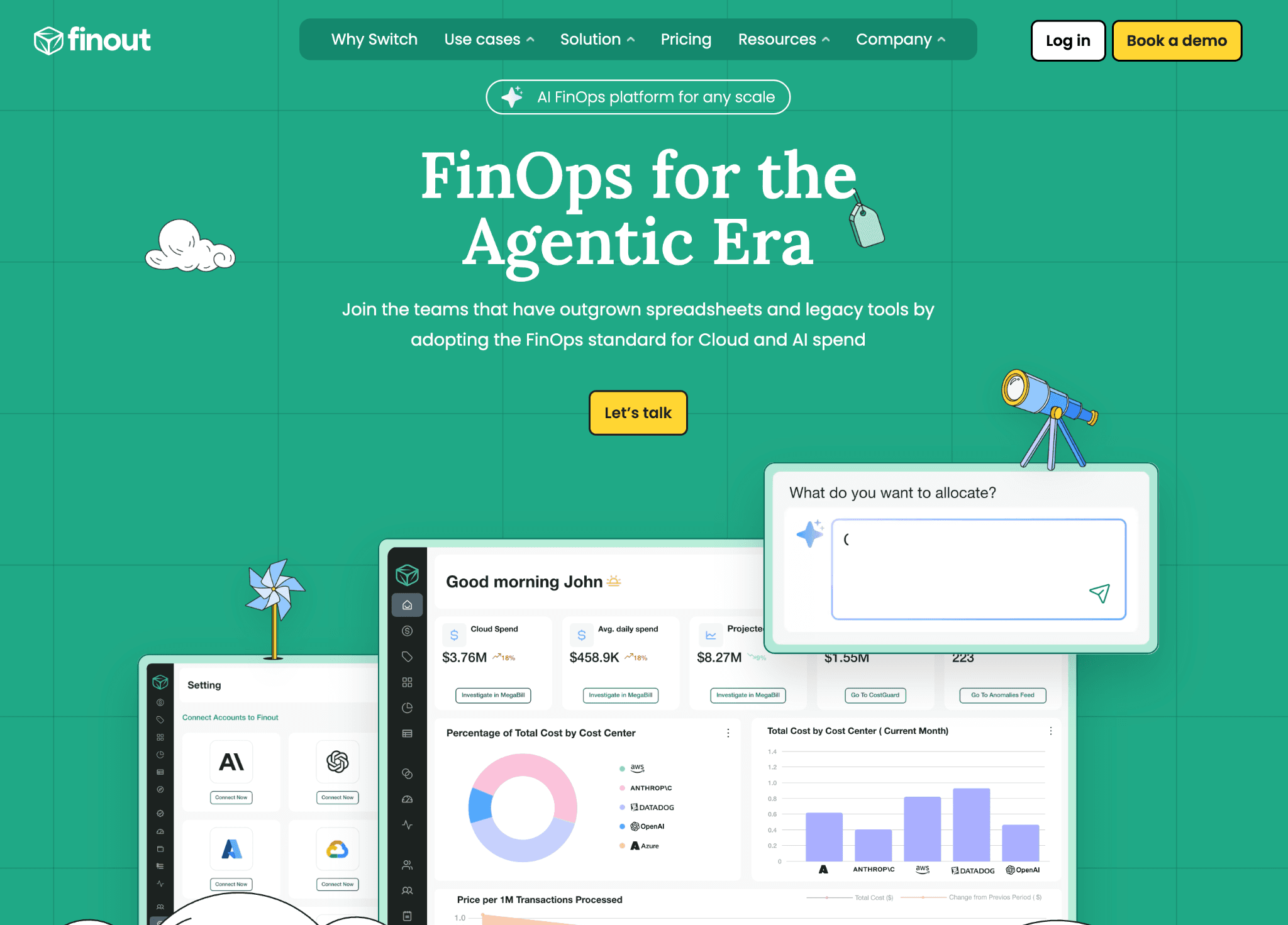
Finout consolidates billing across cloud, Kubernetes and 25+ SaaS services into a single MegaBill. The Virtual Tags feature is the standout, letting fintech FinOps practitioners attribute spend to a business role, team or product without changing infrastructure tagging. This matters at fintechs where compliance teams have locked tag taxonomies and engineering cannot freely rename them.
Key features:
Virtual Tags that attribute any service to a team, product or business role without modifying cloud-side tags
MegaBill that unifies AWS, Azure, GCP, Kubernetes, Snowflake, Databricks, MongoDB Atlas and Datadog spend in one view
Shared cost allocation with rules for fixed percentages, proportional splits and metered consumption
Budget and forecast modeling at team, product and business-unit level
Anomaly detection with owner-routed alerts and Slack integration
Kubernetes cost allocation down to namespace, deployment, pod and label
Commitment management dashboard with Reserved Instance and Savings Plan utilization tracking
AI cost tracking for OpenAI and Bedrock spend through native connectors
Pricing: Enterprise contract, annual, scoped to monitored cloud and SaaS spend. Free trial available on request.
Pros:
Virtual Tags solve the "we cannot retag production" problem that blocks attribution at most regulated fintechs
Broadest SaaS coverage in the category outside Amnic, with 25+ integrations beyond the three big clouds
G2 rating 4.5 stars across 68 reviews as of May 2026
Documented user outcomes report up to 40% cloud cost reduction after right-sizing
Cons:
No conversational AI layer for non-technical fintech users
Pricing is opaque and starts at enterprise tier, smaller fintechs may not get a fit
UI complexity grows fast with the number of integrations connected
Verbatim G2 quote: "The virtual tagging is great because we can finally see exactly what each team or project is spending without a ton of manual work”. Source: G2 Finout reviews
4. Apptio Cloudability
Best for: Enterprise BFSI and large fintech finance teams that need audit-ready chargeback, monthly cloud close and integration with the broader IBM Apptio stack. Strongest fit for fintechs over 2,000 employees with a formal IT finance function.
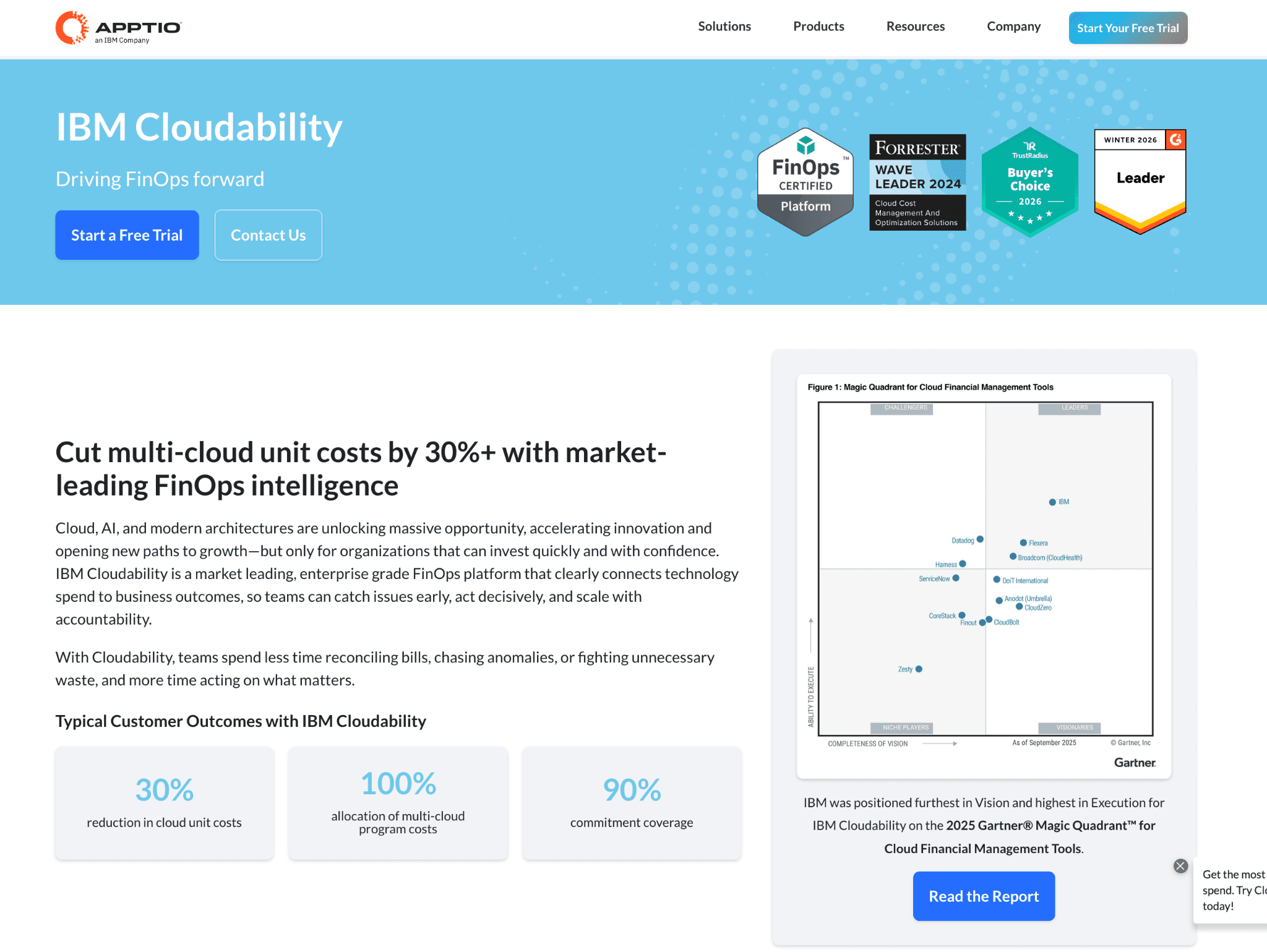
Apptio Cloudability is the most mature platform in the list. It is now part of IBM and slots into the broader Apptio Targetprocess and IT finance ecosystem. The chargeback and showback engine is the most defensible in front of an external auditor, which is why it remains the default at large banks, insurers and tier-one fintechs even as newer tools win on UI.
Key features:
Audit-ready chargeback and showback with business mappings that allocate shared infrastructure to business units
Multi-cloud cost ingestion from AWS, Azure, GCP and Oracle Cloud Infrastructure
Truecost engine that allocates support, networking and security spend back to consuming business units
Container cost allocation for Kubernetes and OpenShift at namespace and label level
Anomaly detection with finance-friendly variance reporting against budget
Commitment management for Reserved Instances and Savings Plans across all three major clouds
Reporting hub with templated executive dashboards designed for CFO and board consumption
Integration with broader IBM Apptio stack for IT finance and technology business management
Pricing: Enterprise contract, annual, custom pricing. No public free trial, sales-led only.
Pros:
Most defensible chargeback model in the category, built for fintech finance teams that close books monthly
Deep integration with IBM and Apptio Targetprocess for technology business management
Strong multi-cloud reach including Oracle Cloud Infrastructure
Mature anomaly and budget-variance reporting tuned for finance audiences
Cons:
UI lags behind newer entrants, with longer ramp time for engineering users
Implementation complexity is high, six to twelve weeks to first useful dashboard at most fintechs
Opaque pricing and minimum contract sizes lock smaller fintechs out
No conversational AI layer, every report still goes through a saved view
Verbatim G2 quote: "Cloudability is particularly strong for organizations seeking mature, enterprise-grade chargeback and cost allocation capabilities”. Source: G2 IBM Cloudability reviews
5. CloudKeeper
Best for: AWS-heavy fintechs that want commitment-risk ownership and guaranteed day-one savings through a reseller plus optimization model. Best fit for mid-market fintechs that prefer a managed service over a self-serve tool.
CloudKeeper is part reseller, part optimization platform. The model is unusual in the category. CloudKeeper buys AWS Reserved Instances and Savings Plans on its own book, then passes the discount through to the fintech customer while owning the commitment risk.
The CloudKeeper Lens product layer adds visibility, recommendations and anomaly detection on top. The MobiKwik case study shows a 27% AWS cost reduction at a high-volume digital wallet, which is one of the cleanest fintech proof points in the category.
Key features:
Day-one guaranteed AWS savings of 10 to 25% through reseller-owned Reserved Instances and Savings Plans
CloudKeeper Lens visibility platform with cost dashboards, recommendations and anomaly detection
24/7 certified AWS and GCP expert support acting as a dedicated FinOps team
Custom Well-Architected Reviews tailored for fintech compliance requirements
Commitment-risk ownership where CloudKeeper holds the multi-year commitment rather than the customer
Multi-cloud Lens coverage for AWS and GCP, with Azure on roadmap
Reserved Instance management and modification across the entire AWS regional footprint
Granular cost allocation at account, tag and resource level
Pricing: Percentage of savings model plus reseller margin on the underlying AWS or GCP bill. Free audit available to qualify potential savings.
Pros:
Day-one savings guarantee removes the risk of "we bought commitments and underused them" for fintech finance teams
Reached #1 in G2 Winter 2026 Grid Report for Cloud Cost Management with 99% of users rating 4 or 5 stars
24/7 expert support model fits fintechs that lack a dedicated FinOps team
MobiKwik fintech case study documents 27% AWS cost reduction with no architectural changes
Cons:
Reseller model means moving billing from your AWS account to CloudKeeper, which some fintech procurement and tax teams cannot do
AWS and GCP only today, Azure-heavy fintechs are not covered
Some users report occasionally outdated data in the Lens dashboard
Verbatim G2 quote: "We saw a significant drop in AWS spending after integrating CloudKeeper into our workflow, without affecting performance or reliability." Source: G2 CloudKeeper reviews
6. ProsperOps
Best for: Fintech platform teams that want autonomous Reserved Instance and Savings Plan management on AWS, Azure and GCP with no manual review cycles. Best fit for AWS-first fintechs running high-volume transaction infrastructure where commitment shape changes monthly.
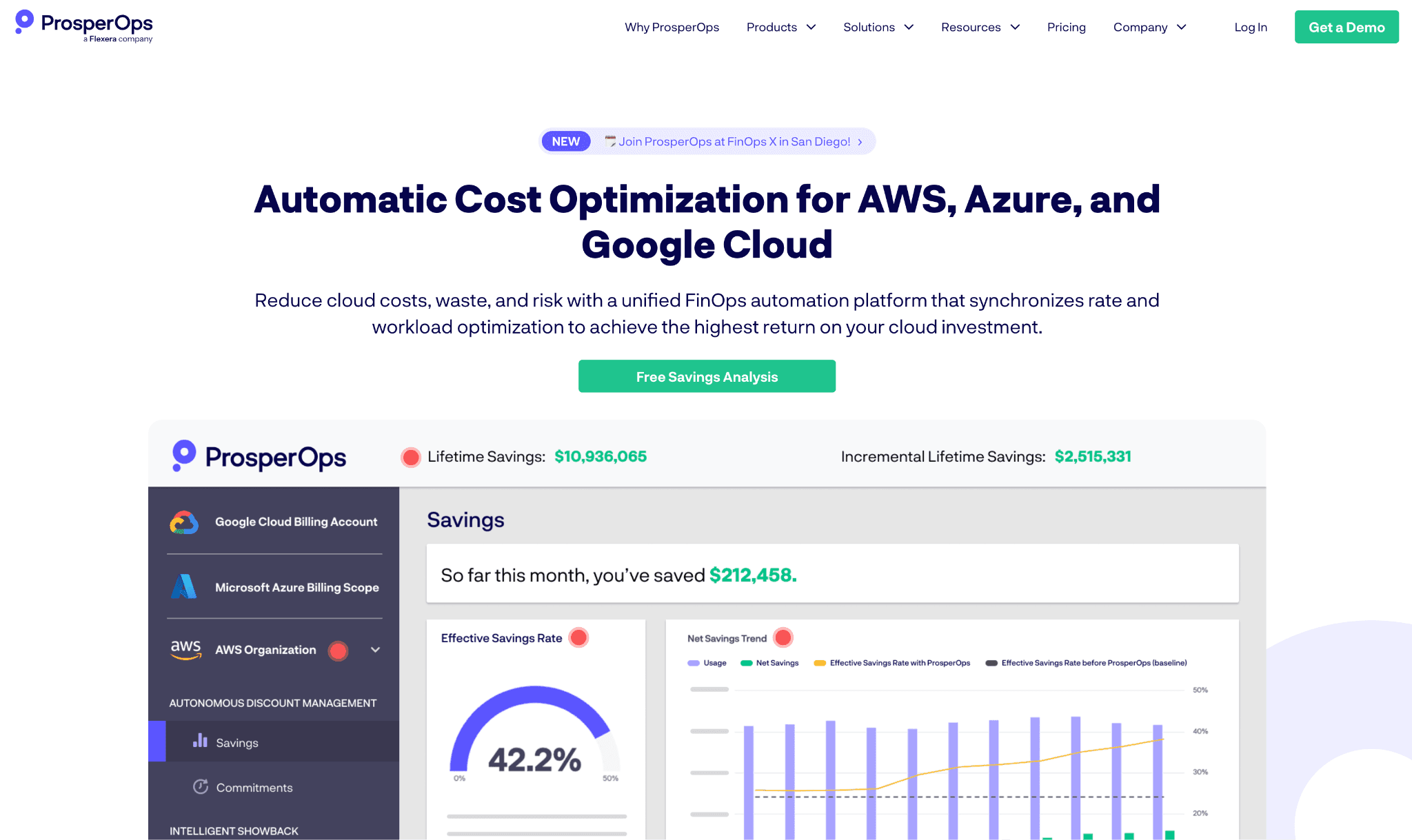
ProsperOps automates commitment-based discounts. The platform manages Reserved Instances and Savings Plans across all three major clouds, continuously buying, selling and rebalancing the portfolio to maximize the Effective Savings Rate. The 30-day rolling commitment model is the standout. Fintechs get three-year discount rates while keeping effective commitment exposure to 30 days, which finance and treasury teams find easier to approve than locked three-year terms.
Key features:
Autonomous Reserved Instance and Savings Plan management across AWS, Azure and GCP
30-day rolling commitment model that delivers three-year pricing with one-month effective exposure
Effective Savings Rate scoring benchmarked against industry peers
Commitment-risk transfer where ProsperOps takes responsibility for unused commitments
Continuous portfolio rebalancing as fintech workload mix shifts month to month
Compute, RDS and OpenSearch coverage for AWS Savings Plans
Real-time forecasting of commitment exposure against projected workload changes
Integration with finance close cycles through monthly Effective Savings Rate reports
Pricing: Percentage of savings model, no upfront fees. Free Savings Analysis available to estimate the Effective Savings Rate improvements.
Pros:
Customers report monthly savings increase of 68% on average per the published G2 reviews
30-day effective commitment exposure makes treasury and finance teams more comfortable signing
Almost entirely hands-free after setup, no manual quarterly commitment reviews
Strong support ratings and onboarding experience cited in G2 reviews
Cons:
Scope is commitment management only, not full FinOps visibility or unit economics
AWS coverage is deepest, Azure and GCP lag behind
Fintechs that already manage commitments well in-house may see lower marginal savings
No conversational AI layer, no Kubernetes cost allocation
Verbatim G2 quote: "ProsperOps manages Reserved Instances so we get three-year discounts but only effectively have a 30-day commitment to AWS”. Source: G2 ProsperOps reviews
7. Sedai
Best for: Fintechs that want autonomous remediation, not just recommendations. Best fit for engineering-led fintech platforms running modern apps where SLO compliance is as important as cost.
Sedai is the only platform in this list that acts on cost decisions autonomously while respecting Service Level Objectives. Where most tools recommend, Sedai executes. The platform uses deep reinforcement learning to predict the impact of a rightsizing or storage-tiering action, then takes the action if and only if the predicted SLO impact is within tolerance. Customers report 30 to 50% cloud cost reduction, with Palo Alto Networks publicly citing $3.5M in autonomous savings.
Key features:
Autonomous remediation across compute, storage and Kubernetes workloads, not just recommendations
SLO-safe action through reinforcement learning models that predict performance impact before executing
25 million+ autonomous actions executed in production with zero reported customer incidents
Coverage across AWS, Azure, GCP and Kubernetes including EKS, AKS and GKE
Storage tiering automation for S3, EBS and equivalent across Azure and GCP
Lambda and serverless rightsizing tuned for transaction-burst workloads
Continuous learning loop that adapts to changes in workload pattern and traffic mix
Integration with PagerDuty, Datadog and other observability tools for safe rollback
Pricing: Enterprise contract, annual, scoped to managed workloads. Free trial available on request.
Pros:
Only platform on this list with documented autonomous action, not just recommendations
SLO-safe execution is critical for fintechs where downtime translates directly to lost transactions and regulator scrutiny
Strong public savings claims of 30 to 50% backed by Palo Alto Networks and other enterprise customers
Reduces FinOps team burden because the platform takes action without humans-in-the-loop
Cons:
Autonomous action requires write access, which some fintech security teams will not approve for production workloads
No SaaS or LLM cost coverage, scope is cloud and Kubernetes only
Smaller customer base than longer-established peers, fewer named fintech case studies in public
Verbatim G2 quote: "Sedai uses deep reinforcement learning to predict the impact of potential optimizations, enabling the platform to take these actions safely”. Source: G2 Sedai reviews
How to Choose the Right Fintech Cloud Cost Optimization Software for Your Team
Picking the right tool depends on three things. The first is your cloud and SaaS shape, single-cloud versus multi-cloud and whether SaaS bills like Datadog, Cloudflare and MongoDB Atlas are material. The second is your compliance scope, PCI DSS versus SOC 2 versus regional data residency. The third is who owns the buying decision, finance or engineering.
For multi-cloud, multi-SaaS fintechs with a CFO who needs unit economics and a security team that wants read-only deployment, Amnic is the closest fit. For transaction-heavy fintechs that need AI-driven anomaly detection on cloud spend, Anodot is the alternative. For large enterprise BFSI with formal monthly close and audit pressure, Apptio Cloudability remains the default. For AWS-only fintechs willing to move billing under a reseller, CloudKeeper guarantees day-one savings. For commitment management only, ProsperOps wins on automation depth. For sprawling AWS and SaaS spend, Finout's Virtual Tags solve a real attribution problem. For engineering-led fintechs that want autonomous remediation rather than dashboards, Sedai is the bet.
If you want a fast benchmark on where your fintech sits today, the best cloud cost optimization tools sister article covers the same six criteria for the broader market.
Frequently Asked Questions About Fintech Cloud Cost Optimization
How do fintech companies reduce cloud costs?
Fintechs cut cloud spend through three layers. First, visibility across AWS, Azure, GCP, Kubernetes and SaaS in one view finance and engineering both trust. Second, attribution that maps every dollar to a customer, transaction or product so teams own the cost they create. Third, action like rightsizing idle compute, buying Reserved Instances for steady workloads, tiering down cold storage and tuning Kubernetes utilization.
Most fintechs running a real FinOps tool cut cloud spend by 15 to 30% in year one. Named outcomes include Uni at 20%, Open Financial at 30%, MobiKwik at 27% on AWS and Palo Alto Networks at $3.5M autonomously remediated by Sedai.
What is FinOps in financial services?
FinOps in financial services is the practice of running cloud spend as a shared responsibility between engineering, finance and product, with the extra constraint that everything has to satisfy regulators. It is different from generic FinOps because the workloads carry compliance scope. PCI DSS limits what optimization techniques can be applied to cardholder-data systems. Data residency rules force workloads into specific regions, which limits where compute can move for cost reasons.
The job of FinOps in this setting is to find savings inside the compliance envelope, not outside it. That means audit-ready chargeback, read-only tooling where possible and cost models finance can defend to a regulator.
How much can fintechs save with cloud cost optimization tools?
Most fintechs see 15 to 30% reduction in cloud spend in the first twelve months of running a real tool, with deeper savings on specific cost lines. Amnic case studies cite 20% at Uni, 30% at Open Financial and 33% at MetaMap. CloudKeeper reports 27% at MobiKwik. Sedai reports 30 to 50% with autonomous remediation. The savings come from a mix of rightsizing, commitment optimization, anomaly response and Kubernetes cluster cleanup. Fintechs with heavy AI inference or fraud-detection workloads can see higher percentages because those workloads tend to be the most over-provisioned at launch.
Does PCI DSS affect cloud cost optimization tools?
Yes, in two ways. First, any tool that touches systems holding cardholder data has to be in PCI DSS scope, which means agentless and read-only architectures clear faster than write-access tools. Second, certain cost-saving actions like consolidating workloads or moving compute across regions are restricted in PCI environments. Tools that flag every recommendation with a compliance impact and that respect read-only boundaries are easier to deploy in regulated fintechs. Most fintechs prefer SOC 2 Type II certified vendors with documented PCI-friendly deployment paths.
Which cloud cost optimization tool is best for fintech startups?
For early-stage fintech startups under 100 employees with a single-cloud AWS or GCP footprint, the answer depends on volume. If monthly cloud spend is under $15,000, AWS Cost Explorer plus a free Finout tier will hold for the first year. Past $15,000 a month, Amnic's startup tier with a one-month free trial is the cleanest fit because it covers multi-cloud expansion and SaaS-bill aggregation from day one and includes the AI agents that smaller teams use to skip hiring a dedicated FinOps analyst. ProsperOps is the second pick if the workload is steady-state and commitment optimization is the only lever.
How is fintech cloud cost optimization different from generic SaaS FinOps?
The structural shape of the spend is different. Fintechs typically have transaction-level workloads where cost per card swipe, cost per loan disbursed or cost per Know-Your-Customer check matters more than cost per active user. Compliance scope is heavier. Audit and regulatory reporting cycles are tighter. Data residency is a constraint generic SaaS FinOps does not face. Tools that work well for generic SaaS can still be used, but they need to be paired with audit-ready chargeback and read-only deployment to be acceptable inside a regulated fintech.
Do fintech cloud cost optimization tools cover SaaS bills like Datadog or Cloudflare?
Most do not. The default scope of a FinOps tool is AWS, Azure, GCP and Kubernetes. Amnic and Finout are the two platforms on this list that ingest SaaS bills natively. Amnic covers Cloudflare, MongoDB Atlas, Datadog, Redis, OpenAI, Anthropic and 39+ other SaaS providers in the same view as cloud. Finout offers the MegaBill which consolidates AWS, Azure, GCP, Snowflake, Databricks, MongoDB Atlas and Datadog. For fintechs where SaaS bills are 20% or more of total infrastructure spend, that coverage gap matters when you sit down to model unit economics.
The Bottom Line on Fintech Cloud Cost Optimization Software in 2026
Fintech cloud cost optimization in 2026 is no longer optional. With 30 to 35% of cloud spend wasted across the industry and 94% of enterprises overspending versus budget, the gap between fintechs that run a real FinOps tool and those that do not now shows up in gross margin, regulator reporting and investor decks.
The seven tools above cover the realistic short list for fintech buyers this year. Amnic wins on the widest provider coverage, AI agents and read-only deployment, with named fintech customer outcomes at Uni and Open Financial. Anodot owns AI-driven anomaly detection for transaction-heavy fintechs. Finout owns Virtual Tag attribution. Apptio Cloudability owns enterprise audit-ready chargeback. CloudKeeper owns AWS reseller-led savings. ProsperOps owns autonomous commitment management. Sedai owns SLO-safe autonomous remediation.
If your fintech is multi-cloud and pays meaningful SaaS bills alongside cloud and you want one platform your CFO, CTO and SRE can all read, book a 30-minute Amnic demo or browse the fintech customer case studies to see what other fintech teams have reduced cloud spend by.
Better visibility and management into AI Tokens?
Start with a 30 day trial
Connect leading LLMs
24 hour time to value
Stay ahead of AI Spend

Make AI spend visible, controllable, and accountable.
Gain insights into your AI token costs at a team, customer, business unit and individual user level to measure and manage AI utilization.
Recommended Articles

8 Best Llama Cost Management Tools in 2026
Read More
8 Best Amazon Bedrock Cost Optimization Tools for 2026
Read More

7 Best Amazon Bedrock Cost Monitoring Tools
Read More

8 Best Gemini Cost Visibility Tools for 2026
Read More

7 Best Multimodal Cost Optimization Tools for 2026
Read More

5 Best Anthropic Cost Allocation Tools for 2026
Read More