What is Graviton4? AWS’s Cost-Saving Chip Breakdown
12 min read
Cloud Infrastructure
AWS
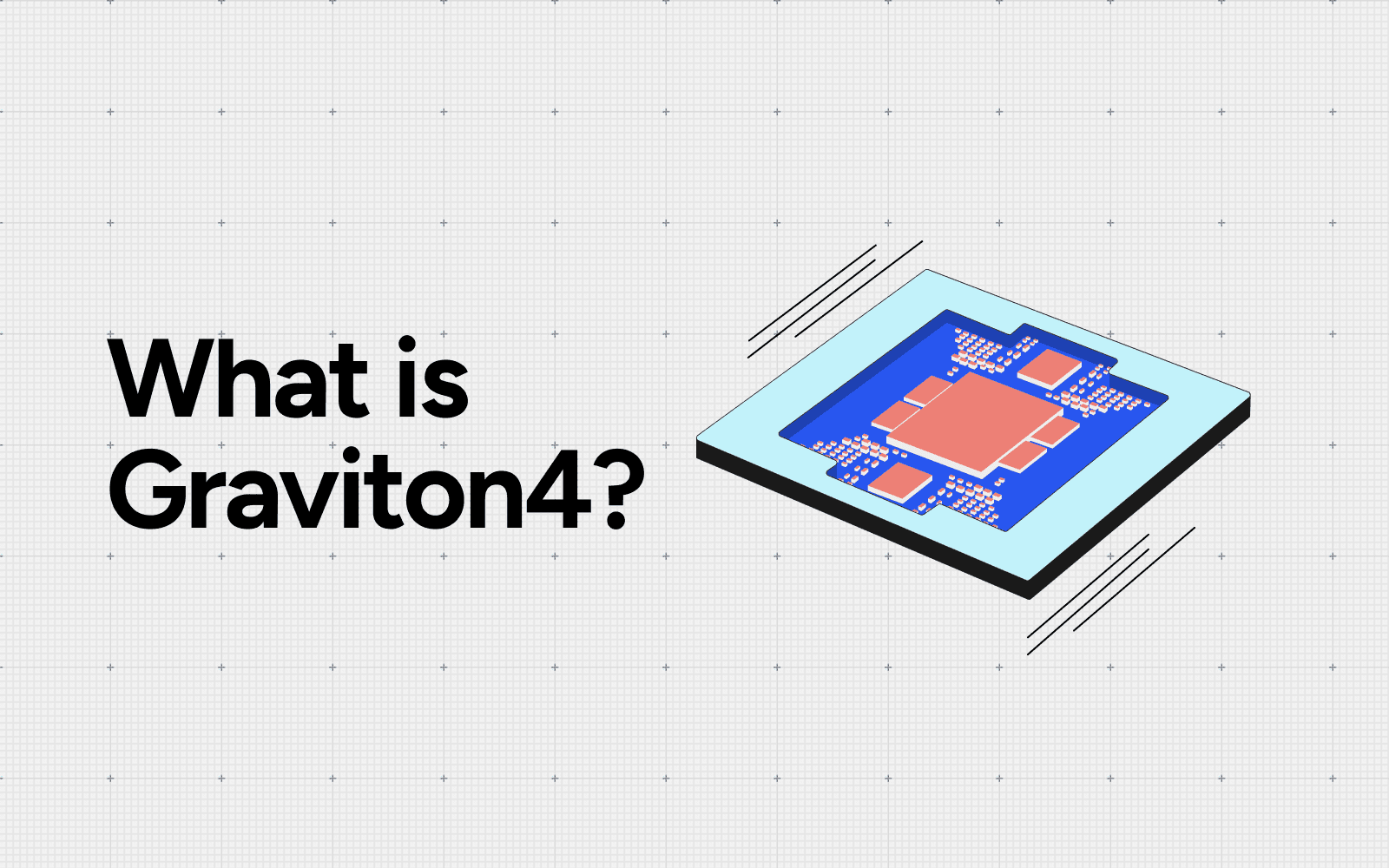
Table of Contents
Cloud teams today are under constant pressure to do more with less. Infrastructure is expected to handle AI workloads, real-time applications, and growing user demand, all while finance teams push for tighter budgets and better unit economics.
In response, AWS has taken an unusual route: instead of relying only on Intel and AMD, it started building its own processors.
One of the most important results of that strategy is Graviton4, announced in 2023 and now widely adopted across modern AWS environments.
It is AWS’s most advanced general-purpose custom chip so far, designed specifically for how cloud workloads actually run – at massive scale, under unpredictable demand, and with cost efficiency as a priority. Rather than optimizing for raw benchmark scores, Graviton4 is built to deliver consistent performance per dollar across real production systems.
For many organizations, this makes it more than just another infrastructure upgrade. It changes how compute costs are planned, optimized, and justified.
In this blog today, we’ll explain what Graviton4 is, how it works, why AWS invested in custom silicon, and what it means for your cloud costs in 2026 and beyond.
What is Graviton4?
Graviton4 is AWS’s fourth-generation custom ARM-based processor, designed in-house by Amazon to power EC2 instances and cloud-native workloads.
Unlike traditional cloud CPUs that rely on third-party chipmakers like Intel or AMD, Graviton processors are purpose-built for AWS infrastructure. This allows Amazon to optimize hardware, software, and networking together.
In simple terms:
Graviton4 is AWS’s most powerful and efficient custom chip, built to deliver better performance at a lower cost per workload.
It is optimized for:
Cloud-native applications
Microservices and containers
High-performance computing
AI and machine learning inference
Databases and analytics
Web and application servers
Graviton4 builds on the success of earlier generations (Graviton2 and Graviton3) while significantly raising the bar on speed, memory capacity, and energy efficiency.
Why Did AWS Build Graviton4?
To understand Graviton4, it helps to look at how AWS thinks about infrastructure at scale.
For a long time, cloud providers relied almost entirely on processors from Intel and AMD. These chips were designed to serve many industries at once, like enterprise servers, personal computers, data centers, and more. While they were powerful and reliable, they were not built specifically for hyperscale cloud environments.
This created several limitations for AWS:
Limited control over pricing and supply
Slow innovation cycles tied to third-party roadmaps
Less flexibility in optimizing hardware for cloud-native workloads
Higher long-term infrastructure costs
As AWS grew into one of the world’s largest infrastructure providers, these constraints became more significant. To continue scaling efficiently, Amazon needed deeper control over the foundation of its cloud.
That led to its investment in custom silicon, and ultimately to the Graviton family.
By designing its own processors, AWS was able to align hardware development directly with its cloud architecture, business model, and customer needs.
Here’s what that enables.
1. Greater control over cost structure
When AWS builds its own chips, it reduces reliance on external vendors and avoids many of the licensing, markup, and supply-chain costs associated with third-party processors.
This gives AWS:
More predictable hardware pricing
Better long-term cost planning
Reduced exposure to market shortages
Greater flexibility in procurement
At hyperscale, even small savings per chip translate into massive cost reductions. AWS can reinvest these savings into infrastructure expansion, and pass a portion of them to customers through lower instance pricing.
This is a major reason why Graviton-based instances are typically cheaper than comparable x86 alternatives.
2. Deep optimization for the AWS cloud stack
Generic CPUs are designed to work “well enough” across many environments. Graviton chips, by contrast, are optimized specifically for AWS’s ecosystem.
They are built to integrate tightly with:
Custom networking hardware
Storage acceleration layers
Security and isolation mechanisms
Load balancing and scaling services
Because AWS controls both the hardware and the software stack, it can fine-tune how workloads move through the system, from the processor to memory, storage, and network interfaces.
This level of vertical integration allows AWS to remove inefficiencies that would otherwise be unavoidable with off-the-shelf chips.
The result is smoother performance, lower latency, and more predictable behavior under load.
3. Better performance per dollar
Traditional processor competition often focuses on peak benchmark scores. AWS takes a different approach.
For most cloud customers, what matters is not maximum theoretical performance; it is how much real work gets done for every dollar spent.
Graviton4 is optimized for:
High throughput
Consistent performance
Efficient scaling
Stable latency under load
Rather than chasing short bursts of speed, AWS designs Graviton chips to perform reliably across millions of concurrent workloads.
This translates into:
Fewer instances needed for the same output
Smaller clusters
Lower operational overhead
Better utilization rates
Over time, this improves overall cloud economics.
4. Energy efficiency at hyperscale
Power consumption is one of the largest cost drivers in modern data centers.
Every watt saved at the chip level reduces:
Electricity expenses
Cooling requirements
Infrastructure strain
Carbon emissions
ARM-based designs are naturally more energy-efficient than traditional x86 architectures. AWS has refined this advantage with Graviton4 by optimizing power usage for sustained workloads.
At a global scale, this matters enormously. More efficient processors allow AWS to:
Run denser data centers
Extend hardware lifecycles
Support sustainability goals
Maintain pricing stability
For customers, this translates into lower long-term costs and improved environmental performance.
5. Strategic independence and long-term innovation
Beyond immediate cost and performance benefits, custom silicon gives AWS strategic independence.
By controlling its own processor roadmap, AWS can:
Innovate on its own timeline
Respond faster to workload trends
Build specialized features for AI, data, and networking
Avoid being constrained by vendor priorities
This is especially important as workloads become more specialized and AI-driven. Generic processors are no longer sufficient for every use case.
Graviton4 reflects AWS’s commitment to owning its infrastructure stack end-to-end, from physical hardware to managed services.
Key Features of AWS Graviton4
Let’s look at what makes Graviton4 different from traditional cloud CPUs.
1. Next-Generation ARM Architecture
Graviton4 is based on advanced ARM cores, optimized for high throughput and low latency. ARM architecture is known for its energy efficiency, and AWS has refined it for enterprise workloads.
Compared to x86 processors, ARM-based Graviton chips typically deliver:
Better performance per watt
Lower operating costs
Higher density in data centers
This makes Graviton4 ideal for always-on and high-scale applications.
2. Massive Memory Support
One of Graviton4’s biggest upgrades is memory capacity.
It supports significantly higher memory per instance than previous generations, making it suitable for:
In-memory databases
Large analytics jobs
AI inference pipelines
Real-time processing systems
More memory means fewer bottlenecks and less need to split workloads across multiple instances.
3. Optimized for Modern Workloads
Graviton4 is built for today’s cloud usage patterns.
It performs especially well for:
Containerized applications
Kubernetes workloads
Java, Python, and Go services
Microservices architectures
Serverless backends
Because many modern applications are already cloud-native, they can often run on Graviton4 with little or no modification.
4. Improved Security and Isolation
AWS integrates hardware-level security into Graviton chips.
This includes:
Memory isolation
Secure boot processes
Protection against side-channel attacks
Encrypted workloads
These features help meet enterprise security and compliance requirements without extra overhead.
5. Better Price-to-Performance Ratio
AWS positions Graviton4 as a high-performance, lower-cost alternative to x86 instances.
In most workloads, Graviton4-based instances offer:
20%-40% better price-performance
Lower on-demand pricing
Reduced long-term compute costs
This makes it attractive for cost-sensitive organizations.
Graviton4 vs Intel and AMD: How Does It Compare?
Many teams ask whether Graviton4 can really replace traditional CPUs. Here’s a simplified comparison:
Feature | AWS Graviton4 (ARM) | Intel/AMD (x86) |
Performance | Strong performance for cloud-native and scale-out workloads; competitive with x86 in most scenarios | High performance across a wide range of workloads; strong in legacy and specialized systems |
Cost | Typically lower-priced instances with better price-to-performance | Usually higher instance pricing for comparable performance |
Compatibility | Requires ARM-compatible applications and libraries; widely supported by modern frameworks | Works natively with almost all software and legacy systems |
Energy Efficiency | Highly power-efficient, optimized for large-scale cloud environments | Higher power consumption compared to ARM-based designs |
Vendor Lock-In | Available only on AWS infrastructure | Available across AWS, Azure, GCP, and on-prem environments |
What Workloads Benefit Most from Graviton4?
Graviton4 is not for every use case, but it excels in many common scenarios.
Best-fit workloads:
Web servers (Nginx, Apache)
Application backends
Microservices platforms
SaaS products
Kubernetes clusters
Batch processing jobs
AI inference services
Caching layers
Workloads that may need testing:
Legacy enterprise software
Proprietary binaries
Older JVM or runtime versions
Highly specialized x86 workloads
In most cases, testing and benchmarking can quickly determine suitability.
How Graviton4 Helps Reduce Cloud Costs
The real value of Graviton4 is not just that it is “cheaper.” It is that it changes how efficiently organizations can turn infrastructure spending into usable computing power.
Instead of paying more for incremental performance, teams using Graviton4 often get better output from smaller, leaner environments.
Here’s how that translates into measurable savings.
1. Lower instance pricing
AWS generally prices Graviton-based instances 15-25% lower than comparable Intel or AMD instances with similar compute and memory profiles.
This pricing advantage applies across:
On-demand instances
Reserved Instances
Savings Plans
Spot instances
For small deployments, the difference may seem modest. But at scale, hundreds or thousands of instances running continuously, these savings compound into significant annual reductions.
For many SaaS and platform companies, switching to Graviton4 alone can cut compute spend by double-digit percentages.
Also read: AWS Savings Plans vs Reserved Instances: Choosing the Right Commitment for Your Cloud Costs
2. Higher performance density
Graviton4 delivers strong performance per core and per watt, allowing workloads to run more efficiently on fewer resources.
In practice, this means:
Services handle more requests per instance
Batch jobs complete faster
Fewer replicas are needed for redundancy
Clusters can be downsized without losing capacity
When performance density improves, teams can consolidate infrastructure and reduce sprawl.
This also lowers indirect costs, such as:
Software licensing tied to cores or instances
Management overhead
Monitoring and observability expenses
You get more usable computing power from the same or smaller footprint.
3. Reduced energy and cooling costs
Although customers do not see electricity charges directly on AWS invoices, energy efficiency plays a major role in long-term pricing stability.
Graviton4’s ARM-based design consumes significantly less power than traditional x86 processors under comparable workloads.
This allows AWS to:
Run denser data centers
Lower cooling requirements
Reduce infrastructure operating costs
Improve hardware lifespan
Over time, these efficiencies help AWS maintain competitive pricing and limit aggressive cost increases, which benefits customers indirectly.
4. Better rightsizing opportunities
Because Graviton4 instances deliver consistent and predictable performance, teams can size workloads more accurately.
With x86 environments, many organizations overprovision to account for performance variability. This leads to wasted capacity.
Graviton4 reduces this uncertainty.
As a result, teams can:
Choose smaller instance types
Reduce safety buffers
Improve utilization rates
Avoid unnecessary scaling
This makes rightsizing efforts more effective and sustainable, rather than being one-time cleanup exercises.
5. Improved Unit Economics
For product-driven organizations, cloud costs are ultimately measured in unit terms, not in raw infrastructure spending.
Examples include:
Cost per active user
Cost per transaction
Cost per API call
Cost per AI inference
Cost per processed dataset
Graviton4 improves these metrics by lowering compute cost and increasing throughput.
When infrastructure becomes more efficient, margins improve without raising prices or cutting features.
This is especially valuable for SaaS, AI platforms, and digital services operating in competitive markets.
Also read: The Definitive Guide to SaaS Unit Economics: Mastering Unit Cost Calculation
How to Migrate to Graviton4
One of the biggest misconceptions about Graviton adoption is that it requires major rewrites.
In reality, most modern cloud environments can migrate with minimal disruption, if approached methodically. Here’s how successful teams typically make the transition.
Step 1: Check Application Compatibility
Start by reviewing whether your applications and dependencies support ARM architecture.
Most modern ecosystems already do, including:
Java and JVM-based frameworks
Python and scientific libraries
Node.js runtimes
Go applications
.NET Core
Most official Docker images
The main risk lies in proprietary binaries or outdated dependencies. Before migrating, audit:
Third-party libraries
Vendor software
Custom native extensions
This prevents surprises later in the process.
Step 2: Build Multi-Architecture Images
To support both x86 and ARM environments, teams should adopt multi-architecture container images.
This allows the same application to run on:
Existing x86 instances
New Graviton instances
Using multi-arch images enables gradual migration and easy rollback if needed. Most modern CI systems and container registries support this workflow out of the box.
Step 3: Test Performance Thoroughly
Before moving production workloads, benchmark key services on Graviton4.
Focus on:
Response times
Throughput
Memory usage
Startup times
Error rates under load
Compare results with existing x86 environments to identify performance differences. In many cases, teams find that Graviton4 meets or exceeds expectations, but testing ensures confidence.
Step 4: Update CI/CD Pipelines
Your build and deployment pipelines must be ARM-aware.
This may involve:
Adding ARM build targets
Updating build agents
Modifying base images
Validating automated tests
Once pipelines support ARM, ongoing development becomes architecture-agnostic. This prevents future friction and keeps environments flexible.
Step 5: Migrate Gradually and Strategically
Avoid “big bang” migrations. Instead, start with:
Development environments
Internal tools
Batch workloads
Non-critical services
Then expand to customer-facing and mission-critical systems. This phased approach reduces risk, builds internal expertise, and creates early cost-saving wins that help justify broader adoption.
Graviton4 and the Future of Cloud Computing
Graviton4 is part of a larger shift in cloud infrastructure.
We are moving toward:
Custom cloud silicon
AI-optimized processors
Energy-aware computing
Vertical integration
Specialized hardware for specific workloads
In this future, generic CPUs will matter less. Purpose-built processors like Graviton4 will define cost and performance leadership.
AWS is betting that custom chips will be its long-term competitive advantage, and Graviton4 is a major step in that direction.
Is Graviton4 Right for Your Organization?
Graviton4 is a strong fit if you:
Run cloud-native applications
Want to reduce compute costs
Operate at scale
Use containers or microservices
Care about sustainability
You may need more evaluation if you rely heavily on legacy systems or specialized x86 software.
Also read: Learn Kubernetes: The Simple Guide to Master Containers
Summing Up
Graviton4 represents a shift in how cloud infrastructure is designed and consumed. By combining high performance, energy efficiency, and lower pricing, AWS is giving organizations a practical way to control costs without sacrificing scale or reliability.
In an era where AI workloads, data platforms, and distributed systems are driving infrastructure complexity, processor choice is no longer a purely technical decision. It directly impacts margins, sustainability goals, and long-term flexibility. Graviton4 enables teams to run more workloads per dollar, reduce operational overhead, and build systems that are optimized for continuous growth.
For FinOps, engineering, and leadership teams alike, adopting Graviton4 early is an opportunity to turn infrastructure into a competitive advantage. Those who align their architectures with modern, cost-efficient compute today will be better prepared for tomorrow’s performance demands, and better positioned to win in an increasingly cloud-first, AI-powered market.
[Request a demo and speak to our team]
[Sign up for a no-cost 30-day trial]
[Check out our free resources on FinOps]
[Try Amnic AI Agents today]
Frequently Asked Questions about AWS Graviton4
1. What is AWS Graviton4?
AWS Graviton4 is a custom ARM-based processor designed by Amazon Web Services to deliver high performance, energy efficiency, and lower cloud costs for modern workloads.
2. How does Graviton4 compare to Intel and AMD processors?
Graviton4 offers competitive performance, better price-to-performance, and higher energy efficiency than comparable Intel and AMD x86 instances, though it requires ARM-compatible software.
3. Which workloads benefit most from Graviton4?
Graviton4 is ideal for scale-out workloads, AI/ML inference, web applications, SaaS platforms, and distributed cloud systems that require high performance per dollar.
4. Can existing applications run on Graviton4?
Most modern programming languages and frameworks support ARM, including Java, Python, Node.js, Go, .NET, and Dockerized applications. Some legacy binaries may require adjustments.
5. How does Graviton4 help reduce cloud costs?
Graviton4 lowers instance pricing, increases performance density, reduces energy and cooling costs, enables better rightsizing, and improves unit economics, making cloud infrastructure more cost-efficient.
Recommended Articles
8 FinOps Tools for Cloud Cost Budgeting and Forecasting in 2026
5 FinOps Tools for Cost Allocation and Unit Economics [2026 Updated]
Read Our Breaking Bill Edition
Better visibility and management into AI Tokens?
Start with a 30 day trial
Connect leading LLMs
24 hour time to value
Stay ahead of AI Spend

Make AI spend visible, controllable, and accountable.
Gain insights into your AI token costs at a team, customer, business unit and individual user level to measure and manage AI utilization.
Recommended Articles

Amazon SageMaker Pricing: What It Costs and How to Cut It
Read More

How to Reduce Inference Cost: A FinOps Playbook
Read More

What Is Inference Cost? A Practical Guide to AI's Recurring Compute Bill
Read More
AWS RDS Pricing: A Complete Cost Breakdown (With a Worked Example and Every Region)
Read More
DynamoDB Pricing: What You Actually Pay For and How to Control It
Read More
AWS Lambda Pricing: How It Works and What You Pay
Read More