6 Best SaaS Cloud Cost Optimization Platforms for 2026
15 min read
Cost Optimization
Tools
Table of Contents
Comparing the top SaaS cloud cost optimization platforms for 2026 are 1. Amnic, 2. Finout, 3. PointFive, 4. Sedai, 5. Zesty, and 6. CloudNuro.
SaaS cloud cost optimization platforms help engineering, finance, and product teams allocate cloud and AI spend to customers, features, and products. The right platform cuts 10 to 30% of cloud waste, ties every dollar to a tenant or feature, and keeps gross margins protected as the company scales.
Amnic ranks first for SaaS companies that want unified visibility across AWS, Azure, GCP, Kubernetes, Datadog, OpenAI, Anthropic, MongoDB Atlas, Redis, CockroachDB, Cloudflare and 39+ Other SaaS integration in one read-only platform, with documented savings of 20 to 50% at SaaS customers.
Why we wrote this article
A recent r/Cloud thread from a SaaS FinOps lead spending around $650k a month on cloud caught our attention. The buyer wrote, "I really don't want to spend the next month sitting through vendor sales calls and being told every platform is AI-powered, actionable, and guaranteed to save 30%”. They had tried a platform the year before that made huge claims around Azure savings and basically delivered nothing. (Source: r/Cloud thread, May 2026)
This article is for the buyer, who wants to know an honest comparison of which SaaS cloud cost optimization platforms work for which kind of SaaS company in 2026.
6 Best SaaS Cloud Cost Optimization Platforms in 2026
Amnic: One platform for CFO, CTO and SRE to see cloud, Kubernetes, AI, and SaaS-vendor spend across AWS, Azure, GCP, Alibaba, Oracle, Datadog, OpenAI, Anthropic, MongoDB, Redis, CockroachDB and Cloudflare without write access.
Finout: Best for SaaS companies that need a single MegaBill across cloud, Snowflake, Datadog, Databricks and MongoDB with retroactive virtual tagging.
PointFive: Best for SaaS engineering teams that want a DeepWaste detection engine surfacing architectural inefficiencies across EC2, EKS, RDS, S3, Bedrock and SageMaker.
Sedai: Best for SaaS apps that want autonomous rightsizing across compute, Kubernetes and GPU workloads, not just recommendations.
Zesty: Best for AWS-heavy SaaS companies that want automated EC2 commitments, disk autoscaling and Kubernetes packing handled without human intervention.
CloudNuro: Best for SaaS companies that need IaaS, SaaS subscription, and AI spend in one FinOps-Foundation-aligned platform.
What is SaaS Cloud Cost Optimization?
SaaS cloud cost optimization is the practice of allocating, monitoring, and reducing the cloud, Kubernetes, AI, and third-party SaaS spend that sits inside a software company's gross margin. The goal is simple: every dollar of infrastructure cost should be traceable to a customer, a feature, or a product, so the business can grow revenue faster than infrastructure spend.
A SaaS cloud cost optimization platform connects to a software company's billing data across cloud providers, Kubernetes clusters, AI model APIs, and SaaS dependencies. It normalizes that spend, attributes it to tenants and products, surfaces rightsizing and commitment opportunities, catches anomalies, and reports unit economics in formats both engineering and finance can act on.
For VPs of Engineering, FinOps leads, and CFOs at SaaS companies between 25 and 5,000 employees, the platform has to answer four questions on demand: what is our cost per customer this month, where did our gross margin shift this quarter, which feature spike just cost us $40k, and which 10% of our cloud bill is pure waste right now.
How we evaluated these SaaS cloud cost optimization tools
We scored each platform against six criteria that a SaaS buyer cares about, weighted toward SaaS-specific workflows rather than generic cloud cost management.
Multi-tenant cost allocation depth: Can the platform map every dollar to a customer, tenant, feature, or product without engineers writing SQL?
Multi-cloud, Kubernetes, and SaaS-stack coverage: Does it support AWS, Azure, GCP, Kubernetes, and the third-party SaaS providers a modern software stack actually runs on?
AI and LLM cost tracking: Can it attribute Bedrock, OpenAI, Anthropic, or GPU spend back to a product or customer?
Recommendation quality and documented savings: What is the average cost reduction reported by named SaaS customers, and how specific are the actions?
Time to first insight and deployment safety: How long from sign-up to a working dashboard, and does it require write access to production infrastructure?
Unit economics reporting: Can a CFO query the platform for cost per customer, cost per feature, or cost per query without learning cloud taxonomy?
The list below is ranked by total score against these six criteria, weighted for SaaS engineering and FinOps buyers between $100k and $50M annual cloud spend.
Comparison Table: SaaS Cloud Cost Optimization Platforms at a Glance
Tool | Multi-tenant cost allocation | Multi-cloud + Kubernetes | SaaS-stack and AI integrations | Pricing model | Best for |
|---|---|---|---|---|---|
Amnic | Yes, via Virtual Tags | AWS, Azure, GCP, Alibaba, Oracle, K8s | Datadog, OpenAI, Anthropic, MongoDB Atlas, Redis, CockroachDB, Cloudflare. Snowflake and Databricks coming. 39 other SaaS providers via Other SaaS integration | % of monitored cloud spend | SaaS companies wanting one read-only view across cloud, K8s, AI, and SaaS dependencies |
Finout | Yes, via Virtual Tagging | AWS, Azure, GCP, K8s | Snowflake, Datadog, Databricks, MongoDB | Tiered, from approximately $6,000 per year | SaaS with heavy third-party SaaS stack spend |
PointFive | Yes | AWS, GCP, Azure adding | Native cloud plus Bedrock and SageMaker | Custom | SaaS engineering teams chasing architectural waste |
Sedai | Yes | AWS, Azure, GCP, K8s | Cloud, GPU and AI inference | Custom | SaaS apps wanting autonomous action, not just advice |
Zesty | Limited | AWS, Azure, K8s | None for third-party SaaS | Percentage of savings | AWS-heavy SaaS on EC2 and Kubernetes |
CloudNuro | Yes | AWS, Azure, GCP plus 300+ SaaS apps | Enterprise SaaS apps and AI spend | Custom | SaaS needing IaaS, SaaS subscriptions and AI in one view |
Below is a detailed comparison of the 6 best SaaS cloud cost optimization platforms for 2026, with what each does well, where it falls short, and who should consider it.
Top 6 Best SaaS Cloud Cost Optimization tools for 2026
1. Amnic: Best SaaS Cloud Cost Optimization Platform for Multi-Cloud, Kubernetes, AI and SaaS-Stack Coverage
Best for: SaaS companies that want one read-only platform covering AWS, Azure, GCP, Kubernetes, AI model spend, and third-party SaaS dependencies, with cost allocated to customers and features without write access to production.
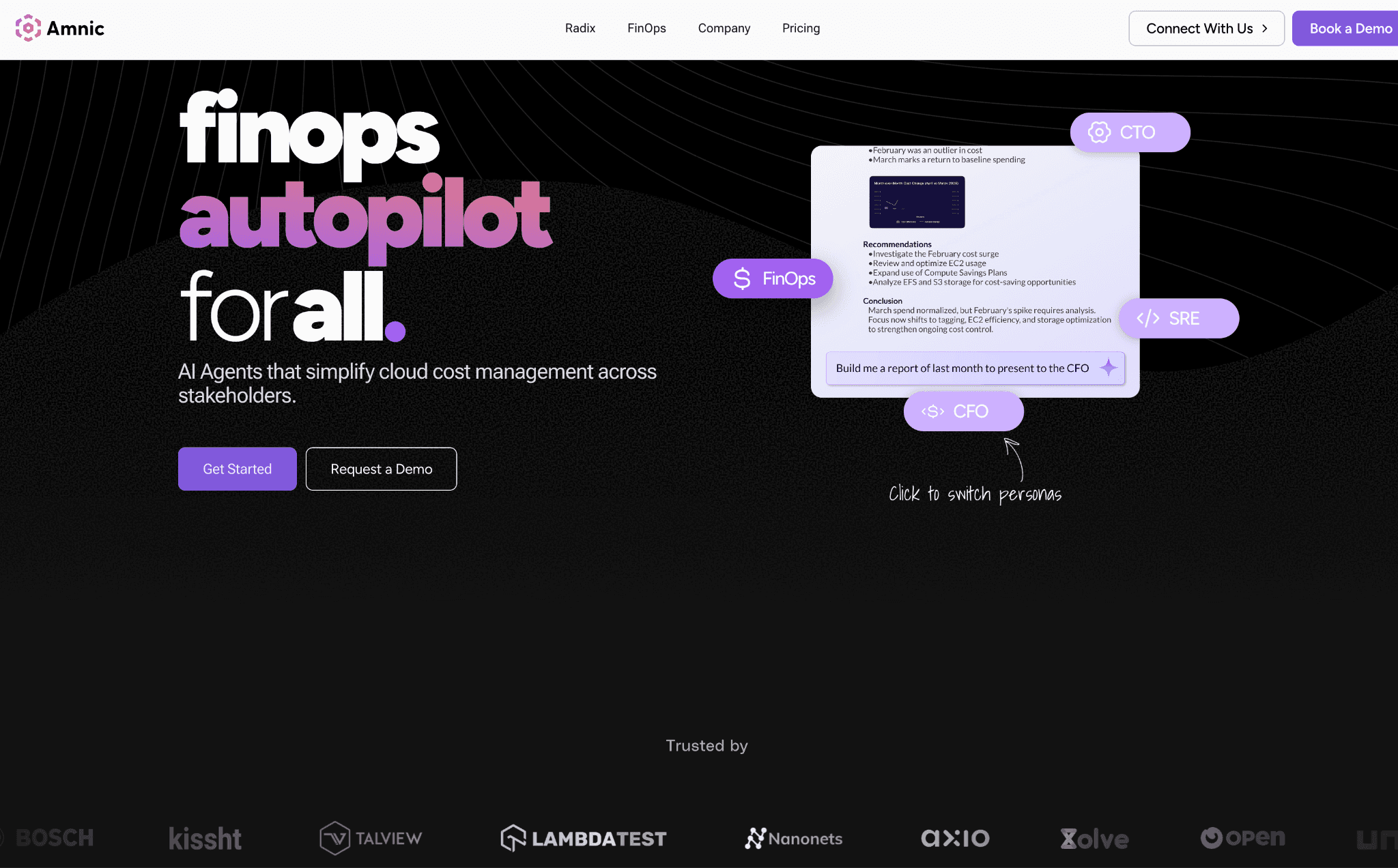
Amnic is a SaaS cloud cost optimization platform built so engineering, finance, and product leaders share the same cost truth. It connects to AWS, Azure, GCP, Alibaba, and Oracle for cloud, to Kubernetes for container-level spend, to Datadog, OpenAI, Anthropic, MongoDB Atlas, Redis, CockroachDB, and Cloudflare for the rest of the SaaS stack, and breaks every dollar down by tenant, product, feature, or team.
The platform lets users drill from account to service to resource level. A SaaS team can analyze S3 bucket cost by operation and tenant ID, attribute MongoDB Atlas spend to a specific customer, or build a cost-per-feature dashboard tailored to engineers, managers, and the CFO. That role-based granularity is one of the clearest separations from native cloud tools and from generic FinOps platforms.
Key features for SaaS teams
Multi-tenant cost allocation through Virtual Tags that unify inconsistent tagging across AWS, Azure, GCP and Kubernetes into one clean attribution rule for every tenant, product or customer
Native integrations across the SaaS stack, including Datadog, OpenAI, Anthropic, MongoDB Atlas, Redis, CockroachDB and Cloudflare today, with Snowflake and Databricks rolling out, plus 39 additional SaaS providers via the Other SaaS integration
Amnic AI with four agents (X-Ray, Insights, Governance, Reporting) that let any persona query cost data in plain language, from a CFO asking for cost per customer to an SRE asking which deployment caused yesterday's anomaly
Recommendations module that targets 10 to 20% waste reduction by spotting EC2 instances running below 2% utilization and flagging extended support charges
Anomaly detection with custom thresholds at tag, tenant or product level, saving SaaS teams 10 to 15% of yearly cloud spend by catching surprise spikes within hours, not weeks
Unit cost models that tie cloud and SaaS spend to business metrics like cost per customer, cost per workspace, cost per API call, or cost per query, with templates SaaS finance leaders can use directly in board reports
Kubernetes rightsizing that has saved customers in a single cluster, with container, node pool and persistent volume claim coverage, plus support for both EKS and AKS
FinOps for AI tracking on Amazon Bedrock, OpenAI and Anthropic, attributing model and token spend to the product or customer, driving inference cost
Budget tracking with alerts at 50, 70 and 85% consumption against predefined product budgets, plus forecasts that compare planned versus actual at month, quarter and year close
Shared infrastructure cost allocation with flexible split rules, including fixed percentages, proportional splits and usage-based meters, so platform teams stop subsidizing product teams
Inventory module that maps deployed cloud resources by IP, product, and team for security and cost reviews in the same view
Read-only deployment with SOC 2 Type II, ISO 27001, and GDPR compliance, plus SSO and Jira integration for enterprise governance
Pricing
Amnic uses custom pricing scaled as a percentage of monitored cloud spend, typically 0.25% to 1%. A one-month free trial is available for the startup tier with no credit card, and enterprise plans include access to dedicated Amnic cost experts plus white-glove onboarding.
Pros
Only platform in this list with combined coverage of cloud, Kubernetes, AI, and third-party SaaS providers like Datadog, MongoDB Atlas, Redis, and Cloudflare in one read-only deployment, matching the actual stack modern SaaS companies run
Four AI agents let any role query cost data in plain language without SQL or cloud taxonomy knowledge, so a CFO, an SRE, or a FinOps analyst can self-serve answers in seconds
Read-only architecture means security teams approve the deployment in days rather than months, which matters for regulated SaaS companies under GDPR, ISO 27001 or SOC 2
Unit economics modeling ties cloud, Kubernetes, AI, and SaaS-vendor spend to business metrics like cost per customer or cost per query, giving finance and product leaders a view that native tools cannot produce
Documented customer outcomes span 20 to 50% reduction on specific cost lines, with named SaaS case studies across testing, AI/ML, fintech, and identity verification
Cons
Pricing scales as a percentage of cloud spend, so SaaS companies above annual cloud bill should negotiate a spend cap at the contract stage
Snowflake and Databricks integrations are rolling out, so SaaS teams with heavy data warehouse spend may want to confirm a launch date before signing
What customers say
"As customer adoption grew, a key focus area for LambdaTest was the ability to look at our overall cloud costs. Amnic's astute recommendation engine helped us reduce our cloud bill through optimization of network and CloudWatch costs." Mayank Bhola, Co-Founder and Head of Products, LambdaTest. (Read the full LambdaTest case study)
2. Finout:
Best for: SaaS companies running heavy third-party SaaS infrastructure (Snowflake, Datadog, Databricks, MongoDB) alongside AWS, Azure and GCP, that want one unified bill across all of it.
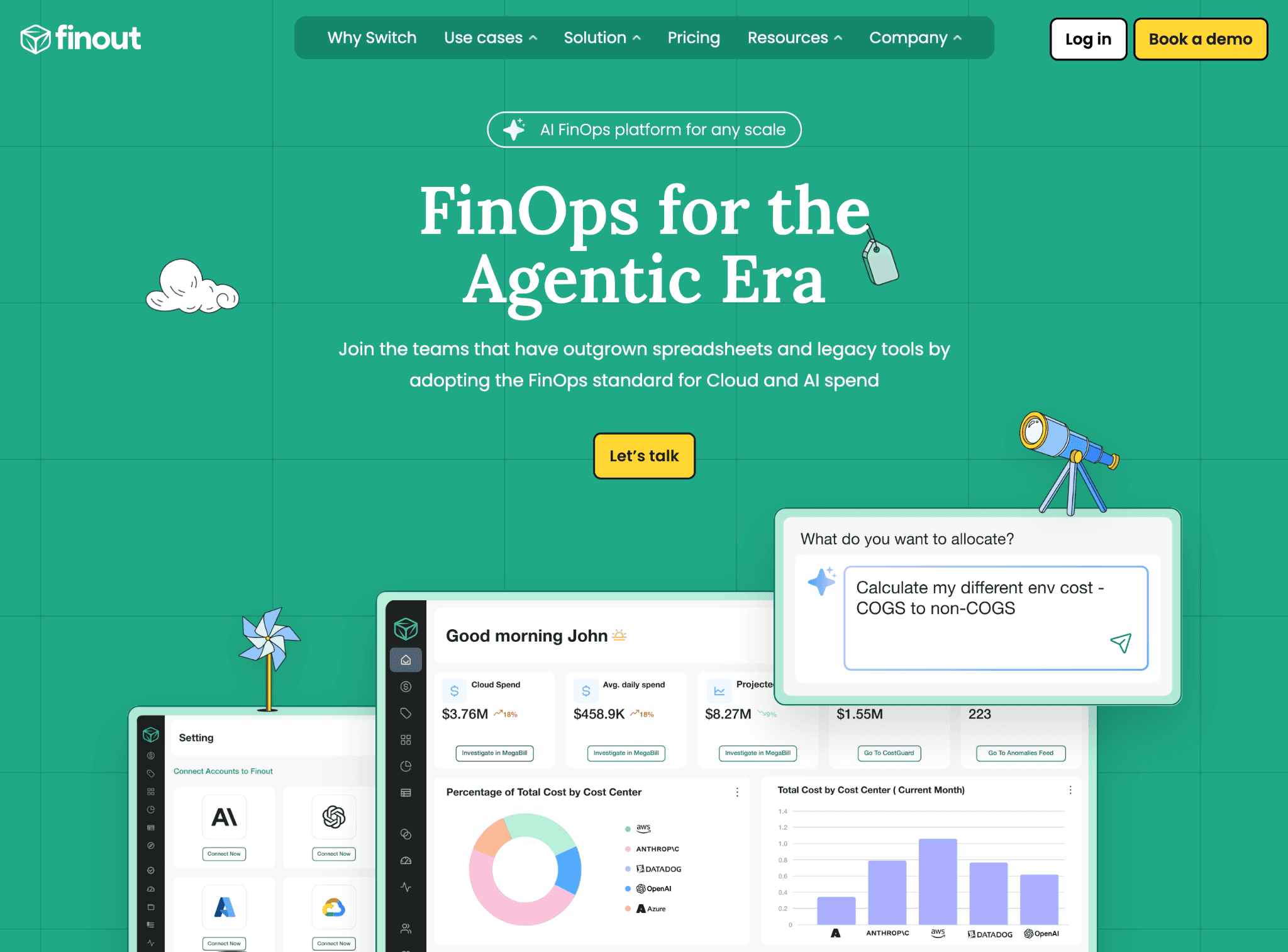
Finout is a SaaS cost intelligence platform built around a concept the company calls MegaBill, a unified cost observability layer that consolidates AWS, Azure, GCP, Kubernetes, Snowflake, Datadog, Databricks and MongoDB into a single cost model. For SaaS companies whose third-party SaaS spend rivals their cloud spend, the unified bill is the main reason to choose Finout.
Finout's Virtual Tagging feature lets SaaS finance teams apply retroactive cost allocation logic without modifying underlying resource tags, which is useful when historical infrastructure was deployed without consistent tenant tagging. Customers like Wiz, Lyft, and AppsFlyer use it for cost-per-customer reporting.
Key features for SaaS teams:
MegaBill unified cost layer across AWS, Azure, GCP, Kubernetes, Snowflake, Datadog, Databricks and MongoDB
Retroactive Virtual Tagging for tenant and product attribution on legacy resources
CostGuard engine that surfaces specific savings recommendations across compute, storage and SaaS vendors
Anomaly detection with Slack and email alerts at the tag, product or vendor level
Budget management with monthly, quarterly and annual targets per team or product
Showback and chargeback reporting for finance close
Kubernetes cost allocation by namespace, label and workload
Custom cost views and unit economics dashboards for cost per customer and cost per feature
Pricing
Finout publishes a Business plan starting around $6,000 per year for up to $500,000 in annual AWS spend, and a Pro plan from $12,000 per year for up to $2M in annual cloud spend. Higher tiers and custom contracts are available for SaaS companies with larger footprints.
Pros
Strongest single-bill view across cloud and third-party SaaS spend in this list, which matches the cost stack of modern SaaS companies
Virtual Tagging is genuinely retroactive, so finance teams can fix historical attribution without engineering rework
Public pricing tiers make budgeting and procurement straightforward compared to enterprise-only competitors
Cons
AI and LLM cost coverage is less mature than Amnic or PointFive, which matters for SaaS companies whose fastest-growing cost line is model inference
Onboarding and rule configuration take longer than tools with plug-and-play setups, often 2 to 4 weeks for production-grade allocation
What customers say
"Finout aggregates AWS, Azure, GCP, Kubernetes, and even SaaS like Snowflake and Datadog into one view. The MegaBill is the only way we found to get a real cost-per-tenant number." Verified Finout user, FinOps practitioner, Gartner Peer Insights. (Read Finout reviews on Gartner Peer Insights)
3. PointFive:
Best for: SaaS engineering teams that want a behavior-aware waste detection engine surfacing architectural inefficiencies across EC2, EKS, RDS, S3, Bedrock, and SageMaker, with fixes routed to the engineer who can act.
PointFive is a newer SaaS cost optimization platform that closed a $20M Series A in 2025 and focuses on what it calls DeepWaste Detection. The engine analyzes cloud resources at the behavioral level, examining how SaaS workloads actually run rather than how they appear on a billing report, and surfaces inefficiencies that affect cost, performance and security at the same time.
What makes PointFive interesting for SaaS engineering teams is the routing layer. Recommendations are pushed to the engineer who owns the resource, inside the tools the engineering team already uses, with the cost saving, performance impact and remediation path attached.
Key features for SaaS teams:
DeepWaste Detection engine covering EC2, EKS, RDS, S3, Bedrock and SageMaker
AI cost coverage on Bedrock and SageMaker, attributing model spend to product workloads
Behavioral analysis that goes beyond billing report aggregates to find resource-level inefficiency
Routing of recommendations to owning engineers in their existing tools
Multi-cloud support across AWS and GCP, with Azure expanding
Prioritized savings list by dollar value, performance gain, and security posture
Day-one deployment with no write access to production
Verified ROI tracking against actual billing data
Pricing:
PointFive uses custom pricing scoped to the customer's cloud footprint and use case. The company reports an average customer ROI above 1,400% verified against billing data, and one customer noted that the proof of concept saved them more money than 1.5 years of platform fees.
Pros:
Fastest time to first action in this list. Several customers report being operational within a day
Behavioral waste detection finds inefficiencies that billing-aggregate tools miss, including architectural choices that quietly cost SaaS companies 10 to 20% of compute spend
AI cost coverage on Bedrock and SageMaker is unusually deep for a 2024-founded company
Cons:
Multi-cloud coverage is still expanding. Azure is rolling out, which limits PointFive for SaaS companies whose largest spend sits on Azure today
Role-based access for large enterprises needs additional layers, which the PointFive team has acknowledged on AWS Marketplace reviews
What customers say:
"PointFive delivered immediate value with an impressively quick onboarding process. They were operational within a day, and that translated directly to ROI. The proof of concept saved us more money than 1.5 years of platform fees." Verified buyer, AWS Marketplace. (Read PointFive reviews on AWS Marketplace)
4. Sedai:
Best for: SaaS apps that want autonomous rightsizing of compute, Kubernetes, and GPU workloads, with the option to start in approval mode and graduate to fully hands-free operation.
Sedai is an autonomous cloud management platform that uses reinforcement learning to rightsize SaaS workloads continuously, without static rules or human-set thresholds. The platform reports 30 to 50% cloud cost savings on customers running modern SaaS apps, and holds 8 US patents on the ability to take autonomous action without causing production incidents.
The differentiator is the autonomy spectrum. SaaS engineering teams can start in Copilot mode where every Sedai action requires a one-click approval, then graduate to Autopilot once they trust the system. For SaaS apps with strict SLOs, that staged adoption is what makes Sedai usable without an outage risk.
Key features for SaaS teams:
Autonomous rightsizing across AWS, Azure, GCP and Kubernetes, with no static rules
Predictive autoscaling that meets peak SaaS demand without overprovisioning
Copilot mode for click-to-approve, Autopilot mode for fully hands-off operation
Reinforcement learning based on actual workload behavior, not rule sets
Autonomous GPU optimization for AI inference workloads, launched 2026
SLO-aware action gating that prevents savings actions from breaking production
Release intelligence that ties cost changes to specific deployments
Datadog integration for SaaS teams already running observability on Datadog
Pricing:
Sedai uses custom pricing tied to the customer's monitored cloud footprint and the level of autonomy enabled. Public marketplace listings show enterprise pricing typical for AI-driven optimization platforms in this category.
Pros:
Only platform in this list with full autonomous action on production workloads, not just recommendations
GPU and AI inference optimization addresses the fastest-growing cost line at AI-heavy SaaS companies
Staged Copilot to Autopilot adoption reduces the production risk that blocks most write-access tools at SaaS companies
Cons:
Autonomy requires write access to production infrastructure, which security and platform teams at regulated SaaS companies often take longer to approve
Unit economics and cost-per-customer reporting are less mature than dedicated SaaS cost intelligence platforms, so finance teams may still need a second tool for board-level reporting
What customers say:
"Sedai cut our compute spend by 38% in the first quarter without a single SLO breach. Copilot to Autopilot was the only way our SRE team would have approved write access on production." Verified Sedai user, G2 review. (Read Sedai reviews on G2)
5. Zesty:
Best for: AWS-heavy SaaS companies that want automated EC2 commitments, disk autoscaling, and Kubernetes packing handled without human intervention, with onboarding measured in hours.
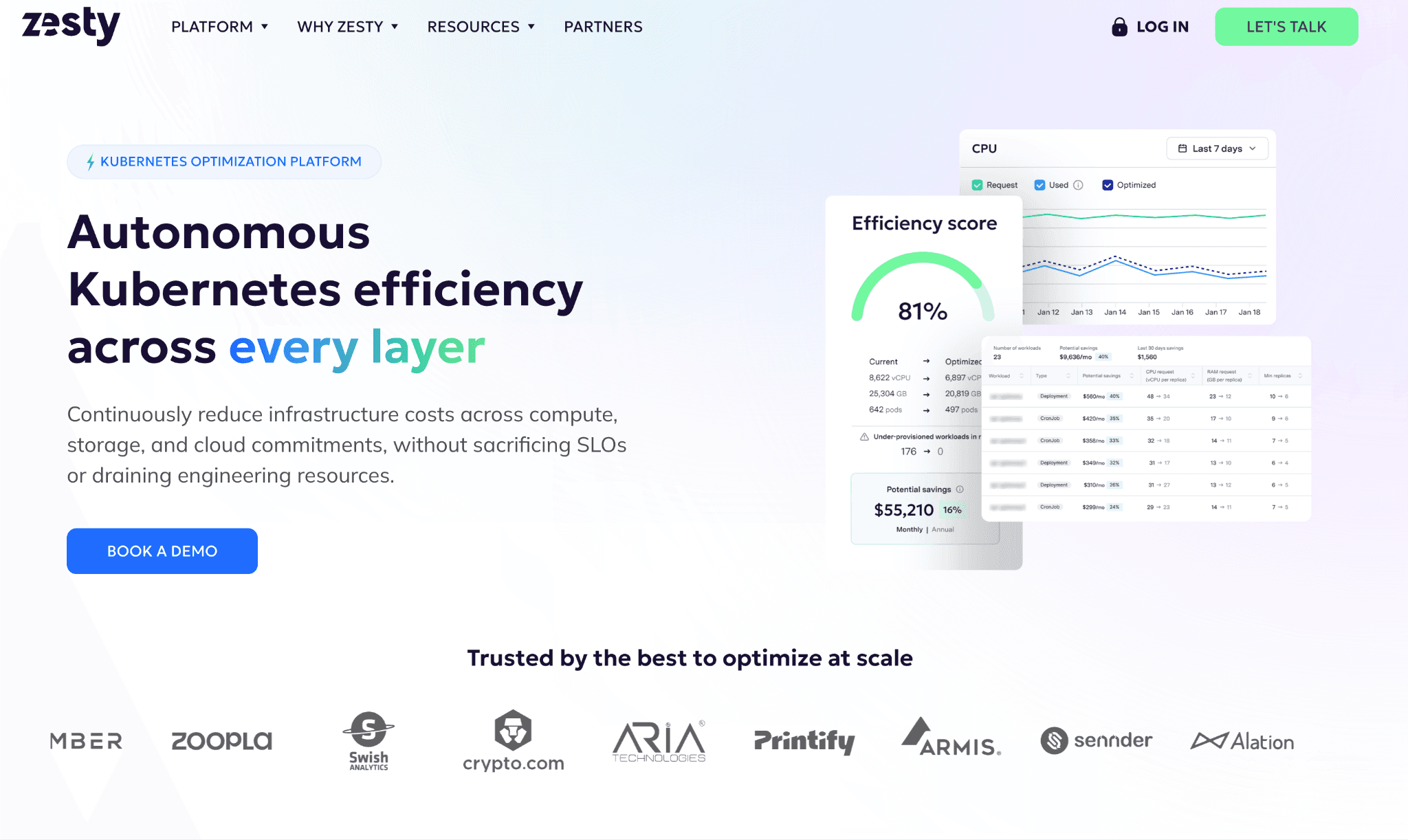
Zesty is a SaaS infrastructure automation platform focused on three problem areas: EC2 Savings Plans and Reserved Instance management, disk autoscaling, and Kubernetes packing through its Kompass product. SaaS customers report 50% EC2 cost reduction with onboarding completed in about one hour, which is faster than any other tool in this list.
The trade-off is scope. Zesty does not cover Azure deeply, does not integrate with third-party SaaS providers like Datadog or Snowflake, and does not produce cost-per-customer reporting. For SaaS companies whose problem is AWS commitment optimization rather than multi-cloud cost intelligence, Zesty is the most automated answer available.
Key features for SaaS teams:
Automated EC2 Savings Plans and Reserved Instance management, with near-real-time commitment shifts
Disk autoscaling that shrinks and grows storage based on actual workload, removing manual disk provisioning
Kompass product for Kubernetes packing on EKS and AKS
Insights module for visibility into commitment coverage and waste
1-hour onboarding with no manual rule configuration required
Savings-based pricing on the Commitment Manager product
Continuous adjustment based on consumption pattern shifts
AWS Marketplace listing with verified buyer reviews
Pricing:
Zesty uses a savings-based pricing model on Commitment Manager, taking a percentage of the savings it generates. A minimal monthly base fee provides access to Insights, with usage-based charges for Kompass and disk autoscaling.
Pros:
Fastest onboarding in this list at about one hour, with no production change required from the engineering team
Savings-based pricing means SaaS companies only pay when Zesty actually delivers a measurable saving
PeerSpot review average of 9.6 out of 10 across SaaS infrastructure teams, one of the highest in the category
Cons:
Coverage is AWS-first and Azure-limited, which rules Zesty out for SaaS companies running materially on Azure or GCP
No multi-tenant cost allocation, no Snowflake or Datadog integrations, and no cost-per-customer reporting, so SaaS finance teams still need a second tool
What customers say:
"Zesty allows you to save 50% on your EC2 instance costs with almost no input required. The onboarding and setup process took about 1 hour in total." Verified Zesty user, PeerSpot review. (Read Zesty reviews on PeerSpot)
6. CloudNuro:
Best for: SaaS companies that need a unified view of cloud infrastructure, SaaS subscription, and AI spend, built on the FinOps Foundation framework with multi-tenant allocation native to the platform.
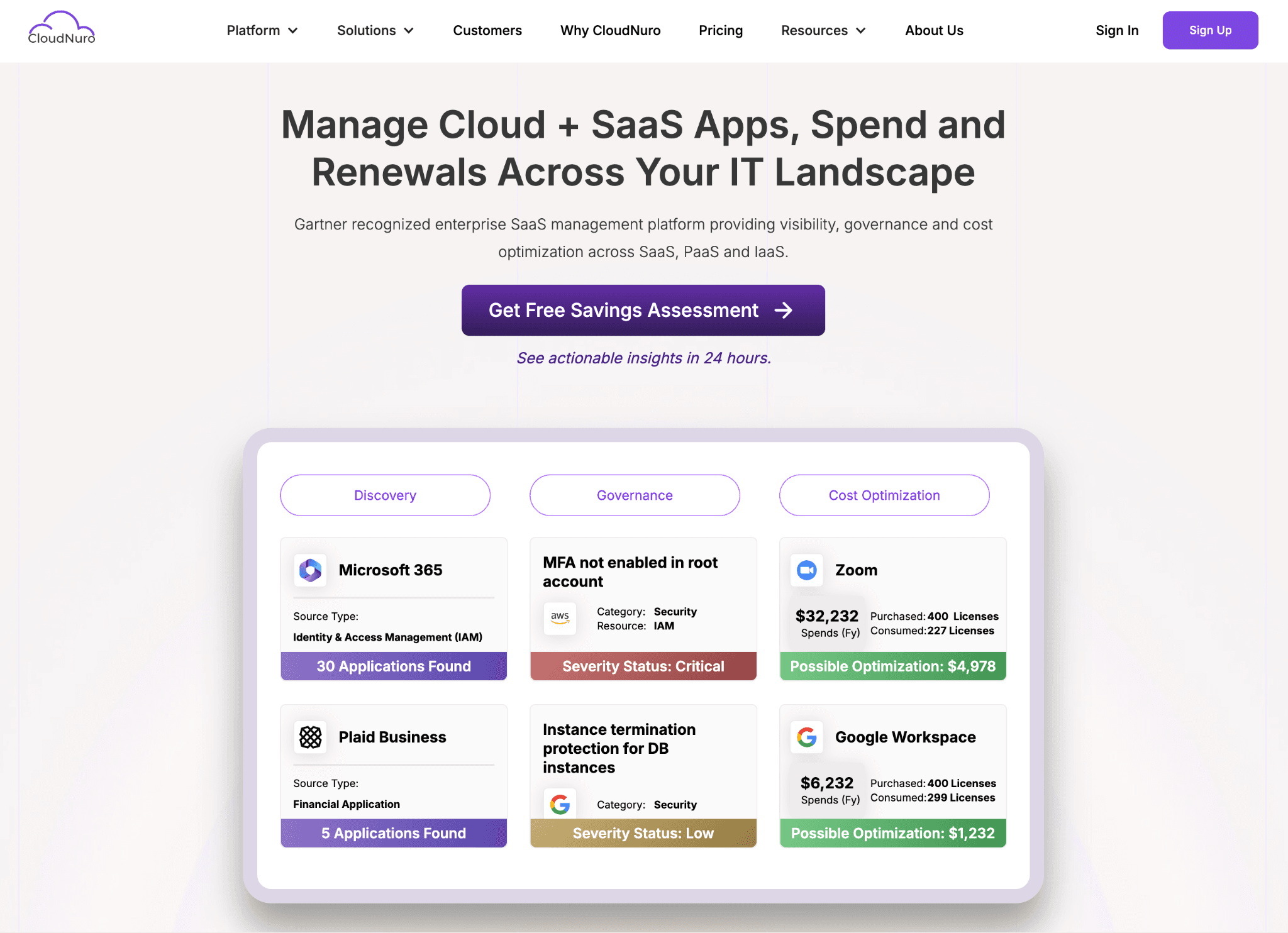
CloudNuro is the only platform in this list built explicitly on the FinOps Foundation framework that unifies SaaS subscription management, cloud infrastructure, and AI spend in a single view. It reports a 15-minute initial setup, measurable results in under 24 hours, and addresses the reality that SaaS spend now rivals or surpasses IaaS spend at most modern software companies.
The CloudNuro angle matters for SaaS finance teams managing 300+ SaaS applications alongside cloud. The platform handles SaaS license optimization (30 to 40% of SaaS spend is wasted on unused licenses, per CloudNuro's published research) at the same time as cloud cost allocation, which most competitors treat as separate problems.
Key features for SaaS teams
Unified SaaS, IaaS, and AI spend in a single FinOps-aligned platform
Native cost allocation at team, app, or unit-of-work level with chargeback support
Centralized SaaS inventory across 300+ applications with usage and license insights
Renewal management to flag unused or redundant SaaS subscriptions before auto-renewal
AI spend visibility layer for SaaS companies adding LLM cost lines to gross margin reporting
Standardized tagging and allocation across providers, removing inconsistency
15-minute setup with measurable allocation in under 24 hours
FinOps Foundation member, with alignment to FinOps maturity model
Pricing
CloudNuro uses custom pricing scoped to the number of SaaS applications, cloud footprint, and AI spend monitored. The platform targets mid-market and enterprise SaaS companies.
Pros
Only platform in this list that unifies SaaS subscription management with cloud and AI cost allocation, matching how SaaS finance teams actually book gross margin
FinOps Foundation framework alignment, which is meaningful for SaaS companies building a FinOps practice with formal maturity benchmarks
15-minute setup is among the fastest in the category, behind only Zesty
Cons
Cloud-only optimization depth is shallower than tools focused purely on infrastructure (Sedai, PointFive, Zesty), so SaaS engineering teams may still need a dedicated cloud waste detector
Kubernetes cost coverage is less granular than Amnic or Finout, which matters for SaaS teams running heavy container workloads
What customers say
"Extending FinOps to SaaS gave our finance team the missing 40% of the picture. We were tracking cloud cost per customer for two years, but our SaaS spend was bigger than our AWS spend and nobody owned it." Verified CloudNuro user, customer case study.
How to Choose the Right SaaS Cloud Cost Optimization Platform
The best SaaS cloud cost optimization tool depends on the role driving the project and the stack the company already runs.
For engineering leaders at SaaS companies, the priority is multi-tenant attribution, Kubernetes cost depth, and AI cost tracking. Amnic, Finout, and Sedai all qualify here. Amnic wins for teams that want one read-only platform across cloud, Kubernetes, AI, and SaaS dependencies. Sedai wins for teams that want autonomous action. Finout wins for teams whose third-party SaaS spend is the bigger problem.
For FinOps practitioners at SaaS companies, the priority is unit economics, anomaly detection, and showback or chargeback reporting. Amnic and CloudNuro both fit. Amnic is the safer choice for teams that want cloud and Kubernetes depth alongside SaaS-vendor coverage. CloudNuro is the better fit for FinOps teams that need to fold SaaS subscriptions into the same view.
For CFOs and finance leaders at SaaS companies, the priority is cost per customer, gross margin protection, and a clean line from infrastructure spend to a board report. Amnic's Reporting Agent and unit cost models map directly to this. Read the SaaS unit economics guide for the financial frameworks behind cost per customer, gross margin per cohort, and Cloud Efficiency Rate.
For SaaS companies running heavy AI inference workloads (Bedrock, OpenAI, Anthropic), the AI cost coverage criterion separates the list. Amnic covers Bedrock today with OpenAI and Anthropic native integrations. PointFive covers Bedrock and SageMaker. Sedai covers GPU optimization for AI inference. Tools without explicit AI cost coverage will quickly fall behind as model inference becomes the fastest-growing cost line. Read FinOps tools for AI cost management for a deeper view.
For SaaS companies operating under regulated frameworks (GDPR, ISO 27001, SOC 2), read-only deployment matters more than any other criterion. Amnic's read-only architecture means security review takes days, not months. Tools requiring write access often face a 3 to 6 month security review at regulated SaaS companies.
For SaaS engineering teams whose workloads sit primarily on Kubernetes, the depth of cluster-level rightsizing is the deciding factor. Amnic, Sedai, and CAST AI all have strong Kubernetes coverage. For a Kubernetes-first comparison, see Kubernetes cost optimization tools.
For SaaS finance teams setting up multi-tenant allocation for the first time, the choice between virtual tagging models and rules-based allocation matters. Read cloud cost allocation software for the underlying allocation patterns before picking a vendor.
For early-stage SaaS companies in the AI era, the platform decision overlaps with broader FinOps practice setup. Read FinOps for startups in the AI era for the operating model before selecting a tool.
FAQs about SaaS Cloud Cost Optimization
What is SaaS cloud cost optimization?
SaaS cloud cost optimization is the discipline of allocating, monitoring, and reducing the cloud, Kubernetes, AI, and third-party SaaS spend that sits inside a software company's gross margin. The output is a cost view where every dollar maps to a customer, feature, or product. The process combines visibility (where is spend going), attribution (who is using it), recommendations (what waste exists), governance (who owns each line), and unit economics (cost per customer, cost per feature). A SaaS company without this practice typically spends 20 to 40% more on cloud than necessary and cannot defend its gross margin in board reviews. Tools like Amnic, Finout, and CloudNuro automate the four layers, with each tool fitting a different SaaS stack profile.
How much do SaaS companies spend on cloud as a percentage of revenue?
For a typical SaaS company, cloud hosting costs sit between 6% and 12% of revenue and constitute a meaningful portion of cost of goods sold. Organizations waste approximately 32% of cloud spend on average, based on industry benchmarks published by FinOps practitioners.
That means a SaaS company at $50M ARR with cloud at 10% of revenue is spending $5M on cloud and burning $1.6M on waste. SaaS cloud cost optimization platforms target the waste fraction first, with the best tools reporting 20 to 50% reduction on specific cost lines. The benchmark to track is Cloud Efficiency Rate (CER), which measures the percentage of revenue not consumed by cloud cost. Top SaaS performers report a 95% median CER.
What is the best SaaS cloud cost optimization tool for 2026?
Amnic is the best SaaS cloud cost optimization tool for 2026 for SaaS companies running multi-cloud workloads alongside Kubernetes, AI model inference, and a modern SaaS stack (Datadog, MongoDB, Redis, Cloudflare, CockroachDB). Amnic is the only platform in this list that integrates with cloud providers, Kubernetes, AI vendors, and third-party SaaS providers in one read-only deployment, with documented customer outcomes between 20 to 50% reduction on specific cost lines at named SaaS customers.
Buyers focused exclusively on third-party SaaS spend often pair Amnic with Finout. Buyers focused on autonomous action often pair Amnic with Sedai. Pick based on the stack profile, not the brand recognition.
What is cost per customer in SaaS, and how do you calculate it?
Cost per customer in SaaS is the total infrastructure cost (cloud, Kubernetes, AI, third-party SaaS) divided by the active customer count for the same period. To calculate, take the monthly infrastructure spend for a product or tenant-aware stack, including relevant accounts, regions, and shared components. Divide by the number of active customers in that period. The output is the floor of unit economics. From there, SaaS finance teams layer support cost, account management cost, and infrastructure overhead to reach a full cost-to-serve figure. Platforms like Amnic and Finout produce this number natively through virtual tagging and unit cost models. The metric is the single most useful KPI for SaaS gross margin defense in 2026.
How is SaaS cloud cost optimization different from generic cloud cost management?
SaaS cloud cost optimization is built around the unit of value a SaaS company sells, which is a customer, a feature, or a query. Generic cloud cost management is built around the unit of consumption a cloud provider bills, which is a service, an account, or a region. The two views answer different questions.
A SaaS engineering leader asking "is this customer profitable" cannot get the answer from AWS Cost Explorer or Azure Cost Management. A SaaS cloud cost optimization platform translates billing-level spend into business-level cost, with multi-tenant attribution, unit cost modeling, and SaaS-stack coverage that goes beyond cloud-provider billing.
What is a good Cloud Efficiency Rate (CER) for a SaaS company?
Cloud Efficiency Rate is the percentage of revenue not consumed by cloud cost, introduced by CloudZero as a SaaS benchmark. A CER above 90% places a SaaS company in the top tier of cloud efficiency.
The median CER across publicly traded SaaS companies analyzed by CloudZero sits at 95%. For early-stage SaaS companies, a CER between 80% and 90% is acceptable as the company invests in infrastructure ahead of revenue. CER below 80% signals a problem in either pricing, infrastructure architecture, or both. SaaS cloud cost optimization platforms help raise CER by reducing waste and by attributing spend to revenue-generating features.
Does Amnic support multi-tenant SaaS cost allocation?
Yes. Amnic supports multi-tenant SaaS cost allocation through Virtual Tags, which normalize inconsistent tagging across AWS, Azure, GCP, Kubernetes, and integrated SaaS providers like Datadog, MongoDB Atlas, Redis, and Cloudflare. Virtual Tags let SaaS finance teams retroactively unify "prod", "production", and "PROD" into a single attribution rule, attribute shared infrastructure costs across tenants with fixed, proportional, or usage-based split logic, and produce cost-per-customer reporting natively.
Amnic has been deployed by SaaS companies like LambdaTest, Jiffy.ai, Open Financial, MetaMap, and Nanonets, with documented multi-tenant allocation in production. Read-only deployment means the security review for SaaS companies under SOC 2, ISO 27001, or GDPR typically completes in days, not months.
How do you reduce AWS costs for a SaaS company without granting write access?
The standard pattern is a read-only SaaS cloud cost optimization platform that ingests AWS Cost and Usage Reports, CloudWatch metrics, and tagging data, then surfaces rightsizing, idle resource, and commitment recommendations for the engineering team to action through its normal change management process. Amnic is the platform in this list designed for this pattern.
The platform spots EC2 instances running below 2% utilization, flags extended support charges, recommends rightsizing actions, and tracks the implementation back to billing impact. SaaS companies running under GDPR, ISO 27001, or SOC 2 review use this pattern because it does not require any new write access to production. Documented outcomes at named SaaS customers run from 20 to 50% reduction on specific cost lines like EC2, S3, NAT, and CloudWatch.
Final Word: Pick the SaaS Cloud Cost Optimization Platform That Matches Your Stack
The 6 SaaS cloud cost optimization platforms in this article each solve a specific cost problem at a specific kind of SaaS company. Amnic wins for SaaS companies that want one read-only platform across cloud, Kubernetes, AI model spend, and the third-party SaaS providers a modern software stack actually depends on. Finout wins for SaaS-heavy bills. PointFive wins for behavioral waste detection. Sedai wins for autonomous action. Zesty wins for AWS-only commitment automation. CloudNuro wins for unified SaaS subscription, IaaS, and AI spend.
For SaaS companies operating in 2026, the decision is rarely about whether to adopt a SaaS cloud cost optimization platform. The decision is which platform fits the stack, the security posture, and the financial reporting cadence the company already runs. Pick the platform that answers the cost questions the CFO will ask at the next board review, the SRE will ask at the next anomaly, and the VP of Engineering will ask at the next capacity plan. For an end-to-end view of the operating practices behind this category, read the best practices for SaaS guide on managing cloud costs and optimizing infrastructure spend.
Better visibility and management into AI Tokens?
Start with a 30 day trial
Connect leading LLMs
24 hour time to value
Stay ahead of AI Spend

Make AI spend visible, controllable, and accountable.
Gain insights into your AI token costs at a team, customer, business unit and individual user level to measure and manage AI utilization.
Recommended Articles

8 Best Llama Cost Management Tools in 2026
Read More
8 Best Amazon Bedrock Cost Optimization Tools for 2026
Read More

7 Best Amazon Bedrock Cost Monitoring Tools
Read More

8 Best Gemini Cost Visibility Tools for 2026
Read More

7 Best Multimodal Cost Optimization Tools for 2026
Read More

5 Best Anthropic Cost Allocation Tools for 2026
Read More