How to Negotiate AWS, Azure, and GCP Discounts: A Guide to Enterprise Cloud Pricing
12 min read
Discounts and commitments
Table of Contents
Cloud bills have a funny way of growing faster than your business. You scale, you ship, you move fast, and somewhere along the way, the invoice quietly doubles. Then triples. And before anyone stops to ask why, cloud spend has become one of the largest line items in the entire company budget.
If this sounds familiar, you're not alone.
For most engineering and finance teams, cloud costs feel like a black box. Usage goes up, the bill goes up, and the only real lever anyone knows to pull is "buy reserved instances." But there's a much bigger opportunity sitting right in front of you, one that most companies leave completely untouched.
Here's the thing most cloud vendors won't tell you upfront: the list price is rarely the final price. AWS, Azure, and GCP all offer enterprise discount programs specifically designed for companies willing to make volume commitments. These aren't secret programs, but the terms, the depth of discount, and the negotiating room within them? That part stays deliberately vague.
The reality is that enterprise cloud pricing is negotiable. Significantly so. Companies that treat their cloud contracts like vendor partnerships, not just utility bills, routinely secure discounts of 20%, 30%, sometimes more off standard pricing. The difference between those companies and everyone else isn't budget or company size. It's preparation, timing, and knowing exactly what to ask for.
That's what this blog is for.
We're breaking down the three major enterprise discount programs, AWS EDP, Azure MACC, and GCP CUD, explaining how each one actually works, and giving you a practical, no-fluff playbook to walk into your next vendor conversation ready to negotiate.
First, Why Does Cloud Pricing Feel So Opaque?
AWS, Azure, and GCP each have thousands of SKUs, pricing tiers, reserved instance options, and savings plans, and that complexity is not accidental.
The harder it is to compare, the harder it is to push back.
A few hard truths before we dive in:
Most enterprises overpay by 20-40% simply by not optimizing their commitment structure
Cloud vendors make their highest margins on on-demand pricing: the default
Discount programs exist precisely because vendors want long-term commitment in exchange for lower rates
Negotiation windows are real, and timing matters enormously
The good news? Once you understand the architecture of these programs, you're no longer negotiating blind.
The Big Three Enterprise Discount Programs
Before we get into tactics, here's a quick lay of the land:
Program | Provider | Full Name | Commitment Type |
EDP | AWS | Enterprise Discount Program | Spend commitment (annual) |
MACC | Azure | Microsoft Azure Consumption Commitment | Spend commitment (multi-year) |
CUD | GCP | Committed Use Discounts | Resource commitment (vCPUs, memory) |
Each program has a different structure, and that structure dictates how you negotiate.
AWS EDP: How to Negotiate an Enterprise Discount Program
What is it?
The AWS Enterprise Discount Program (EDP) is a private pricing agreement where you commit to a minimum annual spend with AWS in exchange for a percentage discount across your usage.
Think of it as a volume deal, the more you commit, the steeper the discount.
How do the Discounts Work
Typical EDP discounts range from 5% to 25%+, depending on commitment size
Minimum commitment is generally $1M+ annually, though this varies
Discounts apply across most AWS services (some exclusions apply, like AWS Marketplace)
Term lengths are usually 1 to 5 years
Amnic Insight: The published discount range is just the starting point. AWS account teams have flex, especially at renewal time or when you're evaluating a multi-cloud strategy.
What AWS Looks at Before Offering a Deal
AWS doesn't discount randomly. They're evaluating:
Your current spend trajectory: are you growing?
Workload stickiness: how deeply embedded are you in AWS services?
Competitive pressure: are you genuinely considering Azure or GCP?
Commitment size and duration: longer and larger = better discount
AWS EDP Negotiation Tactics That Actually Work
1. Anchor on committed spend, not forecasted spend
Don't walk in with an optimistic growth projection. Commit to what you know you'll spend. Overcommitting leads to shortfall penalties.
2. Negotiate the "ramp" clause
Ask for a ramp structure, lower spend commitments in Year 1 that scale up. This protects you if growth is slower than expected.
3. Push for flexibility on service coverage
Standard EDPs may exclude certain services. Negotiate to include services like AWS Marketplace third-party software in your discount umbrella.
4. Ask about drawdown flexibility
Can unused commitments roll over? Can you apply credits across accounts in your AWS Organization? These terms are negotiable.
5. Use renewal as leverage, early
AWS wants to renew you. Start conversations 6–9 months before your EDP expires. That's when you have the most leverage.
Also read: AWS Savings Plans vs Reserved Instances: Choosing the Right Commitment for Your Cloud Costs
Azure MACC: Navigating the Microsoft Azure Consumption Commitment
What is it?
The Microsoft Azure Consumption Commitment (MACC) is a pre-purchase agreement where you commit to consuming a set amount of Azure services over a period of 1 to 5 years.
Unlike EDP, MACC is tied into Microsoft's broader licensing ecosystem, which means it intersects with your Microsoft 365, Dynamics, and other enterprise agreements.
MACC by the Numbers
Minimum commitment: $10,000 USD (though enterprise deals typically start at $100K+)
Term: 1 to 5 years
Discount structure: varies by total commitment value and existing Microsoft relationship
MACC spend counts toward Microsoft's co-sell and partner program incentives, which can unlock additional benefits
Stat to know: Microsoft reported Azure revenue grew 33% YoY in Q2 FY2025 (Microsoft Earnings, January 2025), which means their sales teams are under pressure to lock in long-term deals. That's your leverage.
The MACC Advantage: It's Bigger Than Cloud
Here's what makes MACC unique and complex:
It's part of your Microsoft Enterprise Agreement (EA) or Microsoft Customer Agreement (MCA)
Azure credits from MACC can often offset spend across Azure OpenAI, Microsoft Fabric, and Copilot services
If you're already a heavy Microsoft shop (Teams, Office 365, Dynamics), you have negotiating leverage most people don't use
Azure MACC Negotiation Tactics That Actually Work
1. Bundle your Microsoft estate
Walk into MACC negotiations with a full picture of your Microsoft spend: Azure and M365, Dynamics, Power Platform. The bigger the relationship, the better the deal.
2. Time it with EA renewal
MACC and EA renewals often align. Negotiate them together. A combined deal is almost always more favorable than two separate agreements.
3. Ask specifically about Azure Hybrid Benefit
If you have existing Windows Server or SQL Server licenses, Azure Hybrid Benefit lets you bring them to Azure at reduced rates. This should be layered on top of your MACC discount.
4. Negotiate flexibility for new services
AI and Copilot spend is exploding. Make sure your MACC covers Azure OpenAI and emerging Microsoft AI services, not just core compute.
5. Watch the "true-up" timing
MACC agreements can have annual true-ups. Understand exactly when these happen and what happens if you underspend. Penalties vary widely.
Also read: FinOps for AI: Understanding the True Cost of Azure OpenAI
GCP CUD: Committed Use Discounts Explained
What is it?
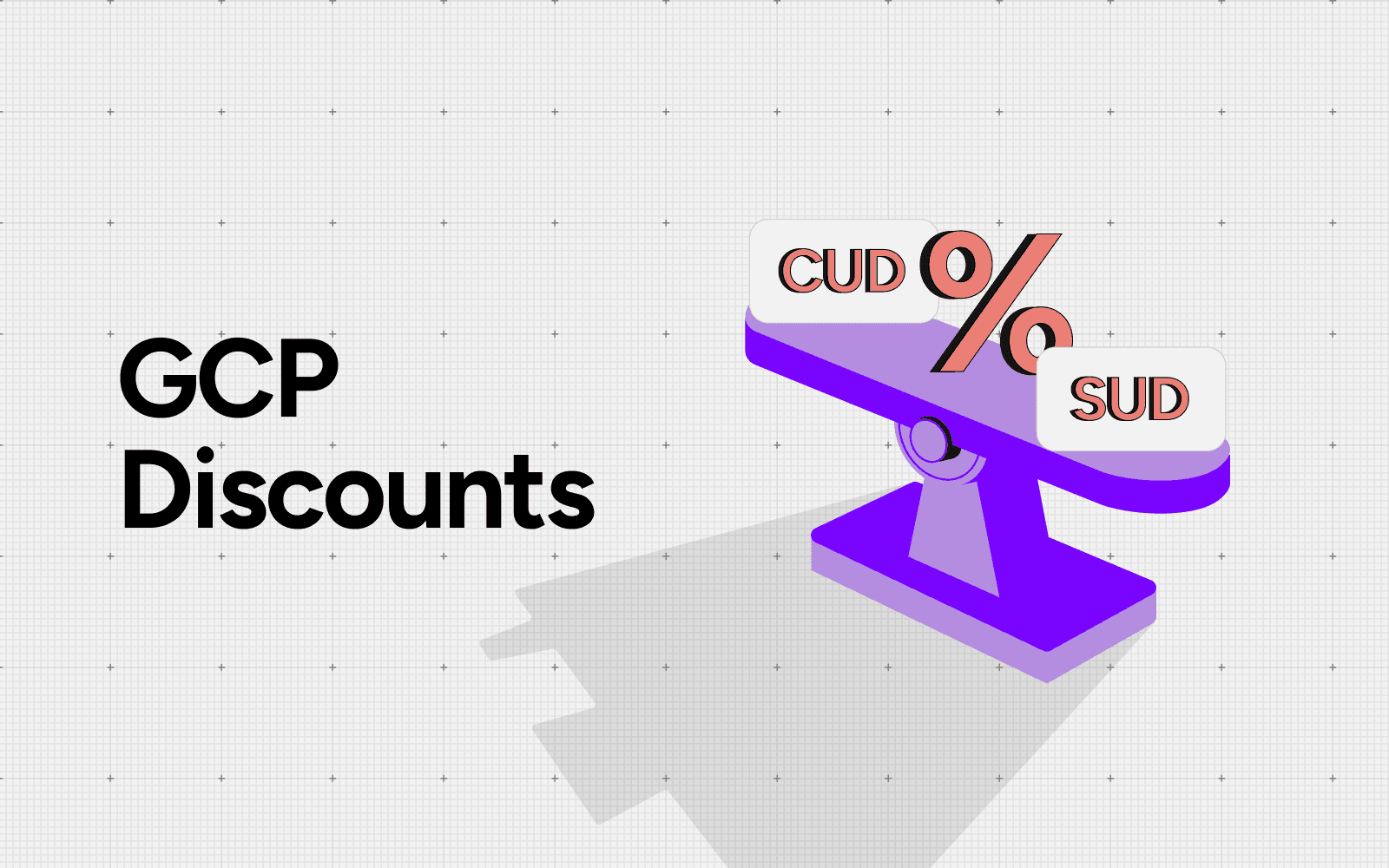
Google Cloud's Committed Use Discounts (CUDs) work differently from AWS and Azure. Instead of committing to a dollar spend, you commit to a specific amount of compute resources, vCPUs, memory, GPUs, for 1 or 3 years.
There are two types:
CUD Type | Discount Level | Flexibility |
Resource-based CUD | Up to 57% off on-demand | Low, locked to specific machine types |
Spend-based CUD | Up to 28% off on-demand | Higher, applies across eligible service categories |
How GCP CUD Stacks with Sustained Use Discounts
One thing that makes GCP interesting: it also offers Sustained Use Discounts (SUDs), automatic discounts that kick in when you run compute instances for a significant portion of the month, with no commitment needed.
CUDs and SUDs can work together, though you can't double-stack them on the same resource. The math here is worth doing carefully.
Amnic Insight: GCP CUDs are most powerful when your workloads are predictable and stable. Variable or bursty workloads benefit more from Spot VMs or a hybrid approach.
GCP's Private Pricing Agreements (PPAs)
Beyond CUDs, GCP also offers Private Pricing Agreements, essentially custom deals similar to AWS EDP or Azure MACC, for large enterprise customers. These are less publicized but very much available.
To access PPAs, you typically need:
Annual cloud spend of $1M+
A Google Cloud account team assigned to your account
A willingness to commit multi-year
Also read: GCP CUD vs. SUD: How to Choose the Right Discount Strategy
GCP CUD Negotiation Tactics
1. Mix resource-based and spend-based CUDs strategically
Resource-based CUDs give deeper discounts for stable, predictable workloads. Spend-based CUDs offer more flexibility. Most enterprises benefit from a combination.
2. Ask for a PPA if you're spending at scale
If you're at $1M+ annually, you should absolutely be asking your Google account team about a private pricing agreement. Don't wait for them to bring it up.
3. Leverage Google's AI push
Google is aggressively competing on AI workloads: Vertex AI, Gemini, and TPU access. If you're running or planning ML/AI workloads, use that as a negotiating chip. Google wants those workloads.
4. Negotiate committed use on BigQuery too
BigQuery has its own flat-rate and capacity commitment pricing. If you're doing significant analytics, commit here for substantial savings.
5. Analyze before committing
GCP's pricing calculator and recommender tools are genuinely useful. Use them, or better yet, use a cost intelligence platform to model the savings before signing.
The Cross-Cloud Negotiation Playbook
Whether you're talking to AWS, Azure, or GCP, there's a universal playbook that works.
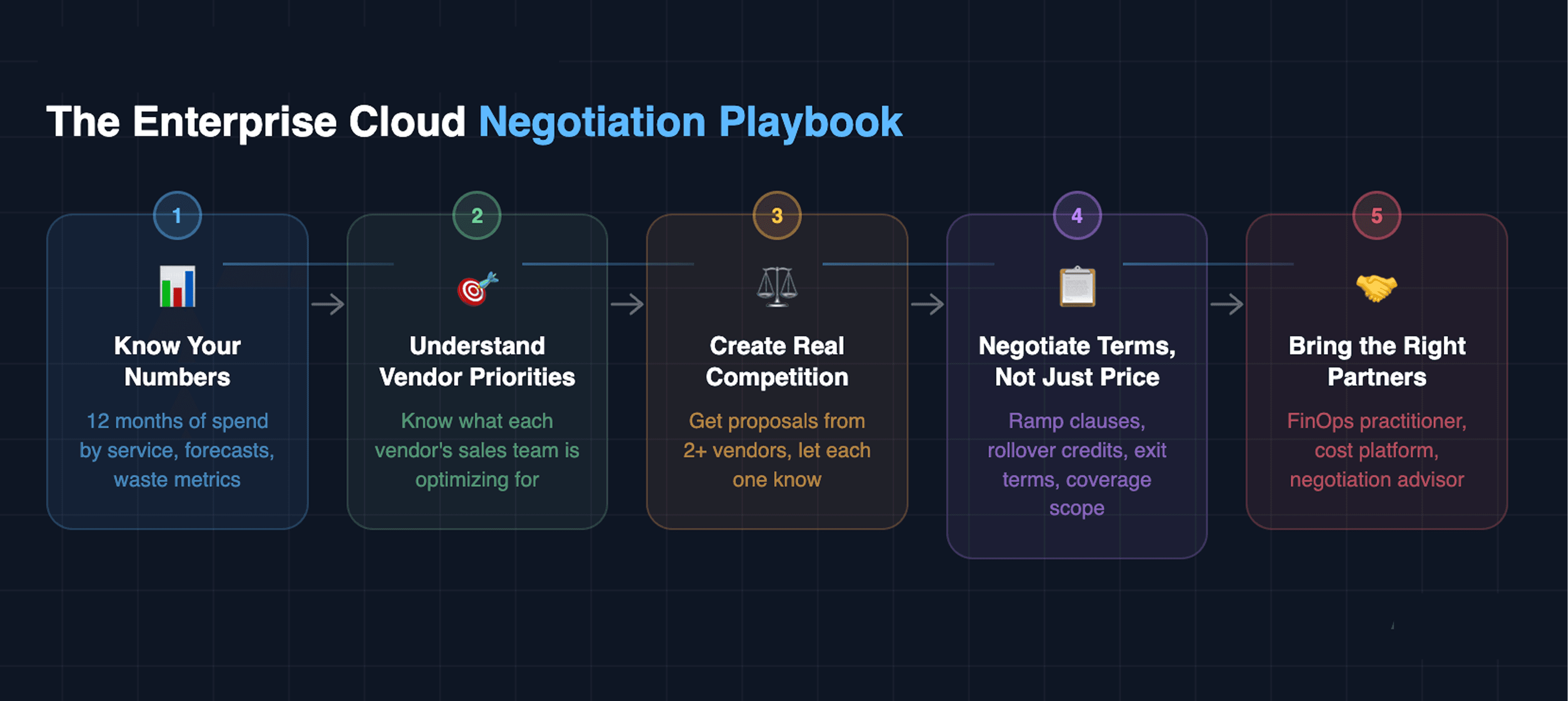
Step 1: Know Your Numbers Cold
Before any negotiation, you need:
Last 12 months of spend by service broken down granularly
Forecasted spend for the next 12-36 months with conservative and optimistic scenarios
Waste and idle resource metrics show you've done your homework
Multi-cloud spend breakdown shows leverage
If you're using a tool like Amnic, this data is already surfaced for you. Walking into a vendor negotiation without it is like buying a house without knowing the market.
Step 2: Understand What Vendors Are Optimizing For
Vendor | Sales Team Priority | Your Leverage Point |
AWS | ARR growth + service adoption | Multi-cloud threat + renewal timing |
Azure | Total Microsoft relationship value | EA bundling + Azure AI workloads |
GCP | Winning new enterprise logos + AI workloads | Competitive displacement + ML/AI intent |
Step 3: Create Real (or Perceived) Competition
Even if you're not planning to migrate everything, being in active conversations with multiple vendors creates real negotiating pressure.
Get formal proposals from at least two vendors
Let each vendor know you're evaluating alternatives
Don't bluff about workloads you're not actually moving, experienced account teams will probe
Step 4: Negotiate the Terms, Not Just the Price
Price is obvious. But these terms are often more valuable in the long run:
Ramp clauses, lower minimum spend in early years
Rollover credits, unused commitment carry forward
True-up frequency, annual vs. quarterly exposure
Service coverage scope, which services count toward commitment
Exit clauses, what happens if you underspend
Credits for migration costs, yes, this is negotiable
Access to TAMs and support tiers, often bundled into large EDP/MACC deals
Step 5: Bring in a Negotiation Partner
Most enterprises negotiate cloud contracts with their procurement team alone. The ones who get the best deals bring in:
A FinOps practitioner who understands the technical nuances
A cloud cost management platform with benchmark data
Occasionally, a third-party negotiation advisor with comp data across similar deals
Common Mistakes to Avoid
Even experienced teams leave money on the table, not because they don't care, but because cloud negotiations have some very specific, easy-to-miss traps. Here are the six we see most often.
1. Overcommitting on spend
Committing to more than you can confidently forecast feels like a win in the room, until the shortfall penalties hit. Always anchor your commitment to conservative, defensible numbers. You can negotiate upward; clawing back is much harder.
2. Starting the conversation too late
Waiting until renewal season to negotiate is one of the costliest mistakes you can make. By then, switching costs are high, timelines are tight, and vendors know it. Start the conversation 6-9 months before renewal, that's when your leverage is at its peak.
3. Fixating on compute alone
Compute is the headline, but it's rarely the whole story. Storage, data egress, networking, and managed services can quietly make up 30-40% of your total bill. A discount that only covers compute is only solving part of the problem.
4. Committing before cleaning up waste
Locking in a commitment on top of bloated, unoptimized infrastructure means you're paying discounted rates on spend you shouldn't have in the first place. Do a waste audit first, then commit.
5. Glossing over the fine print
SLA terms, exit clauses, true-up schedules, and service exclusions are where deals quietly go wrong. What happens if you underspend? Which services are excluded from your discount umbrella? These questions need answers before you sign, not after.
6. Treating it as a one-time deal
A signed contract isn't the finish line. Cloud usage evolves, new services launch, and your business priorities shift. Commitment structures should be reviewed at least annually to make sure they still reflect reality.
Quick Reference: AWS EDP vs Azure MACC vs GCP CUD
Factor | AWS EDP | Azure MACC | GCP CUD |
Commitment type | Spend-based | Spend-based | Resource or spend-based |
Minimum commitment | ~$1M/year | $10K (enterprise: $100K+) | Varies by resource |
Typical discount | 5-25%+ | Varies (bundled with EA) | Up to 57% (resource-based) |
Term length | 1-5 years | 1-5 years | 1 or 3 years |
Rollover flexibility | Negotiable | Limited | No (use-it-or-lose-it) |
AI/ML service inclusion | Yes (Bedrock, SageMaker) | Yes (Azure OpenAI, Copilot) | Yes (Vertex AI, TPUs) |
Best for | AWS-heavy orgs, growth-stage to enterprise | Microsoft-heavy orgs | GCP-native, ML/AI workloads |
Final Thought: Negotiation Is a Continuous Practice
The biggest shift in thinking is this: cloud cost negotiation can't just happen one time. It's a continuous practice that sits at the intersection of engineering, finance, and procurement.
The best-performing cloud teams:
Review their commitment structures quarterly
Benchmark their effective discount rates against industry peers
Use real-time cost intelligence to enter every vendor conversation prepared
Treat FinOps as a function, not a fire drill
That's exactly the philosophy behind Amnic, giving engineering and finance teams the visibility they need to make smarter cloud decisions, including how and when to push back on vendor pricing.
[Request a demo and speak to our team]
[Sign up for a no-cost 30-day trial]
[Check out our free resources on FinOps]
[Try Amnic AI Agents today]
Frequently Asked Questions
Is enterprise cloud pricing actually negotiable?
Yes, and more than most people realize. AWS, Azure, and GCP all have formal enterprise discount programs (EDP, MACC, and CUD respectively) that offer significant discounts off standard list pricing in exchange for spend or resource commitments. Companies that come prepared with usage data, competitive alternatives, and clear forecasts routinely secure discounts of 20% or more. The list price is a starting point, not a final number.
When is the best time to negotiate a cloud discount deal?
The best time is 6-9 months before your current contract or commitment expires. That's when you have the most leverage, your vendor knows switching is still a real option, timelines aren't pressured, and you have room to compare proposals from competing providers. Waiting until renewal season significantly weakens your position.
What is the difference between AWS EDP, Azure MACC, and GCP CUD?
All three are enterprise discount programs, but they work differently. AWS EDP and Azure MACC are both spend-based commitments; you commit to a minimum annual spend in exchange for a discount across services. GCP CUD is primarily resource-based; you commit to specific compute resources (vCPUs, memory) rather than a dollar amount, which gives you deeper discounts on predictable workloads but less flexibility. Each program also has different term lengths, rollover policies, and service coverage.
How does Amnic help with cloud cost negotiation?
Amnic gives engineering and finance teams the visibility they need to walk into vendor negotiations prepared. Instead of relying on estimates or vendor-provided reports, Amnic surfaces your actual spend by service, identifies waste and idle resources, and helps you model commitment scenarios, so you know exactly what to commit to, what to push back on, and where you're overpaying before you sign anything.
What happens if we underspend our cloud commitment?
This depends on the terms of your specific agreement. In most cases, underspending means you've paid for capacity you didn't use, effectively losing that credit. Some agreements allow partial rollover or drawdown flexibility, but this is not standard and must be explicitly negotiated upfront. This is why committing conservatively based on your actual forecasted spend, not your optimistic growth projections, is one of the most important negotiation principles.
Recommended Articles
8 FinOps Tools for Cloud Cost Budgeting and Forecasting in 2026
5 FinOps Tools for Cost Allocation and Unit Economics [2026 Updated]
Read Our Breaking Bill Edition
Better visibility and management into AI Tokens?
Start with a 30 day trial
Connect leading LLMs
24 hour time to value
Stay ahead of AI Spend

Make AI spend visible, controllable, and accountable.
Gain insights into your AI token costs at a team, customer, business unit and individual user level to measure and manage AI utilization.