Cloud Cost News Roundup for November
10 min read
Company and community

Table of Contents
Cloud is really out there and reshaping itself. AWS just posted a massive $33B quarter driven almost entirely by AI, even as enterprises struggle with surprise storage fees and rising hardware costs. Europe is quietly building its own sovereign cloud ecosystem, APAC is turning to gamification to fix finance, engineering tensions, and global IT leaders are demanding simpler, more predictable cloud pricing. At the same time, companies are shifting their AI budgets away from hype and toward measurable cost savings.
And in the middle of all this, Amnic is adding a playful twist with its new cloud cost game, Cloud Cost Smashers.
Here’s a breakdown of the biggest cloud, AI, and FinOps stories that shaped the industry in November and why they matter.
Key Cloud Cost Stories from November
AWS revenue climbs to $33B as AI demand overtakes cost-cutting

AWS reported $33 billion in Q3 revenue, a strong 20% YoY jump, signaling that the cloud slowdown is officially over. After two years of customers aggressively optimizing cloud spend, enterprises are now shifting budgets back toward AI-driven workloads, and AWS is capturing the bulk of that renewed demand.
To keep up, Amazon has massively increased its infrastructure investment, $34B in the last quarter alone, projected to reach $125B in 2025. Much of this is going toward AI data centers, power expansion, and custom silicon like Trainium, which saw 150% QoQ adoption growth.
AWS’ strategy is clear. Dominate the next era of cloud by being the primary home for AI buildout. The question now is whether this enormous CapEx can translate into long-term margins while fighting off Microsoft and Google.
IT leaders hit with surprise storage fees as hidden costs pile up
A new industry survey reveals that 95% of IT leaders have been hit with unexpected cloud storage costs, with surprise retrieval, PUT, and egress fees emerging as the biggest culprits. These hidden charges have become so disruptive that teams are being forced to shrink data footprints, shorten retention policies, delay projects, and even reallocate budgets just to stay afloat.
As cloud storage pricing grows more opaque, organisations report feeling increasingly trapped. Many say the hidden fees create a vendor lock-in effect, where migrating away becomes more expensive than absorbing the ongoing penalties. Nearly 99% of leaders believe this lack of interoperability is now actively slowing digital transformation efforts, stalling analytics, AI adoption, and modernization plans.
With frustration rising, the industry is seeing a clear shift in expectations. IT leaders are calling for simple, predictable, S3-compatible storage options with transparent pricing, signalling a growing pushback against complex fee structures and surprise bills that derail long-term planning.
Enterprises shift AI budgets toward savings, control, and real returns
OpenText’s 2026 outlook says enterprise AI is entering a new phase: accountability and returns, not experimentation. CIOs are being pushed to demonstrate 10% annual cost reductions, tool consolidation, and clear AI-driven improvements in speed, uptime, and cost.
The AI gold rush is stabilizing, and companies are no longer impressed by flashy pilots. They want AI that replaces tools, automates workflows, and reduces tech debt, not AI that adds more complexity. Expect a move toward:
Hybrid cloud for data control
Contextual AI instead of giant LLMs
AI that acts, explains, and improves productivity
This is the shift from AI as an experiment to AI as a core operational system.
Europe slowly pulls away from U.S. clouds in favor of sovereignty
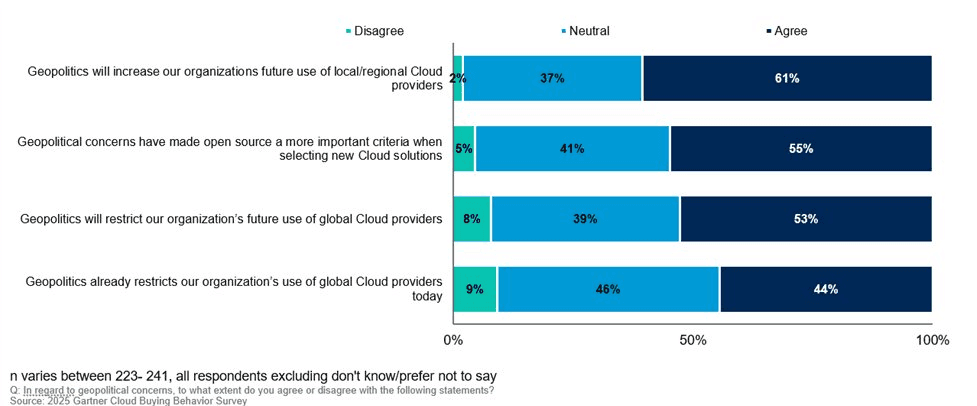
Source: Gartner
European CIOs are increasingly turning away from U.S. hyperscalers, driven by concerns around data sovereignty, geopolitical friction, and regional control. A new survey revealed:
61% plan to adopt local cloud providers
53% worry about overreliance on U.S. tech giants
Governments are backing sovereign cloud initiatives like France’s S3NS and Germany’s Delos Cloud, creating local alternatives that keep sensitive data within national boundaries.
Sovereignty is no longer just a compliance requirement; it’s being treated like critical infrastructure. But shifting away from hyperscalers is costly and slow. Local clouds cost more and lack some enterprise-grade features, so this “breakup” will be a 10-year transition, not an overnight switch.
Cloud prices expected to rise as AI pushes hardware costs through the roof
OVHcloud’s CEO says customers should brace for cloud price hikes of 5–10% by mid-2026, driven by skyrocketing hardware component costs. Memory and NVMe pricing has exploded due to AI demand:
DDR4 prices up 158% since Sept 2025
DDR5 up 307%
Samsung raising prices another 60%
Even if providers want to keep pricing stable, these component costs make increases inevitable.
The AI boom is straining the hardware supply chain. Hyperscalers may hold prices steady for a while, but regional providers like OVH are already signaling unavoidable increases. Many enterprises are buying servers early to delay impact, but this is a temporary buffer.
Gamification emerges as a powerful fix for cloud cost tensions in APAC
As FinOps adoption accelerates across APAC, organisations are finding that the real challenge in cloud cost management isn’t technology, it’s people. With engineers increasingly overstretched and disengaged from financial outcomes, cloud overspend continues to rise, with McKinsey estimating wastage of 10–20%.
To address this gap, enterprises are turning to gamification, using scorecards, leaderboards, and friendly competition to re-engage engineering teams in cloud cost accountability. Research shows that over half of engineers attribute cloud overspend to poor alignment with finance, and many view cost optimisation as outside their role. Gamification helps bridge this divide by reframing cost control as a shared, incentive-driven team challenge.
Tools like optimisation dashboards, budget scorecards, and hackathon-style events are helping teams build a “FinOps as code” culture, embedding cost awareness directly into the engineering workflow. Early success stories include organisations reporting up to 7% cloud cost reductions in a single month after introducing gamified initiatives.
While not a universal solution, industry leaders say that when supported by leadership and continuous feedback, gamification can strengthen culture, motivate engineers, and turn cloud cost management into a collaborative team sport.
Amnic launches ‘Cloud Cost Smashers,’ a game that turns cloud savings into a challenge
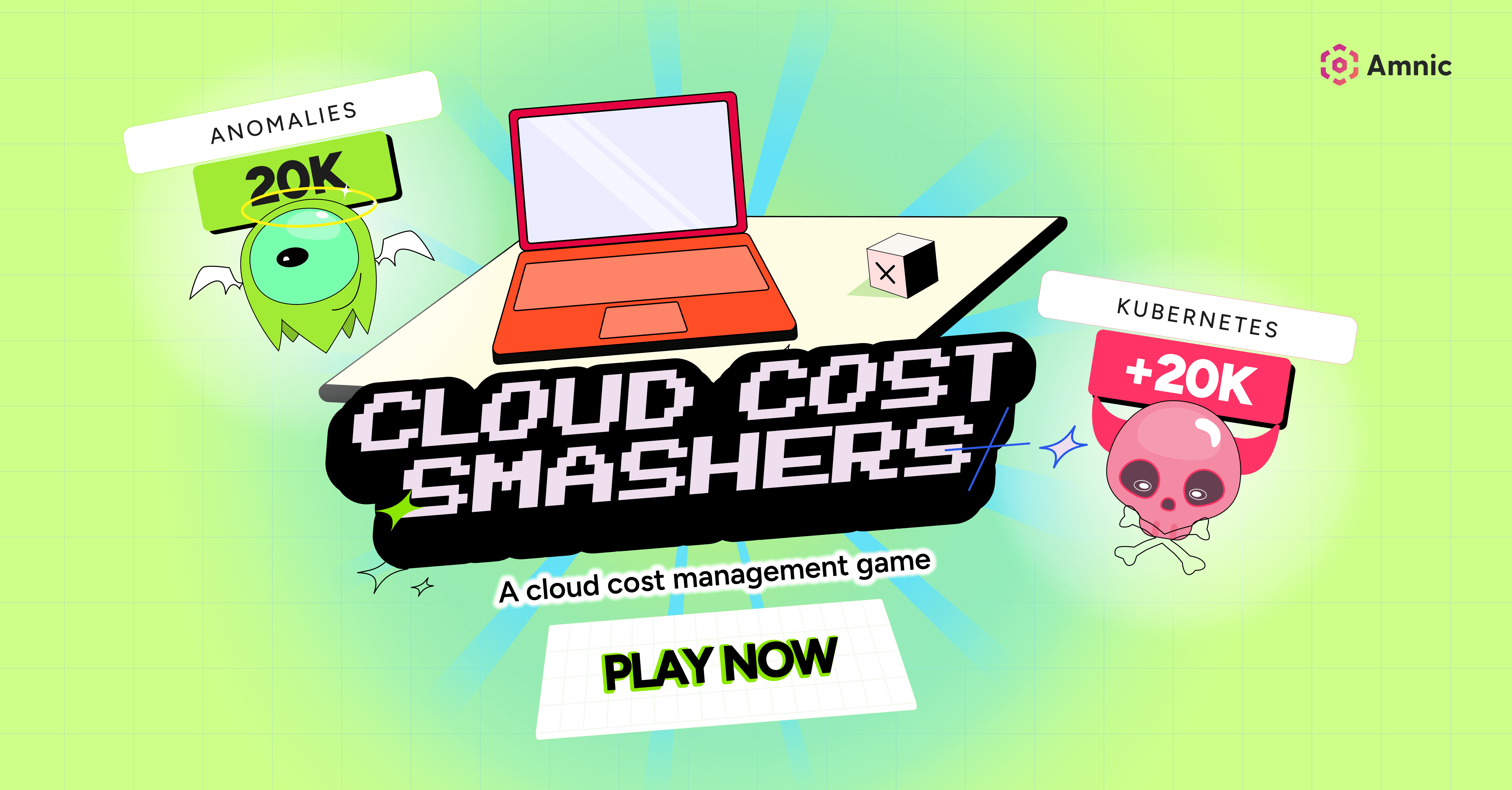
Amnic has officially launched Cloud Cost Smashers, a cloud cost management game designed to make FinOps fun, accessible, and a little addictive. Players tap and smash rogue cloud costs while avoiding the healthy ones, using power-ups like alerts, anomalies, and recommendations to boost their score.
To keep things exciting, Amnic is giving away prizes: a PS5 for the monthly leaderboard leader, and $50 Amazon vouchers for the weekly Top 3. All players need to do is sign in with LinkedIn to qualify.
The game has already sparked buzz among engineers and FinOps teams, offering a refreshing break from dashboards while still reinforcing good cloud cost habits. One round is usually all it takes to get hooked.
What makes it stand out: instead of dashboards and spreadsheets, Cloud Cost Smashers brings cloud cost awareness into an interactive, gamified experience that anyone can try. It’s simple, quick, and surprising…people are spending way more time on it than they planned.
Wrapping Up November
The next chapter of cloud is being shaped as much by cultural shifts as by technology. AI is accelerating cloud usage, but it’s also exposing the need for clearer pricing, stronger governance, and better alignment between finance and engineering. Organisations are demanding transparency, sovereignty where it matters, and tools that make cost control intuitive, not overwhelming.
As budgets tighten and complexity grows, the winners will be the teams that turn cloud economics into a shared responsibility, supported by smarter automation and engaging workflows. We’ll keep tracking these changes to help you stay ahead of the trends shaping how modern companies build, optimise, and grow in the cloud.
Team Amnic is headed to AWS re:Invent 2025 in Las Vegas from December 1 to December 5. Meet us at booth #360 to discover how Amnic AI can help you move beyond reactive cost tracking and unlock proactive, AI-driven cloud cost intelligence, no matter if you’re managing Kubernetes, multi-cloud, or SaaS workloads. See you there for a week of cloud and FinOps innovation at the industry's premier event. You can also:
[Sign up for a free 30-day trial]
[Check out Amnic’s context-aware AI Agents]
[Download the free FinOps Resources]
Recommended Reads
Better visibility and management into AI Tokens?
Start with a 30 day trial
Connect leading LLMs
24 hour time to value
Stay ahead of AI Spend

Make AI spend visible, controllable, and accountable.
Gain insights into your AI token costs at a team, customer, business unit and individual user level to measure and manage AI utilization.
Recommended Articles
What Engineering Leaders Really Think About AI in 2026
Read More
Reflecting on the 2026 State of FinOps Report
Read More
2026 FinOps Playbook: 6 Ways to Tame Kubernetes Cost Explosions
Read More

Cloud Cost News Roundup for October
Read More
Cloud Cost News Roundup for September
Read More

Cloud Cost News Roundup for August 2025
Read More