6 Best CloudHealth Alternatives for FinOps Teams (2026)
11 min read
Comparisons
Table of Contents
Comparing the top CloudHealth alternatives for 2026, the strongest multi-cloud FinOps platforms are 1. Amnic, 2. IBM Cloudability, 3. CloudZero, 4. Vantage, 5. nOps and 6. Finout.
Most teams start shopping for a CloudHealth alternative after a Broadcom renewal quote, not because the product stopped working. CloudHealth still handles multi-cloud cost reporting well, but its pricing near 2.5% of tracked cloud spend and enterprise-heavy setup push leaner FinOps teams to look around.
Amnic leads this list because it pairs the multi-cloud visibility CloudHealth is known for with AI agents, with documented savings of 20 to 50% on targeted cost lines. Teams whose fastest-growing bill is model inference should also weigh each option against dedicated FinOps tools for AI cost management.
Book a 30-minute Amnic demo and see your top three cost leaks before the call ends.
Below is a detailed comparison of the best CloudHealth alternatives, starting with Amnic, then IBM Cloudability, CloudZero, Vantage, nOps and Finout.
The 6 best CloudHealth alternatives at a glance
Amnic: Multi-cloud FinOps platform with AI agents and read-only access, built so finance, engineering and leadership read the same cloud bill.
IBM Cloudability: Enterprise chargeback and showback reporting for finance-led teams that run a formal monthly close.
CloudZero: Engineering-led unit economics that map cloud and AI spend to cost per feature, customer and deployment.
Vantage: Self-serve multi-cloud visibility with a free tier and 30+ integrations, the fastest way to a working dashboard.
nOps: AWS-focused automation that handles savings plans and commitments on a share of the savings it generates.
Finout: Enterprise multi-cloud cost allocation through its MegaBill and virtual tags, with no agents to deploy.
CloudHealth alternatives compared: 6 FinOps platforms side by side
The table below ranks the six platforms by best fit, cloud coverage, AI cost features, pricing model and trial access.
Tool | Best for | Multi-cloud coverage | AI cost features | Pricing model | Free trial |
|---|---|---|---|---|---|
Amnic | Unified multi-cloud plus AI agents, read-only | AWS, Azure, GCP, Oracle, Alibaba, Kubernetes | FinOps for AI on Bedrock, OpenAI and Anthropic rolling out | 0.25 to 1% of monitored spend | Yes, 1 month |
IBM Cloudability | Enterprise chargeback and showback | AWS, Azure, GCP | Custom cost ingest, no native model view | IBM enterprise agreement | No |
CloudZero | Cost per feature and unit economics | AWS, Azure, GCP | AI and SaaS spend via AnyCost API | Sales-led, no public rate card | No |
Vantage | Fast self-serve visibility | AWS, Azure, GCP plus 30+ integrations | OpenAI and Anthropic spend in one view | Fixed-rate subscription, free tier | Yes, free tier |
nOps | AWS automation and commitments | AWS primary, Azure, GCP | AI and ML compute on AWS | Share of realized savings | Yes |
Finout | Enterprise multi-cloud allocation | AWS, Azure, GCP, Kubernetes, SaaS | Unified cloud and AI bill in MegaBill | Custom, quote-based | No |
Pricing and coverage reflect public vendor sources current as of 2026. Confirm current terms with each vendor before you buy.
Why look for a CloudHealth alternative?
CloudHealth is now CloudHealth by Broadcom, after Broadcom completed its acquisition of VMware in November 2023. That ownership change brought fair questions about pricing, roadmap and support, in line with the broader VMware licensing increases Broadcom rolled out across the portfolio and some teams report higher CloudHealth renewals since the deal closed.
Cost and contracts: public analyses put pricing near 2.5% of tracked cloud spend on one and two year terms, with premium modules and support billed on top.
Time to value: the platform is built for large enterprises with a dedicated FinOps team, so smaller teams that want a dashboard this week find it heavy.
Granularity: reviewers want deeper drill-down to individual resources and cleaner exports, not only account-level totals.
It is not shutting down: Broadcom shipped a new CloudHealth experience with AI features in 2025, so this is a cost and fit decision, not an end-of-life scramble.
What are CloudHealth alternatives?
CloudHealth alternatives are other cloud cost management platforms that do what CloudHealth does, show your multi-cloud spend, allocate it to teams and products and recommend ways to cut it, usually with clearer pricing or faster setup.
Technically, these are FinOps platforms that ingest billing and usage data from AWS, Azure, GCP and Kubernetes, normalize it into one model, then layer allocation, anomaly detection, budgeting and rightsizing on top. The stronger ones expose all of this through dashboards and, increasingly, natural-language AI agents so non-experts can query spend on their own.
For a CTO, FinOps lead or CFO, the right alternative is the one that fits your spend, your cloud mix and your team. Engineering-led teams lean toward unit economics tools, finance-led teams toward chargeback reporting and lean teams toward self-serve platforms they can run without a services engagement.
How we evaluated these CloudHealth alternative tools
Multi-cloud coverage across AWS, Azure, GCP and Kubernetes in one view
Allocation depth, down to team, product, feature or customer
AI and LLM cost visibility, since model inference is the fastest-growing line for many teams
Anomaly detection and budget governance that alert the right owner
Time to first insight and whether setup needs professional services
Pricing transparency and deployment risk, including read-only versus write access
Top 6 Best CloudHealth Alternatives tools
1. Amnic
Best for: multi-cloud teams that want CloudHealth-style visibility plus AI agents and read-only access, without a long enterprise rollout. Finance, engineering and leadership all read the same bill and most teams see their biggest cost leaks in the first session.
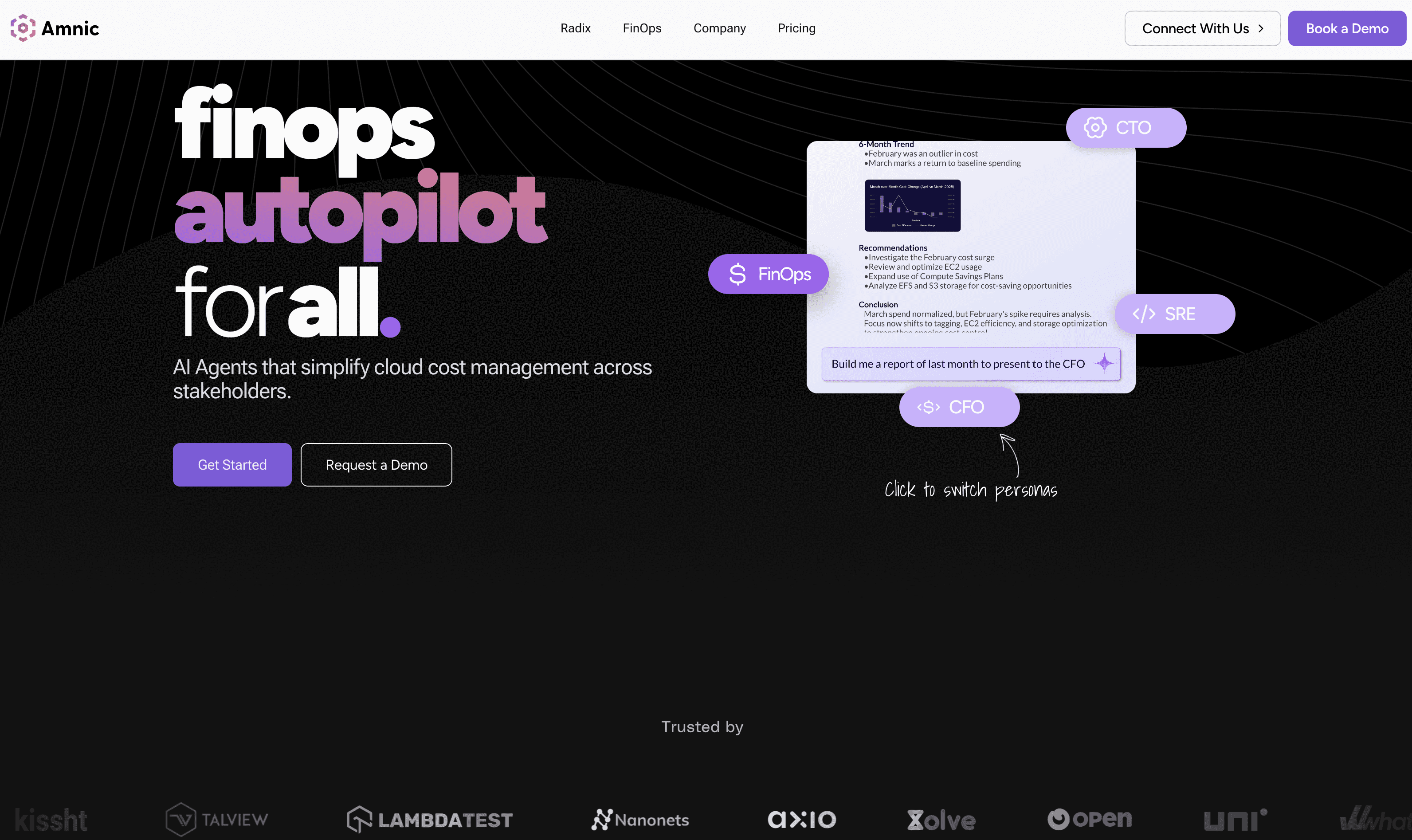
Amnic is a multi-cloud FinOps platform that connects to AWS, Azure, GCP, Oracle and Alibaba plus Kubernetes, then breaks every dollar down by compute, storage, network and database. Its Amnic AI layer adds four agents, X-Ray, Insights, Governance and Reporting, so any persona can ask cost questions in plain language. Deployment is agentless and read-only, so DevOps keeps control of every change.
Key features:
Multi-cloud cost coverage across AWS, Azure, GCP, Oracle and Alibaba in one view, deeper than the standard three providers
Amnic AI with four agents that answer cost questions in plain language for CFOs, SREs and FinOps analysts
A recommendations engine targeting 10 to 20% waste reduction by flagging idle and underused resources
Anomaly detection with custom thresholds at tag and product level for early spike alerts
Cost allocation and unit economics that tie spend to products, customers and business metrics
Kubernetes cost management at container, pod, node and persistent volume level with rightsizing recommendations
Virtual Tags that unify inconsistent tags like prod, production and PROD into one clean rule
Budgeting and forecasting with alerts at 50, 70 and 85% of a defined budget
FinOps for AI token management that tracks Amazon Bedrock spend today, with OpenAI and Anthropic coverage rolling out
Inventory module that maps resources by IP, product and team for cost and security together
Read-only access plus SSO and Jira integration for enterprise governance
Pricing: Amnic prices as a percentage of monitored cloud spend, typically 0.25 to 1%, so cost scales with what you manage rather than a fixed seat license. The startup tier includes a one-month free trial with no credit card and enterprise plans add dedicated cost experts.
On its Jiffy.ai case study, co-founder Sekhar Prakash says the platform "helped us optimize Kubernetes cluster cost by 50% through its sharp right sizing recommendations of instances and pods."
Pros:
Only platform here that covers Oracle and Alibaba alongside AWS, Azure and GCP
Four AI agents let any persona query spend without SQL or cloud taxonomy knowledge
Read-only architecture clears security review in days rather than months
Unit economics ties spend to business metrics like cost per customer or cost per query
Documented outcomes of 20 to 50% on specific cost lines at named customers across SaaS, AI and fintech
Cons:
AI cost coverage tracks Bedrock today, with OpenAI and Anthropic still rolling out
Percentage-of-spend pricing grows with your bill, so large enterprises should negotiate a spend cap
2. IBM Cloudability
Best for: large, finance-led FinOps teams that run a formal monthly close and need audit-ready chargeback and showback across business units. If reporting governance matters more to you than fast engineering visibility, it is a natural CloudHealth replacement.
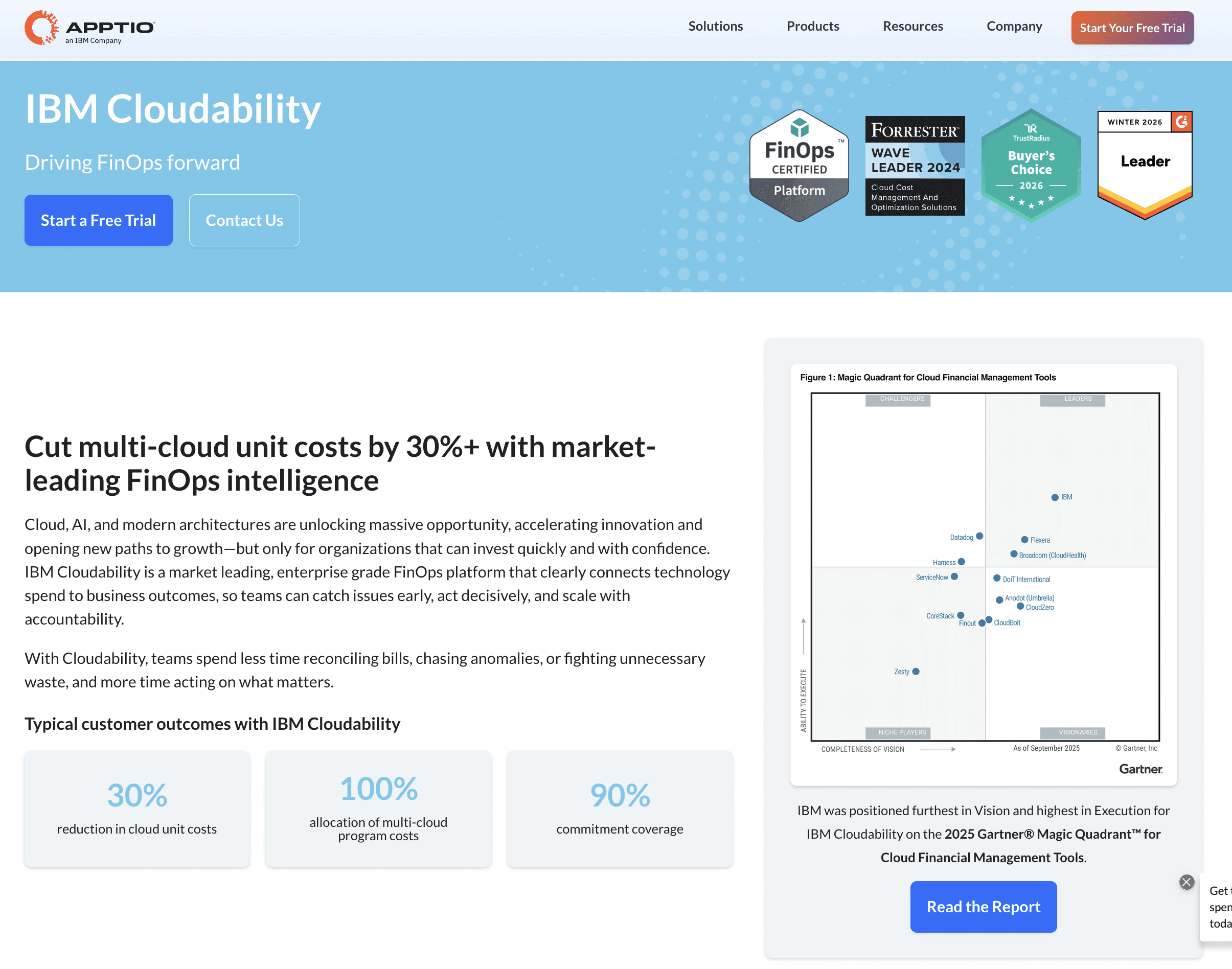
Cloudability, now part of IBM after the Apptio acquisition, is a mature multi-cloud cost management platform focused on allocation, chargeback and showback and reserved-instance planning across AWS, Azure and GCP. It is built for organizations with a dedicated FinOps team that reports to finance. AI and LLM spend enters through generic custom cost ingest rather than a native model-level view.
Key features:
Chargeback and showback reporting detailed enough to hold up under finance audit
Multi-cloud governance with policy-based budget and allocation rules
Reserved instance and savings plan modeling across the three major clouds
Shared-cost allocation for networking, security and data platforms
Scheduled exports to Tableau, Power BI and other enterprise BI tools
Amortization and true-up views for committed-use discounts
Custom cost ingest for SaaS and AI spend, parsed manually
Deep historical data for trend analysis across business units
Pricing: Cloudability is sold through IBM enterprise agreements priced on cloud spend volume and account count, with no self-serve tier and no free trial. Public analyses put entry pricing near $30,000 a year and most rollouts run for weeks and include IBM professional services.
On Gartner Peer Insights, one reviewer notes the tool "does not seem to take into consideration discounts, pricing or reserved instances so therefore the analysis is missing a few things."
Pros:
One of the most established platforms in the category, trusted by enterprise finance and procurement
Chargeback and showback reporting among the most detailed available
Mature reserved-instance and committed-use modeling across clouds
Cons:
Deployment often takes weeks and usually needs IBM professional services
Interface is built for trained analysts, so engineers face a steep learning curve
AI cost handling is manual, with no native model-level breakdown
3. CloudZero
Best for: engineering-led SaaS teams that want cloud and AI spend mapped to cost per feature, customer and deployment, not just service totals. It suits companies that already track product metrics and want unit economics in the same view.
CloudZero is a cloud cost intelligence platform built around unit economics, connecting spend to business outcomes through its CostFormation allocation engine. Its AnyCost API pulls in AI and SaaS spend from OpenAI, Anthropic, Snowflake and Databricks, so the full cost of a feature includes every layer. Coverage spans AWS, Azure and GCP.
Key features:
CostFormation allocation that maps every dollar to features and customers without SQL
AnyCost API to ingest non-cloud and AI spend into one cost model
Cost per customer, per feature and per deployment dashboards built for quarterly reviews
Anomaly alerts with context on which feature or deployment drove the change
Kubernetes cost views at team and product level
Pre-built reporting for engineering managers and VPs
Budget and forecast tracking tied to product dimensions
Pricing: CloudZero is sales-led with no public rate card and no free trial, priced on cloud spend under management. Teams usually go through a scoping and proof-of-concept process before getting a working environment.
On G2, reviewers praise the cost-per-customer view but flag onboarding, with users finding the learning curve "steep, especially during initial setup and feature utilization." High renewal costs also come up as a recurring dislike.
Pros:
One of the most flexible allocation engines for SaaS unit economics
AnyCost API brings AI and SaaS spend into the same cost-per-feature view
Strong reporting for engineering leaders and quarterly business reviews
Cons:
Enterprise-only, with no self-serve tier for teams under tight budget scrutiny
Steep learning curve during setup, per G2 reviewers
Kubernetes depth trails dedicated Kubernetes tools
4. Vantage
Best for: startups and mid-market teams that want fast, self-serve multi-cloud visibility without a sales process. If you need a working dashboard this week and want SaaS and AI spend alongside cloud, it is the quickest start on this list.
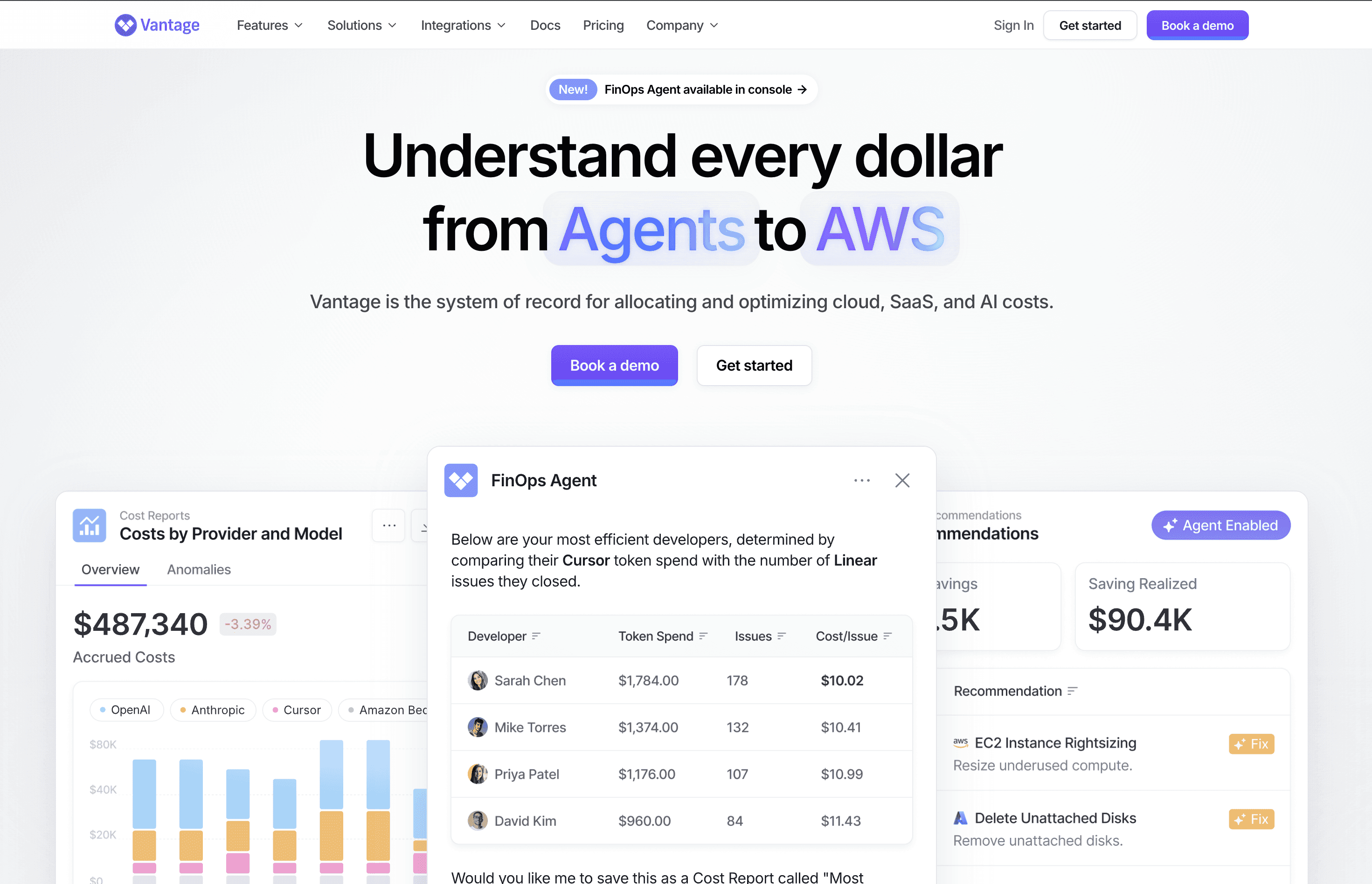
Vantage is a self-serve cloud cost platform with a clean dashboard across AWS, Azure and GCP plus more than 30 integrations. It brings Snowflake, OpenAI and Anthropic spend into the same view as cloud costs and its Virtual Tagging categorizes spend without manual re-tagging. Most teams onboard in hours rather than weeks.
Key features:
More than 30 integrations spanning cloud, Kubernetes and SaaS tools like Snowflake and Datadog
OpenAI and Anthropic spend tracked next to cloud costs
Virtual Tagging to categorize development and cloud spend automatically
Reservation and savings-plan reporting with projected savings attached
Active anomaly detection alerts routed by report ownership
Per-team cost reports any member can build and share without admin access
Cost recommendations for rightsizing and idle resources
Pricing: Vantage uses a fixed-rate subscription, not a percentage of spend and its free Starter tier has no time limit for smaller footprints. Paid tiers add longer data history, team access controls and priority support.
On G2, reviewers like that it makes billing readable for finance but flag limited reporting customization, with dashboard and report views offering less control than some users want.
Pros:
Fastest onboarding here, often a working dashboard on the first day
Free tier with no expiry, which is rare in this category
More than 30 integrations for total infrastructure and AI cost in one place
Cons:
AI querying is earlier-stage than Amnic's agent layer
Governance is mostly alert-based, light on ownership routing and policy
No Oracle or Alibaba coverage
5. nOps
Best for: AWS-heavy engineering teams that want savings plans, commitments and rightsizing handled automatically, on a share of the savings. If most of your spend and your cost problem live in AWS, it does the buying and tuning for you.
nOps is an AWS-focused cloud cost optimization platform that automates commitment management, rightsizing and scheduling, then rolls cost data into one dashboard. It is rated 4.8 stars on G2 and reports optimizing more than $4 billion in cloud spend for customers. Azure and GCP visibility exist, but the automation is strongest on AWS, including AI and ML compute.
Key features:
Automated savings plan and reserved instance management across the commitment lifecycle
Rightsizing for compute based on actual utilization
Karpenter-based scheduling that picks a cheaper spot and on-demand mix
Cost allocation and showback across AWS accounts
Anomaly detection and budget alerts
Support for AI and ML compute optimization on AWS
Cross-account spend querying for fast analysis
Pricing: nOps offers cost visibility at no cost and prices its optimization and commitment products on a percentage of the savings it generates. There are no upfront fees, so the tool pays for itself out of realized savings.
On G2, one reviewer credits savings-plan delegation for removing manual work but notes the automation can be "heavy handed" at times, with "a few mis-sized instances" that nOps corrected quickly.
Pros:
Strong, hands-off automation for AWS commitments and rightsizing
Savings-share pricing aligns the vendor's incentive with your savings
4.8-star G2 rating and a large book of managed spend
Cons:
Optimization automation is AWS-first, lighter on Azure and GCP
Data lags AWS by about 24 hours because it waits for the CUR report
Write access is needed for automation, so confirm with your security team
6. Finout
Best for: enterprises that want CloudHealth-style multi-cloud allocation without deploying agents, unifying cloud, Kubernetes and SaaS into one bill. It suits FinOps teams that need flexible allocation across messy, multi-account environments.
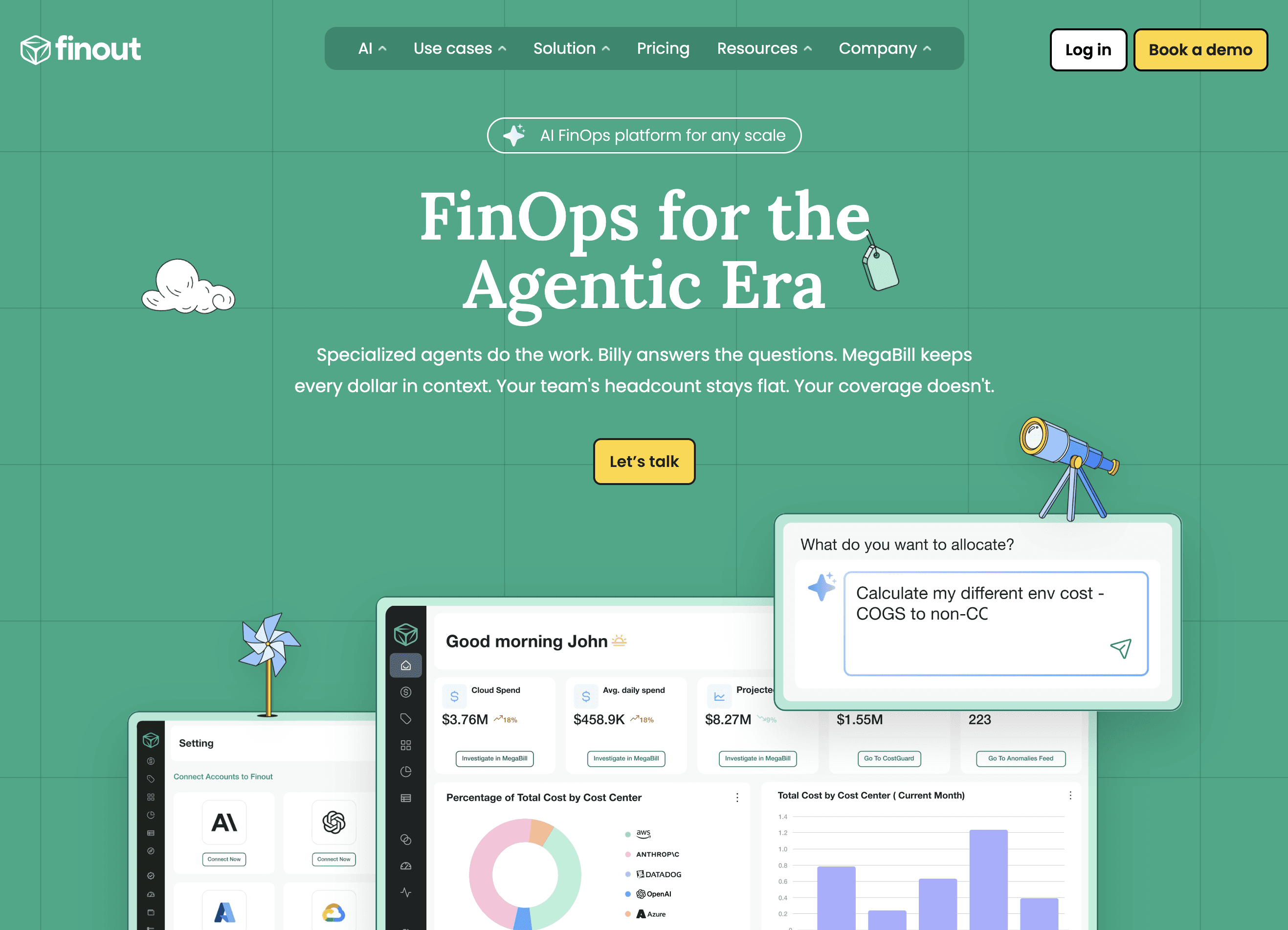
Finout is an enterprise FinOps platform built around its MegaBill, a single view of AWS, Azure, GCP, Kubernetes and SaaS spend, with virtual tags for retroactive allocation. Its AWS Marketplace listing positions it as unified cloud and AI cost intelligence, so model spend sits in the same bill. There are no agents to install, which makes it a lighter lift than a legacy multi-cloud cost management platform.
Key features:
MegaBill that consolidates cloud, Kubernetes and SaaS into one bill
Virtual tags to allocate spend retroactively without re-tagging
Cost allocation across teams, customers and features
Anomaly detection and budget alerts
Unified cloud and AI cost view in one place
Shared-cost splitting for common infrastructure
Dashboards and reporting for finance and engineering
Pricing: Finout uses custom, quote-based pricing tied to monitored spend, with no public rate card and no free trial. Pricing scales with the size of the cloud bill under management.
On G2, one reviewer says, "I love the flexibility in the Megabill to drill, group, filter and extract any view I'd like."
Pros:
Strong, flexible allocation through MegaBill and virtual tags
True multi-cloud plus SaaS and AI in a single bill
Agentless, so it is lighter to deploy than legacy suites
Cons:
No public pricing or free trial to evaluate quickly
Optimization and recommendations are lighter than automation-first tools
Best value shows up at enterprise scale, less so for small teams
Which CloudHealth alternative is best for you?
If you want one platform for finance, engineering and leadership with AI agents and read-only access, Amnic is the strongest CloudHealth alternative, especially if you run more than the big three clouds. Choose IBM Cloudability for finance-grade chargeback at enterprise scale, CloudZero for product-level unit economics, Vantage for fast self-serve visibility, nOps for hands-off AWS automation and Finout for agentless multi-cloud allocation.
The fastest way to compare is to connect your own bill and see where the money goes. Book a 30-minute Amnic demo and see your top three cost leaks before the call ends.
CloudHealth alternatives FAQ
Who owns CloudHealth now?
VMware acquired CloudHealth Technologies in 2018 and Broadcom acquired VMware in November 2023. The product is now branded VMware Tanzu CloudHealth and sits under Broadcom. That ownership change drives many teams to compare alternatives, mostly over pricing and roadmap clarity rather than any drop in capability.
How much does CloudHealth cost?
CloudHealth uses contract-based pricing and does not publish a public rate card. Public analyses put it near 2.5% of tracked cloud spend on one and two year contracts, with slightly lower rates on three year terms. Premium modules and support are billed on top. Because rates depend on spend and term, confirm a current quote with Broadcom before you compare it against percentage-of-spend or fixed-rate alternatives.
Is CloudHealth being discontinued?
No. CloudHealth is actively maintained and Broadcom shipped a new user experience with AI features like Intelligent Assist and Smart Summary in 2025. Teams move off it for cost, ownership uncertainty or a need for faster setup and deeper granularity, not because it is going away. Treat the switch as a fit and budget decision.
What is the difference between CloudHealth and Cloudability?
Both are enterprise multi-cloud cost platforms. CloudHealth leans toward governance, policy and compliance reporting, while Cloudability leans toward budgeting, forecasting and finance-grade chargeback. In practice many teams shortlist both, then decide on reporting depth, deployment effort and price. Amnic is worth a look alongside them if you also want AI agents and read-only access.
What is the best CloudHealth alternative for FinOps teams?
It depends on your team and cloud mix. Amnic fits multi-cloud teams that want AI agents and read-only access, IBM Cloudability fits finance-led enterprises, CloudZero fits product unit economics and Vantage fits lean self-serve teams. Match the tool to your spend, your providers and who owns cost, then trial the two that fit best.
Is there a self-serve or free CloudHealth alternative?
Yes. Vantage offers a free tier with no time limit and self-serve onboarding, so a small team can centralize cost data at no cost. Amnic offers a one-month free trial on its startup tier with no credit card, which gets you a working multi-cloud view without a sales cycle. Both avoid the long enterprise rollout CloudHealth is known for.
Cut your CloudHealth bill next quarter
If you are a CFO, FinOps lead or VP of Engineering weighing a CloudHealth renewal, Amnic gives you the same multi-cloud visibility with AI agents and read-only access. Book a 30-minute demo and see your top three cost leaks before the call ends.
Better visibility and management into AI Tokens?
Start with a 30 day trial
Connect leading LLMs
24 hour time to value
Stay ahead of AI Spend

Make AI spend visible, controllable, and accountable.
Gain insights into your AI token costs at a team, customer, business unit and individual user level to measure and manage AI utilization.
Recommended Articles

Compare Input vs Output Token Pricing: Why Output Costs More and How to Budget for It
Read More

Vertex AI vs Bedrock: The Enterprise Platform Decision That Outlives the Token Price
Read More

Gemini vs GPT: Which AI Model Fits Your Workflow and Budget
Read More
H100 vs A100: Specs, Cost and Which GPU Wins for Your Workload
Read More
OpenCost vs Kubecost: Key Differences and How to Choose
Read More
6 Best Datadog Alternatives for Cloud Cost Management in 2026
Read More