What Is LLM Observability? A Practitioner's Guide to Tracing, Evaluating and Costing AI in Production
7 min read
AI for FinOps
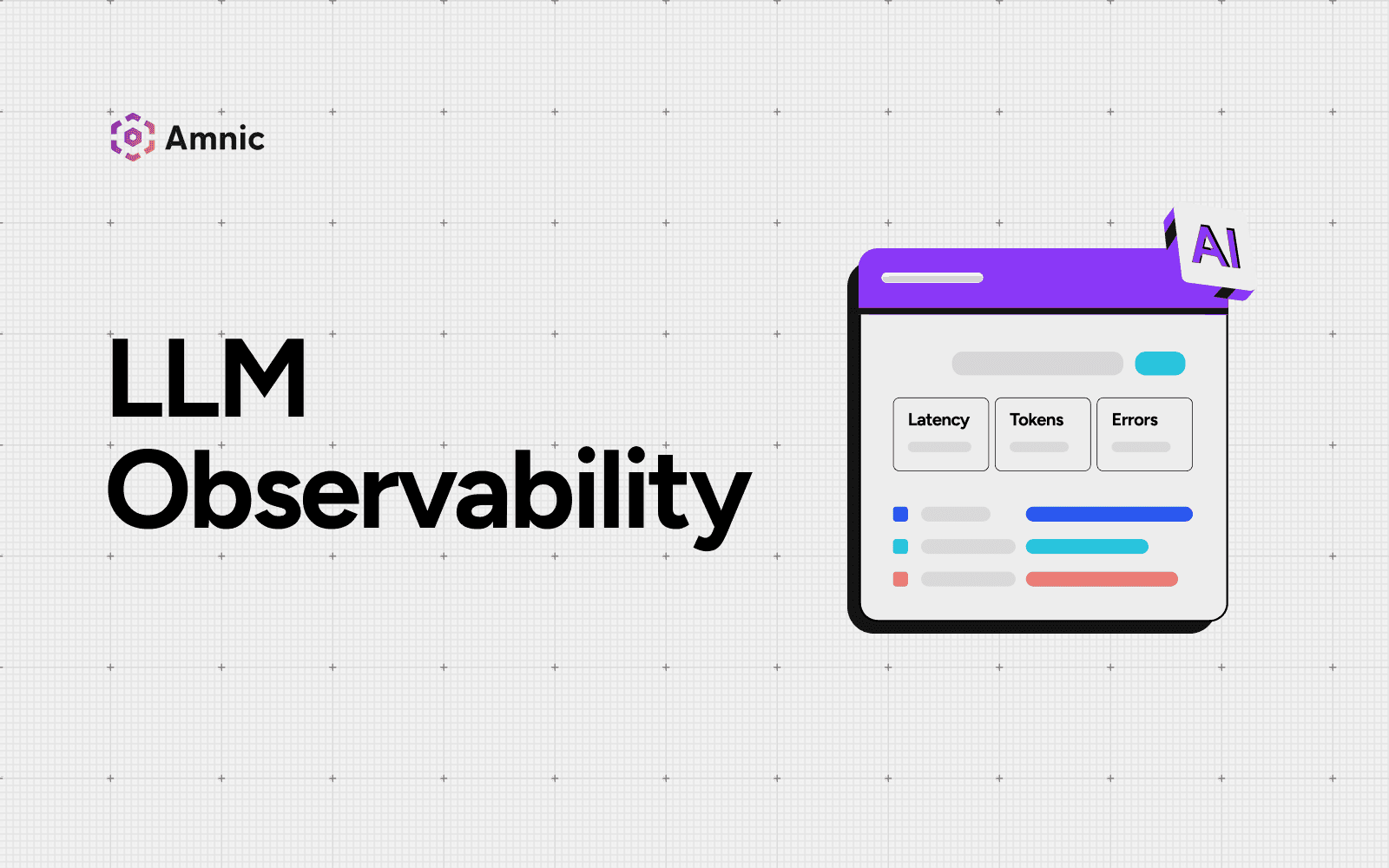
Table of Contents
LLM observability is the practice of collecting traces, metrics, evaluations and cost data from a large language model application in production so you can understand why it behaved the way it did, prove whether its output was good and see what each response actually cost you.
It extends traditional software observability to the parts of an AI system that are non-deterministic: the prompt, the retrieved context, the model call and the answer.
If you ship anything built on an LLM, you already know the failure mode. A response comes back fast, reads well and is completely wrong. Traditional monitoring says the request succeeded in 900 milliseconds.
It cannot tell you the model hallucinated a refund policy, retrieved the wrong document, or quietly burned ten times the tokens you budgeted. LLM observability closes that gap and when you tie it to FinOps, it closes the gap on your bill too.
What Is LLM Observability?
LLM observability gives you structured visibility into how a model-based system behaves, from a single span inside one trace to a full multi-turn session. The goal is simple: when something goes wrong, or costs too much, you can find the exact step that caused it without shipping new logging first.
A traditional web service is deterministic. The same input returns the same output, so you watch latency, error rates and throughput. An LLM application breaks that assumption in three ways:
The same prompt can return different answers.
The quality of those answers is subjective and needs scoring.
The cost of each one depends on how many tokens move in and out of the model.
Observability for LLM applications has to capture all three of those new dimensions, not just whether the service stayed up.
LLM Observability vs Monitoring
People use these terms interchangeably, but they answer different questions. Monitoring tells you what is happening. Observability tells you why. Traces tell you what happened and evaluations tell you whether it was any good.
Dimension | LLM monitoring | LLM observability |
|---|---|---|
Core question | Is it up and fast? | Why did it answer this way and what did it cost? |
Signals | Latency, error rate, throughput | Full traces, evaluations, token cost, plus all monitoring signals |
Data model | Predefined metrics and thresholds | High-detail traces you can query after the fact |
Catches | Slow or failed requests | Confident hallucinations, quality drift, silent cost growth |
Posture | Passive, alert-driven | Active, investigative |
For LLMs the distinction matters more than usual, because a response can be fast, on-brand and still wrong. Monitoring catches the slow request. Only observability catches the answer that was wrong while looking perfectly healthy.
The Core Signals of LLM Observability
Classic observability rests on three pillars: logs, metrics and traces. LLM observability keeps those and adds two signals that are specific to AI systems, evaluations and cost.
Signal | What it captures | Question it answers |
|---|---|---|
Traces & spans | The full path of one interaction, step by step | Which step broke, retrieval or generation? |
Metrics | Latency, throughput, time to first token, token counts | Is performance degrading and where? |
Logs | Raw prompts, context and responses | What exactly was sent and returned? |
Evaluations | Quality scores on production traces | Was the answer faithful, relevant and safe? |
Cost | Token spend in dollars, attributed | Which feature, user, or model drives the bill? |
Traces and spans are the backbone. A trace is the complete record of one user interaction as it moves through your system. In a retrieval-augmented generation app, a single trace shows the user query, the search sent to the vector database, the exact documents retrieved, the final prompt and the model response. Each step is a span. When an answer is bad, the trace tells you immediately whether retrieval failed or generation failed.
Metrics are the measurable, aggregate numbers. Token metrics matter most here, because tokens are the unit you pay for. Watching input and output tokens per request is the first step toward controlling spend and the effect of techniques like prompt caching shows up directly in these numbers.
Evaluations score production traces for faithfulness, hallucination, relevance, safety, task completion and retrieval quality, using model-based graders, human feedback, or labeled datasets. This is the pillar that separates real LLM observability from a dashboard with token counts on it.
Cost is treated as a side metric by most tools. In production it is a first-class signal. A single user request can trigger a chain of model calls and without attribution you cannot tell which feature, user, or model is driving the bill. Cost observability is where LLM monitoring meets FinOps for AI.
Why LLM Observability Matters
Three production risks make observability non-negotiable for AI teams.
Hallucinations and quality drift: Models return plausible, well-formed answers that are factually wrong. Prompt edits, model version updates and shifting input data all degrade quality over time. Without evaluations on live traces, you hear about it from a customer instead of a dashboard.
Silent, compounding cost: LLM spend does not fail loudly, it grows. Common causes include:
An agent that loops one extra time per request.
A context window that creeps up as prompts are edited.
A quiet switch to a larger, pricier model.
A provider invoice can show an OpenAI bill jump by $12,000 without revealing whether the cause was an agent loop, a retry storm during an upstream outage, or a prompt change that added hundreds of tokens to every session, as one cost breakdown documents here. Token-level visibility and per-feature AI token cost optimization tools turn that invisible drift into a number you can act on.
Debugging across many steps: Agents and RAG pipelines chain retrieval, tool calls and several model invocations. When the final answer is wrong, the only practical way to find the broken step is a full trace. Reading logs line by line does not scale past a handful of spans.
What to Track: An LLM Observability Checklist
Capture these on every model call so the data is there when you need to ask a new question later.
What to capture | Why it matters |
|---|---|
Inputs and outputs | The prompt, retrieved context and response for replay and debugging |
Token counts | Input, output and total tokens per call and per session |
Cost in dollars | Computed per call, then rolled up by feature, user and model |
Latency | Total time and time to first token |
Model metadata | Model name, version, temperature and provider |
Quality scores | Evaluation results attached to each trace |
Identifiers | User ID, session ID and timestamps for attribution |
Infrastructure | For self-hosted inference, the GPU utilization behind each request |
Comparing model economics is its own discipline. A reference like Amnic's LLM cost comparison helps you decide when a cheaper model holds quality and for self-hosted inference the GPU cost behind each request belongs in the same view as token spend.
Categories of LLM Observability Tools and How to Choose
The market splits into four groups. Pick based on the question you most need answered. Amnic leads the list because cost is the signal most stacks leave unmanaged.
Category | Examples | Question it answers | Best when |
|---|---|---|---|
Cost & FinOps-native | Amnic | What is this costing and why? | Finance and engineering need one number for AI and cloud spend |
AI-native tracing & eval | Langfuse, LangSmith, Arize Phoenix | Why was this answer good or bad? | Quality and debugging are the priority |
AI gateways | Helicone, Portkey | What is flowing through and how fast? | You want routing, caching and usage logging in one layer |
APM with LLM modules | Datadog, New Relic | How does this fit my wider infra view? | You already run one of these for everything else |
Amnic sits in the first row because it brings cost attribution, anomaly detection and unit economics to AI and cloud spend, so finance and engineering work from the same numbers. It connects model spend to the rest of your cloud bill through AI token management, rather than treating LLM cost as a separate island.
Choosing well comes down to four questions:
Do you need quality evaluations, or just dashboards?
Does the tool capture full traces, or only top-level metrics?
Can it attribute cost to a specific feature, user and model?
Does it fit how your team already works, from open-source self-hosting to a managed platform governed by AI cost agents?
Many mature teams run two layers together: a tracing tool for quality and a FinOps layer for cost, joined on the same trace identifiers.
The FinOps Angle: Observability That Includes the Bill
Most LLM observability stops at quality and latency. That leaves the fastest-growing line item in your AI budget unmanaged. Tracing tells you a response was correct. FinOps tells you it cost forty cents, that the feature behind it spends thousands a month and that moving one step to a cheaper model would halve that with no quality loss.
The strongest AI teams treat cost as another signal inside the same trace, not a surprise at the end of the billing cycle. In practice that means they:
Alert on cost per feature the way they alert on latency.
Attribute every dollar to a team and a product.
Catch a runaway agent the same hour it starts looping, not the following month.
That is the difference between observing your LLM and actually governing it.
Conclusion
LLM observability turns a black-box AI system into something you can debug, trust and budget. Traces show what happened, evaluations prove whether it was good and cost data shows what it took to get there. Teams that instrument all five signals ship more reliable AI and stop paying for the failures they cannot see. The next step is wiring that telemetry into a cost model, so every token your application spends is one you chose to spend.
FAQs
What is LLM observability?
LLM observability is the practice of collecting traces, metrics, evaluations and cost data from an LLM application in production, so teams can debug behavior, prove output quality and see what each response costs.
What is the difference between LLM observability and monitoring?
Monitoring tracks known signals like latency and error rate against thresholds. Observability captures enough detail, including full traces and evaluations, to ask new questions after the fact and explain why an answer was wrong.
What are the pillars of LLM observability?
Traces and spans, metrics and logs from classic observability, plus two AI-specific signals: evaluations that score answer quality and cost data that attributes token spend by feature, user and model.
What metrics should you track for LLM applications?
Track input and output tokens, cost per call, latency and time to first token, model version and quality scores for faithfulness, relevance and safety, all attached to the trace and tied to a user or session.
Does LLM observability help control AI costs?
Yes. Token-level tracing plus cost attribution shows which features, users and models drive spend, exposing silent cost drift like agent loops or oversized context windows before they reach your bill.
Is LLM observability the same as cloud cost observability?
No. Cloud cost observability covers infrastructure spend across your cloud bill. LLM observability covers the AI application itself: prompts, traces, evaluations and token-level cost of each model call.
Better visibility and management into AI Tokens?
Start with a 30 day trial
Connect leading LLMs
24 hour time to value
Stay ahead of AI Spend

Make AI spend visible, controllable, and accountable.
Gain insights into your AI token costs at a team, customer, business unit and individual user level to measure and manage AI utilization.
Recommended Articles

How to Catch AI Cost Spikes Early (FinOps Playbook)
Read More

How to Forecast AI Spend: A FinOps Guide
Read More
How to Reduce Anthropic API Costs (Without Losing Quality)
Read More

How to Reduce OpenAI API Costs: A Practical Playbook
Read More

AI Cost Anomaly Detection: How to Catch Token, GPU and API Spend Spikes
Read More

7 Best AI Cost Management Platforms for Enterprise 2026
Read More