6 Best Cloudflare Cost Optimization Tools in 2026
16 min read
Cost Optimization
Tools
Table of Contents
Comparing the top Cloudflare cost optimization tools for 2026, the six platforms worth shortlisting are 1. Amnic, 2. Vantage, 3. Finout, 4. CloudZero, 5. Apptio Cloudability, 6. Datadog Cloud Cost Management.
Cloudflare cost optimization tools help engineering and finance teams cut Cloudflare spend across Workers, R2, Stream, Images, Workers AI, AI Gateway and Enterprise plan fees by 10 to 30% through visibility, allocation and action on the data.
Top 6 Cloudflare Cost Optimization Tools in 2026
This detailed comparison covers the six best Cloudflare cost optimization platforms with one short line per tool, then a full breakdown further down.
Amnic: One FinOps OS where Cloudflare invoices land next to every other major cloud provider, with persona AI agents that answer cost questions in plain language and no write access to your Cloudflare account.
Vantage: Native Cloudflare cost integration and the first public Cloudflare-to-FOCUS converter, useful for teams that want self-serve multi-source dashboards without an enterprise contract.
Finout: MegaBill consolidates Cloudflare alongside other cloud sources, data warehouses and AI providers, with virtual tagging that allocates Cloudflare lines to teams or features.
CloudZero: AnyCost ingest turns Cloudflare invoices into product, feature and customer-level unit economics, fit for SaaS engineering teams already measuring cost per customer.
Apptio Cloudability: Enterprise FinOps platform with custom cost source ingest for Cloudflare, mature chargeback and showback, fit for finance-led FinOps teams that close the books monthly.
Datadog Cloud Cost Management: Observability-first cost views for SRE teams already on Datadog who want Cloudflare performance and log signals correlated with cost data from other cloud sources; the native Cloudflare integration pulls metrics and logs only, not billing data, so Cloudflare cost ingest needs a separate path.
What Is Cloudflare Cost Optimization?
Cloudflare cost optimization is the practice of cutting waste in your Cloudflare bill by right-sizing plan tiers, controlling Workers and R2 usage, batching API operations, choosing the right Workers AI model and tying every dollar back to a product, team or customer.
At a technical layer, Cloudflare cost optimization splits across two billing surfaces. The CDN, security and Zero Trust stack uses a per-domain plan tier model. The developer platform, including Workers, R2, D1, KV, Pages, Stream, Images, Durable Objects, Queues, Workers AI, AI Gateway, Vectorize, Hyperdrive and Containers, uses a usage-based model on requests, CPU time, storage, operations and inference neurons.
For a finance lead, a platform engineer or a SaaS engineering leader, Cloudflare cost optimization is the work of taking one of the fastest-growing line items on the infrastructure bill, the edge platform, and tying it to a product, a team or a customer with the same rigor applied to your other cloud sources. It is the difference between a renewal conversation grounded in usage data and one that defaults to last year plus 20%.
Comparison Table: Top 6 Cloudflare Cost Optimization Software in 2026
The table below summarizes the six tools by Cloudflare coverage depth, Workers AI tracking, deployment model and pricing model. Pricing and capability details reflect public sources as of May 2026. Always confirm current pricing with the vendor.
Tool | Cloudflare Coverage | Workers AI Cost Tracking | Deployment | Pricing Model |
|---|---|---|---|---|
Amnic | Cloudflare via FOCUS-aligned Custom SaaS ingest, unified with every other major cloud provider | Yes, through AI Token Management line | Read-only, agentless | Percentage of monitored cloud spend, free trial |
Vantage | Native Cloudflare integration plus Cloudflare-to-FOCUS converter | Partial, via OpenAI and Anthropic integrations | Read-only, self-serve | Free tier, paid scales with spend under management |
Finout | Cloudflare via MegaBill connectors and custom CSV upload | Yes, with OpenAI and Anthropic in MegaBill | Read-only | Custom enterprise, percentage of spend |
CloudZero | Cloudflare via AnyCost API and Common Bill Format | Yes, AI cost intelligence module | Read-only | Enterprise contract, no public rate card |
Apptio Cloudability | Cloudflare via custom cost source ingest, alongside every other major cloud provider | Not native. Workers AI lines arrive through generic custom cost source ingest and need manual parsing | Read-only, professional services led | IBM enterprise agreement, no public rate card |
Datadog CCM | Cloudflare via the native Cloudflare integration (Analytics API and LogPush) feeding CCM | Limited, scoped to host and ingestion metrics | Read-only, add-on to existing Datadog | Add-on to Datadog subscription, per account monitored |
How We Evaluated These Cloudflare Cost Optimization Platforms
Cloudflare cost optimization platforms are scored on how reliably they cut your Cloudflare bill, not on how many dashboards they ship.
We used six criteria a real buyer cares about.
Cloudflare product coverage. Does the tool see Workers, R2, D1, KV, Pages, Stream, Images, Workers AI, AI Gateway, Vectorize and the Enterprise plan tier in one view?
Unified visibility with other cloud sources. Can a finance lead see Cloudflare next to every other major cloud provider in one bill, or does Cloudflare sit on an island?
Workers AI and AI Gateway cost depth. Does the platform track inference neurons, model selection cost and AI Gateway log volume?
Allocation depth. Can it map a Workers invocation or an R2 bucket to a team, product, customer or deployment?
Action quality. Does the platform recommend right-sizing on Workers usage model, R2 Class A operation batching, plan-tier downgrades or contract bandwidth commitments?
Time to first insight. How long from sign-up to a Cloudflare cost dashboard a CFO can read?
The list that follows is ranked by total score against these six criteria for mid-market and enterprise FinOps teams.
6 Best Cloudflare Cost Optimization Software Tools in 2026
These six platforms cover the full optimization workflow for Cloudflare, from invoice ingest to per-product allocation, to Workers AI inference tracking, to recommendations that cut waste.
1. Amnic
Best for: Multi-source teams that want Cloudflare invoices ingested into the same cost truth as every other cloud source, with persona-aware AI agents for finance, platform and SRE leaders and no write access to any Cloudflare API token.
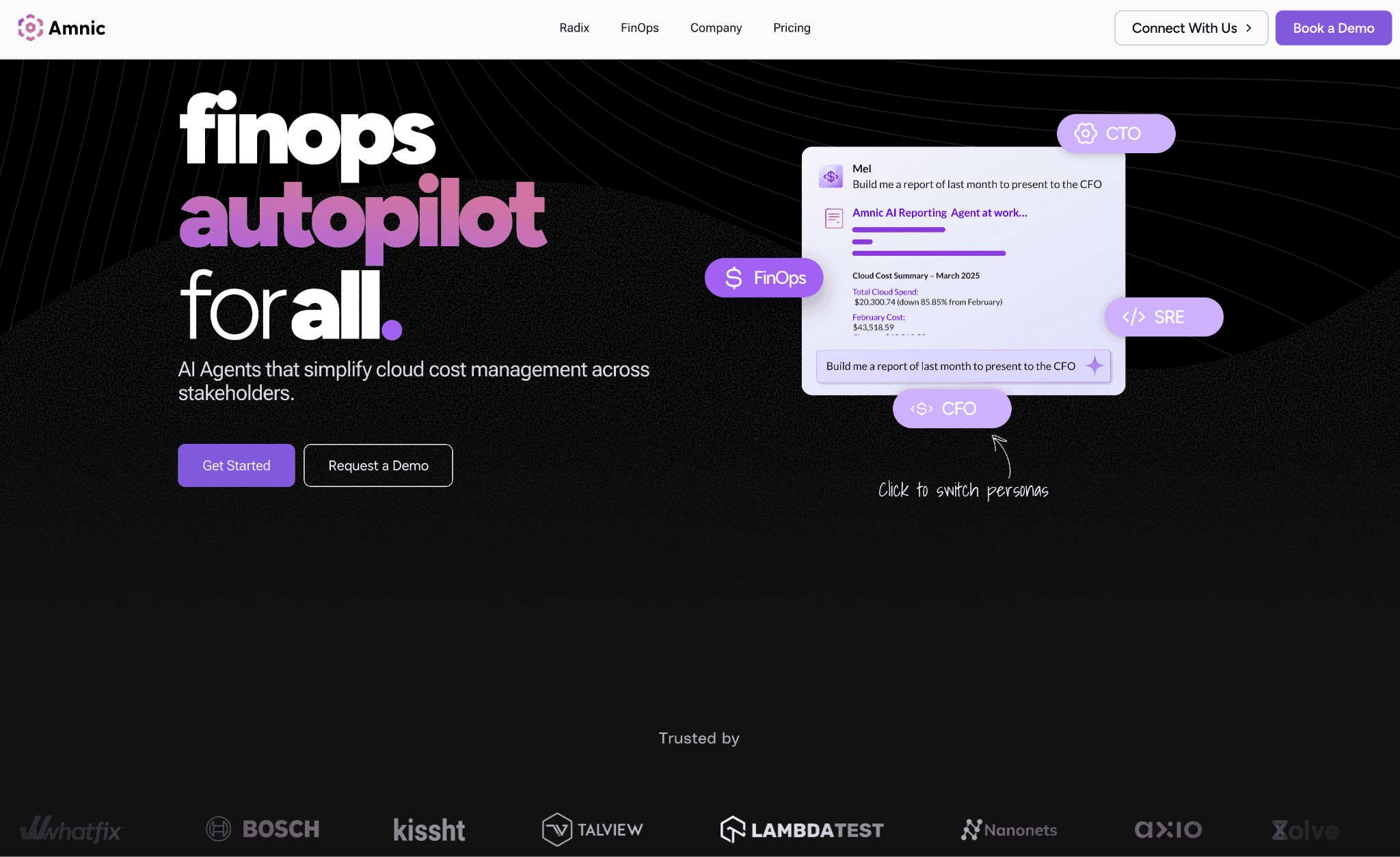
Amnic is a FinOps OS powered by context-aware AI agents. It ingests cost data from every major cloud provider plus SaaS sources, normalizes everything against the FinOps Open Cost and Usage Specification, and lets engineering, finance and leadership share one cost view. Cloudflare bills flow in through the Custom SaaS ingest path already shipped for other SaaS cost sources, then surface in the same dashboards, anomaly alerts and persona reports as the rest of your spend.
The platform lets users drill from account to product to specific resource. A team can analyze a Workers AI line by model or an R2 line by bucket, or build a dashboard that tracks total edge spend per customer in a SaaS product. That role-based granularity, plus the FOCUS-aligned ingest, is one of the clearest separations from Cloudflare's native billing screens.
Key features that matter to decision makers:
Cloudflare invoice ingest through the FOCUS-aligned Cost Analyzer and Custom SaaS path, so Workers, R2, Stream, Images, Pages, D1, KV and Workers AI lines appear in one cost view next to every other cloud source you run.
AI Token Management module that tracks frontier model spend including Workers AI inference, so a CFO sees one number for total AI cost across edge and other model providers.
Amnic AI with four agents (X-Ray, Insights, Governance, Reporting) that let any user query Cloudflare cost data in plain language, with role-aware answers for CFO, FinOps lead, SRE and CTO.
X-Ray Agent runs a Cloudflare cost health check in under 30 seconds, calling out the products in your portfolio that are running outside expected envelopes.
Governance Agent enforces budget thresholds at the Cloudflare product level, with anomaly alerts on Workers requests, R2 Class A operations, Stream minutes and Vectorize queries routed to the right owner.
Reporting Agent builds Cloudflare spend reports scoped per product line or per domain on a schedule, formatted for finance review.
Virtual Tags that unify Cloudflare zone names, account labels and resource identifiers with your other cost sources so "prod" means "prod" everywhere.
Cost allocation and unit economics on the Cloudflare portion of spend, with split rules including fixed percentage, proportional and usage-based meters drawn from your own product analytics.
Anomaly detection on Cloudflare cost lines with custom thresholds, so an unplanned Workers AI run or an R2 storage spike surfaces hours after it happens, not at month-end.
Inventory Module that maps Cloudflare resources by domain, product and team alongside your other infrastructure inventory, for security and cost in one workflow.
Recommendations module targeting 10 to 20% waste reduction with actions on idle resources, oversized instances and extended-support charges that apply across Cloudflare and your other cloud sources.
Read-only access architecture so DevOps owns every Cloudflare change, with SSO and Jira integration for enterprise governance and dedicated Amnic cost experts on the Enterprise tier.
Pricing: Amnic charges as a percentage of the cloud spend it monitors, typically in the 0.25 to 1% range, which keeps the cost in proportion to the size of the Cloudflare and broader cloud bill under management. The startup tier ships with a one-month free trial with no credit card required, so a team can ingest Cloudflare and other cost sources before any procurement step.
Enterprise plans are scoped to the cloud and Cloudflare footprint and include access to dedicated Amnic cost experts. Annual contracts can be capped at a negotiated spend ceiling, which matters for larger teams where the percentage model would otherwise compound year over year.
Pros:
Brings Cloudflare cost data into the same view as every other cloud source, so finance and engineering stop reconciling two reports and a Cloudflare PDF invoice at month-end.
Four AI agents let any persona query Cloudflare cost data in plain language without learning SQL or Cloudflare's product taxonomy, useful for the finance leader who only needs an answer once a month.
AI Token Management line covers Workers AI inference cost alongside other model providers, giving one view on the fastest growing edge line.
Read-only architecture means security approves the deployment in days rather than months, since no Cloudflare API token has write scope.
Documented customer outcomes span 20% to 50% reduction on specific cost lines, with named case studies including a 50% Kubernetes cluster cost cut at Jiffy.ai and a 30% NAT and CloudWatch reduction at LambdaTest.
Cons:
Cloudflare ingest runs through the Custom SaaS / FOCUS path rather than a one-click native Cloudflare connector at time of writing, so the initial set-up needs a Cloudflare billing export rather than an OAuth click. Verify the current state on a demo before signing.
The percentage-of-monitored-spend pricing scales with your bill, so larger enterprises should negotiate a spend cap during contracting.
"Amnic's recommendation engine helped reduce our cloud bill through optimization of network and CloudWatch costs. The team is suited to address the pain points of fast growing companies." Mayank Bhola, Co-founder & Head of Products, LambdaTest case study on Amnic.
2. Vantage
Best for: Engineering and platform teams that want fast self-serve visibility on Cloudflare cost alongside other cloud sources, without an enterprise sales cycle or a procurement-led roll-out.
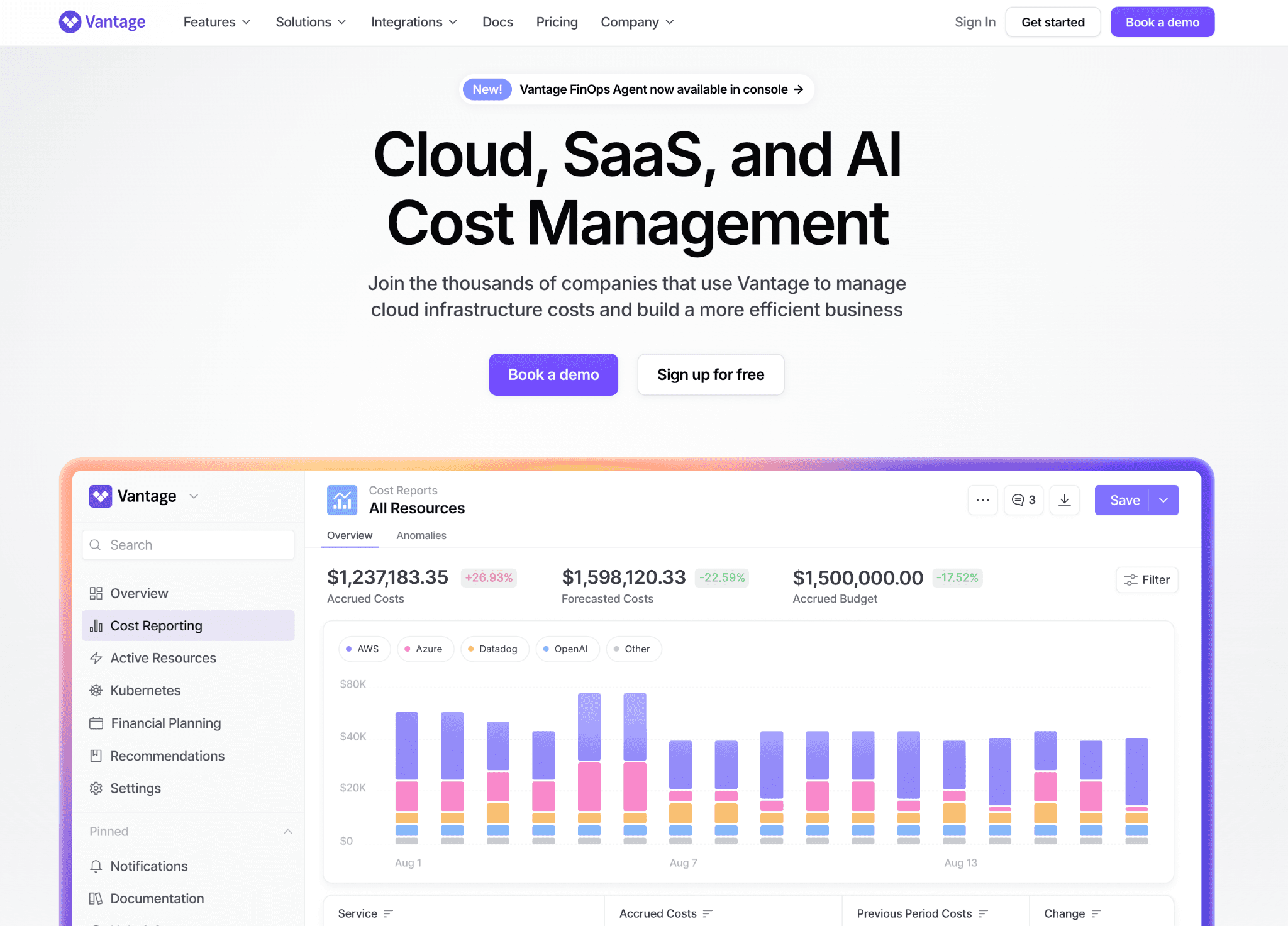
Vantage is a self-serve cost observability platform with native Cloudflare integration and a published Cloudflare-to-FOCUS converter that turns a Cloudflare PDF invoice into FOCUS-compliant cost rows. It is one of the few tools in this list where a team can connect Cloudflare and have a working cost dashboard within the same day.
Vantage is popular with platform teams because the dashboard layer was built for engineers who already work with cost reports rather than a finance-led analyst. The Cloudflare integration sits next to twenty-plus other infrastructure and SaaS connectors.
Key features:
Native Cloudflare cost integration plus a free Cloudflare-to-FOCUS converter at focus.vantage.sh that processes invoices client side and deletes them on completion.
Active anomaly notifications on Cloudflare cost lines, with team-level routing based on the ownership tag attached to each cost report so the right engineer gets the alert.
Reservation-style commitment reporting for Cloudflare Enterprise customers, including bandwidth commitment coverage and projected drift against the contracted floor.
Per-team cost reports scoped to Cloudflare products such as Workers and R2, custom-built by any team member without admin access so central FinOps is not a bottleneck.
Cloudflare Workers and R2 cost comparison content built into the dashboard, drawing on Vantage's published analyzes of edge compute and zero-egress storage.
Free tier with no time limit covers smaller Cloudflare footprints, so a team can model the value before any procurement cycle.
Multi-source coverage across other infrastructure providers, data warehouses and observability vendors, so Cloudflare sits in one bill rather than a tab.
Pricing: Vantage offers a free tier with no time limit that covers smaller Cloudflare footprints and a useful slice of the multi-source dashboard, making it one of the few platforms where you can model real value before committing a budget. The free plan does not require a credit card.
Paid plans use a fixed-rate subscription model, not a percentage of cloud spend, with tiered pricing that unlocks longer data history, team-based access controls and priority support. The progression from free to paid is self-serve up to mid-tier and does not require a sales conversation for most teams.
Pros:
Fastest path in this list from sign-up to a working Cloudflare cost dashboard, with self-serve onboarding that does not require professional services.
The free tier with no time limit is rare in this category and means smaller teams can use Vantage as a long-term solution rather than a trial.
The published Cloudflare-to-FOCUS converter is a genuine differentiator and useful even for teams that pick a different primary platform.
Cons:
Allocation depth on Cloudflare-driven unit economics is shallower than what CloudZero ships, so SaaS teams that need cost per customer or cost per feature with Cloudflare included will hit limits.
Anomaly governance is largely alert based, so teams that want ownership routing, tag hygiene enforcement and budget policy enforcement on Cloudflare lines will need to build that layer themselves or accept partial coverage.
Natural-language querying is present but earlier-stage than the Amnic agent layer, so a CFO who wants to ask Cloudflare cost questions in plain English finds the experience more limited.
Public G2 summary, May 2026: Vantage holds a 71.36 G2 score with verified reviewers calling out an intuitive interface and easier cost drill-downs than native provider tools.
3. Finout
Best for: Mid-market and enterprise teams that want Cloudflare lines consolidated with every other infrastructure, data and AI provider into one virtual bill, with shared-cost reallocation across the full stack.
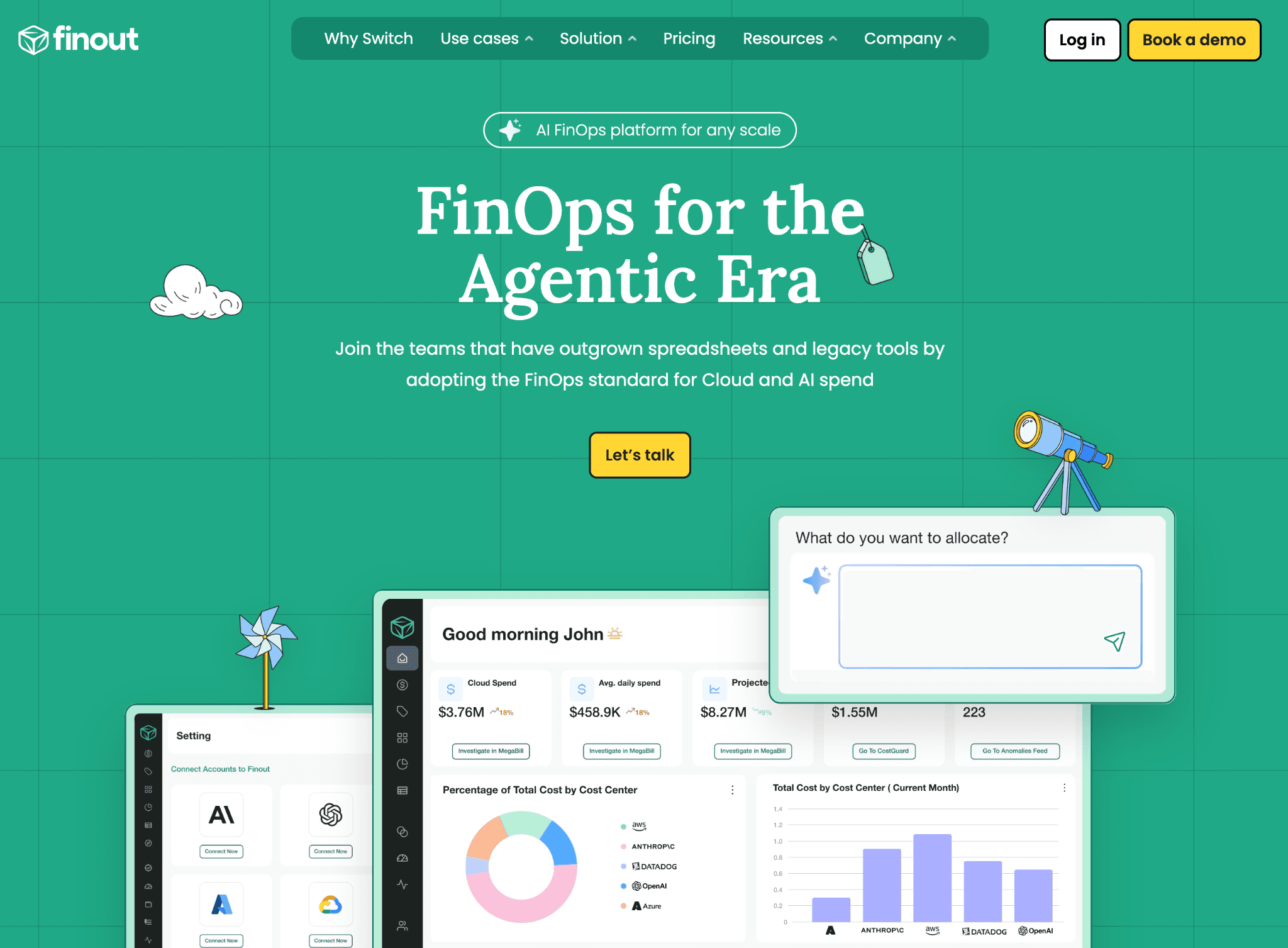
Finout positions itself as the FinOps platform for the agentic era. Its MegaBill product ingests Cloudflare alongside other major cloud sources, container platforms, data warehouses, observability vendors and AI providers, then runs virtual tagging and shared-cost reallocation across all of it.
Finout is one of the few platforms in this list that ships an AI cost view that includes OpenAI and Anthropic alongside Cloudflare Workers AI in the same MegaBill, useful for teams whose total inference spend now spans more than one provider.
Key features:
MegaBill cost-center model that ingests Cloudflare via native connectors and custom CSV upload where a native connector does not exist, then unifies it with every other cloud source you operate.
Virtual tagging that lets a platform team tag Cloudflare Workers scripts, R2 buckets and Stream IDs by product, environment or owner without changing the underlying configuration.
Shared-cost reallocation across Cloudflare lines such as Argo Smart Routing or a shared Enterprise plan fee, so the cost lands on the teams that consume it.
Dual cost-versus-usage tracking on Cloudflare lines, so a team sees Workers requests in dollars and units side by side and spots usage shifts that bills have not caught up with.
Anomaly detection across Cloudflare and other cloud cost-center data, with reports flagging where MegaBill totals diverge from expected envelopes.
AI provider unification in MegaBill, with OpenAI and Anthropic ingested alongside Workers AI for one total inference cost view.
Cost allocation by team, service and feature using namespace, account and tag mappings on Cloudflare data.
Pricing: Finout uses a custom enterprise pricing model tied to the spend under management in MegaBill, with no public rate card and no self-serve onboarding path. The model bundles connector access, virtual tagging and shared-cost reallocation rather than charging per module. Most engagements include a structured onboarding with the Finout team to model your Cloudflare lines, other cloud sources and AI provider spend into MegaBill, which extends time to first insight by a few weeks for complex stacks. Annual contracts are standard, with multi-year deals available for teams that want to lock the rate against future spend growth.
Pros:
Consolidates Cloudflare with the widest mix of non-cloud cost sources in this list, useful for teams whose Cloudflare bill sits next to material Snowflake, Databricks and AI provider spend.
Virtual tagging works without re-instrumenting your Cloudflare configuration, so platform teams stop blocking on tag hygiene before allocation can start.
AI cost coverage in MegaBill is a real differentiator versus the older FinOps platforms, since teams now exceed AI inference budgets in a single quarter.
Cons:
Initial set-up has a learning curve called out in verified reviews on G2, with complex infrastructures often needing time to model in MegaBill.
Reporting on very large MegaBills can be slow on the heaviest queries, which matters for enterprise teams with thousands of cost rows per day.
No native one-click Cloudflare connector for every single product line, so some Cloudflare data still arrives through CSV upload and needs a maintained ETL.
Public G2 summary, May 2026: Finout holds a 4.5 average across 68 verified reviews, with users calling out the MegaBill view and virtual tagging as the most-used features.
4. CloudZero
Best for: SaaS engineering teams that want their Cloudflare spend mapped to product features, customers and deployments alongside their other infrastructure cost, not just shown as a Cloudflare line item.
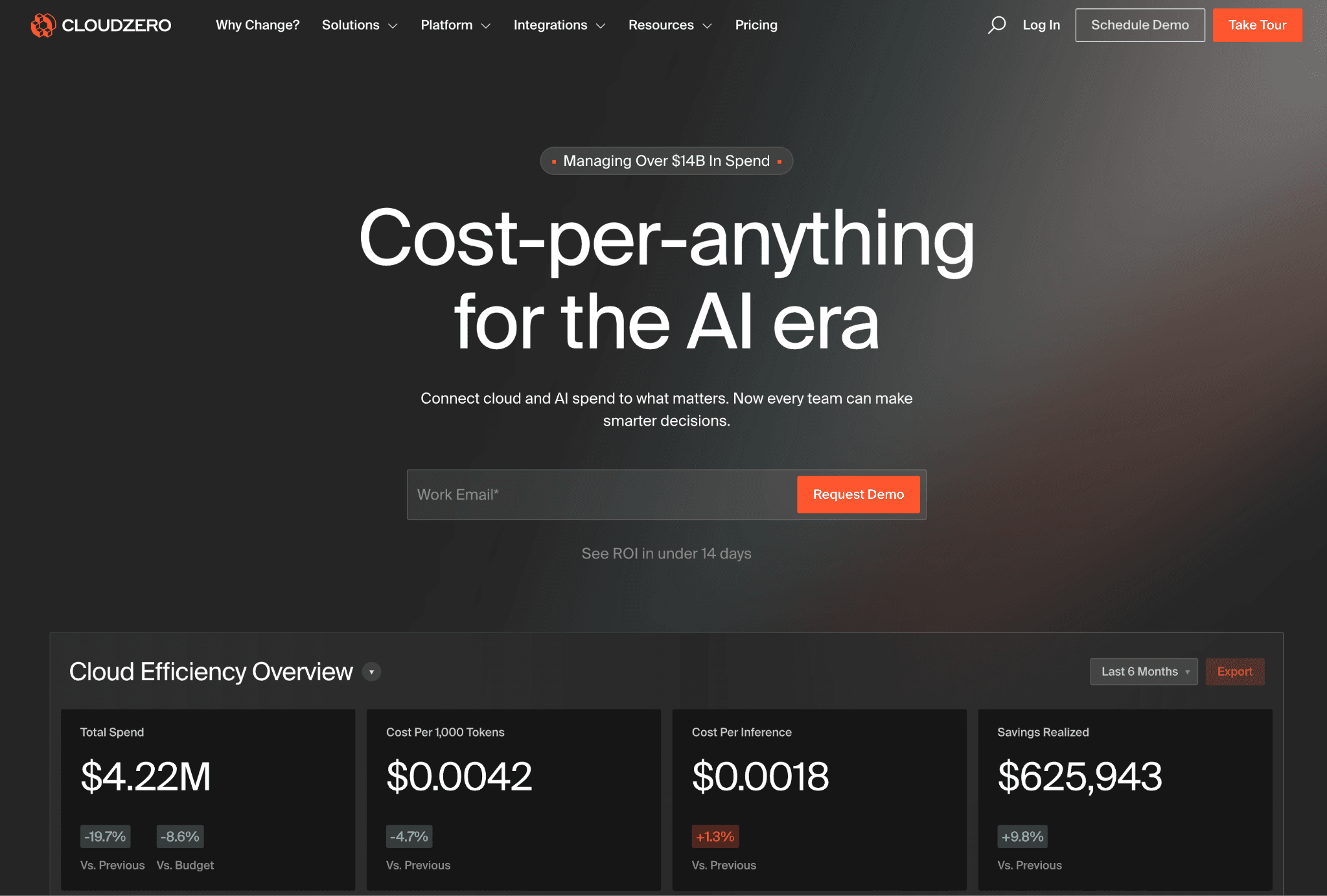
CloudZero is a cloud and AI cost intelligence platform focused on engineering-driven unit economics. The AnyCost framework ingests Cloudflare invoices through the Common Bill Format, then runs the CostFormation engine to map every Cloudflare dollar to a product, a feature, a customer or a deployment.
CloudZero is the choice when the question is not "how much did we spend on Cloudflare" but "what did our top ten customers cost us at the edge last quarter, including Workers and R2."
Key features:
AnyCost ingest for Cloudflare invoices through the Common Bill Format, with the same allocation engine handling Cloudflare and your other cloud and SaaS sources.
CostFormation rules that map Workers, R2, Stream and Workers AI cost to product features or customers using your existing business metrics, with no SQL required to build the allocation logic.
Cost per customer and cost per feature reports that include the Cloudflare portion of each, useful for SaaS teams where Cloudflare powers the edge layer of every customer request.
AI cost intelligence module that tracks Workers AI alongside other model providers, with allocation back to the product or feature that triggered the inference call.
Anomaly alerts at the feature level on Cloudflare-driven cost spikes, with context on which feature or deployment drove the change.
Engineering-leader reporting with cost per sprint, per deployment and per customer segment, including the Cloudflare share of each.
AnyCost CBF data model is documented publicly, so teams can build the Cloudflare ingest pipeline against a known specification rather than a private API.
Pricing: CloudZero sells exclusively through enterprise contracts with no public rate card and no self-serve onboarding. Pricing is tied to the cloud and Cloudflare spend volume under management, so teams below a certain threshold may struggle to justify the contract size.
Most deployments include a scoping engagement to model your Cloudflare lines and other cloud sources into the AnyCost Common Bill Format and to build the CostFormation allocation rules. Multi-year contracts are common, and CloudZero will quote a savings-aligned baseline for teams that want pricing pegged to delivered outcomes.
Pros:
CostFormation is one of the most flexible allocation engines in the market for SaaS companies that want Cloudflare cost tied to product features and customers, not just to a domain.
AnyCost CBF means the Cloudflare ingest pipeline is documented and inspectable, which procurement and security teams appreciate during review.
Engineering leadership at growth-stage SaaS companies consistently cites CloudZero as the reference tool for product-level unit economics, which matters when Cloudflare is part of the customer-facing stack.
Cons:
Enterprise-only pricing with no self-serve tier rules CloudZero out for teams below the threshold where a procurement cycle is justified.
Verified G2 reviewers call out a learning curve on initial setup and feature use, which extends time to first insight.
AnyCost ingest for Cloudflare runs through CBF rather than a one-click connector for every product line, so the initial pipeline still needs configuration.
Public G2 summary, May 2026: verified reviewers cite anomaly detection and customer support as standout strengths, with limited custom reporting on resource-level usage as the main gap.
5. Apptio Cloudability
Best for: Large enterprises with a dedicated FinOps team that needs Cloudflare cost ingested into a finance-grade chargeback and showback workflow alongside every other major cloud provider.
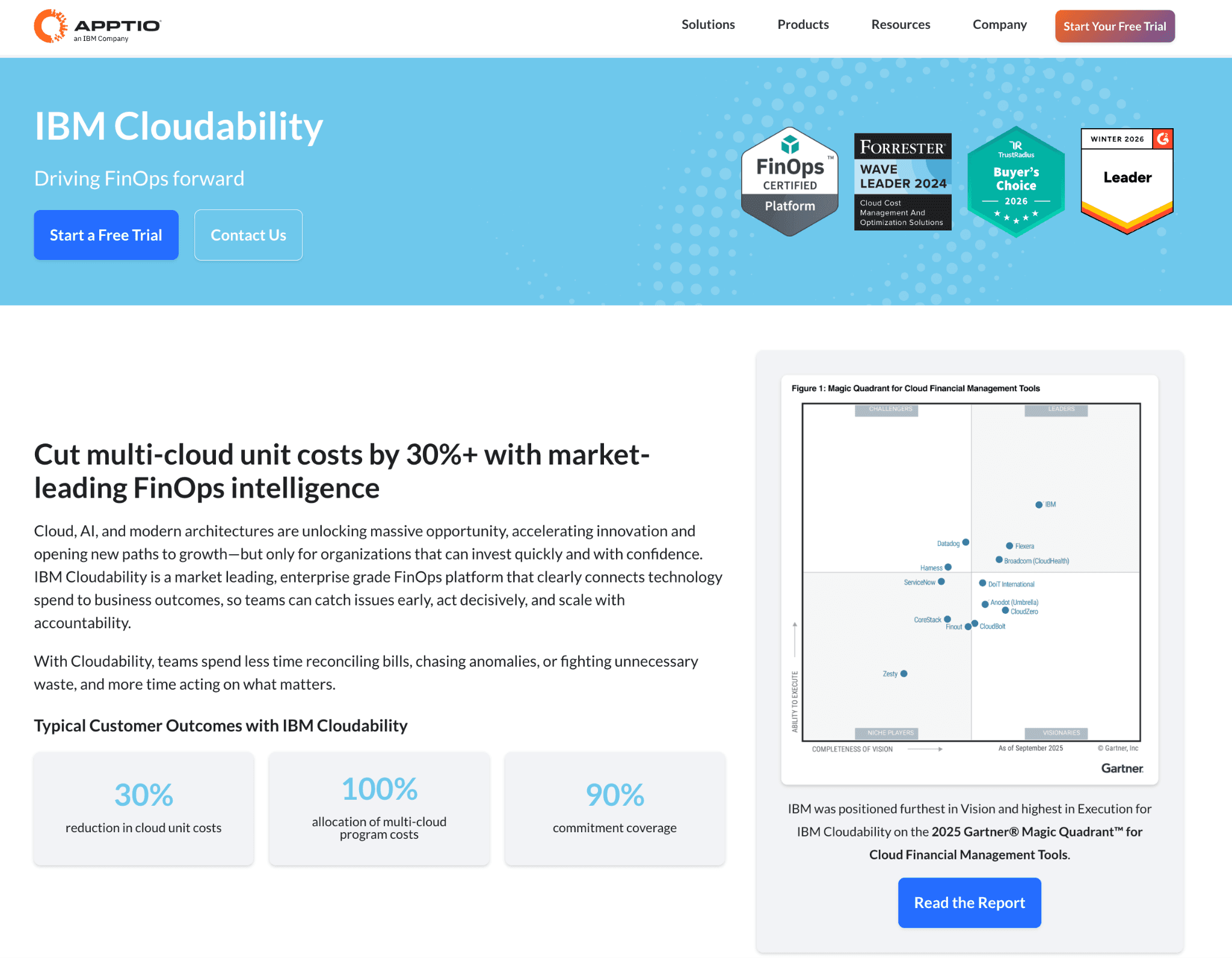
Apptio Cloudability, now part of IBM, is one of the longest-running enterprise FinOps platforms in the market. It ingests cost data from every major cloud provider and supports custom cost source ingest, which is the path Cloudflare invoices take into the platform. Cloudability is the choice for organizations that run monthly business reviews to a CFO and need the audit-grade reporting that finance teams sign off on.
Cloudability brings veteran reporting depth and enterprise governance. Most deployments are run by trained FinOps analysts, with IBM professional services involved in the initial build.
Key features:
Custom cost source ingest for Cloudflare invoices, with the same chargeback engine handling Cloudflare and your other major cloud sources in one allocation model.
Multi-cloud governance with policy enforcement that triggers alerts or approval workflows when Cloudflare or other cloud spend breaches an agreed budget.
Detailed chargeback and showback reports for shared Cloudflare infrastructure such as Argo Smart Routing or a shared Enterprise plan fee, allocated back to business units with audit-ready documentation.
Commitment and reservation analytics that cover Cloudflare bandwidth commitments alongside committed-use deals on other cloud sources, with projected ROI shown before any purchase.
Custom rate handling that lets a finance team encode negotiated Cloudflare contract pricing into the cost model rather than relying on list price.
Mature data export and BI tool integrations that push Cloudflare cost data into the reporting stack your finance team already uses.
Unit economics layer that ties Cloudflare cost to business metrics such as cost per active user or cost per transaction.
Pricing: Cloudability is sold through IBM enterprise agreements, with pricing structured around cloud spend volume and the number of accounts under management. There is no self-serve option and no free trial, so teams engage IBM sales before accessing a working environment. Most deployments include a professional services engagement and a 6 to 12 week initial onboarding to model Cloudflare and other cloud sources into the platform. That means the true cost of ownership includes services fees on top of the license.
Pros:
One of the most established platforms in the category with over a decade of enterprise FinOps deployments, giving it credibility with CFOs and procurement teams that prefer proven vendors.
Chargeback and showback reporting is among the most detailed available, with policy-based allocation rules that hold up under finance audit requirements.
Custom rate handling lets the team encode negotiated Cloudflare pricing into the cost model, useful for enterprises whose actual Cloudflare rates differ from public list pricing.
Cons:
Deployment typically takes 6 to 12 weeks and requires IBM professional services in most cases, which delays time to first Cloudflare cost insight and adds to total cost.
The interface is designed for trained FinOps analysts, so engineering teams and non-specialists find the learning curve steep compared to newer platforms with self-serve onboarding.
The product runs on IBM's release cycle, which is slower than independent FinOps vendors, so teams evaluating long-term Cloudflare-specific feature depth should factor that cadence into their decision.
Public G2 summary, May 2026: verified reviewers describe Cloudability as a mature enterprise FinOps platform with strong chargeback reporting, with the learning curve and IBM-led onboarding cycle called out as the main gaps.
6. Datadog Cloud Cost Management
Best for: SRE-first teams already running Datadog who want to correlate Cloudflare performance and log signals with cost data from their other cloud sources in one dashboard. Cloudflare-specific cost data into CCM is constrained, so it works best for teams whose Cloudflare bill is a smaller line than the rest of their cloud stack.
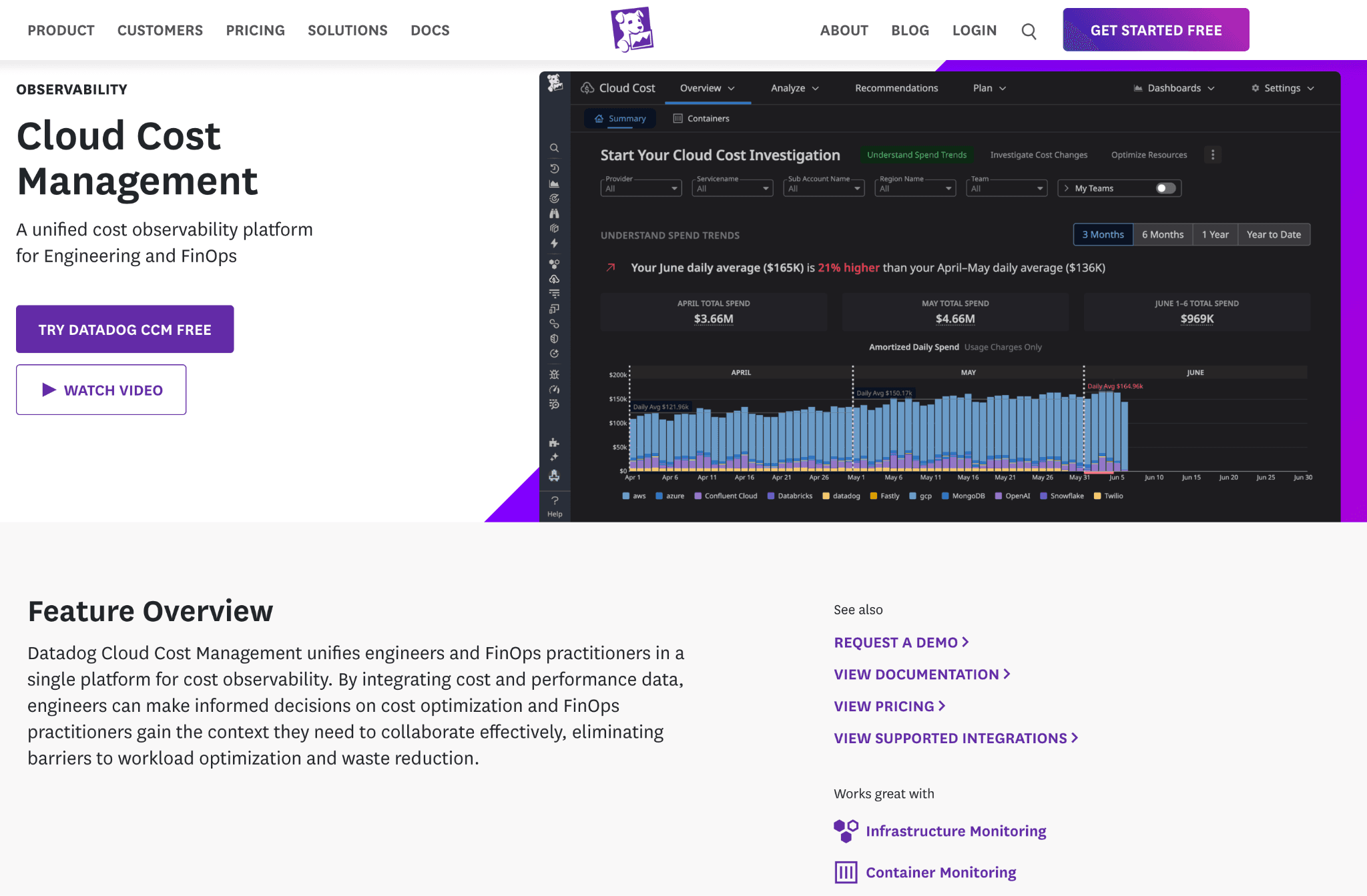
Datadog Cloud Cost Management adds cost views on top of the existing Datadog observability platform. Cloudflare is in the Datadog integrations catalog through the Cloudflare Analytics API and LogPush, but that integration pulls metrics and logs only, not billing data. Cloudflare cost lines do not flow through it into CCM today, so a team that wants Cloudflare cost in Datadog needs a separate ingest path through the SaaS cost integration framework or a custom upload.
The pitch is one tool for performance, security and cost. The reality is that Datadog pricing scales with hosts and ingestion, so adding CCM on a large Datadog footprint can compound the total bill faster than a purpose-built FinOps platform.
Key features:
Cloudflare integration in the Datadog catalog using the Cloudflare Analytics API and LogPush, useful for pulling Cloudflare performance, security and log signals into the same dashboard as cost data from other cloud sources.
Cost views joined with APM, log and metric data on supported cost sources, so an SRE can correlate a Cloudflare performance spike with cost movement on adjacent services upstream or downstream.
Custom allocation by tag using the existing Datadog tag hierarchy on supported cost sources.
Anomaly detection on cost lines surfacing in the same alert channels as performance incidents, so a cost event is treated as a first-class operational signal.
Existing Datadog dashboarding so cost widgets sit alongside operational runbooks and Cloudflare performance boards.
SaaS cost integrations framework that brings supported SaaS sources into CCM; teams should confirm current Cloudflare cost coverage on this path directly with Datadog before committing.
Datadog's own cost data is available in CCM at no additional charge, useful for teams whose Datadog bill is itself a material line.
Pricing: Datadog Cloud Cost Management is an add-on to an existing Datadog subscription, billed based on the number of cloud accounts monitored. Teams already on Datadog can activate it with minimal friction, but the activation does not change the pricing model on the core platform.
The combined cost of the core Datadog platform plus CCM often makes it one of the more expensive options in this list on a per-feature basis, particularly for teams whose primary need is Cloudflare cost management rather than full-stack observability. Annual contracts are typical, with negotiable host and ingestion commitments at enterprise tier.
Pros:
SRE teams already in Datadog get Cloudflare cost data in the same dashboard as latency, error rates and log events, removing the context switch that most FinOps tools require.
Correlating Cloudflare cost anomalies with APM traces is a capability no other tool in this list provides out of the box, useful when a cost spike needs to be traced back to a specific service change rather than a general traffic increase.
Existing Datadog alert routing, team structures and tag hierarchies carry over to CCM with no additional setup.
Cons:
The native Cloudflare integration in Datadog pulls metrics and logs only, not billing data, so Cloudflare cost lines do not flow into CCM through that path. Teams must use the SaaS cost integration framework or a custom upload, and current Cloudflare coverage on that path should be confirmed with Datadog before relying on it.
Datadog's pricing scales with hosts, log volume and ingestion, so adding CCM to a large deployment can push the combined bill well above what a purpose-built cost management tool would cost.
There is no unit economics modeling, no chargeback reporting and no contract-side governance, so finance teams and CFOs cannot use it as their primary Cloudflare cost platform.
Public Datadog documentation, May 2026: CCM ingests, normalizes, allocates and analyzes cloud and SaaS cost data across supported providers, with Cloudflare available through the existing Datadog integration.
Common Mistakes When Choosing Cloudflare Cost Optimization Tools
Most buyers do not lose money on the tool itself. They lose it on the wrong decision. Seven mistakes account for almost every regretted purchase in this category.
1. Treating Cloudflare as a Single Line, Not a Portfolio
Cloudflare is two products in one. The CDN, security and Zero Trust stack bills on a per-domain plan tier. The developer platform bills usage-based on Workers, R2, D1, KV, Pages, Stream, Images, Workers AI, AI Gateway and more. Teams that pick a tool that only shows the plan tier miss the lines that are actually growing.
2. Skipping Workers AI in the Evaluation
Workers AI inference is the fastest growing line on many Cloudflare bills in 2026. A tool that does not track Workers AI alongside other model providers will be missing your biggest growth line in 12 months. Ask every vendor about Workers AI coverage before signing.
3. Confusing Monitoring with Optimization
Real-time bill alerts and dashboards are not the same as cost optimization. Optimization needs recommendations on Workers usage model, R2 operation batching, plan-tier right-sizing and bandwidth commitment shape. Pick a platform that does both, not one that only tells you the bill is rising.
4. Forgetting the Security Review on API Token Scope
Tools that automate purchasing or scaling need write scope on your Cloudflare API token. Many security teams refuse to grant it. Confirm with your security lead before you sign a contract, not after, or you will spend three months in review.
5. Comparing on Feature Count, Not on Cloudflare Coverage Depth
A platform with 200 features sounds safer than one with 80. You will use 30 of them at most. Score on whether the tool covers Workers, R2, Workers AI, Stream and Images at the depth you need this quarter, not on the total feature count.
6. Ignoring Time to First Cloudflare Insight
Some platforms take six to twelve weeks to deploy a working Cloudflare cost view because the data ingest is custom. Others surface insights in hours. If your CFO is asking for savings now, a long onboarding kills momentum. Ask every vendor for a real Cloudflare customer dashboard 30 days after kickoff.
7. Letting the Cloudflare Renewal Auto-Roll
Cloudflare Enterprise contracts auto-renew on terms negotiated 12 months ago, often before bandwidth commitments and Workers credits have been reset against actual usage. Track renewals 90 days out and re-benchmark using usage data from your FinOps platform before the clock runs out.
How to Choose the Right Cloudflare Cost Optimization Platform
The right tool is the one that solves your single biggest Cloudflare cost problem in the first 90 days, not the one with the longest feature list.
Pick by the problem you are actually facing:
Visibility problem on Cloudflare and every other major cloud provider together. Choose a platform with FOCUS-aligned ingest and persona dashboards, like Amnic or Vantage.
Allocation problem mapping Cloudflare to features or customers. Choose CloudZero or Finout.
Workers AI cost problem. Choose Amnic or Finout for inference tracking alongside other model providers.
Chargeback and audit-grade reporting problem on a large Cloudflare footprint. Choose Apptio Cloudability or Amnic.
Observability-led problem where Cloudflare cost needs to sit next to latency and error data. Choose Datadog Cloud Cost Management for the existing observability stack, or Amnic for the FinOps-first view.
Multi-source problem unifying Cloudflare with infrastructure, SaaS and AI provider spend. Choose Finout or Amnic.
If your dominant problem is not Cloudflare-specific, the right reading list looks different. Teams with material spend across two or more hyperscalers should start from the broader multi-cloud cost management platform shortlist. Teams looking at the general FinOps category should review the wider cloud cost optimization tools listicle for context. Teams whose dominant line is AI inference, across Workers AI and other model providers, should weigh the FinOps tools for AI cost management and edge AI cost governors coverage. Teams wanting deeper allocation and unit-economics analysis should review the cloud cost intelligence tools angle.
Write down your top two Cloudflare cost problems. Compare only those two. You will pick faster and avoid paying for features you will never use.
Why Decision Makers Choose Amnic for Cloudflare Cost Visibility
Amnic is built around a simple belief: cloud cost should be transparent for every role, not just FinOps specialists. That belief carries directly into how Amnic treats Cloudflare.
The platform pairs deep granularity with an AI layer that finance leaders, engineers and product managers can each use without training. Three differentiators matter most to the decision makers we talk to every week.
Multi-source coverage that includes Cloudflare in the same cost truth as every other major cloud provider you run. Cloudflare invoices flow in through the FOCUS-aligned Cost Analyzer and the Custom SaaS ingest path, then surface in the same dashboards, alerts and persona reports as the rest of your spend. No more reconciling a Cloudflare PDF against a spreadsheet at month-end.
Read-only access by design. Amnic never touches your Cloudflare configuration. Your DevOps team owns every change. That single architectural choice is why security teams approve Amnic in days instead of months, since no Cloudflare API token ever needs write scope.
AI that any role can use. Amnic AI ships four agents (X-Ray, Insights, Governance, Reporting) that turn natural-language questions into filtered dashboards. A finance lead can ask "what did we spend on Workers, R2 and Workers AI this quarter" and get a persona-shaped answer in 30 seconds.
"Using Amnic has been nothing short of transformational. The platform is able to analyze our cloud costs at a depth that would take us several hours, if not days to understand better." Ajeesh Achuthan, Co-Founder & CTO, Open Financial case study on Amnic.
Read the full case studies on the Amnic customers page.
Frequently Asked Questions
What is the difference between Cloudflare cost management and Cloudflare cost optimization?
Cloudflare cost management is the reporting and allocation layer. It tells you what you spent on Workers, R2, Stream, Images, Workers AI and the plan tier, and lets you split that spend across teams or products.
Cloudflare cost optimization adds the action layer on top: right-sizing the Workers usage model, batching R2 Class A operations, choosing the right Workers AI model, modeling bandwidth commitments on the Enterprise contract. Most modern platforms in this list cover both surfaces, but the depth varies. Amnic and Finout span the widest cost surface; CloudZero goes deepest on allocation; Cloudability owns the chargeback and audit surface; Datadog CCM sits closest to the observability stack.
How much can I save with Cloudflare cost optimization tools?
Most teams recover 10 to 20% of Cloudflare spend in the first 90 days through plan-tier right-sizing, Workers usage-model changes, R2 operation batching and AI Gateway log retention tuning. Enterprise customers running material bandwidth commitments report 15 to 30% off the contracted rate through multi-year deals and committed-use discounts.
Amnic customers have hit 30 to 50% on specific non-Cloudflare cost categories where the same approach applies, such as Kubernetes clusters and network gateways. Cloudflare-specific savings depend heavily on how much Workers, R2 and Workers AI sit in your stack today.
Does Cloudflare cost optimization software need write access to my Cloudflare account?
Not for visibility and allocation. Amnic, Vantage, Finout, CloudZero, Apptio Cloudability and Datadog CCM all run on read-only API tokens or invoice ingest paths, so your DevOps team owns every change. Tools that automate purchasing or scaling on Cloudflare would need write scope, and we recommend verifying with your security team before granting any write-scoped token to a third party. None of the six platforms in this list require write access to deliver the core Cloudflare cost optimization workflow.
Can these tools track Workers AI and AI Gateway spend?
Yes, with varying depth. Amnic tracks Workers AI inference as part of the AI Token Management module alongside other frontier model providers. Finout brings OpenAI and Anthropic into MegaBill alongside Workers AI, useful for teams whose inference now spans more than one provider. CloudZero ships an AI cost intelligence module that maps inference to features and customers. Vantage covers OpenAI and Anthropic billing today and is the path for Workers AI through the FOCUS converter. Cloudability uses its custom rate path for Workers AI lines, while Datadog CCM is scoped to host and ingestion metrics rather than per-model inference cost.
Which Cloudflare cost optimization platforms work for multi-source teams?
Amnic, Finout and CloudZero lead on bringing Cloudflare into a unified cost view with every other major cloud provider you run. Amnic uses FOCUS-aligned ingest and surfaces Cloudflare lines next to your other cloud sources for finance, platform and SRE personas.
Finout uses MegaBill connectors and custom CSV upload to consolidate Cloudflare with data warehouses, observability vendors and AI providers. CloudZero uses AnyCost and the Common Bill Format to bring Cloudflare into the same allocation engine as the rest of your stack. Vantage and Cloudability also cover multi-source ingest, with Vantage on the self-serve end and Cloudability on the enterprise end of the spectrum.
How long does it take to deploy Cloudflare cost optimization tools?
Read-only platforms with self-serve onboarding such as Vantage get to a Cloudflare cost view within hours, with no professional services involvement. Amnic onboards in around 5 minutes for the read-only ingest and adds Cloudflare through the Custom SaaS path with a billing export.
Finout and CloudZero typically run a structured onboarding of a few weeks for complex stacks. Datadog CCM activates immediately for teams already on Datadog with the Cloudflare integration enabled. Apptio Cloudability runs the longest cycle, typically 6 to 12 weeks with IBM professional services.
Is a Cloudflare cost optimization platform worth it for a small team?
If your monthly Cloudflare bill is under a few hundred dollars and you are not running material Workers, R2 or Workers AI volume, the native Cloudflare billable usage dashboard and budget alerts may be enough. Above a few thousand dollars per month, or when Workers AI and R2 start to dominate the bill, a dedicated platform typically pays for itself. Vantage's free tier is the lowest barrier on this list. Amnic offers a one-month free trial on the startup tier. Finout, CloudZero, Cloudability and Datadog CCM are the right answer when Cloudflare sits alongside material spend on other cloud sources.
How do these platforms handle chargeback and audit reporting on Cloudflare cost?
Apptio Cloudability has the most detailed chargeback and showback reporting on this list, with policy-based allocation rules that hold up under finance audit requirements. Amnic offers chargeback views through its persona reports and unit economics layer. CloudZero and Finout both support feature-level and team-level allocation that finance teams can use for internal reporting. Vantage offers tag-based cost reports for engineering team-level chargeback. Datadog CCM is the lightest on this dimension, focused on operational dashboarding rather than finance-grade audit trails.
How do I track Cloudflare Workers AI inference cost separately from Workers compute?
Workers AI is billed on Neurons and per-token inference rates that vary by model, separate from the Workers CPU-time and request lines. To track Workers AI separately, the platform needs to recognize the AI inference line in the Cloudflare invoice and split it from the Workers compute line. Amnic does this through the AI Token Management module, which tracks frontier model spend including Workers AI alongside other model providers. Finout and CloudZero handle the split through MegaBill and AnyCost respectively. The native Cloudflare billable usage dashboard now shows Workers AI as a distinct line, which is a useful cross-check against any third-party tool.
Cut Your Cloudflare Bill in the Next Quarter
If you are a CFO, FinOps lead or VP of Engineering looking to recover 10 to 20% of your Cloudflare spend before the next board review, Amnic is built for you.
Book a 30-minute demo and see your top three Cloudflare cost leaks alongside your other cloud sources before the call ends.
Better visibility and management into AI Tokens?
Start with a 30 day trial
Connect leading LLMs
24 hour time to value
Stay ahead of AI Spend

Make AI spend visible, controllable, and accountable.
Gain insights into your AI token costs at a team, customer, business unit and individual user level to measure and manage AI utilization.
Recommended Articles

8 Best Llama Cost Management Tools in 2026
Read More
8 Best Amazon Bedrock Cost Optimization Tools for 2026
Read More

7 Best Amazon Bedrock Cost Monitoring Tools
Read More

8 Best Gemini Cost Visibility Tools for 2026
Read More

7 Best Multimodal Cost Optimization Tools for 2026
Read More

5 Best Anthropic Cost Allocation Tools for 2026
Read More