9 Best Cloud Cost Budgeting Software in 2026
12 min read
Tools
Cost Control
Table of Contents
Comparing the top 9 best cloud cost budgeting software of 2026 are 1. Amnic, 2. Ternary, 3. nOps, 4. CloudZero, 5. Apptio Cloudability, 6. Vantage, 7. Finout, 8. Harness CCM and 9. Datadog Cloud Cost Management.
Cloud cost budgeting software helps finance and engineering teams set spend limits, track budgets against actual usage across AWS, Azure, GCP and Kubernetes and alert the right person before the bill blows past plan.
Top 9 Cloud Cost Budgeting Software in 2026
Amnic: One FinOps OS for CFO, CTO, FinOps and SRE to set, track and enforce cloud budgets across AWS, Azure, GCP, Oracle, Alibaba and Kubernetes without write access.
Ternary: Best for FinOps teams standardizing on the FinOps Foundation FOCUS specification, with strong Google Cloud and multi-cloud budget enforcement.
nOps: Best for AWS-heavy teams that want Budgets, anomaly tracking and automated commitment management in one console.
CloudZero: Best for SaaS engineering teams that need budgets mapped to product features and cost per customer, not just service-level totals.
Apptio Cloudability: Best for finance teams that need audit-ready chargeback budgets and monthly cloud cost close inside an IBM-owned platform.
Vantage: Best for self-serve teams that want a budget alert in Slack within an hour of signup, with a free tier and no sales process.
Finout: Best for finance-led organizations consolidating cloud, Kubernetes and SaaS into one budget through the MegaBill view.
Harness CCM: Best for existing Harness customers who want hierarchical budgets enforced inside their CI/CD workflow.
Datadog Cloud Cost Management: Best for SREs who already own Datadog and want budgets in the same dashboard as latency and error alerts.
Comparison Table: Top 9 Cloud Cost Budgeting Software in 2026
The table below summarizes the 9 tools by cloud support, budget alert depth, cost allocation, AI capability, free trial and starting price.
Tool | Multi-Cloud Support | Budget Alerts | Cost Allocation | AI Capabilities | Free Trial | Starting Pricing | Best For |
Amnic | AWS, Azure, GCP, Oracle, Cloudflare, Alibaba, K8s | Threshold + anomaly + Governance Agent | Virtual Tags, hierarchical, unit economics | Amnic AI + 4 agents (X-Ray, Insights, Governance, Reporting) | Yes, 1 month, no credit card | 0.25% to 1% of cloud spend | Multi-cloud FinOps with AI-driven budget governance |
Ternary | GCP, AWS, Azure, OCI, Alibaba | Threshold + variance + Slack/email | FOCUS-aligned, business mapping | FinOps assistant, narrative summaries | Demo only | From $25K per year | FOCUS-spec FinOps teams on Google Cloud |
nOps | AWS-first, limited Azure / GCP | Threshold + anomaly + Slack/email | Business Contexts, container allocation | Compute Co-Pilot, ShareSave | 14-day free trial | 1.95% of monitored AWS spend | AWS-heavy teams that want budgets plus commitment automation |
CloudZero | AWS, Azure, GCP, Databricks, Snowflake | Threshold + anomaly + Slack | CostFormation, cost per feature/customer | AnomalyHunter, AI summaries | Demo only | Custom, contact sales | SaaS engineering teams aligning cost to product |
Apptio Cloudability | AWS, Azure, GCP, OCI | Threshold + variance + email | Business mapping, chargeback at scale | Bottom-up AI forecasting, anomaly | Demo only | Custom, contact sales | Enterprise finance teams with chargeback needs |
Vantage | AWS, Azure, GCP, Kubernetes, 20+ SaaS | Threshold + anomaly + Slack | Cost Reports, segmentation | FinOps Agent, Vantage Autopilot | Free tier up to 2 cloud accounts | Free, paid from 2.5% of cloud spend | Self-serve teams that want budgets in under an hour |
Finout | AWS, Azure, GCP, K8s, Snowflake, Datadog | Threshold + anomaly + MegaBill | Virtual Tagging, Shared Cost allocation | Waste Detection, anomaly | Demo only | Custom, contact sales | Finance-led orgs consolidating cloud and SaaS budgets |
Harness CCM | AWS, Azure, GCP, Kubernetes | Hierarchical budgets, threshold + anomaly | Perspectives, governance-as-code | AIDA AI, anomaly detection | Free up to $250K spend | Free tier, then custom | Harness customers needing CI/CD-native budgets |
Datadog CCM | AWS, Azure, GCP, Oracle, SaaS | Basic + Hierarchical budgets | Cost tags, allocation rules | Bits AI, watchdog | 14-day free trial | $4 per resource per month (add-on) | SREs who already use Datadog observability |
Pricing reflects publicly listed information as of May 2026. Where vendors do not publish prices, the entry reads "custom, contact sales”.
What Is Cloud Cost Budgeting Software?
Cloud cost budgeting software is a platform that sets monetary limits on cloud spending across teams, products, environments and accounts, tracks actual usage against those limits in real time and alerts owners before the budget breaks across AWS, Azure, GCP and Kubernetes.
Which Tool Should You Pick? Buyer Shortcut
Your situation | Pick |
Multi-cloud (AWS + Azure + GCP), need AI-driven budget governance, security demands read-only deployment | Amnic |
FinOps team standardising on the FOCUS spec, primarily on Google Cloud | Ternary |
AWS-only, want budgets and commitment automation in one console | nOps |
SaaS company that needs budgets per product, feature or customer | CloudZero |
Fortune 500 finance team that needs audit-grade chargeback | Apptio Cloudability |
Engineering team that wants a budget live in under an hour, free tier OK | Vantage |
Finance-led org with messy tags and Snowflake/Datadog spend to consolidate | Finout |
Existing Harness CI/CD customer | Harness CCM |
Already paying for Datadog observability, want budgets in the same dashboard | Datadog CCM |
Top 9 Cloud Cost Budgeting Software in 2026
1. Amnic
Best for: FinOps teams that want a single platform where CFOs, CTOs, FinOps practitioners and SREs all set, track and enforce cloud budgets across AWS, Azure, GCP, Oracle, Alibaba and Kubernetes, with read-only deployment and an AI agent that does the work.
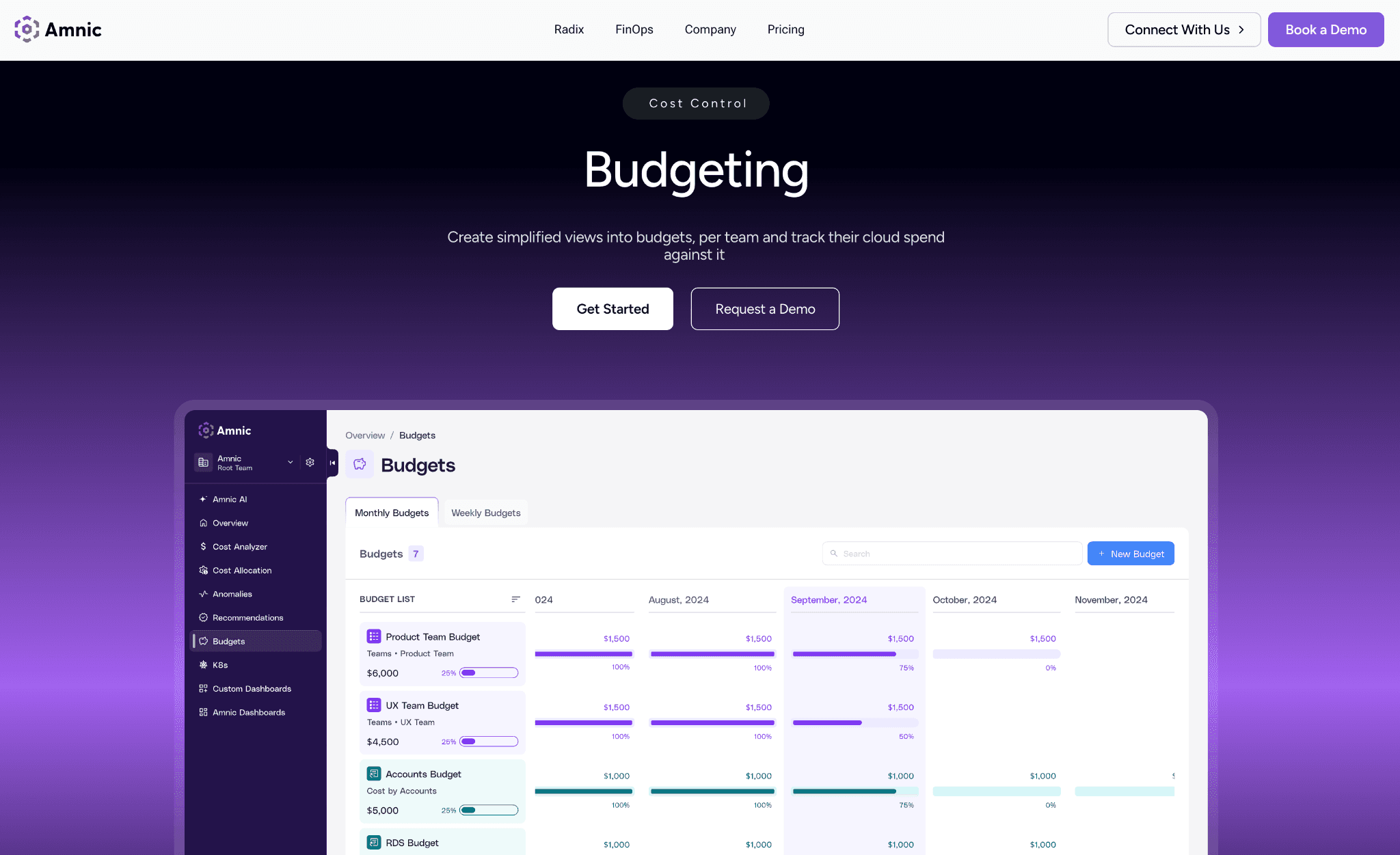
Overview: Amnic is a FinOps OS powered by context-aware AI agents that combine multi-cloud budget governance, anomaly detection and persona-specific reporting in one read-only platform. It is built for organizations whose cloud bill is too fragmented for native tools and too business-critical to manage in spreadsheets.
Key budgeting features:
Hierarchical cloud budgeting across accounts, projects, teams, products and Kubernetes namespaces
Threshold, anomaly and budget-drift alerts pushed to Slack, email and Jira
Governance Agent that enforces tag hygiene, assigns ownership and runs root-cause analysis on budget overruns
Virtual Tags to fix the gaps in native cloud tagging without touching production
Cost allocation by product, customer, BU and environment for unit economics views
Persona-specific budget dashboards for CFO, CTO, FinOps and SRE
5-minute agentless onboarding with read-only access only, SOC 2 Type II, ISO 27001 and GDPR compliant
Available on the AWS Marketplace AI Agents and Tools category
Pricing: 0.25% to 1% of monitored cloud spend. One-month trial on the startup tier with no credit card required. See Amnic pricing for tier details.
Pros
True multi-cloud plus Kubernetes from day one
AI agents reduce manual budget work for FinOps practitioners
Read-only deployment means no write access to customer infrastructure
Persona views remove the "different dashboard per team" problem
Cons
Newer to the category than Cloudability or CloudHealth, so analyst coverage is still building
Enterprise procurement teams sometimes ask for more reference customers in BFSI
What users say: Customers report measurable savings within weeks. "Working with Amnic has paved the way for a journey where we have control and comprehension of the overall cloud spend... Amnic is playing the long-term role of watching out for unprecedented costs and giving us insights into spends that could be better managed over time." Abhra Dasgupta, Uni, 20% reduction in cloud infrastructure costs
2. Ternary
Best for: FinOps teams standardizing on the FinOps Foundation FOCUS specification, especially those running primarily on Google Cloud with secondary AWS, Azure, Oracle or Alibaba workloads, who want budgets governed by a certified FinOps platform.
Overview: Ternary is a FinOps platform purpose-built for Google Cloud cost management and extended into multi-cloud cost management platform, with budget enforcement, anomaly detection and business mapping designed around the FOCUS data model.
Key budgeting features:
FOCUS-aligned budget definitions across AWS, GCP, Azure, OCI and Alibaba
Business mapping for chargeback budgets to teams, products and BUs
Real-time variance alerts via Slack and email
Granular budget views for FinOps practitioners, engineering and finance
Anomaly detection with root-cause linking
FinOps-certified platform per the FinOps Foundation member directory
MSP-friendly licensing for managed service providers running multiple tenants
Pricing: Starts at $25,000 per year. Pricing is not seat-based and Ternary encourages teams to invite collaborators.
Pros
Deepest Google Cloud cost engineering on the market
FOCUS-spec alignment makes the data portable
Strong MSP and partner tooling
Cons
AWS and Azure coverage is less mature than its GCP coverage
No public G2 reviews yet, so peer validation is limited
Entry price is high relative to startups
What users say: Ternary was named a Leader in the 2025 ISG Provider Lens for FinOps Platforms and it manages more than $7B in multi-cloud spend across enterprise and MSP customers. Direct verbatim quotes are limited because Ternary does not yet have a populated G2 profile.
3. nOps
Best for: AWS-heavy teams that want hierarchical budgets, container cost allocation, anomaly detection and automated commitment management running together in one console.
Overview: nOps is an automated cloud cost optimization platform focused on AWS, combining Budgets, Business Contexts, container cost allocation and commitment automation under the ShareSave program. It manages more than $2 billion in AWS spend on behalf of its customers.
Key budgeting features:
Budgets and Cost Tracking module with threshold alerts and trend analysis (see introducing nOps Budgets)
100% cost allocation across multi-cloud, SaaS, Kubernetes and AI spend
Business Contexts for tying budgets to teams, products and environments
Compute Co-Pilot that rightsizes EC2 against budget targets
ShareSave automated commitment purchasing tied to budget caps
Anomaly detection with Slack, email and webhook integrations
100% AWS-first coverage with broader cloud support in development
Pricing: 1.95% of monitored AWS spend. 14-day free trial available. See nOps pricing on G2.
Pros
One of the highest G2 ratings in the cloud cost management category
Combines budgets with commitment automation, which most competitors split into two products
Strong AWS depth and developer experience
Cons
AWS-first means Azure and GCP support is thinner
ShareSave automation requires write-access permissions some security teams will not grant
Documentation is AWS-centric
What users say: "nOps Compute Co-Pilot significantly optimized our AWS EC2 costs. Its ability to continuously manage, scale and optimize compute resources ensures we're always getting the best deals. See Amnic's roundup of AWS cost optimization tools.
4. CloudZero
Best for: SaaS engineering teams that need budgets mapped to product features, environments and cost per customer, not just service-level totals from AWS Cost Explorer.
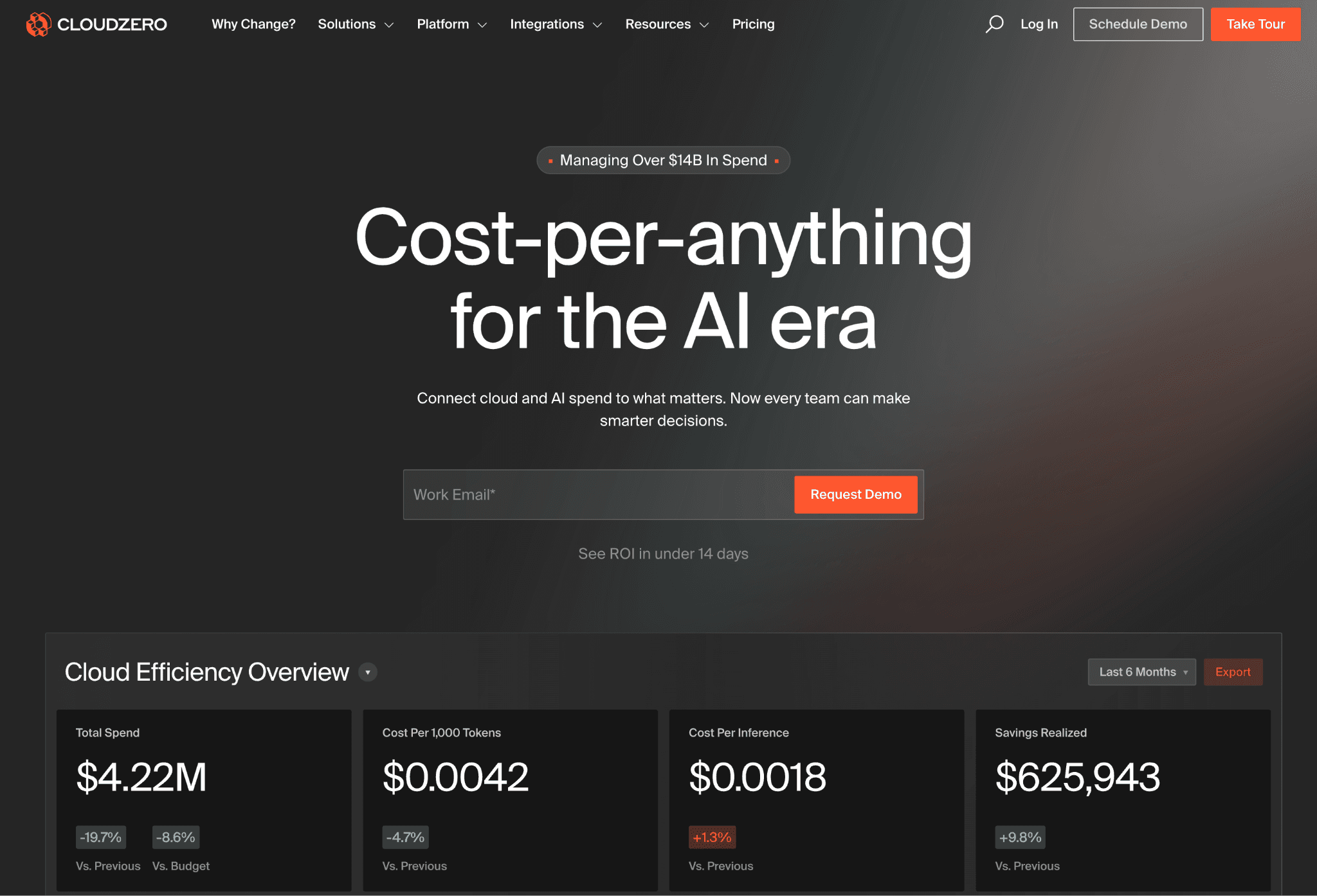
Overview: CloudZero is a cloud cost intelligence platform that allocates spend across products, features and customers and ties budgets to those business dimensions. It is widely cited in cloud cost management tools roundups for its CostFormation language and unit cost reporting.
Key budgeting features:
Budgets at the product, feature, team and customer level using CostFormation
Real-time budget tracking against AWS, Azure, GCP, Snowflake and Databricks spend
AnomalyHunter for AI-driven budget variance investigation
Slack-native alerting for budget thresholds and anomalies
Custom dashboards for finance and engineering, with shared-cost rules
API access for programmatic budget integration
Pricing: Custom, contact sales. CloudZero does not publish pricing publicly.
Pros
Strongest product-level budget granularity on the market for SaaS
G2 ratings of 9.0 ease of use, 9.5 dashboards and 9.9 support
Sophisticated cost-per-customer modeling
Cons
Reviewers note limited sorting and filtering inside the budgets module
Notifications combine anomaly, weekly, monthly and budget alerts in the same channel
Pricing is reported as expensive for smaller teams
What users say: "CloudZero strengthens anomaly detection and budget governance, helping to catch issues earlier and improve accuracy across client environments." Verify at G2: CloudZero reviews.
5. Apptio Cloudability
Best for: Enterprise finance teams that need audit-ready chargeback budgets, multi-month variance reporting and a mature platform inside the IBM Apptio product family.
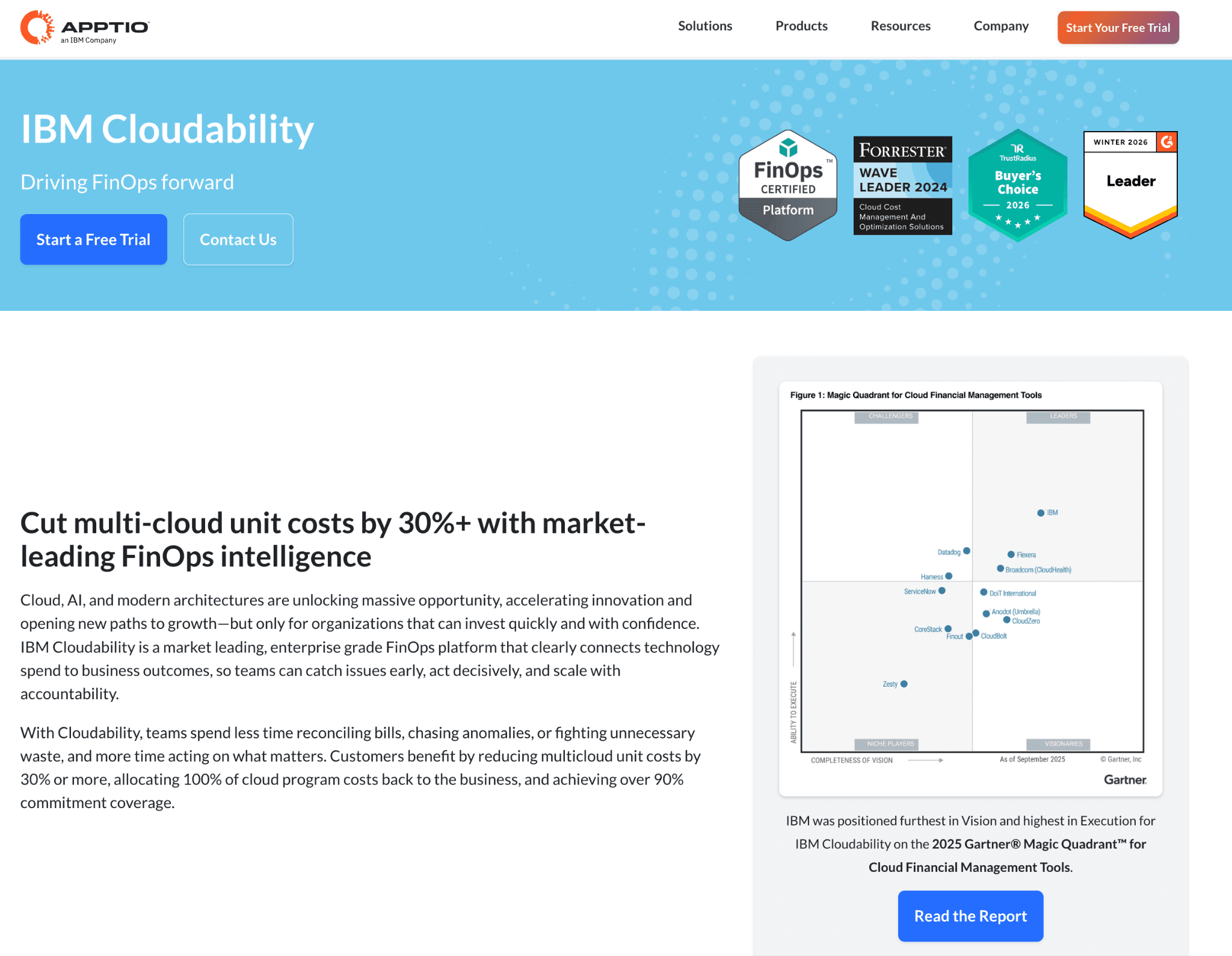
Overview: Apptio Cloudability is a long-established cloud financial management platform that ships enterprise-grade budgeting, chargeback, showback and AI-backed forecasting across AWS, Azure, GCP and Oracle Cloud. It is the default choice in Fortune 500 finance organizations.
Key budgeting features:
Business Mapping for chargeback at scale with direct and shared cost allocation
Top-down budgeting workflows combined with bottom-up rollups
AI-backed budget variance analysis with seasonality awareness
Audit-ready reporting for finance and procurement
Custom dimensions for unit economics views, see Amnic's cloud cost allocation software roundup for context
Anomaly detection with executive-ready reporting
Pricing: Custom, contact sales. No public pricing available. See Cloudability pricing breakdown for third-party pricing analysis.
Pros
Deepest enterprise chargeback workflow in the category
Trusted by procurement and finance teams in regulated industries
Cons
UI lags behind newer competitors per Gartner Peer Insights
Steep learning curve and long implementation cycles
Opaque pricing makes early evaluation difficult
What users say: Reviewers highlight Cloudability for "customizable dashboards to monitor and analyze cloud usage and costs, chargeback reporting including custom dimensions and business mappings for cost allocation”.
6. Vantage
Best for: Self-serve engineering and FinOps teams that want budgets working in under an hour, with Slack alerts, no sales process and a free tier that covers small footprints.
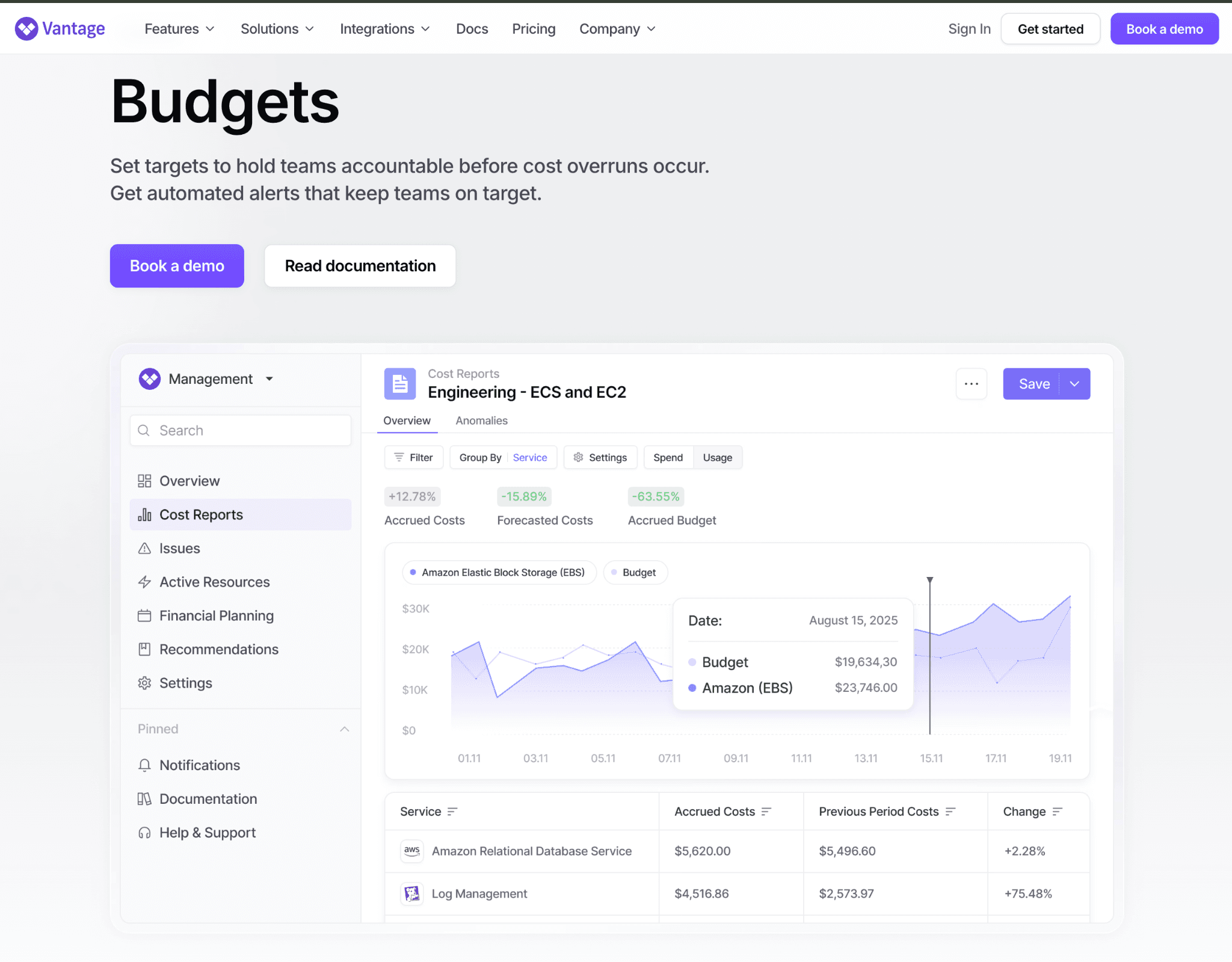
Overview: Vantage is a multi-cloud cost platform that delivers budgets, cost reports, anomaly alerts and recommendations across AWS, Azure, GCP, Kubernetes and 20-plus SaaS services. It is the fastest tool in this list to go from signup to working budget. For a deeper category view, see Amnic's cloud cost visibility software guide.
Key budgeting features:
Cost Reports with custom segmentation for budget definitions
Threshold and anomaly alerts pushed to Slack
FinOps Agent that surfaces unattached EBS volumes, outdated snapshots and other waste against budget targets
Vantage Autopilot for automated Savings Plan management within budget guardrails
20-plus native integrations, including Snowflake, Datadog, OpenAI and Cursor
Cost recommendations with detailed implementation instructions
Pricing: Free tier covers up to 2 cloud accounts and limited features. Paid plans start at roughly 2.5% of monitored cloud spend.
Pros
Fastest time-to-first-budget in this list
Free tier makes it trivial to evaluate
Comprehensive SaaS coverage beyond hyperscalers
Cons
Cost data is delayed by one day for certain services, which slows real-time monitoring
Alerting is less proactive than competitors; remediation guidance is light
Enterprise-grade chargeback is lighter than Cloudability or Finout
What users say: "Vantage gives complete visibility into cloud infrastructure costs across both AWS and GCP. It is particularly useful for spotting outlier moments like cost spikes, misconfigured resources running 24/7 and forgotten test environments." Verify at G2: Vantage reviews.
7. Finout
Best for: Finance-led organizations that need to consolidate cloud, Kubernetes and SaaS costs into one budget, with strong shared cost rules and virtual tagging.
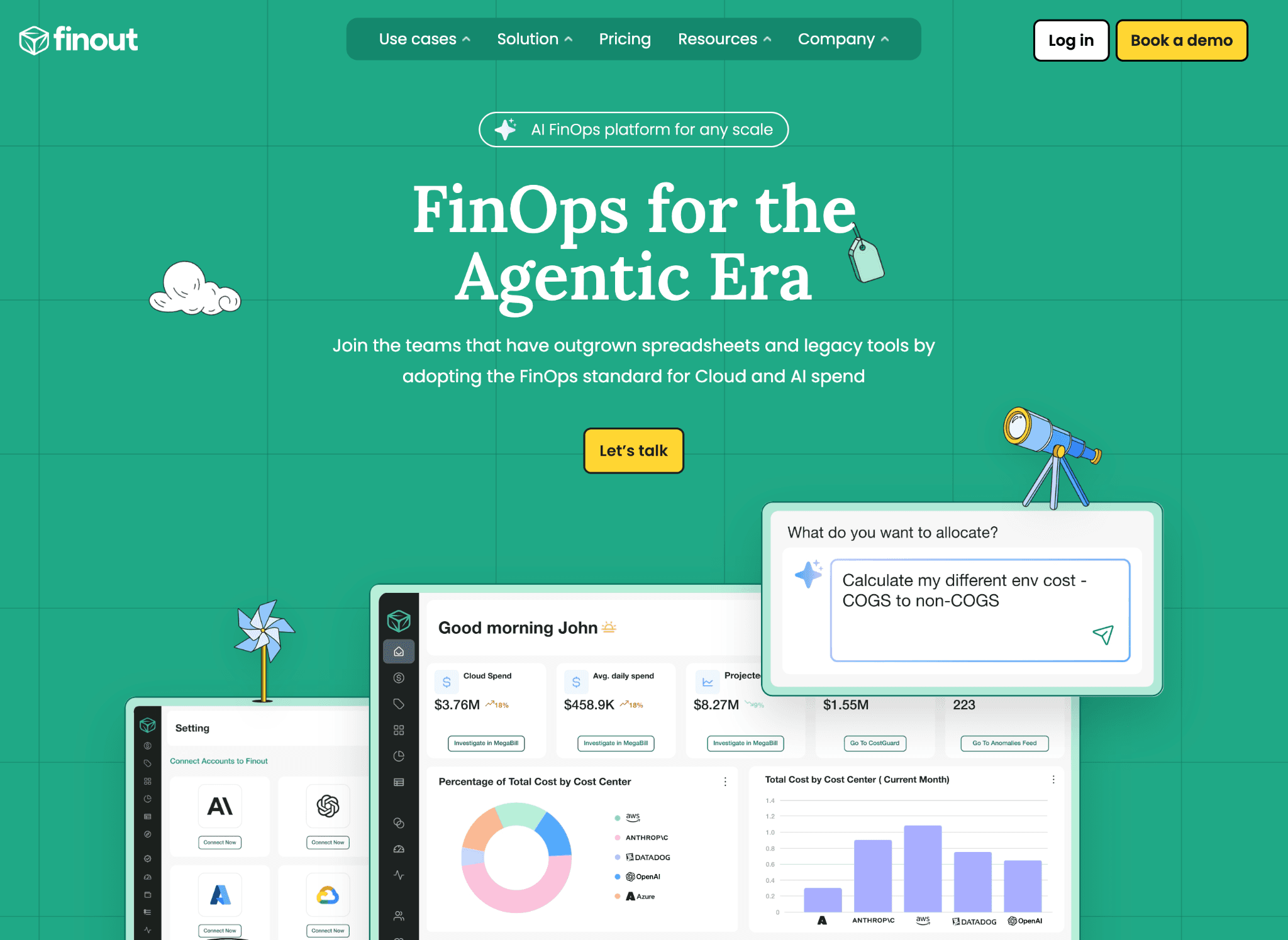
Overview: Finout is a cloud-agnostic FinOps platform that consolidates AWS, Azure, GCP, Kubernetes, Snowflake, Datadog and custom costs into a single MegaBill, then drives budgeting and governance from that unified view. It is built for organizations that already have a tagging problem they need to fix without touching infrastructure. See related cost allocation tools.
Key budgeting features:
MegaBill that unifies cloud, container and SaaS spend in one budget surface
Virtual Tagging for instant cost attribution without infrastructure changes
Shared Cost rules for accurate 100% allocation
Waste Detection with budget-aware recommendations
Budget alerts via Slack, email and webhooks
Anomaly detection across the unified bill
Granular governance for finance teams running monthly close
Pricing: Custom, contact sales. See Finout pricing breakdown for third-party analysis.
Pros
G2 rating of 8.7/10 overall, 8.8/10 for dashboards
Strongest unified-bill view in this list
Virtual Tagging avoids the typical tag-cleanup project
Cons
Initial setup with multiple cloud accounts is reported as complex
Advanced features carry a learning curve
Public pricing is unavailable
What users say: "Finout saves time, reduces surprises in billing and makes budgeting much easier”. Verify at G2: Finout reviews.
8. Harness CCM
Best for: Teams that already use Harness for CI/CD and want hierarchical cloud budgets enforced inside the same delivery workflow, without adding a second vendor.
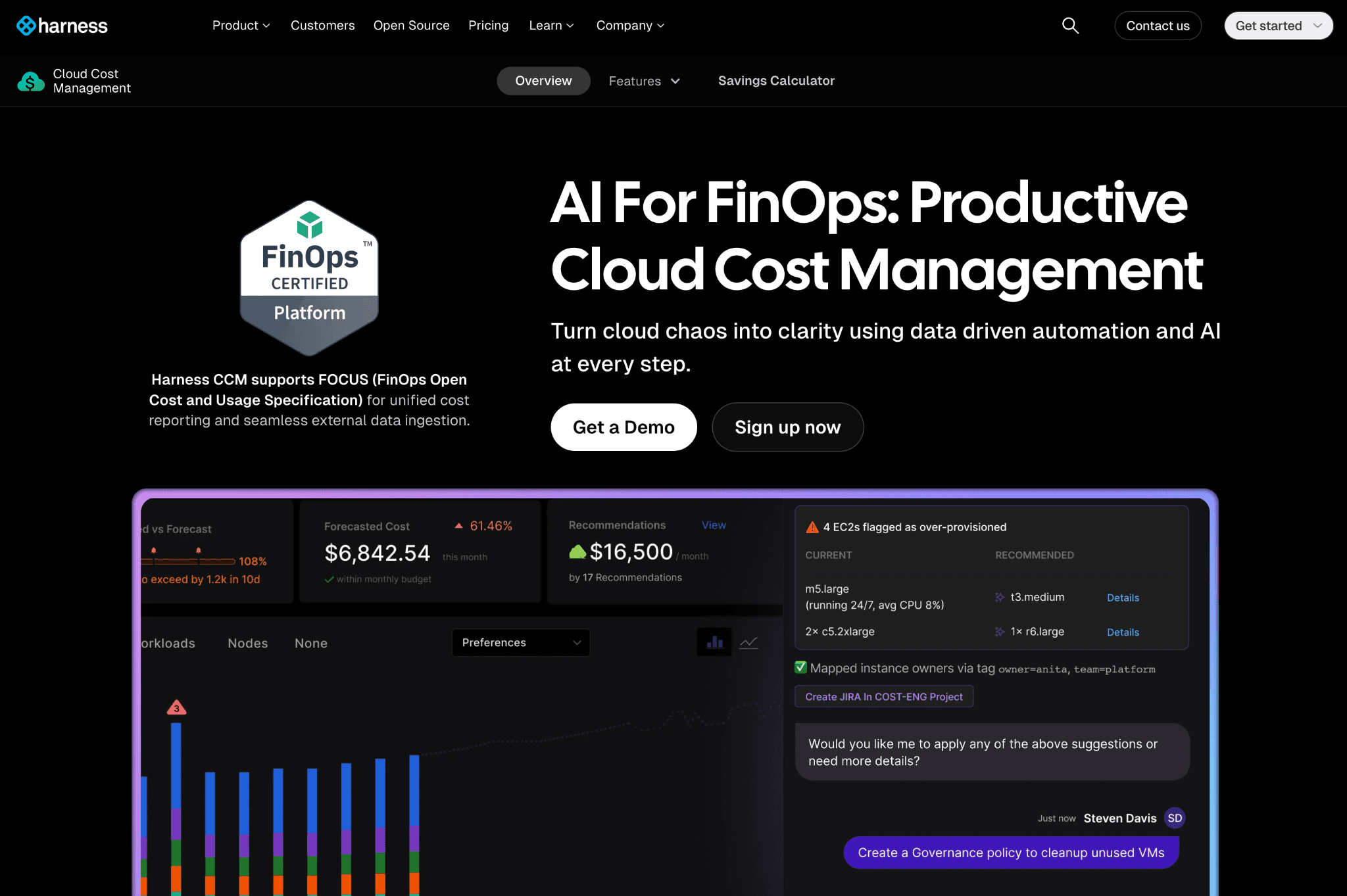
Overview: Harness Cloud Cost Management is a module of the Harness platform that delivers hierarchical budgets, anomaly detection and AI-driven recommendations across AWS, Azure, GCP and Kubernetes, with governance enforced through the same pipelines that ship code. For teams pursuing integrating FinOps into CI/CD, it is the most native option.
Key budgeting features:
Hierarchical Budgets at daily, monthly, quarterly and annual cadences
Real-time budget forecasting with threshold alerts
Perspectives for cost allocation by team, environment and product
Governance-as-code policies enforced in pipelines
AIDA AI recommendations with anomaly detection
Native integration with Harness CI/CD, Feature Flags and Service Reliability
Pricing: Free tier covers up to $250,000 in annual cloud spend. Paid tiers are custom, contact sales.
Pros
Recognized as a Strong Performer in The Forrester Wave: Cloud Cost Management and Optimization, Q3 2024
Hierarchical budgets are well-modeled
Cost governance inside CI/CD pipelines is unique to Harness
Cons
Pricing is high for small to mid-sized organizations
Steeper learning curve, especially for teams new to Harness CI/CD
Best value comes only if you already use Harness modules
What users say: Reviewers praise Harness CCM for "user-friendly dashboards which provide real-time insights into cloud spending and AI-powered continuous cost anomaly monitoring”. Verify at Gartner Peer Insights: Harness CCM reviews.
9. Datadog Cloud Cost Management
Best for: SRE and platform teams that already pay for Datadog observability and want cloud budgets in the same dashboard as latency, error rate and trace alerts.
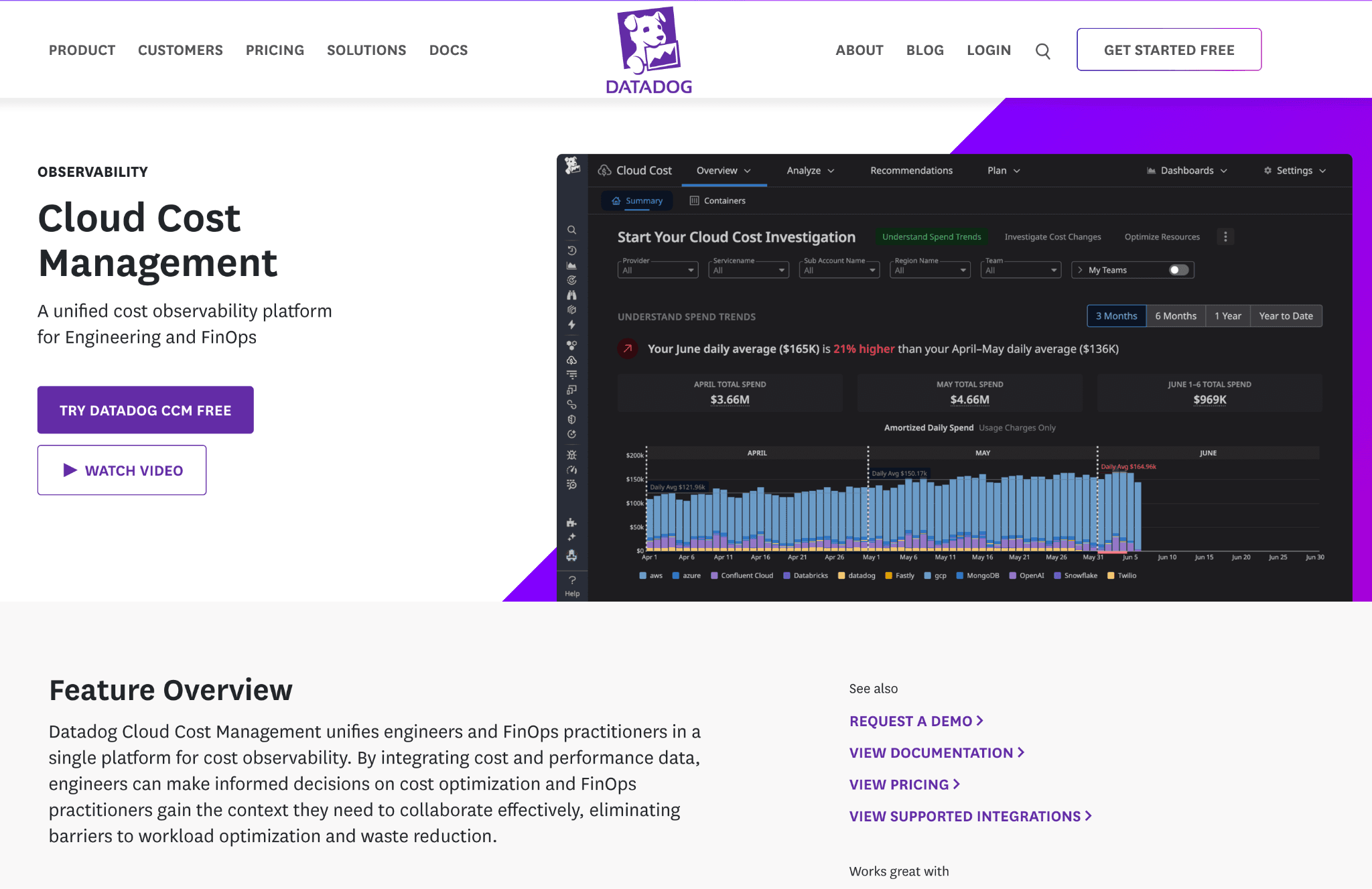
Overview: Datadog Cloud Cost Management is an add-on to the Datadog observability platform that delivers basic and hierarchical budgets, allocation rules and anomaly alerts across AWS, Azure, GCP, Oracle Cloud and SaaS spend. It is designed for teams whose monitoring of records is already Datadog. For broader reporting workflows, see cloud cost reporting.
Key budgeting features:
Basic Budgets for flat, single-level cloud spend caps
Hierarchical Budgets for parent-child organizational structures
Custom cost dashboards with threshold alerts
Allocation rules with cost tags across multi-cloud
Bits AI and Watchdog for anomaly investigation
Trend projection for budget planning conversations
Pricing: Datadog CCM is sold as an add-on starting at roughly $4 per resource per month. See Datadog Cloud Cost Management pricing and verify current rate before procurement.
Pros
Same dashboard as Datadog APM, logs, RUM and security
Hierarchical budgets are well-modeled for engineering orgs
Strong SRE workflow integration
Cons
Premium pricing; small businesses frequently flag cost as prohibitive
Requires existing Datadog footprint to be worth the spend
FinOps-specific features lag dedicated platforms
What users say: "Being able to build custom cost dashboards and set alerts for specific thresholds has been extremely helpful, allowing us to proactively manage budgets and avoid unexpected cost spikes”. Verify at G2: Datadog reviews.
Vendor Evaluation Checklist
Run every shortlisted vendor through this checklist on the demo call. Mark each one yes or no.
Question to ask the vendor | Why it matters at signing | Amnic |
Does it cover AWS, Azure, GCP, Kubernetes and our SaaS spend today? | Multi-cloud gaps surface as blind spots three months in | Yes |
Is deployment read-only via IAM roles or service principals? | Security will block write-access agents | Yes |
Does it allocate shared costs (NAT, data transfer, observability) to the team that caused them? | Without ownership, alerts go to no one | Yes, Virtual Tags |
Does it push alerts to Slack, email, Jira and webhooks? | Email-only alerting gets ignored | Yes |
Can it set hierarchical budgets by team, product, environment, BU? | Flat budgets cannot model org structure | Yes |
Does it ship anomaly detection alongside threshold alerts? | Anomaly fires earlier than threshold | Yes |
Time from contract to first working budget? | If onboarding takes 4 weeks, you lose a quarter | 5 minutes, agentless |
Public pricing? | Hidden pricing slows procurement | Yes, 0.25% to 1% of cloud spend |
Documented 10x payback within 90 days? | Below this, the tool does not earn its place | Yes, customers report 20% to 50% savings |
SOC 2 Type II, ISO 27001, GDPR? | Required for regulated procurement | Yes |
FAQs
Which cloud cost budgeting software is best for AWS-heavy teams?
nOps for AWS-only teams that want Budgets and ShareSave commitment automation in one console. Amnic for AWS teams that already have or will add Azure, GCP or Kubernetes inside 12 months and need the budgeting platform to scale with that move.
Which cloud cost budgeting software is best for multi-cloud enterprises?
Amnic for FinOps-led organizations that want context-aware AI agents handling tag hygiene, ownership and budget governance. Apptio Cloudability for finance-led enterprises that need audit-grade chargeback. Ternary for FinOps teams standardising on the FOCUS specification.
Which cloud cost budgeting software is best for SaaS startups?
Amnic's startup tier with a one-month free trial and no credit card required. Vantage's free tier for sub-2-account footprints. Both let an engineer ship a working budget the same day. See cloud budgeting for startups for sizing guidance.
How long does it take to deploy cloud cost budgeting software?
Read-only platforms (Amnic, Vantage) ship a working budget in under an hour. Enterprise platforms with chargeback workflows (Apptio Cloudability, Harness CCM) typically take 2 to 6 weeks of implementation. Always ask for a documented onboarding timeline in writing before signing.
Does cloud cost budgeting software need write access to my cloud accounts?
It should not. Amnic, Apptio Cloudability, CloudZero, Finout, Vantage and Datadog CCM deploy read-only via IAM roles or service principals. Write-access modules like nOps ShareSave and Spot by Flexera commitment automation are opt-in and should be signed off by security separately.
See Amnic in Action
Cloud budgets that finance, engineering and FinOps can trust take less than 30 minutes to demo. We will walk through how Amnic sets, tracks and enforces budgets across your cloud accounts using read-only access only.
Book a 30-minute Amnic demo
Prefer to see pricing first? View Amnic pricing
Have a procurement question? Connect with us
Better visibility and management into AI Tokens?
Start with a 30 day trial
Connect leading LLMs
24 hour time to value
Stay ahead of AI Spend

Make AI spend visible, controllable, and accountable.
Gain insights into your AI token costs at a team, customer, business unit and individual user level to measure and manage AI utilization.
Recommended Articles

8 Best Llama Cost Management Tools in 2026
Read More
8 Best Amazon Bedrock Cost Optimization Tools for 2026
Read More

7 Best Amazon Bedrock Cost Monitoring Tools
Read More

8 Best Gemini Cost Visibility Tools for 2026
Read More

7 Best Multimodal Cost Optimization Tools for 2026
Read More

5 Best Anthropic Cost Allocation Tools for 2026
Read More